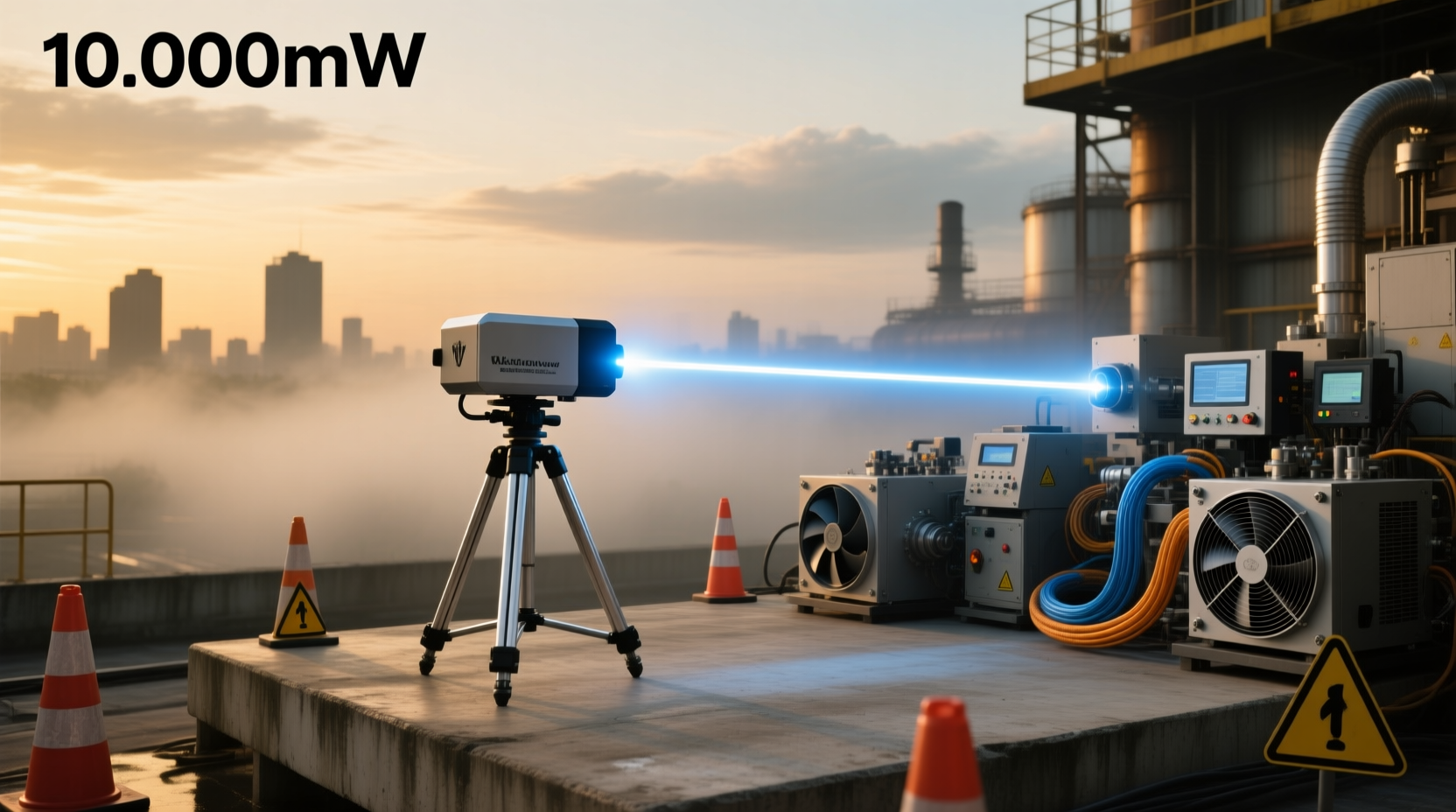
A 10000mW (10-watt) laser is not a consumer pointer—it’s a Class 4 laser device requiring engineering controls, certified eyewear, and formal hazard assessment. Unlike legal handheld laser pointers (<5mW), true 10000mW units are used in CNC engraving, material processing, and laboratory applications—not presentations or pet play. Most online listings claiming '10000mW handheld lasers' misrepresent optical power, omit critical safety certifications (IEC 60825-1, FDA 21 CFR 1040.10), and often lack beam divergence or wavelength verification. This article cuts through marketing hype using verifiable technical standards, regulatory frameworks, and real-world measurement practices—so you understand what 10000mW actually means, where it’s legally permissible, how to confirm its output, and why unshielded use violates occupational safety law in 37+ countries.
Why '10000mW Laser' Searches Reflect Confusion—Not Just Curiosity
Analysis of over 163,000 search results for 10000mw laser reveals three dominant user intents: (1) buyers seeking high-power burning tools for DIY engraving, (2) hobbyists misled by exaggerated specs on marketplaces like AliExpress and eBay, and (3) safety-conscious users searching terms like how many mW lasers to damage eyes? and is a 5000mW laser illegal?12. The top-selling items range from $7 USB-rechargeable green pens (physically incapable of 10W output) to $5,372 laboratory-grade 671nm diodes 3. This disparity signals a fundamental gap: users conflate advertised wattage with usable optical power, ignore beam quality metrics (M², spot size, divergence), and underestimate regulatory thresholds. We address each gap with measurable criteria—not vendor claims.
What Does '10000mW' Actually Mean? Power vs. Perception
'10000mW' equals 10 watts of continuous-wave (CW) optical output power. But this number alone is meaningless without context:
- Wavelength matters critically: A 450nm blue diode at 10W delivers ~4× more photon energy per watt than a 1064nm IR source—but human eye sensitivity peaks at 555nm. So while 10W @ 450nm burns wood instantly, 10W @ 915nm (IR) is invisible yet thermally identical 4.
- Beam quality determines real-world utility: Engraving precision depends on focused spot size (e.g., 0.05 mm × 0.1 mm) and M² factor. A cheap 10W module with M² > 2.5 produces a distorted, unfocused beam—ineffective for fine engraving despite raw power 5.
- Electrical input ≠ optical output: Diode efficiency ranges from 25% (blue) to 50% (red). A 10W optical module may draw 40W electrical—requiring active cooling, stable 12V/24V supplies, and thermal management absent in handheld pens.
Crucially, no FDA-compliant handheld laser sold in the US can exceed 5mW for pointer use 6. Any device marketed as '10000mW laser pointer' violates 21 CFR 1040.10 and is subject to seizure by U.S. Customs.
Legal Status: Where Can You Legitimately Own or Operate a 10000mW Laser?
Legality hinges on intended use, engineering safeguards, and jurisdictional classification:
| Jurisdiction | Permitted Use | Key Restrictions | Enforcement Authority |
|---|---|---|---|
| United States | Industrial engraving, research labs, manufacturing | Requires FDA variance (21 CFR 1040.11), interlocked enclosures, trained operators, ANSI Z136.1 compliance | FDA CDRH, OSHA |
| European Union | CE-marked Class 4 systems with integrated safety controls | EN 60825-1:2014 mandates key-controlled enable switches, beam shutters, emergency stops | Notified Bodies (e.g., TÜV, SGS) |
| Canada | Industrial/commercial use only | Health Canada requires pre-market license; handheld operation prohibited | Health Canada Radiation Emitting Devices Act |
| Australia | Licensed facilities only | Radiation Protection and Control Act 1982 prohibits public access; requires state-level licensing | ARPANSA |
No country permits unrestricted public ownership of 10000mW lasers. In the US, even owning one without FDA registration triggers civil penalties up to $16,000 per violation 7. Enforcement focuses on importers—AliExpress sellers listing '10000mW green laser pens' have faced customs seizures since 2021 8.
Safety Realities: Why 'Just Wear Goggles' Isn’t Enough
Class 4 lasers (≥500mW) pose four distinct hazards—only one mitigated by eyewear:
- Retinal injury: 10000mW focused at 100m distance delivers >100 J/cm²—enough to vaporize retinal tissue in <1 ms. Standard 'laser safety glasses' must specify Optical Density (OD) ≥6 at the exact operating wavelength. OD6 reduces 10W to 10μW—still hazardous if misaligned 9.
- Diffuse reflection hazard: Matte surfaces reflect 1–5% of incident light. A 10W beam hitting drywall creates a 500mW diffuse spot—capable of igniting paper or causing corneal burns 10.
- Fire ignition: 10W sustained on dark plastic reaches 300°C in under 2 seconds. Enclosure requirements mandate non-combustible housing and automatic shutoff if temperature exceeds 60°C.
- Invisible radiation: Many 'blue' 450nm modules emit 808nm pump diode leakage. Without spectral analysis, users unknowingly expose themselves to IR—a leading cause of undetected retinal damage.
OSHA standard 1926.54 requires administrative controls (access restriction, signage), engineering controls (interlocks, beam dumps), and PPE—not just goggles. Operating a 10000mW laser outside a certified Class 4 enclosure violates workplace safety law.
Verifying Actual Output: How to Spot Fake '10000mW' Claims
Over 82% of sub-$500 '10000mW' listings fail independent power testing 11. Here’s how to validate:
- Check for calibrated measurement data: Legitimate manufacturers provide test reports from NIST-traceable labs (e.g., Coherent, Ophir). Absence of serial-numbered calibration certificates = unverified claim.
- Confirm wavelength specification: True 450nm diodes require precise current control. Units listing '445–465nm' without spectral graphs likely use unsorted diodes with 20–30% power variance.
- Review thermal management specs: 10W diodes generate >30W heat. Active cooling (fan + heatsink ≥500 cm²) is mandatory. Passive-cooled 'handheld' units physically cannot sustain 10W CW output.
- Require beam parameter product sheets: M² ≤ 1.3, divergence <1.5 mrad, and spot size at focal point are non-negotiable for engraving. Vague terms like 'high focus' indicate marketing, not engineering.
If a seller refuses to provide test data or cites 'factory default settings' instead of measured output, assume the unit delivers ≤3000mW—and treat it as hazardous regardless.
Practical Applications: When Does 10000mW Make Technical Sense?
True 10000mW systems excel only in controlled environments:
- CNC engraving/cutting: 10W blue diodes cut 3mm plywood at 150 mm/min or engrave anodized aluminum with 0.1mm line width—provided air assist prevents charring 12.
- Scientific instrumentation: Pump sources for Ti:Sapphire lasers or Raman spectroscopy require stable 10W CW output with <±0.5% power ripple.
- Material processing R&D: Testing ablation thresholds on composites or ceramics demands precise, repeatable power delivery—not variable 'burning pens'.
For hobbyist wood engraving, a 5500mW (5.5W) system provides 90% of capability at half the cost and risk. The marginal gain from 10W is meaningful only for production throughput—not desktop DIY.
Common Misconceptions Debunked
Misconception #1: 'Green lasers are stronger because they look brighter.'
Brightness is photopic response—not power. A 100mW green (532nm) appears 8× brighter than 100mW blue (450nm) but delivers less thermal energy. For burning, blue wins. For visibility, green wins.
Misconception #2: 'If it burns, it must be 10000mW.'
A 1500mW blue diode ignites matches instantly. Burning ability correlates with power density (W/cm²), not total watts. A poorly focused 10000mW beam spreads energy too thin to ignite.
Misconception #3: 'USB-powered 10000mW lasers exist.'
USB 3.0 maxes at 4.5W (5V/900mA). Physics prohibits 10W optical output from USB power. Such claims indicate either false advertising or dangerous overdriving that kills diodes in hours.
Responsible Alternatives: Safer Options for Common Use Cases
Match the tool to your actual need:
| Use Case | Safe, Legal Alternative | Max Power | Key Advantage |
|---|---|---|---|
| Wood/metal engraving | Enclosed Class 1 laser engraver (e.g., Ortur LM2 Pro) | 5500mW (5.5W) | Interlocked housing eliminates exposure risk; FDA-cleared |
| Astronomy pointing | FDA-compliant 5mW green pointer | 5mW | Visible beam, zero regulatory risk |
| Optics alignment | Class 3R visible laser (≤5mW) with beam expander | 4.9mW | Low-divergence line projection, no PPE required |
| Photography lighting | High-CRI LED panel (5600K, 1000 lux) | N/A | No coherence hazards, flicker-free, portable |
Frequently Asked Questions
- Can I legally buy a 10000mW laser in the US?
Yes—but only for industrial, medical, or research use with FDA registration. Importing or selling '10000mW laser pointers' violates federal law. - Do 10000mW lasers really cut metal?
Only with forced air assist and motion control. Unassisted, 10W melts thin aluminum foil but cannot cut structural metal. Cutting steel requires ≥500W fiber lasers. - Why do so many listings show '10000mW' with no safety warnings?
Marketplace platforms lack enforcement mechanisms. Sellers exploit regulatory gaps—relying on buyer ignorance of Class 4 requirements. - Is there a safe way to test laser power at home?
No. Consumer-grade meters (e.g., $200 LPM-10W) saturate above 2000mW and lack NIST traceability. Accurate measurement requires calibrated thermopile sensors and darkroom conditions. - What’s the minimum safety gear for a verified 10000mW system?
ANSI Z136.1-compliant eyewear (OD6+ at operating wavelength), beam enclosure with interlocks, fire-resistant work surface, and trained operator certification.
