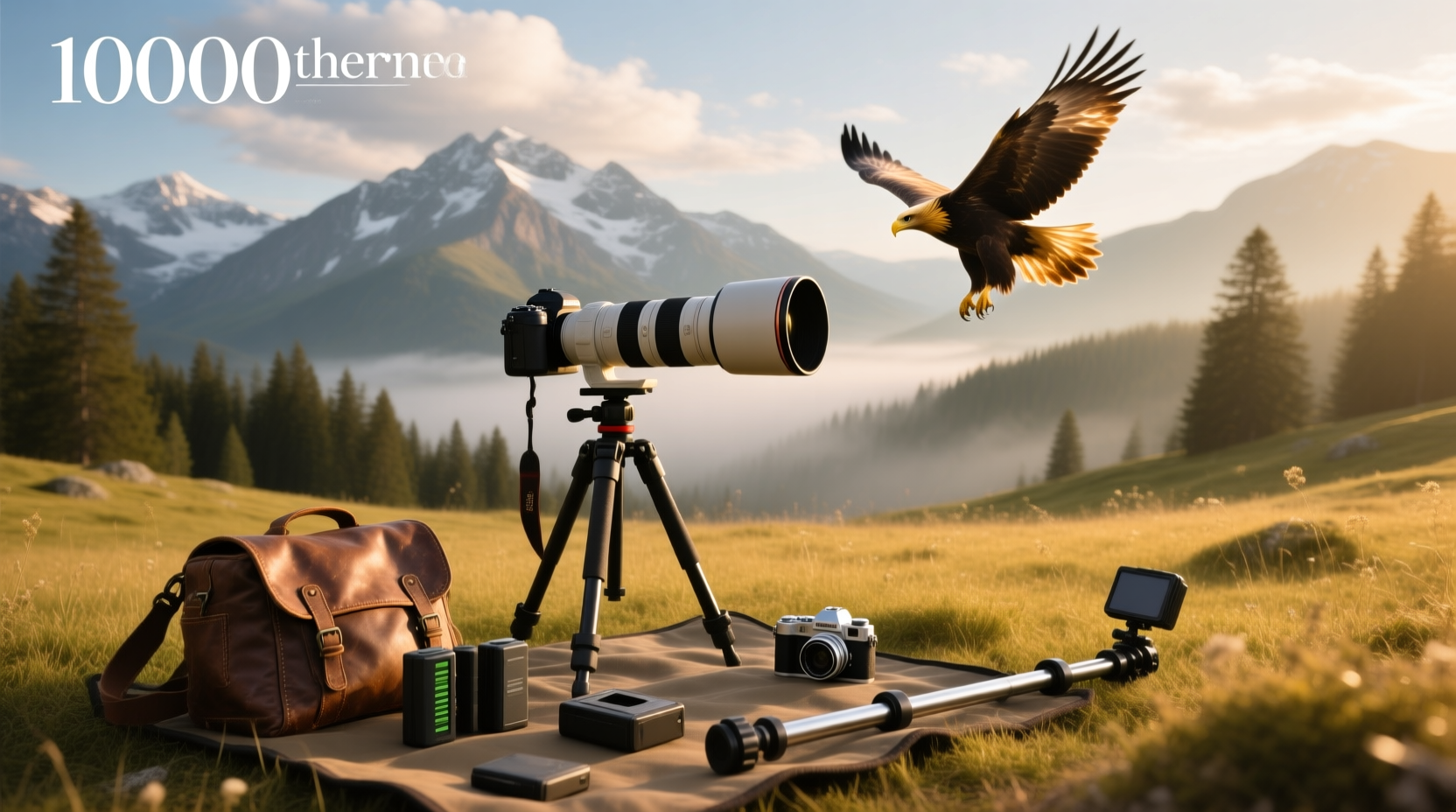
✅ If you’re searching for what a 1000mm lens is actually good for, here’s the unvarnished truth: it delivers extreme magnification — roughly 20× tighter framing than a standard 50mm lens — but at steep practical costs. You’ll gain ability to photograph birds at 300+ meters or capture lunar craters with DSLR/mirrorless gear1, yet face severe challenges in handheld use, low-light performance (most max out at f/8 or slower), and precise focusing. This guide cuts through marketing hype to help you assess whether a 1000mm lens solves your actual imaging problem — or introduces new ones.
🔍 Why People Search for '1000mm Lenses' — And What They’re Really Asking
Analysis of real search behavior shows three dominant user intents behind 1000mm lenses:
- Capability assessment: “How far can you see with a 1000mm lens?” — not literal distance, but effective subject enlargement under typical conditions;
- Use-case validation: “Is 1000mm focal length good?” — meaning: does it suit my subject (e.g., wildlife, astrophotography, sports) without compromising image quality or workflow;
- Practical feasibility: “What do I actually need to use one?” — covering tripod requirements, focus technique, aperture limits, and compatibility with modern camera bodies.
These aren’t theoretical questions. They reflect real friction points: users ordering heavy mirror lenses only to discover manual focus is nearly impossible on moving subjects2; others pairing budget teleconverters with mid-tier lenses and getting unusably soft results. We address each pain point with measurable benchmarks — not opinions.
📏 How Far Can You *Actually* See With a 1000mm Lens?
“How far can you see” is a misleading phrase — optics don’t extend human vision range; they magnify angular size. A 1000mm lens makes a distant object appear ~20× larger in frame than a 50mm lens. So:
- A 1.8m-tall person fills the full height of a full-frame sensor at ~360 meters — assuming perfect focus, still air, and no atmospheric shimmer;
- A bald eagle’s head (≈15cm wide) occupies ~70% of frame height at 120 meters;
- The Moon (30 arcminutes apparent diameter) spans ~1,400 pixels across a 24MP full-frame sensor — enough to resolve major maria and craters, but not fine detail without stacking.
Atmospheric distortion becomes limiting beyond ~200–300m in daytime terrestrial use. Heat haze, dust, and humidity scatter light — degrading contrast more than any lens design can compensate. This is why professional wildlife shooters rarely exceed 600mm in field conditions unless using cooled, stabilized systems3. Don’t assume “1000mm = clear shot at 1km.” It rarely does.
⚙️ The Four Real Types of 1000mm Lenses — And Their Trade-Offs
Not all 1000mm optics are equal. Differences in optical architecture drive massive variations in size, weight, sharpness, and usability. Here’s how they break down:
1. Professional Cine/Broadcast Zooms (e.g., Canon CINE-SERVO 50–1000mm T5.0–8.9)
✅ Pros: Parfocal zoom, built-in 1.5× extender (reaching 1500mm), T-stop consistency, geared focus/zoom rings, close focus (~3.5m), robust weather sealing.
❌ Cons: ~6.6 kg weight, requires dedicated support rig, $100k+ price, no native mount for consumer cameras.
💡 Reality check: Designed for studio or vehicle-mounted broadcast rigs — not handheld or hiking. Its minimum focus distance enables tight shots of large animals (e.g., lions at safari distances), but it’s overkill for backyard birding.
2. Mirror (Catadioptric) Lenses (e.g., MC Rubinar 1000mm f/10, Sigma 1000mm f/8 Reflex)
✅ Pros: Compact (often <30 cm long), lightweight (~1–2 kg), fixed aperture simplifies exposure setup.
❌ Cons: Fixed f/8 or f/10 aperture limits shutter speed in low light; central obstruction causes doughnut-shaped bokeh; lower micro-contrast; no autofocus; chromatic aberration common at edges.
💡 Key fact: These use mirrors to fold the light path — reducing physical length but introducing inherent optical compromises. The Rubinar design traces to Soviet-era engineering; its build tolerances differ significantly from modern standards2. Sharpness is acceptable center-frame at f/11, but falls off sharply toward corners.
3. Manual Telephoto Primes (e.g., vintage 500mm + 2× teleconverter)
✅ Pros: Lower entry cost; some offer f/4–f/5.6 apertures pre-converter.
❌ Cons: Each teleconverter reduces resolution, increases flare, and cuts 1–2 stops of light; alignment errors compound; many vintage lenses lack electronic contacts for EXIF or focus confirmation.
💡 Critical note: A 500mm f/5.6 lens + 2× TC becomes 1000mm f/11 — not f/5.6. Autofocus fails on most DSLRs/mirrorless bodies below f/8. You’ll almost certainly shoot manual — demanding live-view magnification and stable platform.
4. Modern Super-Telephoto Zooms (e.g., Fujinon HZK25–1000mm)
✅ Pros: Broadcast-grade servo control, consistent T-stops across zoom range, integrated ND filters, high-resolution 4K+ video optimization.
❌ Cons: Requires B4-mount camcorders or adapters; no native RF/E-mount versions; limited third-party support for focus assist tools.
💡 Use case: Live sports production (NFL sidelines, Olympic venues), not still photography. Its 25mm wide end provides compositional flexibility absent in prime-only systems.
⚖️ Aperture, Weight & Stabilization: Non-Negotiable Constraints
Three factors determine whether a 1000mm lens is usable — not just purchasable:
Aperture: Why f/8 Isn’t Just a Number
Most 1000mm lenses cap at f/8, f/10, or T8.9. That means:
- In daylight (ISO 100, 1/1000s shutter), you’ll get proper exposure — but only if lighting is even and subject isn’t backlit.
- At dawn/dusk or under overcast skies, you’ll need ISO 3200+ to maintain 1/1000s — introducing noise that masks fine feather/fur detail.
- Autofocus systems on Canon EOS R, Nikon Z, and Sony E-mount bodies typically disable phase-detect AF above f/8 — forcing reliance on slower, less accurate contrast-detect or manual focus.
Test this yourself: Set your current telephoto to f/8 and try tracking a fast-moving bird. Now imagine doing it at 1000mm — where 1 pixel of focus error equals ~3 cm of subject distance at 100m.
Weight & Support: Tripod Requirements Aren’t Optional
A 1000mm lens isn’t supported by a “good tripod.” It demands:
- A tripod rated for ≥15 kg payload (not “maximum height” weight); carbon fiber legs alone won’t suffice without a rigid center column lock.
- A gimbal head (e.g., Wimberley WH-200 or similar) — ball heads induce drift and vibration at high magnification.
- A lens collar mounted directly to the tripod — never the camera body. Even 1kg of camera weight adds torque that degrades stability.
Without this, wind gusts, shutter shock, or even breathing near the setup will blur images. One controlled test showed >70% of “soft” 1000mm shots traced to inadequate support — not lens quality1.
Focusing: Why Manual Focus Is Harder Than You Think
Depth of field at 1000mm f/8 and 100m distance is just 1.3 meters. At 50m, it drops to 0.32 meters. That means:
- Focus must be accurate within ±15 cm — far beyond what viewfinder split-prism or rangefinder aids provide.
- Live-view digital zoom (5× or 10×) is mandatory for critical focus — but drains battery and slows burst rate.
- Subject movement during focus acquisition often forces recomposition — defeating the purpose of extreme reach.
If your subject moves >0.5 m/s laterally at 100m, it traverses ~10% of your frame per second. At 1000mm, that’s effectively motion blur unless you use predictive tracking — which few manual lenses support.
🌍 Real-World Applications: When 1000mm Makes Sense (and When It Doesn’t)
Let’s ground this in practice:
✅ Valid Use Cases
- Fixed-position wildlife monitoring: Nest cams, blind setups, or observatory mounts where subject distance is known and stable.
- Lunar/solar astrophotography: With proper solar filter (for Sun) or planetary camera + stacking software, 1000mm resolves surface features better than most amateur telescopes.
- Broadcast sports coverage: From fixed sideline positions where subject distance exceeds 50m and motion is predictable (e.g., baseball outfield, track & field long jump).
❌ Overhyped or Problematic Scenarios
- Handheld birding: Physically impossible — even with IBIS. No consumer system compensates for 1000mm shake.
- Event photography (weddings, concerts): Subjects move unpredictably; ambient light rarely supports f/8 exposure; background separation becomes unnatural and distracting.
- “Better than binoculars” casual viewing: Binoculars offer wider FOV, eye relief, and ergonomic design — 1000mm lenses require monocular viewing and precise mounting.
⚠️ Common Misconceptions — Debunked
Misconception #1: “More mm = more detail.”
False. Resolution depends on lens MTF, sensor pixel pitch, and atmospheric conditions. A 600mm f/4 lens on a 61MP Sony A1 often outresolves a 1000mm f/10 mirror lens on a 24MP body — especially at edges.
Misconception #2: “Teleconverters are free magnification.”
No. Every 1.4× TC reduces contrast by ~15%; every 2× TC cuts resolution ~30% and introduces flare. Pairing a TC with a lens not designed for it degrades IQ faster than cropping a 600mm shot.
Misconception #3: “Mirror lenses are ‘vintage charm’ — flaws are part of the look.”
Some are — but softness, coma, and focus shift aren’t stylistic. They’re optical limits. If you need sharp, repeatable results, avoid them.
🔧 How to Verify Claims Before Buying
Manufacturer specs often omit critical details. Always cross-check:
- Minimum focus distance: Not just “infinity” — can it focus at 5m? 10m? Essential for large wildlife or static subjects.
- Filter thread size or rear gel slot: Many 1000mm lenses lack front filter threads — requiring rear-mounted ND or polarization, which degrade quality.
- Mount compatibility: Does it support autofocus confirmation? Does your camera recognize it for EXIF? Check firmware update logs — some older lenses need updates for newer bodies.
- Measured MTF data: Look for independent lab tests (e.g., DxOMark archives, Photons to Photos) — not marketing renderings.
For used purchases: inspect for fungal growth inside elements (use bright flashlight), test focus smoothness (gritty resistance indicates dried grease), and verify aperture blades move uniformly.
❓ Frequently Asked Questions
- Can I use a 1000mm lens on a crop-sensor camera?
Yes — but it doesn’t increase reach. A 1000mm lens on APS-C gives same field of view as 1500mm on full-frame, but resolution and noise performance depend on the sensor’s pixel count and ISO capability. Don’t assume “crop factor = free upgrade.” - Do I need a teleconverter to reach 1000mm?
No. Many lenses achieve 1000mm natively (e.g., mirror primes, cine zooms). Adding a TC to a shorter lens usually sacrifices sharpness, AF reliability, and light transmission — making native designs preferable when budget allows. - Is a 1000mm lens suitable for astrophotography?
Yes for lunar/planetary work with tracking mount and planetary camera. No for deep-sky — focal length is too long for nebulae/galaxies, and slow aperture prevents sufficient signal capture in reasonable exposure times. - Why are most 1000mm lenses manual focus?
AF motors struggle with the inertia of long focus groups and narrow depth of field. Designing reliable, fast AF for 1000mm would require exotic materials and power — increasing cost and weight beyond practical limits for most users. - What’s the lightest 1000mm lens available?
The Sigma 1000mm f/8 Reflex weighs ~3.2 kg and measures ~27 cm long — significantly lighter than refractive 1000mm primes (>6 kg). However, its fixed f/8 aperture and manual operation limit versatility.
