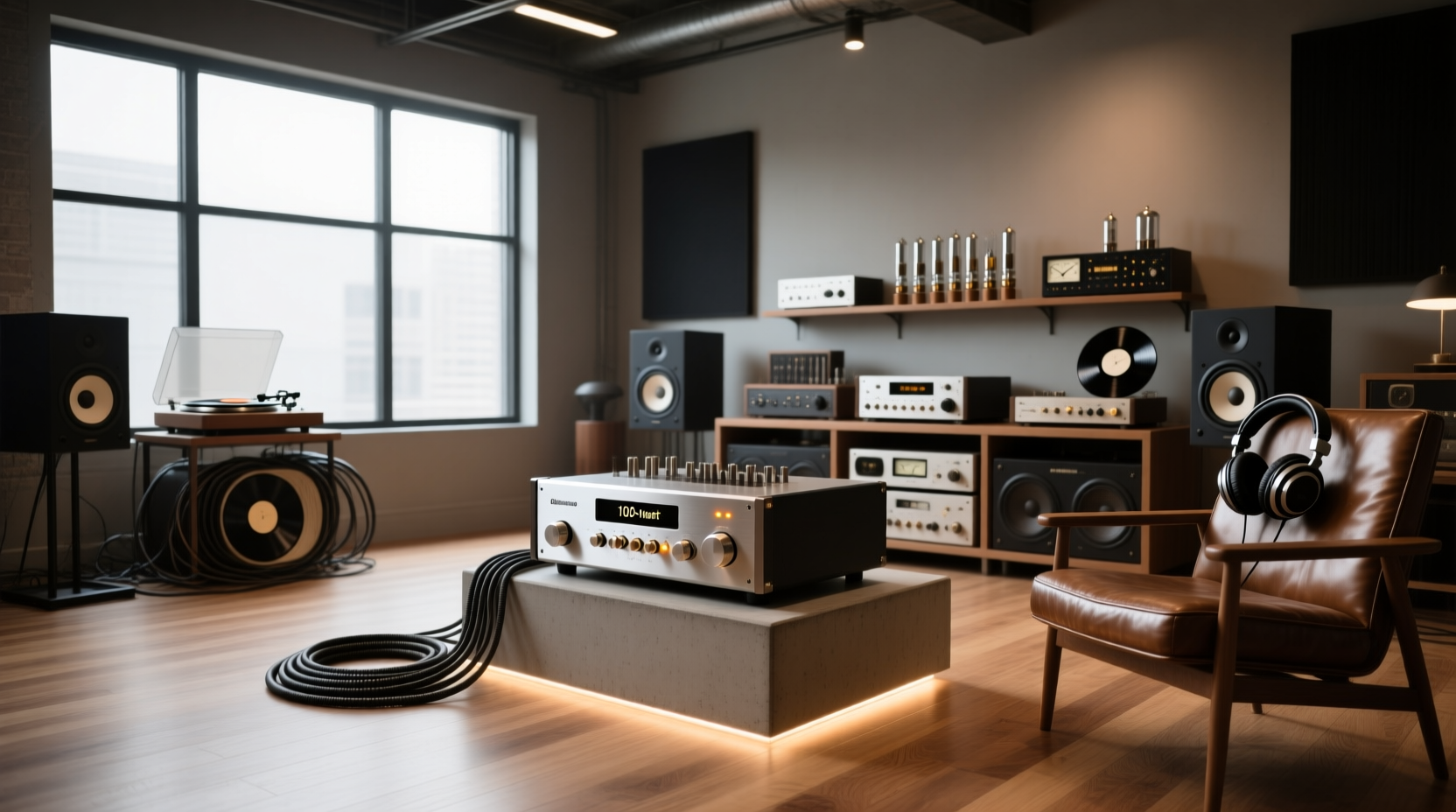
You’ll pay between $30 and $900+ for a true 100-watt amplifier — but not all 100W ratings mean the same thing. The price difference reflects real engineering trade-offs: thermal design, distortion performance (THD+N as low as 0.008% vs. 1.2%), power supply robustness, channel configuration (mono vs. stereo vs. 4-channel), and intended use (PA, guitar, hi-fi, or home theater). A $31 TPA3116-based board delivers peak 100W into 4Ω with modest heatsinking and no protection circuitry; a $899 Denon Home Amp sustains 100W per channel into 8Ω with full Class AB topology, dual toroidal transformers, and HEOS streaming integration. This guide cuts through marketing claims to help you assess what you’re actually paying for — and whether a 100W amp fits your space, speakers, and listening goals.
Why Does a 100W Amplifier Cost So Much — or So Little?
The wide price spread — from under $40 to over $900 — isn’t arbitrary. It maps directly to five measurable design and functional dimensions: power delivery integrity, thermal management, signal fidelity, feature set, and intended application class. Understanding these helps avoid overpaying for unused capabilities — or underbuying for your speaker load and room size.
1. Power Rating: Peak vs. RMS — And Why It Matters for Price
“100W” on a product label rarely tells the full story. Manufacturers may quote:
- Peak power: Short bursts (e.g., drum hits), often inflated (e.g., “100W x 2 channels” meaning 100W total, not per channel); common in budget PA and DIY kits 1.
- RMS (continuous) power: Sustained output under real-world conditions — the only rating that predicts usable loudness and headroom. High-end models specify RMS at both 4Ω and 8Ω loads (e.g., Denon Home Amp: 100W + 100W @ 8Ω, 1kHz, 0.08% THD) 2.
- Dynamic power: A middle-ground spec used by some integrated amps (e.g., Yamaha A-S801: 100W @ 8Ω, 20Hz–20kHz, 0.019% THD) 3.
A $35 amplifier quoting “100W” without specifying impedance, bandwidth, or THD likely delivers ≤65W RMS into 8Ω — enough for nearfield desktop use but insufficient for floorstanding speakers in a 25 m² living room. In contrast, a $799 integrated amp guaranteeing 100W RMS across the full 20Hz–20kHz spectrum with ≤0.02% THD reflects higher-grade output transistors, oversized power supplies, and precision voltage regulation — components that drive cost upward.
2. Thermal Design: How Cooling Impacts Longevity and Stability
Every watt dissipated becomes heat. A 100W amplifier operating at 50% efficiency (typical for Class AB) generates ~100W of waste heat. Budget units rely on small aluminum extrusions or passive PCB heatsinks — adequate for intermittent use but prone to thermal shutdown during extended bass-heavy playback. Mid-tier ($150–$400) models add forced-air cooling (quiet fans) and copper-clad PCBs. Premium units (>$600) use dual-stage thermal monitoring, vapor-chamber heatsinks, and chassis-as-heat-sink architecture — reducing thermal stress on output devices and preserving linearity over hours of operation.
Ask before buying: Does the spec sheet list thermal derating curves? If not, assume power drops significantly above 35°C ambient — critical for enclosed cabinets or summer installations.
3. Signal Path Quality: Where Fidelity Costs More
Two 100W amps can sound radically different due to analog signal chain decisions:
- Input stage: Discrete JFET vs. op-amp based — affects noise floor and transient response.
- Volume control: Motorized Alps potentiometer vs. digital attenuator — impacts channel balance stability and channel separation (>110 dB vs. ~85 dB).
- Power supply: Single transformer with shared rail vs. dual independent windings — reduces crosstalk and improves dynamic headroom.
- Output stage: MOSFET vs. bipolar transistors — influences damping factor (ability to control speaker cones) and harmonic signature.
For example, a $299 stereo amp may use a high-quality NJM5532 op-amp in the pre-stage and discrete output transistors with 300VA toroidal transformer — delivering tight bass and low intermodulation distortion. A $45 unit using generic LM358 and a 60VA EI-core transformer will compress dynamics and exhibit audible grain at moderate volumes. These differences aren’t marketing fluff — they’re measurable in FFT analysis and perceptible in blind A/B testing 4.
4. Channel Configuration & Integration Level
Price scales with channel count — but not linearly. Here’s how typical configurations break down:
| Configuration | Typical Price Range (USD) | Common Use Cases | Key Trade-Offs |
|---|---|---|---|
| Mono (1-channel) | $30–$180 | Subwoofer driving, distributed audio zones, DIY projects | High current capability; minimal features; often lacks tone controls or inputs beyond RCA/XLR |
| Stereo (2-channel) | $80–$900+ | Bookshelf/floorstanding speakers, hi-fi systems, studio monitors | Balanced left/right channel matching critical; integrated amps add phono stage, DAC, streaming |
| 4-Channel | $120–$450 | Multi-room audio, car audio (with 12V input), small venue PA | Often shares power supply across channels → lower per-channel headroom; may lack individual gain trim |
| Guitar-specific (100W tube/solid-state) | $350–$1,200 | Stage practice, recording, live performance | Includes speaker emulation, effects loops, footswitch I/O — not interchangeable with hi-fi amps |
Note: A “100W 4-channel” amp rarely delivers 100W per channel simultaneously — most are rated at 100W total or 50W × 4 into 4Ω with significant inter-channel crosstalk. Always verify per-channel RMS power at your speaker’s nominal impedance, not aggregate numbers.
5. Application Context: Matching Amp to Real-World Needs
Price also reflects optimization for specific environments:
- Home Hi-Fi: Prioritizes low-noise, wide bandwidth, and speaker damping. Expect $250–$900 for verified 100W/channel RMS into 8Ω. Look for ≥400VA transformer, ≥10,000µF capacitance, and damping factor >100.
- PA / Portable Sound: Focuses on ruggedness, fan cooling, XLR inputs, and built-in limiters. $150–$500 range; check SPL output with 8Ω reference speakers (e.g., “112 dB @ 1m” means usable for 50–100 person venues).
- Guitar Amplification: Emphasizes tonal character, speaker interaction, and harmonic saturation. A 100W tube head (e.g., Marshall DSL100H) costs $1,000+ because transformers, valves, and hand-wired point-to-point construction are labor-intensive and non-replaceable with ICs.
- DJ / Studio Monitoring: Requires ultra-low latency, balanced I/O, and precise level calibration. $400–$700 units include relay-based input switching and calibrated VU meters — features irrelevant to home listeners but essential in professional workflows.
How to Verify a True 100W Rating — Before You Buy
Don’t trust front-panel labels. Use this 5-step verification checklist:
- Check the datasheet: Search “[model number] datasheet PDF”. Legitimate manufacturers publish full test conditions (e.g., “100W RMS, 8Ω, 20Hz–20kHz, THD+N = 0.05%, 1% clipping margin”).
- Identify the output chip: TPA3116D2 (common in $30–$60 boards) is rated 100W into 4Ω at 10% THD — acceptable for background music but not critical listening. NJM2520 or STMicro TD1520 offer lower distortion at similar power.
- Weigh it: A genuine 100W RMS stereo amp needs substantial iron and copper. Units under 3 kg (6.6 lbs) likely cut corners on transformer size and heatsink mass.
- Look for protection specs: Over-temperature, DC offset, short-circuit, and ultrasonic oscillation protection indicate robust design — absent in most sub-$100 units.
- Review independent measurements: Sites like Audio Science Review (ASR) or Secrets of Home Theater publish objective tests. If no third-party data exists, treat the spec with skepticism.
When Is 100W Actually Too Much — or Not Enough?
Wattage alone doesn’t determine suitability. Consider these scenarios:
- Too much for small rooms: In a 3m × 4m bedroom, even 25W RMS can exceed 105 dB SPL with efficient 90dB/W/m speakers — potentially damaging hearing and causing neighbor complaints. A 100W amp here offers unnecessary headroom and risks amplifier clipping if paired with low-sensitivity speakers (<85dB/W/m).
- Not enough for large spaces: In a 6m × 8m open-plan living area with 85dB/W/m bookshelf speakers, 100W RMS yields ~102 dB peaks — adequate for casual listening but insufficient for dynamic orchestral passages without compression. You’d need ≥150W RMS for clean, uncompressed peaks.
- Impedance mismatch risk: Driving 4Ω speakers with an amp only rated for 8Ω minimum causes excessive current draw, overheating, and premature failure — even if labeled “100W”. Always match amp minimum impedance rating to speaker nominal impedance.
Common Misconceptions About 100W Amplifiers
❌ “Double the watts = double the loudness.”
No. A 10dB increase requires 10× the power. Going from 10W to 100W yields only +10dB SPL — subjectively “twice as loud” to human ears, but not linear. Speaker sensitivity dominates perceived volume far more than amp wattage.
❌ “Any 100W amp will drive any 100W speaker.”
False. Speaker power handling (e.g., “100W max”) indicates thermal limits — not impedance or sensitivity. A 100W speaker with 84dB sensitivity needs far more amp power to reach the same volume as a 94dB speaker. Worse, mismatched damping factor causes bass bloat or flabbiness.
❌ “Digital amps (Class D) can’t sound good at 100W.”
Outdated. Modern Class D modules (e.g., Hypex UcD, Purifi Eigentakt) achieve THD+N <0.001% at 100W and outperform many Class AB designs in damping and transient response — while running cooler and lighter. Price reflects implementation quality, not topology.
Practical Buying Recommendations by Use Case
For home stereo with bookshelf speakers (85–90dB/W/m) in a 4m × 5m room: Prioritize 2-channel integrated amps with ≥100W RMS into 8Ω, discrete output stage, and ≥300VA transformer. Budget: $350–$650. Avoid “100W” models lacking THD specs or using single-rail power supplies.
For DIY subwoofer enclosure (single 12” driver, 4Ω): A mono Class D plate amp with adjustable low-pass filter, phase switch, and variable gain (e.g., 100W RMS into 4Ω, THD <0.1%) is optimal. Budget: $75–$160. Confirm it includes DC protection and thermal foldback.
For portable PA (outdoor events, 50–80 people): Choose a 4-channel or stereo amp with XLR inputs, built-in limiter, fan cooling, and ≥110 dB SPL capability. Verify weight (≥8 kg suggests adequate heatsinking) and IP rating if used outdoors. Budget: $220–$420.
For guitar practice (bedroom/studio): A 100W solid-state head is overkill unless mic’d. Consider a 20–50W tube amp with master volume or a 100W modeling amp with cabinet simulation — both deliver “100W tone” at bedroom volumes. Budget: $300–$800.
Frequently Asked Questions
- Is a 100W amplifier loud?
It depends entirely on speaker sensitivity and room size. With 87dB/W/m speakers in a 20 m² room, 100W RMS reaches ~108 dB peaks — comparable to a chainsaw at 1m. But with inefficient 83dB speakers in a large, reflective space, it may sound only moderately loud. - Is 100 watts good for an amp?
Yes — if matched to your speakers’ sensitivity (≥88dB), impedance (≥6Ω), and room size (<50 m²). For larger spaces or low-sensitivity towers (<85dB), consider 150W+. For desktop/nearfield, 25–50W is often sufficient and more controllable. - What’s the difference between a 100W stereo amp and a 100W 2-channel amp?
No technical difference — “stereo” and “2-channel” are synonymous. However, “stereo amplifier” often implies consumer-facing features (phono input, remote, display); “2-channel” may denote pro-audio or modular units with XLR I/O and rack ears. - Can a 100W amplifier drive a subwoofer?
Yes — but only if it’s a mono 100W amp or one channel of a stereo amp used in bridged mode (check manual: not all support bridging). Most powered subs include their own optimized 100–300W amp; adding external amplification usually degrades control unless using active crossover networks. - Do I need a separate preamp with a 100W power amp?
Only if the power amp lacks volume control and input selection — i.e., it’s a “pure” power amp. Integrated amps combine preamp and power sections. Using a separate preamp adds flexibility (multiple sources, tone controls, phono stage) but increases complexity and potential noise paths.
