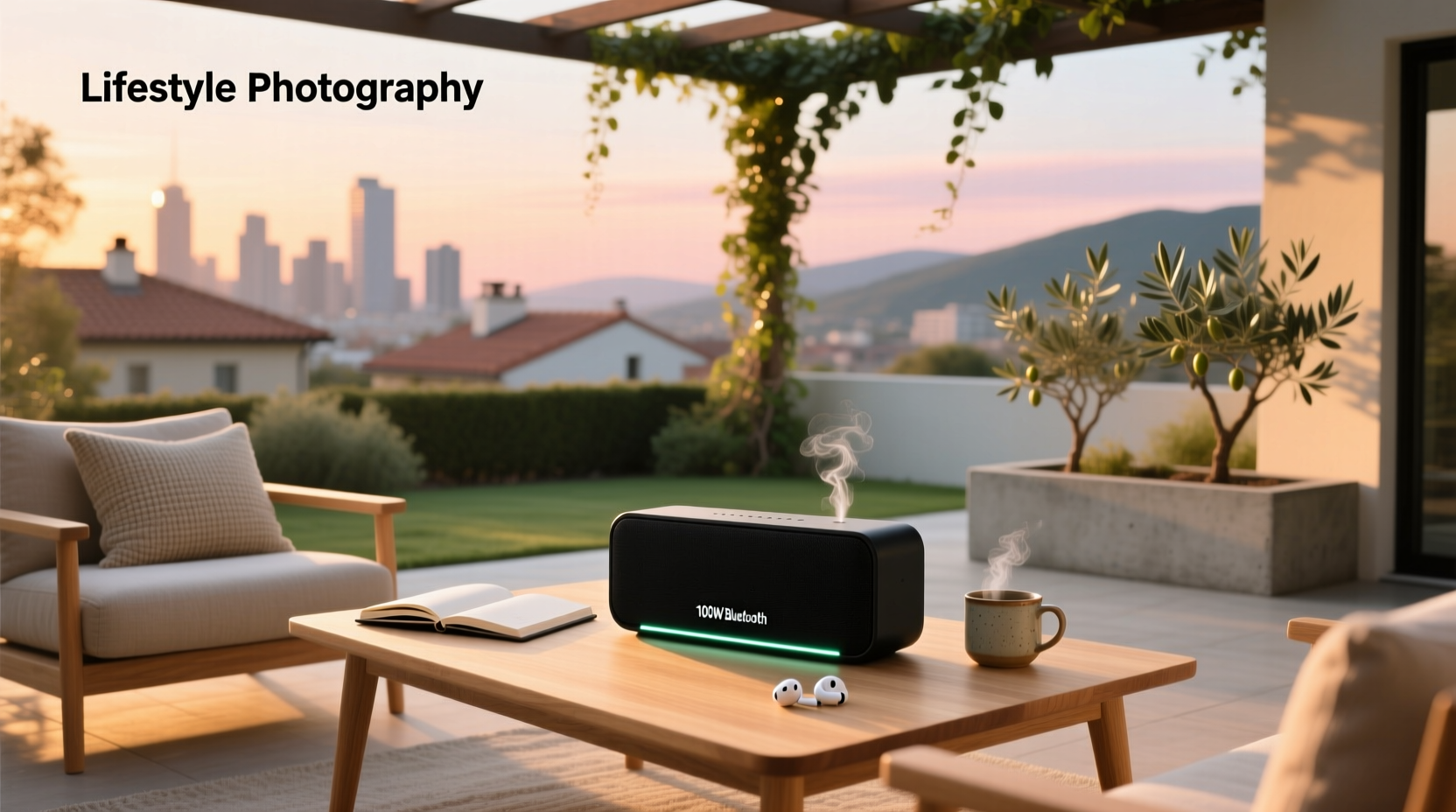
You’re not wrong to be skeptical: When searching for a 100 W Bluetooth speaker, you’ll see dozens of models labeled “100W” — yet many sound no louder than mid-tier 30W units. That’s because most advertised ‘100W’ figures reflect peak or PMPO power — not continuous (RMS) output. In practice, true RMS power for portable 100W-labeled speakers typically ranges from 25W to 42W per channel (or 50–85W total system RMS), depending on driver design, thermal management, and battery voltage 1. This distinction directly impacts volume consistency, bass control, and heat-related compression — especially outdoors or at high volumes for >30 minutes. Below, we decode what ‘100W’ actually means, how to verify real-world performance, and which specs truly matter for your use case — whether it’s backyard parties, beach trips, or mobile DJ setups.
Why ‘100W’ Is Misleading — And What to Check Instead
The term 100W Bluetooth speaker triggers strong expectations: loud, room-filling sound, deep bass, all-day playback. But wattage alone tells only part of the story — and often the least useful part. Here’s why:
- Peak vs. RMS matters more than the number: Manufacturers almost always quote peak or PMPO (Peak Music Power Output) — a theoretical maximum under ideal lab conditions, sustained for milliseconds. RMS (Root Mean Square) measures continuous, thermally sustainable power. A speaker rated at “100W PMPO” may have just 28W RMS total output — roughly equivalent to a quality 30W home speaker 2.
- Battery voltage limits real power: Most portable 100W-labeled speakers run on 12.6V (3S Li-ion) or 18V (4S/5S) battery packs. At full charge, they may briefly hit higher wattage; but as voltage drops (e.g., below 11.5V), amplifier headroom shrinks dramatically. Without active voltage regulation, perceived loudness can drop up to 30% between 100% and 40% battery 3.
- Driver efficiency and enclosure design override raw wattage: Two speakers with identical 100W PMPO ratings can differ by 8–10 dB SPL (perceived as 2–4× louder) due to driver sensitivity (measured in dB @ 1W/1m), cabinet tuning (bass reflex vs. sealed), and passive radiator implementation.
If RMS isn’t listed (and it rarely is on consumer packaging), estimate realistic output using these proxy indicators:
| Indicator | What It Suggests (for ~100W-labeled models) | How to Verify |
|---|---|---|
| Battery capacity ≥ 20,000 mAh | Likely supports sustained 35–50W RMS output for ≥2 hours before thermal throttling | Check spec sheet or teardown videos — avoid models listing only "20H playtime" without load context |
| Driver size ≥ 6.5" + passive radiator | Higher likelihood of controlled low-end extension (≥55 Hz ±3dB) even at moderate RMS | Measure physical driver diameter — ignore “total speaker size” or “cabinet volume” claims |
| IP67 rating + aluminum heat sink visible in product images | Engineered for thermal stability — less likely to compress or distort above 70% volume | Look for close-up photos showing metal fins near tweeter/midrange housing; avoid rubberized plastic-only builds |
Real-World Scenarios: When Does 100W Actually Deliver Value?
A 100W-labeled speaker isn’t universally “better.” Its value depends entirely on your environment, duration, and acoustic goals:
✅ Best Fit: Outdoor group gatherings (20–50 people), open patios, beach use
Here, ambient noise (wind, traffic, waves) demands high SPL (sound pressure level). A speaker delivering ~40W RMS with 90 dB sensitivity can produce ~102 dB at 1 meter — sufficient to cover conversation zones up to 15 meters wide. Key enablers: directional waveguide tweeters, bass-reflex ports tuned ≥60 Hz, and stable 18V battery architecture. Note: IPX7 waterproofing is non-negotiable for sand/water exposure — but verify submersion testing reports, not just marketing copy 4.
⚠️ Overkill / Risky Fit: Indoor small rooms (<25 m²), bedroom use, or long-duration background listening
In confined spaces, excessive power causes early distortion, bass boominess, and listener fatigue. Many 100W-labeled units lack precise EQ controls or room-correction firmware — resulting in muddy mids and uncontrolled low-end resonance. For indoor use, prioritize driver linearity over wattage: look for dual 2.0" silk-dome tweeters, 4" woven-composite woofers, and built-in DSP limiting (not just “bass boost” buttons).
❌ Poor Fit: Multi-room audio, stereo pairing precision, or critical listening
Most 100W portables use single-board amplifiers with shared ground planes — making true left/right channel separation difficult. TWS (True Wireless Stereo) pairing often introduces 40–80 ms latency between units, disrupting stereo imaging. If you need accurate panning or vocal clarity (e.g., podcast editing, language learning), choose two matched 30–50W bookshelf-style Bluetooth speakers with aptX Adaptive or LDAC support instead 1.
Key Specs Decoded — Beyond the “100W” Label
When evaluating a 100 watt Bluetooth speaker, treat wattage as a starting point — then drill into these five technical dimensions:
🔋 Battery & Thermal Management
Real-world runtime ≠ advertised “24H playtime.” That figure assumes 50% volume, no bass boost, and 25°C ambient temperature. At 85% volume with bass enhancement enabled, expect 30–50% less. Look for:
- Explicit “RMS-rated runtime” (e.g., “12 hrs @ 35W continuous”)
- Active cooling (small fan or copper heat pipes — rare but present in prosumer models like JBL Boombox 3)
- Charge-through capability: Can it play while charging via USB-C PD (≥45W input)? This prevents downtime during multi-day events.
📡 Connectivity & Codec Support
Bluetooth version alone doesn’t guarantee quality. Prioritize:
- Bluetooth 5.2+ with LE Audio support — enables lower latency and multi-stream audio (critical for TWS sync)
- LDAC or aptX Adaptive decoding — preserves detail in 24-bit/96kHz streams (if your source supports it)
- Dual-mic far-field voice pickup — for reliable hands-free assistant use outdoors (often omitted in budget 100W models)
🔊 Driver Configuration & Crossover Design
A single 100W amplifier driving one full-range driver sounds thinner and less dynamic than a 60W amp powering a 3-way system (tweeter + midrange + woofer). Ask:
- Is there a dedicated tweeter? (Essential for crisp highs above 8 kHz)
- Are passive radiators tuned separately from the main woofer? (Improves transient response)
- Is the crossover point published? (Optimal: 2.5–3.2 kHz for balanced dispersion)
🛡️ Build Quality & Environmental Ratings
IP67 means dust-tight and submersible to 1m for 30 min — but only if seals remain intact after 500+ lid cycles. Check for:
- Over-molded rubber bumpers covering all seam lines
- Stainless-steel grille mesh (not plastic-coated wire)
- UV-stabilized ABS or polycarbonate housing (prevents yellowing/brittleness after sun exposure)
🎛️ Onboard Controls & Firmware Updates
Many 100W speakers ship with fixed DSP profiles. Better options include:
- Mobile app with parametric EQ (±12 dB per band, 5–7 bands)
- Firmware update path (via app or USB-C)
- Physical bass/treble dials — not just “+/-” buttons that cycle presets
Common Misconceptions — Debunked
Misconception #1: “Higher wattage = deeper bass.”
Not necessarily. Bass extension depends on driver excursion (Xmax), cabinet volume, and port tuning — not amplifier power. A well-designed 40W speaker with 12mm Xmax and 40L cabinet can outperform a 100W unit with shallow 4mm excursion and undersized enclosure.
Misconception #2: “All IP67 speakers survive pool submersion.”
IP67 certification applies only to *new*, unscratched units with properly seated seals. After 6 months of UV exposure and sand abrasion, seal integrity degrades — especially around charging ports. Always rinse with fresh water post-beach use and inspect O-rings quarterly.
Misconception #3: “TWS mode gives true stereo.”
Most TWS implementations use master-slave topology with 60–120 ms delay between channels. For synchronized playback, verify “low-latency TWS” claims with independent tests — not manufacturer white papers.
How to Verify Claims Before You Buy
Don’t rely on spec sheets alone. Use these field-verification methods:
- Check teardown videos: Search “[model name] teardown” on YouTube. Look for amplifier IC markings (e.g., TI TPA3255 = ~300W Class-D, but usually derated to 50W RMS in portable use) and capacitor count near power stages.
- Review frequency response graphs: Reputable reviewers (e.g., RTINGS.com, SoundGuys) publish anechoic measurements. Focus on ±3 dB bandwidth (e.g., 55 Hz – 20 kHz) — not just “20 Hz–20 kHz” marketing ranges.
- Test thermal behavior: Play pink noise at 75% volume for 45 minutes. If the speaker shuts down, reduces output, or emits burning odor, its thermal design is inadequate — regardless of wattage claims.
Frequently Asked Questions
- Can a 100W Bluetooth speaker really fill a large backyard?
Yes — but only if it delivers ≥35W RMS with ≥88 dB sensitivity and is placed ≥2 meters from reflective surfaces. Avoid corners or enclosed patios, where bass buildup masks mids. - Do I need a separate subwoofer with a 100W portable speaker?
Not for general use. Most quality 100W-labeled models include passive radiators or ported enclosures that extend usable bass to 45–50 Hz. Add a sub only if you host dance-focused events requiring <35 Hz energy. - Why do some 100W speakers weigh under 5 kg while others exceed 8 kg?
Weight correlates strongly with driver mass, magnet size, and heatsink volume. Lighter units often use neodymium drivers and aggressive thermal throttling — trading peak output for portability. Heavier builds favor sustained RMS and lower distortion. - Is Bluetooth 5.3 worth prioritizing in a 100W speaker?
Only if you pair with modern Android/iOS devices and use features like LE Audio broadcast or multi-device connection. For basic streaming, Bluetooth 5.0 with SBC/AAC is functionally identical. - Can I use a 100W Bluetooth speaker with a turntable or microphone?
Only if it has a dedicated line-in (3.5 mm or RCA) with ≥10 kΩ input impedance and mic-level preamp (not just “MIC IN” labeling). Many “karaoke-ready” models lack phantom power or gain staging — resulting in noisy, clipped vocals.
