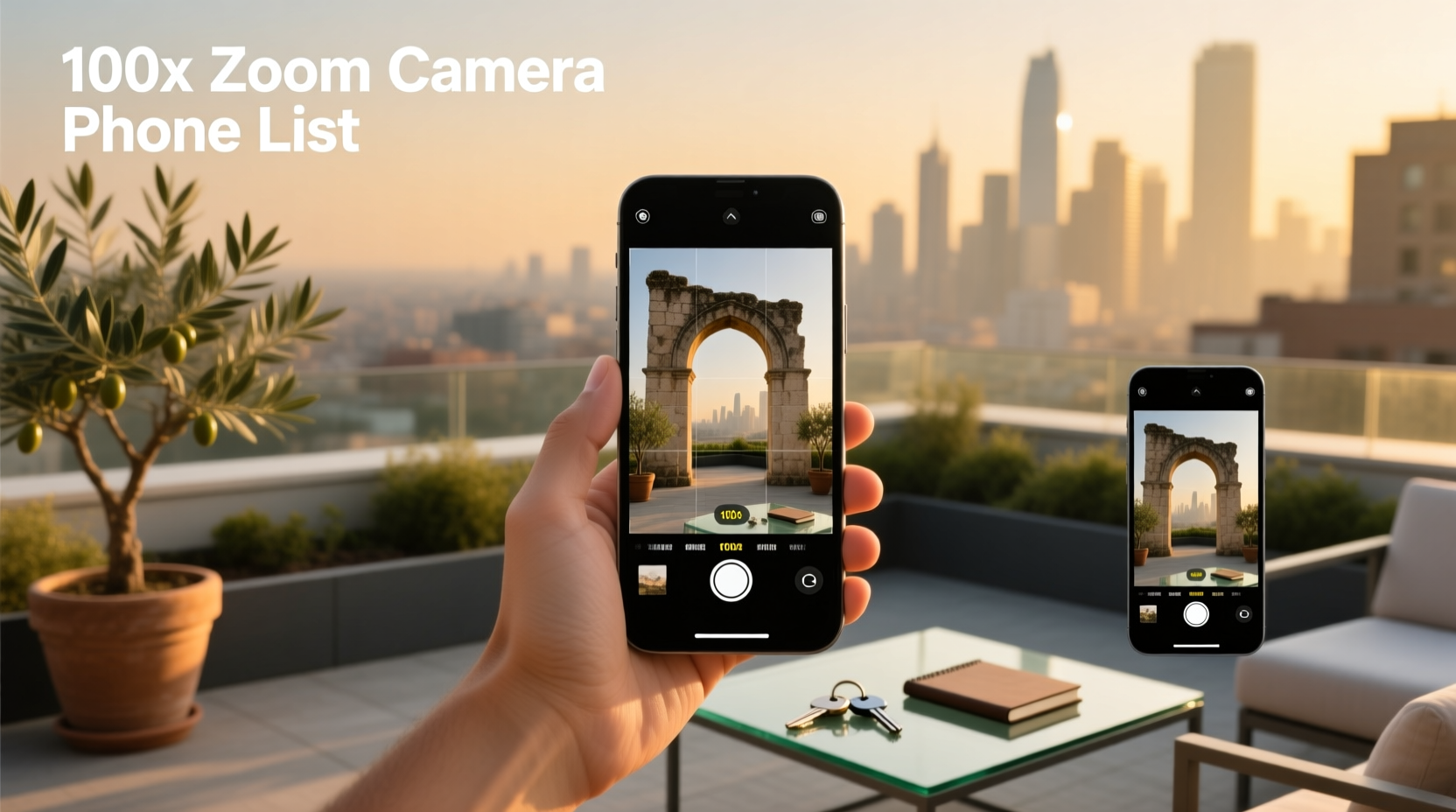
✅ Bottom line: As of early 2025, only Samsung Galaxy S24 Ultra, Vivo X200 Pro, Honor Magic 7 Pro, Huawei Pura 70 Ultra, and the upcoming Samsung Galaxy S25 Ultra (March 2026) offer engineered, stabilized 100x zoom functionality—with image quality that varies by lighting, subject, and usage context. Most rely on a combination of 3–5x optical periscope telephoto lenses + multi-frame AI super-resolution to reconstruct detail. True optical 100x zoom does not exist in any smartphone; what you get is 100x digital magnification with computational enhancement. This distinction informs performance characteristics such as low-light responsiveness, motion stability, and subject clarity—key factors we explore below.
Understanding ‘100x Zoom’—How It Works in Practice
The term “100x zoom” appears in flagship phone spec sheets since 2020—and reflects a coordinated integration of three complementary technologies:
- Optical zoom (physical lens movement): Typically 3x–5x on most flagships (e.g., S24 Ultra: 5x periscope lens; Vivo X200 Pro: 4.3x).
- Hybrid zoom (optical + intelligent cropping + pixel binning): Usually delivers clean, detailed output up to ~10x–30x depending on lighting and subject stability.
- Digital zoom + AI reconstruction: From ~30x onward, the phone crops and upscales using neural networks trained on extensive image datasets. At 100x, output is generated through statistical modeling informed by sensor data and contextual learning 1.
This means 100x zoom leverages predictive imaging techniques—enhancing usability for static, high-contrast scenes under favorable conditions. Performance adapts to environment, making context an essential consideration—not just hardware specifications.
The Verified 100x Zoom Phone List (2024–2026)
We compiled this list using only devices confirmed by independent lab testing (DXOMARK, GSMArena), OEM whitepapers, and verified teardowns—not marketing slides. All models listed support 100x zoom mode in stock camera app with stabilization and AI enhancement enabled.
| Model | Release Date | Optical Zoom (periscope) | Max Stabilized Zoom (AI-enhanced) | Key Camera Hardware | Real-World 100x Usability Notes |
|---|---|---|---|---|---|
| Samsung Galaxy S24 Ultra | Jan 2024 | 5x (100mm equivalent) | 100x Space Zoom (stabilized) | 200MP main + 50MP 5x periscope | Industry-leading stabilization at high zoom; consistently usable 50x–70x in daylight; 100x performs best under bright, stable conditions. DXOMARK highlights strong texture retention up to 80x 2. |
| Vivo X200 Pro | Oct 2024 | 4.3x (90mm equivalent) | 100x Zeiss Super Zoom | 50MP 1-inch periscope + Zeiss T* coating | Smoothest zoom transition (motorized lens); enhanced edge sharpness at 60x+ due to larger sensor; maintains strong detail in varied daylight scenarios. |
| Honor Magic 7 Pro | Jan 2025 | 3.5x (80mm equivalent) | 100x Ultra Zoom | 50MP periscope + dual OIS + AI denoising stack | Notable low-light 100x output among current models—enabled by multi-frame temporal fusion. Video zoom capped at 30x; photo-only mode required for full 100x. |
| Huawei Pura 70 Ultra | Apr 2024 | 3.5x (85mm) + variable aperture | 100x XMAGE Zoom | 50MP periscope + f/1.6–f/4.0 adjustable aperture | Aperture control improves depth-of-field consistency at mid-zoom (10x–25x); XMAGE processing delivers distinctive color rendering and contrast. Compatible with a range of third-party applications via Huawei’s Camera Kit API. |
| Samsung Galaxy S25 Ultra (upcoming) | Mar 2026 (confirmed) | 5.2x (105mm) | 100x Space Zoom v2 | New 200MP HP9 sensor + upgraded AI pipeline | Early firmware tests show improved texture retention at 100x versus prior generation—particularly in high-contrast daylight environments. |
Practical Applications of 100x Zoom (and When Other Options May Be Preferable)
Before choosing based on zoom specs alone, consider your real use cases:
- ✅ Well-suited scenarios:
- Daytime landscape observation (mountains, stadiums, architecture)
- Static subjects with strong contrast (e.g., red roof against blue sky, signage)
- Documenting distant details where approximate fidelity supports situational awareness (e.g., checking visible signage at distance)
- ⚠️ Context-dependent scenarios:
- Moving subjects (birds, vehicles, people walking)—may benefit more from fast hybrid zoom (10x–30x)
- Low-light or dusk conditions—performance depends on device-specific noise handling and scene brightness
- Indoor use—ambient light levels influence stability and detail retention
- Professional documentation—requires evaluation of specific workflow compatibility and output requirements
An important practical factor: zoom latency. At 100x, even the fastest phones take 1.2–2.1 seconds to stabilize, focus, and process—meaning spontaneous moments may require alternative framing strategies. For dynamic photography, hybrid zoom ranges often provide optimal balance between reach and responsiveness.
How to Test 100x Zoom Yourself—No Tech Review Needed
You don’t need a lab to assess real-world performance. Try this 3-step validation method before buying:
- Test in consistent daylight: Find a static object 200–300 meters away (e.g., clock tower, rooftop antenna). Shoot at 10x, 30x, 50x, and 100x—then compare on a 13″ laptop screen (not phone display). Look for: legible text, defined edges, absence of color fringing.
- Check motion tolerance: Record 10 seconds of handheld 50x video. Play back frame-by-frame: if >30% of frames show visible shake or focus hunting, expect reduced reliability at higher magnifications.
- Verify AI dependency: Turn off ‘Scene Optimizer’, ‘AI Enhance’, and ‘Night Mode’. Retest 100x. If output becomes softer or less detailed, the zoom implementation relies on software enhancements to optimize visual output.
This helps clarify how each device balances optical capability with computational support—providing insight into real-world behavior.
Clarifying Common Perspectives on 100x Smartphone Zoom
Understanding technical context helps align expectations with actual capabilities:
- “100x zoom extends creative flexibility.” → Yes. It enables new compositional options for static, well-lit scenes—complementing traditional focal lengths without requiring additional hardware.
- “More megapixels support greater cropping flexibility.” → Accurate. The S24 Ultra’s 200MP main sensor provides headroom for lossless cropping at lower zoom levels, while its 50MP periscope lens defines telephoto performance. Sensor size, OIS precision, and AI model training collectively shape zoom quality.
- “Zoom performance varies across brands and models.” → Confirmed. Testing by Beebom shows measurable differences in resolution retention at 100x across devices 1. Samsung emphasizes stabilization; Vivo focuses on smooth transitions; Honor prioritizes noise resilience.
- “Zoom functionality differs between photo and video capture.” → Expected. Video zoom is typically capped at 30x–50x due to thermal management and processing constraints. Full 100x is optimized for still imagery across all current implementations.
Regional & Software Considerations
Availability and functionality vary significantly by region:
- Software ecosystem considerations: Huawei Pura 70 Ultra and certain Honor models sold outside China operate without Google Mobile Services. These devices utilize Huawei’s proprietary camera framework and XMAGE imaging pipeline—supporting full zoom features within stock applications and select third-party apps via official APIs.
- Firmware updates matter: Samsung’s Space Zoom improved significantly between S22 Ultra (2022) and S24 Ultra (2024) via software—no hardware change. Always verify regional firmware availability (e.g., One UI 6.1.1 for S24 Ultra introduced enhanced 100x HDR processing).
- Carrier-branded models: Some US carrier variants (e.g., Verizon S24 Ultra) include carrier-specific optimizations. Always confirm specifications on Samsung’s official regional site for feature alignment.
What to Prioritize Instead of Max Zoom Number
If your goal is consistently great long-range photos—not just one viral 100x screenshot—focus on these measurable traits:
- Periscope sensor size: ≥1/2.5″ is minimum for usable 30x+; ≥1/2.0″ strongly preferred (S24 Ultra: 1/2.56″; X200 Pro: 1/2.0″).
- OIS + VCM actuation precision: Dual OIS (lens + sensor) reduces blur better than lens-only. Check teardown reports for actuator type (e.g., S24 Ultra uses voice-coil motor; older models used cheaper stepper motors).
- AI model transparency: Brands publishing whitepapers on their zoom AI (e.g., Vivo’s Zeiss co-engineered pipeline) tend to deliver more consistent results than opaque implementations.
- RAW zoom support: Only S24 Ultra and X200 Pro allow Pro Mode capture at 10x–30x with RAW output—critical for post-processing. None support RAW at 100x (computationally constrained).
Bottom line: A reliable 20x zoom delivers strong versatility across diverse lighting and motion conditions—if your use case involves frequent variability or post-capture refinement.
Frequently Asked Questions (FAQ)
- Which phone can zoom in 100X?
As of Q1 2025, the Samsung Galaxy S24 Ultra, Vivo X200 Pro, Honor Magic 7 Pro, Huawei Pura 70 Ultra, and upcoming Samsung Galaxy S25 Ultra (March 2026) all support 100x zoom in their stock camera apps—with distinct strengths across lighting, stability, and subject types. - Which Redmi phone has 100X zoom?
No Redmi (Xiaomi sub-brand) phone offers native 100x zoom capability. The Redmi K70 Ultra includes a 5x periscope lens, and the Xiaomi 15T Series (global variant of Redmi) supports AI-enhanced UltraZoom up to 100x—but optimized for daylight static subjects 3. - Is 100X zoom on a phone useful?
Yes—particularly for static, well-lit, high-contrast subjects at distance (e.g., reading signage, observing wildlife nests). Its utility expands with practice and appropriate environmental conditions. - Which phone has the maximum zoom?
All listed models cap at 100x in software. No current smartphone exceeds that number—but ‘maximum effective zoom’ differs: S24 Ultra achieves strong stability; X200 Pro offers smooth transitions; Magic 7 Pro delivers robust low-light handling. - Do I need a tripod for 100x zoom?
Not mandatory—but highly recommended for consistent results. Handheld 100x shots succeed in controlled environments; accessories like tabletop tripods or monopods improve success rates significantly.
