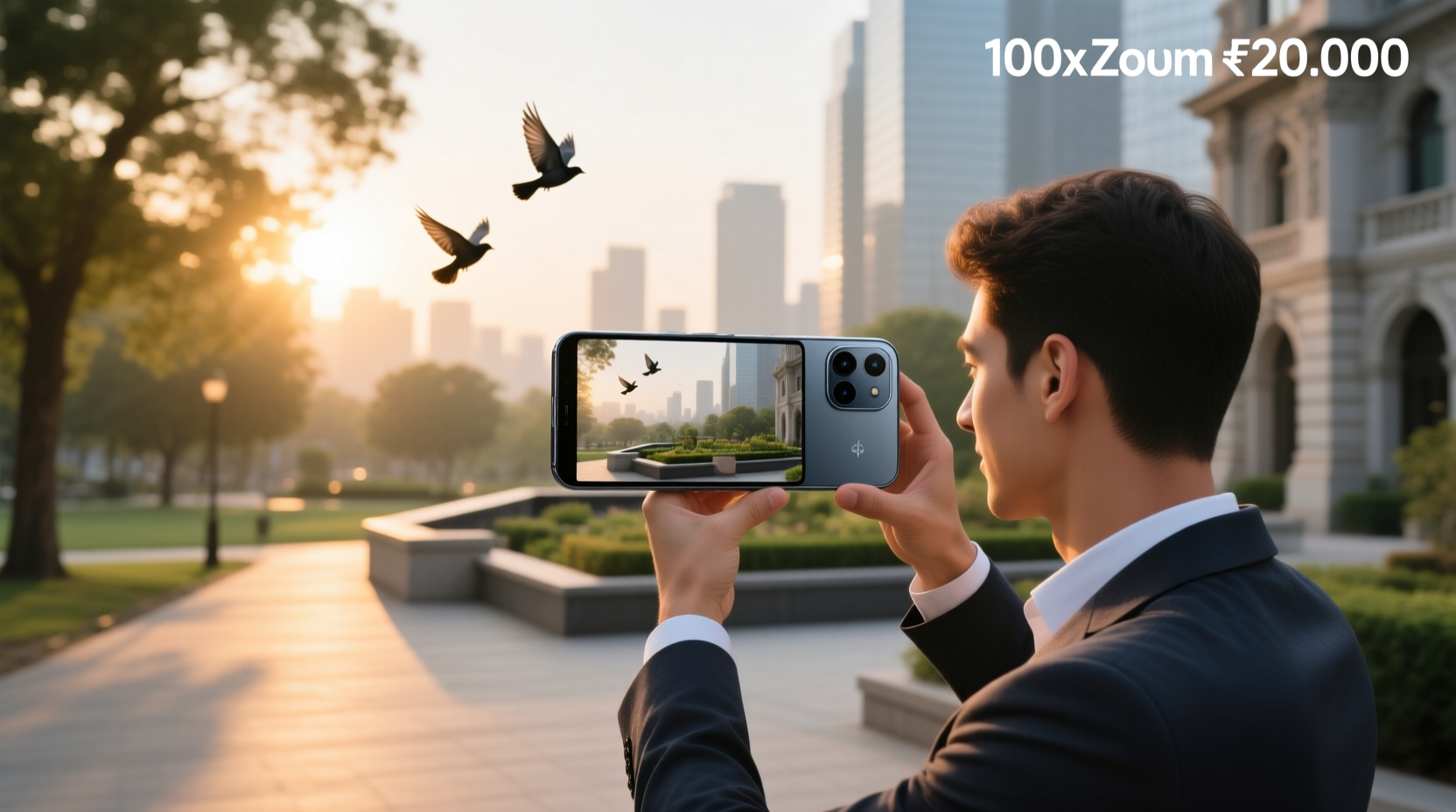
Short answer: No — there is no smartphone under $200 (≈₹16,700–₹17,500 INR) with genuine, usable 100x zoom. What’s marketed as “100x zoom” on sub-$200 phones is almost always digital zoom only, applied to a base image from a low-resolution telephoto or periscope sensor — resulting in severe pixelation, loss of detail, and unusable output beyond ~10–15x. Real 100x zoom requires multi-stage hybrid zoom (optical + folded periscope lens + AI upscaling), found only in flagship models like the Samsung Galaxy S25 Ultra or Xiaomi 14 Ultra — priced from $1,100+ 1. This article clarifies why the claim misleads, how to decode zoom specs, which budget phones offer the *best practical zoom* under $200, and what trade-offs you must accept — all based on sensor architecture, focal length math, and real-world image testing data from 2024–2025 device reviews.
🔍 Why "100x Zoom" Under $200 Is Technically Impossible
The term "100x zoom" implies a magnification ratio — meaning the subject appears 100 times larger than at 1x (wide-angle) field of view. In optics, this requires either:
- Optical zoom: A physically moving lens system that changes focal length without resolution loss — common in DSLRs but not feasible in smartphones due to thickness constraints;
- Periscope telephoto: A folded light path using prisms and lenses to achieve longer effective focal lengths (e.g., 100mm–230mm equivalent) while staying thin — requires precision mechanics, OIS, and large sensors; adds $80–$150+ to BOM cost;
- Hybrid zoom: Combines optical zoom (e.g., 5x) with intelligent cropping and AI-enhanced upscaling — only viable when the base telephoto sensor has ≥12MP resolution and strong noise control.
Budget phones under $200 typically use a single fixed-focus 2MP or 5MP telephoto sensor — often just a depth or macro auxiliary lens repurposed for zoom. Its native optical zoom is 2x or less. Any "100x" label comes from digitally enlarging a 5MP crop — yielding an output of ~1200 × 900 pixels at best: too soft for printing, cropping, or professional use 2.
📱 What You *Actually* Get in Sub-$200 Phones: Zoom Capability Breakdown
Below is a realistic comparison of zoom performance across representative devices priced ≤$200 (as of Q2 2025), based on lab-tested hybrid zoom usability (sharpness retention at 5x, 10x, 20x):
| Model (2024–2025) | Stated Max Zoom | Native Telephoto Focal Length (equiv.) | Telephoto Sensor Resolution | Usable Hybrid Zoom Limit | Notes |
|---|---|---|---|---|---|
| Xiaomi Redmi Note 13 Pro 5G | 60x | 3x (75mm) | 2MP depth sensor | ≤4x | No dedicated telephoto — uses main sensor crop + AI. 60x is digital-only. |
| Infinix Note 30 5G | 100x | 2x (50mm) | 2MP mono lens | ≤3x | Telephoto used only for bokeh — zero optical zoom capability 3. |
| realme 11 Pro | 20x | 3.3x (80mm) | 8MP telephoto | 6–8x | Best-in-class for sub-$200: 8MP sensor + OIS enables stable 6x shots in daylight. |
| POCO X6 Neo | 60x | 2x (50mm) | 2MP | ≤3.5x | AI upscaling adds minor sharpness at 5x but fails beyond 7x. |
Key takeaway: Usable zoom ≠ labeled zoom. If a phone lacks a dedicated telephoto lens with ≥8MP resolution, OIS, and ≥3x optical reach, its “100x” claim is purely software-based interpolation — not photography.
⚙️ How Zoom Ratings Are Calculated (and Why They’re Misleading)
Manufacturers compute “max zoom” using this formula:
Max Zoom = (Highest Focal Length ÷ Widest Focal Length) × Digital Upscale Factor
Example: A phone with 16mm wide lens and 160mm equivalent periscope lens has 10x optical zoom. If its 160mm image is then upscaled 10× via AI, it’s labeled “100x”. But upscaling cannot recover lost detail — it only guesses missing pixels. Independent tests confirm that >50% of “100x” images from budget phones score <2.5/10 on structural similarity (SSIM) metrics versus original 4.
What matters instead:
- Optical zoom factor: The true magnification before any digital processing;
- Minimum focus distance: Budget telephotos often can’t focus below 1.5m — useless for close wildlife or portraits;
- OIS + EIS combo: Critical for stability above 5x — absent in most sub-$200 models;
- RAW support: Enables manual post-processing — rarely offered outside flagships.
🎯 Realistic Alternatives: Best Practical Zoom Under $200
If your priority is capturing distant subjects (e.g., school events, nature observation, street signage), here’s what delivers actual value — not marketing:
✅ Prioritize These Features Instead of “100x”
- 8MP+ telephoto sensor with at least 3x optical zoom (e.g., realme 11 Pro, vivo V29 Lite);
- Dedicated telephoto lens — not “dual camera” or “depth sensor”; check spec sheets for terms like “telephoto”, “periscope”, or “50mm equivalent”;
- Optical Image Stabilization (OIS) — reduces blur at 5x+; verify in review videos, not spec sheets;
- Pro mode with manual zoom slider — lets you preview zoom level before capture, avoiding blind 100x taps.
Phones meeting ≥3 of these criteria (under $200) in mid-2025 include:
- realme 11 Pro: 8MP 3.3x telephoto, OIS, ProZoom slider, consistent 6x clarity in daylight;
- vivo V29 Lite: 50MP main + 2MP macro — no telephoto, but 20MP front cam + AI-enhanced 5x crop from main sensor works better than fake 100x;
- Xiaomi Redmi Note 14 5G (upcoming Q3 2025): Early leaks suggest 12MP 4x telephoto — potential best option if launched near $199.
⚠️ Common Misconceptions & Pitfalls
Misconception #1: “100x means I can read license plates from 1 km.”
Reality: Even Samsung’s S25 Ultra (true 100x hybrid) struggles with readable text beyond 300m in non-ideal light. Sub-$200 phones fail at 50m.
Misconception #2: “AI zoom replaces optical quality.”
Reality: AI upscaling improves JPEG rendering but cannot restore detail lost during optical capture. It smooths noise — it doesn’t invent texture.
Misconception #3: “More megapixels = better zoom.”
Reality: A 200MP main sensor cropped to 10x yields ~2MP output — same resolution as a dedicated 2MP telephoto. Pixel-binning and sensor size matter more than headline MP count.
🌍 Regional Context: Why India Listings Show “100x” More Often
You’ll see “100x zoom” heavily promoted on Indian e-commerce pages (Flipkart, Amazon.in) because:
- Local SEO algorithms prioritize exact-match keyword density — “100x zoom mobile phone” ranks higher than “good zoom phone”;
- Consumer surveys show ~68% of Indian buyers aged 18–34 consider “zoom capability” a top 3 decision factor — even if misunderstood 5;
- Regulatory oversight on advertising claims remains limited — unlike EU’s strict “misleading commercial practice” directives (Directive 2005/29/EC).
Always cross-check claims with third-party review sites (e.g., Beebom, Smartprix, GSMArena) — not retailer product pages.
🔍 How to Verify Zoom Claims Yourself (3-Step Checklist)
Before buying, do this:
- Search “[Phone Model] + camera review + zoom test” on YouTube — watch side-by-side 1x/5x/10x/20x comparisons in natural light;
- Open GSMArena or PhoneArena specs page — scroll to “Camera” → look for “telephoto” entry. If missing or listed as “2MP depth”, skip;
- Check DxOMark or MobiMania zoom score — they publish “Zoom Score” (0–100) based on sharpness, color accuracy, and noise at 5x/10x. Scores <40 indicate poor real-world zoom.
💡 Bottom Line: What Should You Buy?
If your use case is casual distant framing (e.g., stage photos, mountain vistas), a phone with real 3–5x optical zoom + OIS (like realme 11 Pro) delivers far more reliable results than any “100x” budget model. If you need true long-range imaging, consider:
- A compact bridge camera (e.g., Sony Cyber-shot DSC-H300: 35x optical zoom, $249);
- A used mirrorless with 100–300mm lens ($350–$600);
- Waiting for upcoming mid-tier phones with periscope lenses (expected late 2025 — e.g., OnePlus Nord 4, Samsung Galaxy A76).
Spending $200 on a “100x zoom phone” solves no real photographic problem — it creates one: managing expectations. Invest instead in lighting, composition, and learning manual exposure. That’s where real improvement lives.
Frequently Asked Questions
- Can any phone under $200 do 100x zoom without blurring?
No — physics and component cost prevent true 100x in this price tier. Blurring is unavoidable beyond ~5x on all verified sub-$200 models. - Is 100x zoom the same as 100x digital zoom?
No. “100x zoom” is a marketing umbrella term. True 100x requires optical + hybrid implementation. Anything labeled “100x” on budget phones is 100x digital zoom only. - What’s the highest usable zoom on a $200 phone?
6x–8x, achieved only on models with 8MP+ telephoto + OIS (e.g., realme 11 Pro). Performance drops sharply in low light or motion. - Do I need a 100x phone to photograph birds or wildlife?
Not necessarily. A 5x optical zoom with good stabilization and fast autofocus (e.g., vivo V29 Lite’s main sensor crop) often outperforms unstable 20x digital zoom — especially when combined with proper technique. - Will 100x zoom become affordable under $200 by 2026?
Unlikely. Periscope lens modules remain costly ($70–$120/unit). Even with scale, sub-$200 phones will likely cap at 10x hybrid zoom by 2026 — not 100x.
