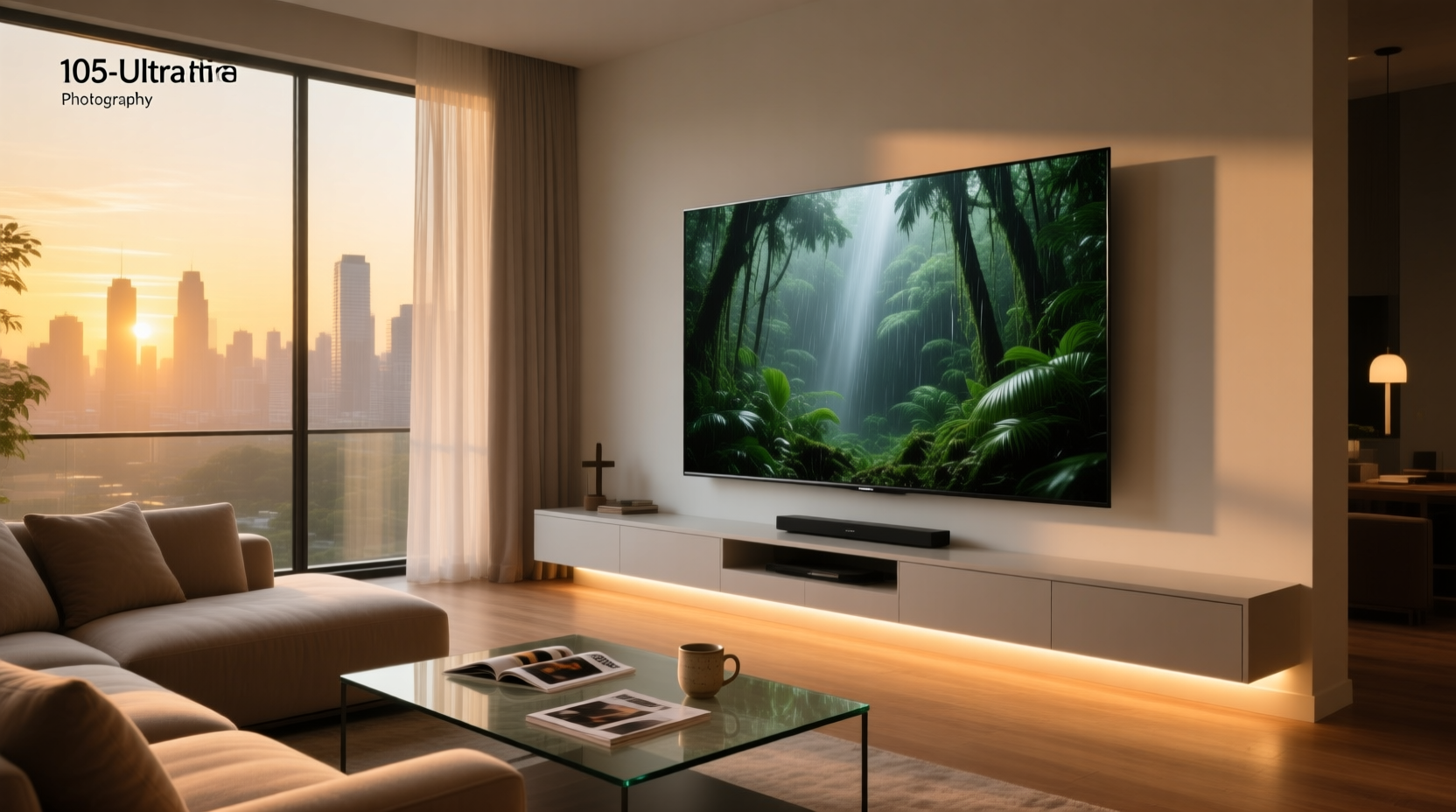
Buying a 105-inch TV isn’t like upgrading from a 55″ to a 65″ — it’s entering commercial-grade display territory. In reality, a true 105-inch diagonal screen measures approximately 267 cm (8.75 ft) wide and 150 cm (4.9 ft) tall — far larger than most residential doorways, stairwells, or wall mounts can accommodate1. These displays are almost exclusively commercial LED video walls or legacy high-end curved consumer models, not mainstream retail TVs. Prices start around $53,000 USD (₹43 lakh) and exceed $100,000 for current-generation Mini-LED or laser-based systems2. If you’re searching for ‘105 inch tv price in India’ or ‘105 inch tv dimensions’, this guide cuts through marketing claims to clarify what’s physically possible, commercially available, and practically advisable — whether you’re evaluating for home theater, corporate AV, or immersive media spaces.
Why a 105-Inch TV Is Extremely Rare — And Often Misunderstood
The term “105-inch TV” triggers immediate assumptions about a single-panel, plug-and-play television — but that’s functionally obsolete. LG’s 105UC9, launched at CES 2014, was the last mass-marketed consumer 105″ curved LED TV1. It used an IPS 4K panel with a 21:9 cinematic aspect ratio, weighed over 100 kg, required reinforced wall mounting, and retailed for ~$100,000 USD. No major brand — Samsung, Sony, or LG — currently manufactures or sells a new, single-panel 105-inch consumer TV in any global market. What appears in Indian e-commerce results labeled “105 inch TV” falls into three categories:
- Legacy stock or refurbished units (e.g., LG 105UC9T or Samsung UN105S9W), often listed without verified availability;
- Misleading dimension labeling — some sellers list total cabinet width (e.g., 230 cm = ~90.5″) as “105 inch”, or confuse diagonal measurement with physical footprint;
- Modular LED video wall systems sold as “105 inch large format LED display” — these are not TVs but commercial-grade tiled arrays requiring external processors, cooling, and calibration3.
This confusion directly impacts buyer expectations. A search for “105 inch tv samsung” yields no active SKUs on Samsung’s official global or India sites. Similarly, Sony’s Bravia lineup caps at 100″ (via laser projector or UX Series), and TCL’s largest listed consumer model is 115″ — but only as a Mini-LED video wall system, not a conventional TV2. Understanding this distinction prevents costly missteps.
Real-World Dimensions: Width, Height, Depth & Weight
A 105-inch screen measured diagonally follows standard 16:9 aspect ratio geometry unless specified otherwise (e.g., LG’s older 21:9 curved models). For accurate planning, use these verified calculations:
| Measurement | 16:9 Aspect Ratio (Standard) | 21:9 Aspect Ratio (Cinematic, e.g., LG 105UC9) |
|---|---|---|
| Diagonal | 105.0 inches (266.7 cm) | 104.6 inches (265.7 cm) |
| Width | 91.5 inches (232.4 cm) | 97.2 inches (246.9 cm) |
| Height | 51.5 inches (130.8 cm) | 46.7 inches (118.6 cm) |
| Depth (panel only) | 5–9 cm (varies by tech) | ~12 cm (curved panel + stand) |
| Weight (approx.) | 75–110 kg (165–240 lbs) | 105–125 kg (230–275 lbs) |
Note: These figures assume no bezel, stand, or wall-mount hardware. Add ≥10 cm to width/height for full-frame dimensions. Most Indian apartment doorways are 75–85 cm wide — meaning even panel-only transport requires disassembly of doors or removal of drywall. Structural load capacity must also be verified: a 100+ kg display mounted high on drywall risks anchor failure without steel stud reinforcement or a custom-engineered wall bracket.
Pricing Reality: Why ‘Under ₹1 Lakh’ Listings Are Not Feasible
Search results showing “105 inch tv under ₹1,00,000” or “₹8,000 wall-mounted 105 inch LED display” reflect either placeholder listings, industrial signage panels (not TVs), or outright inaccuracies. Genuine large-format LED displays begin at ~₹40 lakh ($48,000) for entry-level 105″ configurations. Verified pricing data shows:
- LG 105UC9 (2014, refurbished): ~₹43–54 lakh ($52k–$65k)1;
- TCL 115″ Mini-LED video wall (2025): ₹2.7 crore ($325,000)2;
- Hisense 120″ Laser TV (consumer-grade alternative): ₹3.99 lakh ($4,800) — but uses ALR screen + projector, not direct-view LED3.
The ₹8,000 listing on Aajjo.com refers to an unbranded industrial LED display module — no tuner, no smart OS, no HDMI inputs, and no consumer warranty. It requires external media players, video processors, and cooling — making total system cost exceed ₹25 lakh. Always cross-check SKU numbers against manufacturer product databases. If a listing lacks a verifiable model number (e.g., “LG 105UC9T”, “Samsung UN105S9W”), treat it as non-viable.
Technology Options: LED vs. Laser vs. Video Wall — What Actually Exists Today
There are exactly three display technologies capable of delivering a 105″ image — but only one qualifies as a “TV” per consumer definition:
✅ True Consumer TV (Legacy Only)
Single-panel, self-contained, with built-in tuner, smart OS, speakers, and HDMI inputs. Only LG (105UC9) and Samsung (UN105S9W) shipped these. No new models exist. They use edge-lit or direct-lit LED backlights with 4K resolution (3840×2160). Drawbacks include limited contrast (vs. OLED), visible backlight clouding, and fixed curvature limiting viewing angles.
✅ Laser TV + ALR Screen (Practical Alternative)
Systems like Hisense 120″ or Xiaomi 100″ use ultra-short-throw (UST) laser projectors paired with ambient light rejecting (ALR) screens. While marketed as “100 inch TV”, they deliver 105″-class immersion at 1/10th the price and weight. Key trade-offs: requires precise screen placement, sensitive to ambient light, no native 3D, and projector lamp/laser lifetime (~25,000 hrs).
❌ Modular LED Video Walls (Not a TV)
What many Indian B2B platforms label “105 inch LED display” are 1.5–2.5mm pitch LED tiles (e.g., 3×2 or 4×2 configuration). These require external video processors (e.g., Novastar, Brompton), constant cooling, pixel-level calibration, and no built-in smart features. They’re rated for 24/7 operation — not home use. Resolution is often sub-4K unless using premium tiles (e.g., Unilumin UHD Pro), adding 40–60% to cost.
Installation & Infrastructure: Non-Negotiable Requirements
Before committing, verify these four infrastructure prerequisites:
- Structural Integrity: Drywall alone cannot support >45 kg above 1.2 m height. You need anchored-to-stud mounting or a freestanding floor stand rated for ≥130 kg.
- Power Supply: A 105″ LED panel draws 800–1,200W continuously. Dedicated 20A circuit with surge protection is mandatory — shared circuits risk brownouts or breaker trips.
- Cooling & Ventilation: These panels generate significant heat. Minimum 15 cm rear clearance + passive airflow or low-noise fans required. Enclosed cabinets cause thermal throttling and premature failure.
- Content Delivery: Native 4K@60Hz HDR requires HDMI 2.0b or 2.1. Older AV receivers may not pass 10-bit color or Dolby Vision. Plan for direct source connections (Apple TV 4K, NVIDIA Shield) or certified HDMI 2.1 switchers.
Professional installation isn’t optional — it’s essential. Most authorized service centers refuse warranty coverage if mounting violates torque or load specs. In India, only certified partners of LG Commercial or Samsung Display Solutions handle such deployments.
Is a 105-Inch TV Right for You? Decision Framework
Ask these five questions before proceeding:
- ❓ Do you have ≥3.5 m (11.5 ft) unobstructed viewing distance? Sitting closer causes visible pixels and eye strain. Recommended minimum is 3.7× screen height = ~5.7 m (18.7 ft).
- ❓ Is your room lighting fully controllable? LED panels suffer glare; laser/ALR systems need near-total ambient light control.
- ❓ Can your space accommodate ≥2.4 m (7.9 ft) wall width + 15 cm service gap? Include space for IR remotes, cable management, and service access.
- ❓ Do you need broadcast TV tuners, app ecosystems (Netflix, Disney+), or voice assistants? Video walls lack all of these unless paired with external boxes — adding latency and complexity.
- ❓ Is your budget ≥₹40 lakh with 15–20% reserved for installation, calibration, and extended warranty? Under-budgeting guarantees compromised quality or unsupported setups.
If two or more answers are “no”, a 100″ laser TV or 85–98″ premium QLED is objectively more suitable, offering 90% of visual impact at 30% of cost and complexity.
Common Misconceptions Debunked
❌ “105 inch means the whole unit is 105 inches.” No — it’s the screen diagonal only. Total footprint is always larger.
❌ “It works like a regular smart TV.” Legacy 105″ models run outdated WebOS/Tizen versions with no security updates or app support post-2018.
❌ “HDR and Dolby Vision work out-of-the-box.” Most 105″ panels use static metadata (HDR10), not dynamic tone mapping. Dolby Vision certification was never granted to any 105″ consumer model.
❌ “You can mount it on any wall.” Standard toggle bolts fail under shear load. Engineering sign-off is required for concrete or brick walls; steel reinforcement needed for drywall.
Frequently Asked Questions (FAQ)
- Is there a 105-inch TV available for purchase today?
As a new, single-panel consumer TV — no. The LG 105UC9 and Samsung UN105S9W are discontinued and only available via secondary markets or refurbished channels. Current offerings labeled “105 inch” are either mislabeled, industrial modules, or video wall systems. - What is the actual width and height of a 105-inch TV screen?
For standard 16:9 aspect ratio: ~91.5 inches (232 cm) wide × 51.5 inches (131 cm) tall. For 21:9 (LG’s curved model): ~97.2 inches (247 cm) wide × 46.7 inches (119 cm) tall. - Can I install a 105-inch TV in my home theater?
Only if your room has ≥5.7 m (18.7 ft) viewing distance, reinforced walls/floor, dedicated 20A circuit, and climate control. Most residential builds lack structural capacity — consult a certified structural engineer first. - What’s the cheapest realistic option for a ~105-inch viewing experience?
A 120″ ultra-short-throw laser TV (e.g., Hisense 120L9G) with ALR screen, starting at ₹3.99 lakh. It delivers comparable immersion, lower weight (22 kg), and full smart TV functionality. - Do 105-inch TVs support 4K at 120Hz?
No consumer 105″ model supports 4K@120Hz. Maximum refresh rate is 60Hz (native) with motion interpolation. Video walls can achieve higher rates but require external processing and aren’t plug-and-play.
