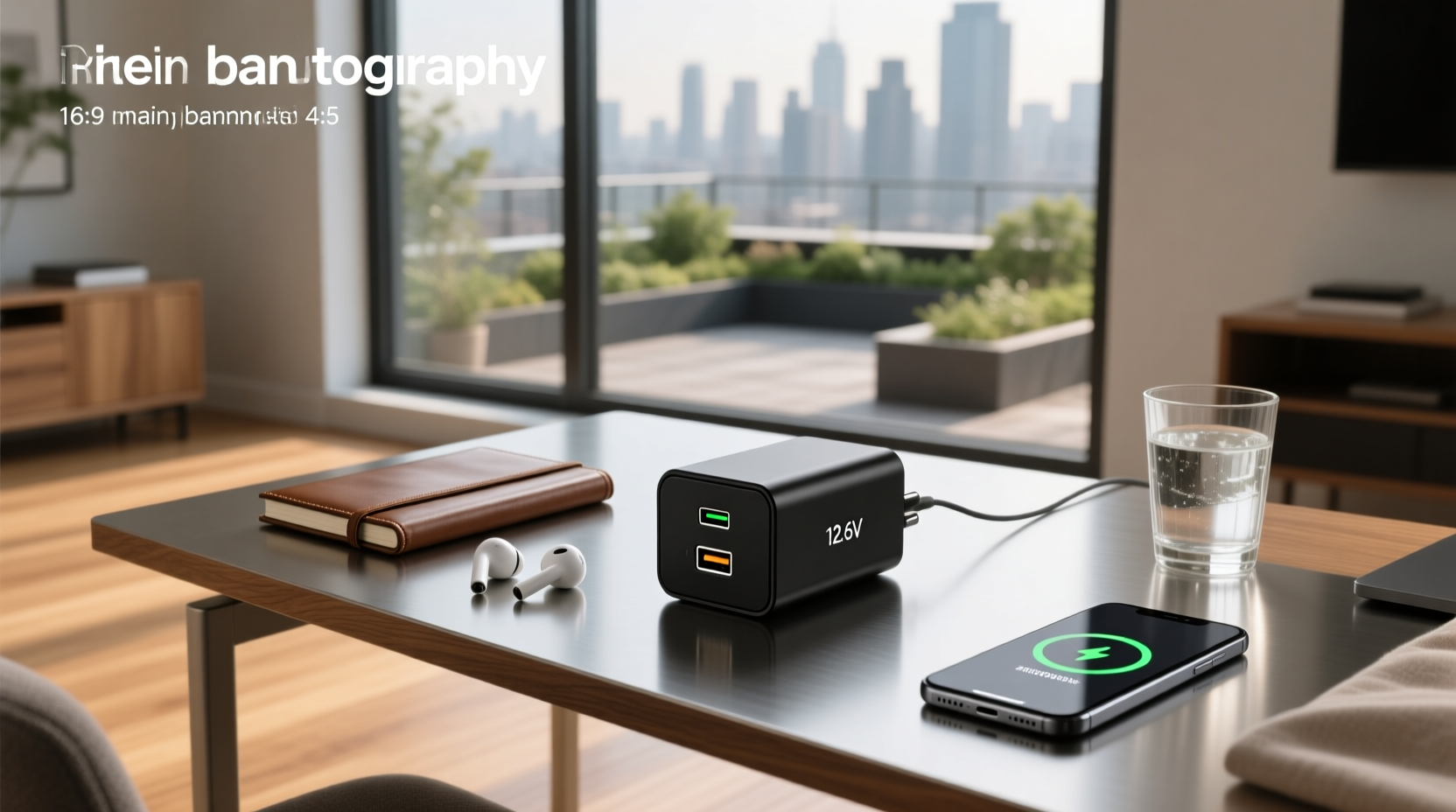
You need a 12.6V charger only if your device uses a 3-cell lithium-ion (3S Li-ion) or lithium-polymer (3S LiPo) battery pack — not a standard 12V lead-acid or automotive battery. The '12.6V' refers to the fully charged nominal voltage (3 × 4.2V per cell), not a generic 12V supply. Choosing the wrong current rating, connector size, or lacking CC/CV (constant current/constant voltage) regulation can overheat batteries, shorten lifespan, or cause thermal runaway. This guide explains how to verify compatibility, interpret specs correctly, and avoid common missteps — whether you’re replacing a massage gun adapter, powering an LED strip, or charging a custom 18650 battery pack.
Why 12.6V — Not 12.0V or 13.8V?
The number '12.6V' is highly specific — it reflects the maximum resting voltage of a fully charged 3-series (3S) lithium-based battery. Each lithium-ion or lithium-polymer cell has a nominal voltage of 3.7V but charges to 4.2V. So: 3 cells × 4.2V = 12.6V. This is not interchangeable with:
- 12.0V: typical for lead-acid or NiMH systems — too low to fully charge a 3S Li-ion pack;
- 13.8V: common in automotive alternator outputs — dangerously high for lithium chemistries without precise regulation;
- 14.4V or 14.8V: used for 4S Li-ion (16.8V full charge) — will overcharge and destroy a 3S pack.
Using a non-CC/CV power supply labeled "12.6V" — such as a generic adjustable bench supply or unregulated wall adapter — does not make it a safe lithium battery charger. True lithium chargers must switch from constant current (CC) mode during bulk charging to constant voltage (CV) mode near full capacity, then terminate or trickle at safe thresholds. Without this, even a correctly labeled 12.6V source risks overvoltage, excessive current, or thermal stress 1.
Key Specifications That Actually Matter (Beyond Just '12.6V')
When evaluating any 12.6V charger listing — especially those priced under £10 on marketplaces — verify these four technical parameters. Omitting or obscuring any one increases risk.
✅ Output Current Rating (A or mA)
This determines charge speed and safety margin. A 3S Li-ion pack rated at 2,200 mAh should ideally be charged at ≤1C (≤2.2A). Common ratings found in search results include:
- 0.4A: Suitable only for small packs (<1,000 mAh), e.g., some portable massage guns 2;
- 1.0A: Safe baseline for mid-capacity tools or lighting systems (1,000–2,500 mAh); widely available and cost-effective;
- 2.0–3.0A: Required for higher-capacity devices (e.g., power tools, larger LED arrays), but demands robust thermal design and quality PCB layout;
- ≥5A: Rare in consumer-grade adapters; typically seen in industrial or lab-grade units — requires active cooling and UL/IEC 62368-1 certification.
⚠️ Warning: A charger rated for 2A output does not mean it’s safe to use with a 500 mAh battery unless its minimum current cutoff is clearly specified. Some low-cost modules lack low-current termination and may apply float voltage indefinitely — degrading cycle life.
✅ Connector Type & Polarity
Physical compatibility is non-negotiable. The most common barrel jack sizes for 12.6V chargers are:
| Size (OD × ID) | Typical Use Cases | Polarity Standard |
|---|---|---|
| 5.5 mm × 2.1 mm | Most 18650 battery packs, LED drivers, portable tools | Center-positive (standard) |
| 5.5 mm × 2.5 mm | Some EU-sourced massage guns and medical devices | Center-positive (verify with multimeter) |
| 4.0 mm × 1.7 mm | Compact electronics, older audio gear | Often center-negative — check device label |
Never assume polarity. Always test with a multimeter before connecting. Reversed polarity can instantly damage protection circuits or blow internal FETs. Also note: USB-C or Micro-USB inputs on '12.6V chargers' are input-only — they do not deliver 12.6V output. These are boost modules, not standalone chargers 3.
✅ Charging Algorithm & Safety Protections
A genuine lithium battery charger must implement at minimum:
- Overvoltage protection (OVP): Cuts off at ≥12.7V to prevent cell swelling;
- Overcurrent protection (OCP): Limits inrush and fault current;
- Thermal shutdown: Monitors PCB or ambient temperature;
- Charge timeout: Stops after ~4–6 hours if full charge isn’t reached (indicates defective cell);
- Pre-charge mode: For deeply discharged cells (<9V), applies reduced current first.
Many budget listings describe themselves as “multi-level protected” or “fireproof” — terms with no standardized definition. Look instead for explicit references to UL 1310 Class 2, IEC 62368-1, or EN 61558-2-16 compliance. If no certification mark (e.g., CE, UKCA, ETL) appears on product photos or spec sheets, treat it as unverified for continuous duty.
✅ Input Voltage Range & Plug Type
Most modern 12.6V chargers accept 100–240V AC input — making them usable across UK, EU, US, and AU regions. However, plug type varies:
- UK 3-pin (BS 1363): Required for mains compliance in UK; look for fused plug (3A fuse standard);
- EU Schuko (Type F): Two round pins, no earth in basic versions — verify grounding if used with metal-cased equipment;
- US NEMA 1-15: Ungrounded two-blade; avoid for high-current (>1.5A) applications;
- Universal input with interchangeable tips: Convenient but introduces contact resistance — not recommended for >1.2A sustained loads.
⚠️ Caution: Adapters labeled "100–240V input" do not guarantee wide output stability. Some cheap switching supplies drop regulation below 110V or above 230V — causing undercharging or erratic CV transition.
Common Misconceptions — And Why They’re Dangerous
Search data shows recurring confusion around voltage equivalence and battery health. Here’s what the evidence says:
❌ "12.6V means it’s fully charged — so any 12V supply will work"
No. A 12.0V DC supply cannot reach the 12.6V threshold required to terminate Li-ion charging. It will either never reach full state-of-charge (reducing runtime) or — worse — force the battery management system (BMS) into extended constant-current mode, increasing heat and impedance rise. Lithium cells require precise voltage ceiling control.
❌ "If my battery reads 12.6V at rest, it’s healthy"
Not necessarily. A degraded 3S pack may show 12.6V open-circuit voltage (OCV) after charging but collapse under load due to high internal resistance. Healthy 3S Li-ion cells typically hold ≥12.4V at 50% state-of-charge and ≥12.0V at 10%. If voltage drops below 11.1V under light load (e.g., 0.2A), capacity loss likely exceeds 30% 4.
❌ "A universal adjustable charger set to 12.6V is safe for lithium"
Only if it includes programmable CC/CV limits, cell balancing capability (for multi-cell packs), and temperature feedback. Most generic lab-style supplies lack cell-specific termination logic. Using one risks applying 12.6V continuously — which equals overcharging once cells reach saturation.
How to Verify Compatibility Before You Buy
Don’t rely solely on product titles. Follow this checklist:
- Check your device manual or label: Look for phrases like "Input: 12.6V DC, 1A", "Battery: 3S Li-ion", or "Charging: CC/CV".
- Measure existing charger output: Use a multimeter under load (not just open-circuit) — cheap adapters often sag 0.3–0.5V when loaded.
- Confirm connector dimensions: Measure outer diameter (OD), inner diameter (ID), and pin length. A 5.5×2.1mm plug won’t fit a 5.5×2.5mm socket — even if both say "DC barrel".
- Look for BMS communication support: High-end tools (e.g., professional massage guns, drones) may require SMBus or CAN bus handshake. Generic 12.6V adapters won’t support this.
- Review safety certifications: Search for model number + "certification report" or check manufacturer’s website for test lab documentation (e.g., TÜV, SGS, Intertek).
When to Avoid a Generic 12.6V Charger Altogether
There are scenarios where off-the-shelf 12.6V adapters are inappropriate — regardless of price or specs:
- Battery packs without built-in protection circuitry (PCM/BMS): Unprotected 18650 cells require cell-level monitoring — a simple 12.6V CC/CV supply cannot balance cells or detect individual overvoltage.
- MEDICAL or SAFETY-CRITICAL DEVICES: Massage guns used in clinical settings, mobility aids, or therapeutic equipment must comply with IEC 60601-1 — generic chargers do not.
- High-reliability applications (e.g., security sensors, remote telemetry): Where uptime >99.9%, opt for industrial-grade units with 100,000+ hour MTBF and conformal coating.
- Devices with proprietary charging protocols: Some brands (e.g., certain cordless vacuum lines) embed authentication chips. A generic 12.6V supply may power the device but won’t initiate charging.
Real-World Use Case Breakdown
Based on top-selling items in search results, here’s how requirements differ by application:
🔧 Massage Guns (e.g., Milcea MG100, similar clones)
Typical spec: 12.6V, 0.4–0.5A, 5.5×2.5mm jack, no BMS negotiation. Low-power, intermittent duty cycle. Priority: correct plug fit and stable voltage under brief 30-second loads. Avoid chargers with >1A rating — excess current may bypass internal current limiting.
💡 LED Light Strips & Portable Lighting
Often paired with 3S 18650 packs (e.g., 2,600–3,500 mAh). Requires ≥1.2A output and thermal derating for enclosed fixtures. Look for IP65-rated enclosures if used outdoors.
🔋 Custom 18650 Battery Packs (DIY projects)
Requires strict adherence to CC/CV timing: 0.5C constant current until 12.6V, then CV until current drops to ≤0.05C. Prefer chargers with status LEDs (red = charging, green = complete) and auto-restart inhibition after fault.
⚙️ Industrial Sensors & Remote Monitoring Units
May draw microamps in sleep mode but spike to 500mA during transmission. Needs ultra-low standby current (<100 µA) and brown-out reset protection. Generic consumer adapters often leak 2–5mA — draining battery in weeks.
Frequently Asked Questions (FAQ)
- Can I use a 12.6V charger for a 12V lead-acid battery?
No. Lead-acid requires 13.8–14.4V absorption voltage and 13.2–13.8V float voltage. A 12.6V supply will undercharge and sulfate the plates over time. - Is 12.6V the same as 11.1V or 10.8V?
No. 11.1V and 10.8V indicate 3S Li-ion at ~30% and ~10% state-of-charge respectively. Only 12.6V represents full charge. Chargers rated for "11.1V/12.6V" usually mean they support both 3S nominal and full-charge profiles — confirm datasheet. - Why do some 12.6V chargers list multiple voltages (e.g., 4.2V/8.4V/12.6V)?
These are multi-cell switch-mode chargers supporting 1S (4.2V), 2S (8.4V), and 3S (12.6V) configurations. Ensure the unit has physical or software selection — automatic detection is unreliable and risks mismatch. - Does cable length affect performance?
Yes. For 2A loads, every 1 meter of 24 AWG wire adds ~0.085Ω resistance — resulting in ~0.17V drop. Use 20 AWG or thicker for runs >0.5m, especially with 2A+ chargers. - How long does a 12.6V lithium pack take to charge?
With a 1A charger and 2,200 mAh pack: ~2.5 hours (including CC and CV phases). With a 0.4A charger: ~6–7 hours. Never charge overnight unless the charger has certified auto-termination.
