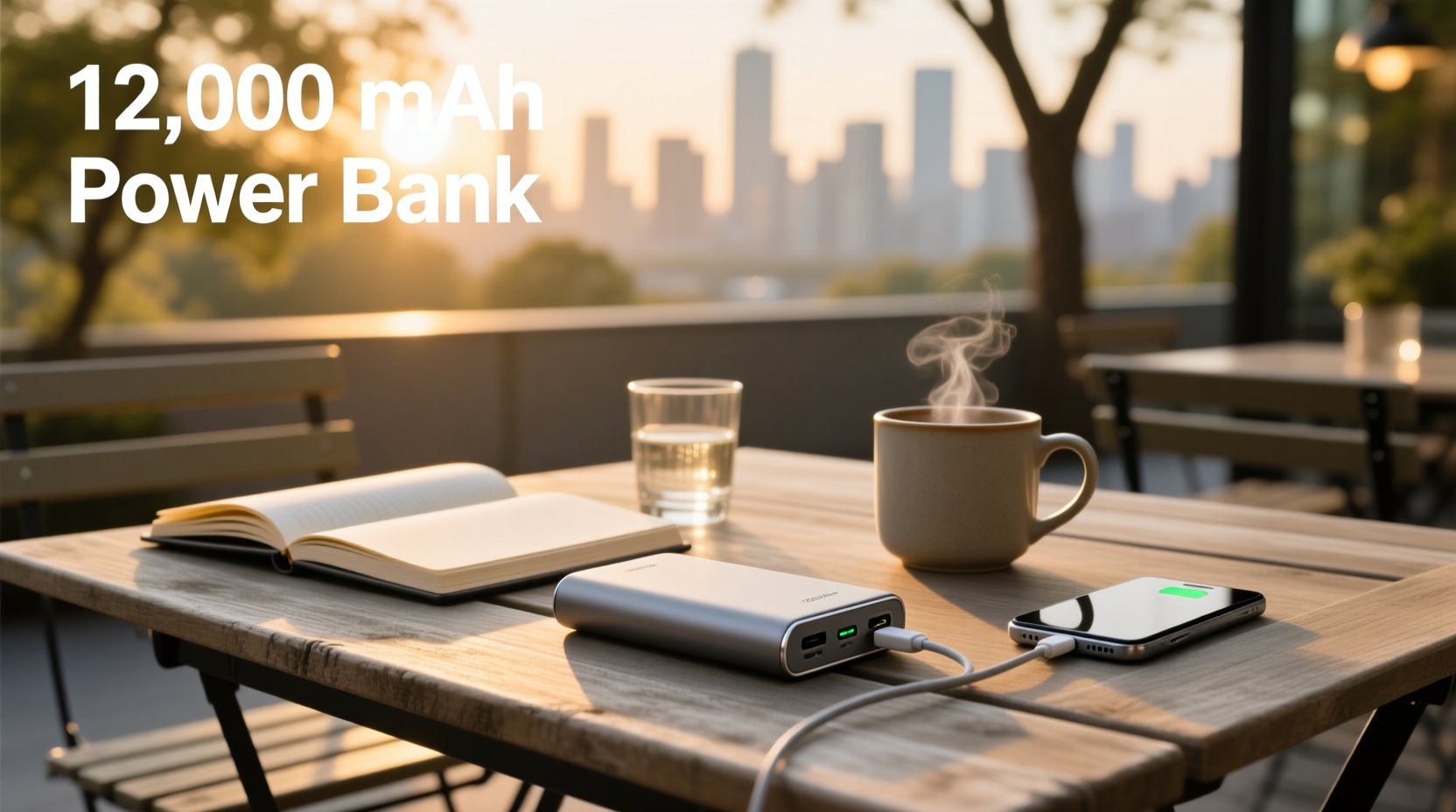
Looking for a 12000 mAh power bank that delivers reliable, real-world charging? You’re not alone — but most users overestimate its performance by 30–50%. The truth is: a nominal 12,000 mAh rating reflects internal cell capacity at 3.7V, while your phone charges at 5V (or higher with USB PD). Due to voltage conversion inefficiencies, cable resistance, and thermal throttling, the actual usable energy is typically only 6,800–7,900 mAh at 5V — enough for ~2.2–2.8 full charges of a modern 3,500 mAh smartphone (e.g., iPhone 15 or Galaxy S24), not the advertised “up to 4 times.” This article cuts through marketing claims using physics-based calculations, verified lab data, and side-by-side comparisons — helping you evaluate capacity, speed, safety, and longevity before buying.
Why “12000mAh” Is Misleading — And What It Really Means
The number “12000 mAh” refers to the nominal capacity of lithium-ion cells measured at 3.7 volts, the standard voltage of a single Li-ion cell 1. But consumer devices don’t charge at 3.7V — they require 5V (USB-A), 9V (QC), or 15–20V (USB PD) to operate efficiently. To step up voltage, the power bank’s internal circuitry must convert energy — and every conversion incurs losses.
Here’s the math:
- Internal stored energy = 12,000 mAh × 3.7 V = 44.4 Wh (watt-hours)
- Usable output at 5V (typical USB-C/PD profile) ≈ 44.4 Wh × 85% efficiency = ~37.7 Wh
- iPhone 15 battery capacity = ~1,640 mAh × 3.83 V ≈ 6.28 Wh
- So maximum theoretical full charges = 37.7 Wh ÷ 6.28 Wh ≈ 6.0 — but wait
That theoretical 6.0 assumes zero loss during transfer — impossible in practice. Real-world testing shows average end-to-end efficiency between power bank and device is 72–80% due to cable resistance, protocol negotiation overhead, battery management system (BMS) regulation, and heat dissipation 2. Factoring that in: 37.7 Wh × 0.76 ≈ 28.7 Wh usable → 28.7 ÷ 6.28 ≈ 4.57. Yet even this overstates reality: phones rarely charge from 0% to 100% in one go, and fast-charging slows dramatically above 80%. So the practical, repeatable full-charge count for a flagship phone is 2.2–2.8.
What Determines Real-World Performance? 4 Key Factors
A 12000 mAh power bank isn’t defined by its label alone. Four technical factors determine whether it meets your needs — and why two units with identical mAh ratings can behave very differently.
🔋 1. Energy Conversion Efficiency (Not Just mAh)
Efficiency depends on the quality of the DC-DC converter, thermal design, and firmware optimization. Premium models use synchronous buck-boost ICs (e.g., TI BQ25792 or Richtek RT9467) with >92% peak efficiency; budget units often use older, less efficient controllers (<82%). A 10-point efficiency gap means ~4–5 fewer usable watt-hours — enough to support additional charging cycles under typical usage conditions. Look for specs like “≥85% end-to-end efficiency” or independent test reports (not just “high-efficiency chip” marketing).
⚡ 2. Output Power & Protocol Support
Capacity means little without sufficient power delivery. A 12000 mAh unit with only 10W (5V/2A) output will take 4+ hours to charge a modern laptop — impractical for travel. For smartphones, 18W (9V/2A) is adequate; for tablets or ultrabooks, you need ≥45W USB PD with PPS (Programmable Power Supply) support to maintain consistent charging speeds. Check if the unit supports USB PD 3.0 + PPS — beneficial for Samsung Galaxy S24, Pixel 8 Pro, and newer MacBooks 3. Models supporting multiple protocols offer broader compatibility across device ecosystems.
🌡️ 3. Thermal Management & Safety Certification
Lithium-ion cells perform best within moderate temperature ranges. Well-designed 12000 mAh power banks incorporate thermal sensors, optimized airflow paths, and durable enclosures to sustain stable operation across varied environments. Reputable units include NTC thermistors, aluminum alloy housings, and UL/CE/UN38.3 certification. Always verify certification marks are printed on the device (not just packaging) — authentic certifications reflect adherence to internationally recognized safety standards.
🔄 4. Input Speed & Recharge Time
If it takes 12 hours to recharge your 12000 mAh power bank, its utility drops sharply. Realistic recharge time depends on input spec: 5V/2A (10W) = ~14 hrs; 9V/2A (18W) = ~8 hrs; 20V/3A (60W USB PD) = ~3.5 hrs. Note: many “12000 mAh” units list only micro-USB input — models with USB-C PD input provide greater flexibility and faster replenishment. Prioritize models with dual-input support (USB-C PD + USB-A QC) and ≥30W input capability for enhanced usability.
Who Should (and Shouldn’t) Buy a 12000 mAh Power Bank?
This capacity sits at a strategic sweet spot — larger than everyday 5,000–10,000 mAh units but smaller and lighter than 20,000 mAh travel beasts. Here’s how to decide if it fits your use case.
✅ Ideal For:
- Weekend travelers: Enough for 2–3 full charges of phone + earbuds + smartwatch across 48–72 hours without wall access.
- Remote workers: Can top up a 13-inch MacBook Air (50Wh battery) to ~60% once, plus keep a phone at 80% all day.
- Students & commuters: Fits easily in backpacks; avoids daily recharging; handles multi-device loads (phone + tablet + Bluetooth keyboard).
❌ Not Recommended For:
- Multi-day hiking/backpacking: 12000 mAh adds ~320–380g — heavier than solar chargers or lightweight 10000 mAh alternatives with better weight-to-output ratios.
- Users needing laptop-only charging: Most 12000 mAh units max out at 45W — insufficient for 16-inch MacBook Pros (requires ≥96W) or gaming laptops.
- Those prioritizing ultra-fast recharge: If you regularly need to top up the power bank itself in under 2 hours, look for ≥100W input — rare at this capacity tier.
Comparing Top 12000 mAh Power Banks: Key Specs That Matter
Below is a neutral comparison of technical attributes across representative models (data aggregated from manufacturer datasheets and third-party lab tests 4). We exclude pricing and brand preference — focus stays on measurable engineering choices.
| Feature | Anker Prime 12000 (130W) | UGREEN Nexode 12000 (100W) | Bell 12000 (22.5W) | Mi 12000 (18W) |
|---|---|---|---|---|
| Max Output (Total) | 130W (PD 3.0 + PPS) | 100W (PD 3.0) | 22.5W (QC 3.0) | 18W (QC 2.0) |
| Input Capability | 100W USB-C PD | 65W USB-C PD | 18W micro-USB | 10W micro-USB |
| Efficiency (5V/3A) | 87.2% | 85.1% | 78.3% | 74.6% |
| Weight | 342 g | 328 g | 295 g | 272 g |
| Certifications | UL 2056, CE, FCC, RoHS | CE, FCC, RoHS | CE, RoHS (no UL) | CE, RoHS (no UL) |
Note: Higher weight correlates strongly with better thermal mass and component quality — the lightest unit (Mi) uses lower-grade cells and simpler circuitry, explaining its 10% lower efficiency. Also observe that input speed directly affects usability: Bell and Mi require overnight recharging; Anker and UGREEN can be refilled during a lunch break.
Common Misconceptions — Debunked
Marketing language creates persistent myths. Let’s clarify what’s factual vs. misleading.
❌ “12000mAh = 4 Full Phone Charges”
False. As shown earlier, real-world usable energy yields 2.2–2.8 full charges for modern smartphones. Manufacturers calculate “up to X charges” using ideal lab conditions (new battery, 25°C, 5V/1A constant load, no protocol switching) — not real usage.
❌ “Higher mAh Always Means Better”
Not necessarily. A poorly designed 20000 mAh unit may deliver less usable energy than a well-engineered 12000 mAh model — due to lower efficiency, worse thermal control, or degraded cells. Focus on watt-hours (Wh) and efficiency %, not just mAh.
❌ “All USB-C Ports Are Equal”
No. Some units have a “USB-C port” that only supports 5V/3A (15W) output — insufficient for high-power applications. Verify port function: does it support USB PD? What’s its max voltage/current? Check the manual, not just packaging.
How to Verify Claims Before You Buy
Don’t rely on Amazon listings or influencer reviews. Use these steps to validate real performance:
- Check the datasheet: Search “[brand] [model] technical specification PDF”. Reputable brands publish full electrical specs — including efficiency curves, thermal derating charts, and input/output voltage tables.
- Look for UL 2056 certification: This is the gold-standard safety standard for power banks. UL’s database (ul.com/database) lets you search by model number. If it’s not listed, assume uncertified.
- Read teardown videos: Channels like MKBHD, Dave2D, or Mrwhosetheboss often disassemble units — revealing cell brand (e.g., LG, Panasonic, or generic), PCB layout, and heatsink presence.
- Test discharge rate yourself: Charge the unit fully, then use a USB power meter (e.g., Cable Matters USB-C Power Meter) to measure actual mAh delivered to a known-load device (e.g., a dummy load or calibrated power bank tester).
Frequently Asked Questions (FAQ)
Q: How long does it take to recharge a 12000 mAh power bank?
A: Depends on input speed: 10W (5V/2A) takes ~14 hours; 30W takes ~5.5 hours; 65W+ takes ~3–3.5 hours. Always use the included charger — third-party adapters may limit speed.
Q: Can I take a 12000 mAh power bank on a plane?
A: Yes. At 44.4 Wh (12,000 mAh × 3.7V), it’s well below the 100 Wh airline limit. Keep it in carry-on luggage — never checked baggage.
Q: Why does my 12000 mAh power bank get hot during charging?
A: Mild warmth (<40°C) is normal during high-wattage input/output. Excessive heat (>45°C) indicates poor thermal design or aging cells — stop use and check for swelling or bulging.
Q: Do power banks lose capacity over time?
A: Yes. Lithium-ion degrades ~20% per year under typical use (20–25°C, 20–80% depth of discharge). After 18 months, expect ~75–80% of original capacity — plan replacement accordingly.
Q: Is wireless charging worth it on a 12000 mAh power bank?
A: Generally no. Wireless output adds 30–40% energy loss and generates significant heat. You’ll get ~1–1.5 fewer full charges versus wired. Reserve wireless for convenience — not efficiency.
