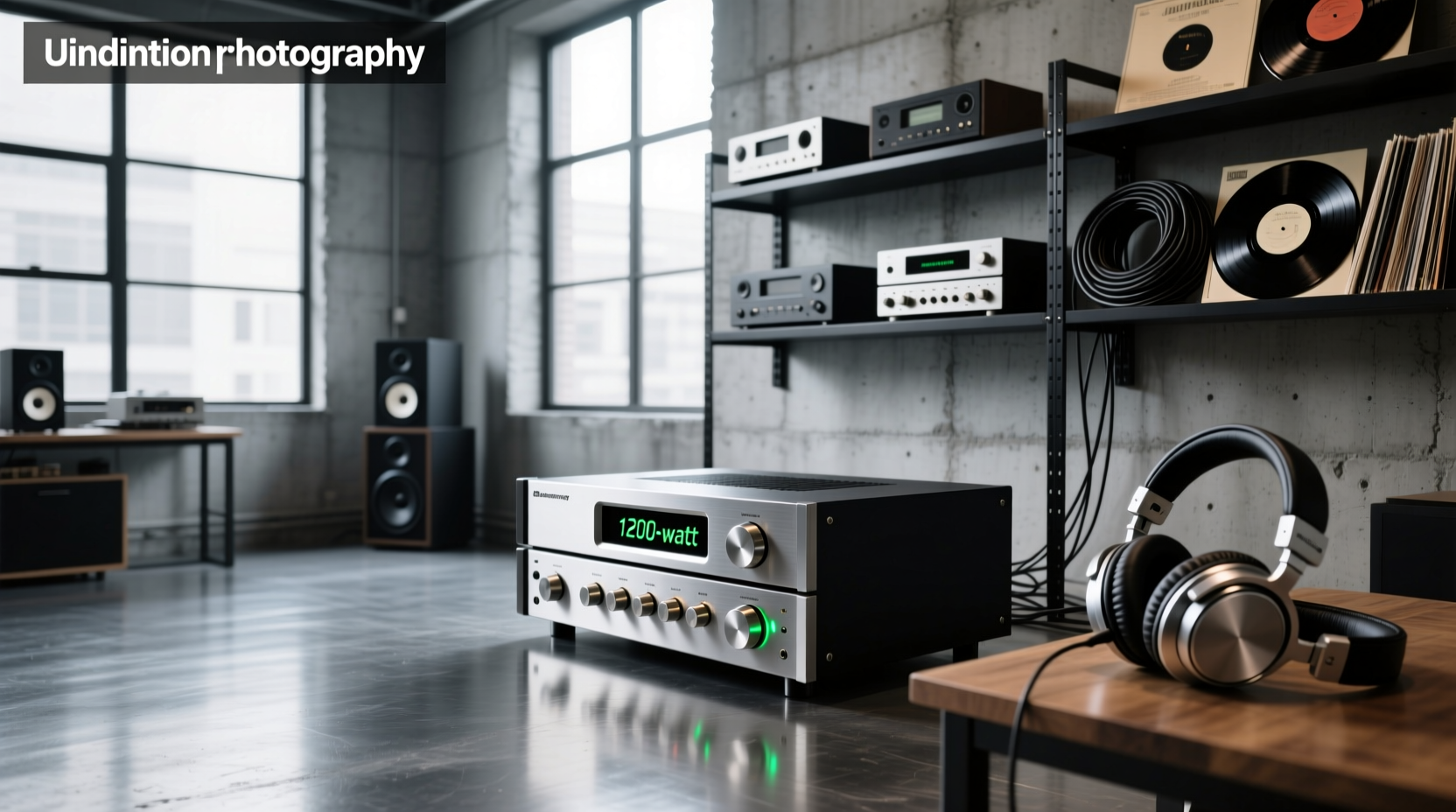
When you search for amplifier 1200 watt, what you actually need isn’t just raw wattage—it’s clarity on what that number means in practice. A true 1200W RMS amplifier—properly engineered, adequately cooled, and matched to compatible speakers—can drive large-format PA systems or high-excursion subwoofers with authority. But the vast majority of products labeled "1200W" online advertise peak or PMPO power (often inflated 2–4×), not continuous RMS output. In real-world use, many deliver only 350–600W RMS per channel at 4Ω—enough for mid-sized venues or car audio, but insufficient for professional line arrays or sustained bass pressure. This guide cuts through marketing noise using measurable electrical principles, thermal constraints, and verified product specifications to help you assess capability—not claims.
Why '1200W' Alone Tells You Almost Nothing
The term amplifier 1200 watt is functionally meaningless without context. Two critical parameters determine real-world performance: RMS (Root Mean Square) power and load impedance. RMS reflects continuous, thermally sustainable output under standard test conditions (e.g., 1 kHz sine wave, THD ≤1%, both channels driven). Peak power is momentary—often measured at clipping or with short bursts—and has no correlation to usable headroom or reliability. For example, one widely listed 1200W 4-channel model specifies 210W RMS per channel at 8Ω, dropping to 465W RMS at 2Ω—yet its front panel displays "1200W"1. That 1200W figure represents peak power output, while the RMS values reflect continuous performance under defined conditions. Always locate the RMS rating at your intended load (2Ω, 4Ω, or 8Ω) in the manufacturer’s datasheet—not the product title or banner image.
How Much Current Does a 1200W Amplifier Actually Draw?
Electrical demand is where many users encounter real-world limitations. A 1200W RMS amplifier operating at 120V AC draws ~10 amps continuously (P = V × I → I = P/V = 1200/120 = 10A)2. But this assumes 100% efficiency—a physical impossibility. Most Class AB amplifiers operate at 50–65% efficiency; Class D units reach 80–90%. So actual input current is higher: a 1200W RMS Class AB amp may draw 15–20A at 120V, requiring a dedicated 20A circuit with 12-gauge wiring. In car audio, 12V DC systems face steeper demands: delivering 1200W RMS requires 100+ amps (I = 1200/12 = 100A) at full output—demanding upgraded alternators, heavy-gauge power cables (4 AWG or larger), and robust grounding3. Meeting these requirements supports stable voltage, clean signal delivery, and long-term operational reliability.
Class D vs. Class AB: Efficiency, Heat, and Application Fit
Amplifier class dictates thermal behavior, size, weight, and suitability. Class D (e.g., Skar Audio RP-1200.1D, Hifonics A1200.1D) uses switching topology to achieve >85% efficiency. At 1200W RMS output, it dissipates under 200W as heat, enabling compact chassis, passive cooling, and stable operation in confined spaces like vehicle trunks or rack-mounted enclosures. Class AB designs (common in pro audio 2U rack units) run hotter: a 1200W RMS unit may dissipate 400–600W as waste heat, requiring large heatsinks and forced-air cooling. This makes them heavier, noisier, and less suitable for mobile or space-constrained setups. However, Class AB often delivers lower distortion at low-to-mid power levels and smoother clipping characteristics—advantageous for vocal-centric applications or studio monitoring where fidelity is prioritized. Neither class is universally superior; match the topology to your environment, cooling capacity, and signal profile.
Speaker Matching: Impedance, Sensitivity, and Power Handling
No amplifier performs well without correct loudspeaker pairing. A 1200W RMS monoblock should be matched carefully with loudspeakers to ensure optimal performance and longevity. Key matching criteria:
- Impedance stability: Verify the amp’s minimum stable load (e.g., "1Ω stable mono") matches your speaker’s nominal impedance. Driving a 2Ω load with an amp rated only for 4Ω+ requires careful system design and may trigger protection circuits under dynamic conditions.
- Power handling margin: Loudspeakers should handle at least 1.5× the amplifier’s RMS output. A 1200W RMS amp pairs best with subs rated ≥1800W program or ≥2400W peak.
- Sensitivity matters more than raw power: A 98 dB @ 1W/1m speaker produces the same SPL with 300W as a 92 dB speaker does with 1200W. Prioritize sensitivity when selecting drivers for efficiency-limited systems.
Underpowering (using a low-wattage amp pushed into clipping) is more likely to damage speakers than clean, high-power amplification. A 1200W RMS amp driven at 70% volume delivers cleaner, safer output than a 400W unit driven at 100%.
Real-World Output vs. Advertised Specs: What Testing Reveals
Independent testing helps clarify performance expectations. YouTube reviews of various 1200W amplifiers show measured RMS outputs ranging from 580–720W at 2Ω for certain entry-level models, while others validate their published specs closely4. Even reputable brands sometimes rate conservatively: Rockford Fosgate’s R2-1200X1 lists 1200W RMS into 1Ω, and independent dyno tests confirm ~1150W RMS with <1% THD at 1kHz, validating the spec5. The gap between label and reality stems from three factors: (1) measurement bandwidth (narrowband 1kHz vs. full-range music signals), (2) duty cycle (continuous vs. intermittent), and (3) thermal derating (output drops as heatsinks warm). Always consult third-party measurements—not datasheets alone—when evaluating claims.
Use Case Analysis: Where a True 1200W RMS Amplifier Makes Sense
A genuine 1200W RMS amplifier serves specific, power-hungry applications—not general-purpose home audio. Valid use cases include:
- Car audio subwoofer systems: Driving one or two high-excursion 12"–15" woofers in sealed or ported enclosures, especially with aggressive bass EQ.
- Small-to-midsize live sound: Front-of-house for bands with electronic elements, or stage monitor wedges for drummers/bassists needing high SPL.
- Fixed-installation bass reinforcement: Under-balcony fills, delay towers, or distributed sub arrays in churches or community centers.
It is not appropriate for bookshelf speakers, desktop setups, or background music systems—where 50–150W RMS suffices. Over-speccing creates unnecessary cost, heat, and complexity. If your primary content is speech or acoustic instruments, prioritize clarity and low-noise design over maximum wattage.
Thermal Management: The Silent Performance Limiter
Even correctly rated 1200W amplifiers perform optimally when thermal management is addressed. Internal temperature sensors maintain safe operating conditions by adjusting gain or initiating protective shutdown if heatsink temperatures approach thresholds (typically 70–85°C). In rack installations, leave ≥2U of vertical space above/below the unit. In vehicles, mount away from exhaust paths and ensure intake/exhaust vents are unobstructed. Dust accumulation degrades heatsink efficiency—clean filters and fins every 3–6 months in high-particulate environments. Passive-cooled Class D amps tolerate tighter spacing but still require ambient temps below 35°C for full-rated output.
Common Misconceptions Debunked
Misconception 1: "Higher wattage always means louder sound."
Loudness depends on speaker sensitivity, room acoustics, and amplifier headroom—not just wattage. Doubling power yields only +3 dB SPL increase—barely perceptible to human ears.
Misconception 2: "1200W amps work with any speaker labeled '1200W.'"
Speaker power ratings are often misleading. "1200W" on a driver may indicate peak handling, not continuous (RMS) capacity. Always check the manufacturer’s recommended amplifier power range—e.g., "500–1000W RMS." Exceeding the upper limit risks mechanical failure (voice coil rub, suspension fatigue).
Misconception 3: "All 1200W models perform identically."
Two amps with identical RMS specs differ in damping factor (control over speaker motion), signal-to-noise ratio (background hiss), and slew rate (transient response). These affect tightness, clarity, and articulation—especially critical for kick drums and synth basslines.
Verification Checklist Before Purchase
Before committing to any amplifier 1200 watt product, verify these five points:
- Is the 1200W figure explicitly labeled RMS (not "max," "peak," or "PMPO") in the official datasheet?
- At what impedance is that RMS rating specified? (e.g., "1200W RMS @ 1Ω mono" is valid; "1200W" with no load stated is not.)
- Does the product list THD+N (Total Harmonic Distortion + Noise) at that power level? Acceptable values are ≤0.1% for pro audio.
- Are independent measurements available (YouTube, Sound & Vision, audio engineering labs)?
- Does your power source (AC circuit or vehicle electrical system) support the required input current with margin?
Frequently Asked Questions
- Can a 1200W amplifier safely drive 4-ohm speakers?
- Yes—if the amplifier is explicitly rated for 4Ω operation (check its minimum stable load). Many 1200W monoblocks support 1–4Ω, while stereo models may only be stable down to 4Ω. Never connect a 2Ω speaker to a 4Ω-minimum amp.
- How much does a true 1200W RMS amplifier cost?
- Commercial-grade 1200W RMS units start around $285 (e.g., Hifonics A1200.1D) and scale to $2,000+ for multi-channel DSP-enabled models. Units priced under $200 almost never deliver verified 1200W RMS output.
- Do I need a separate power conditioner for a 1200W amp?
- Not for basic protection—but a quality surge suppressor (UL 1449, 3,000+ joules) is essential. Power conditioners with active filtering add cost with minimal benefit unless your venue suffers severe EMI/RFI (e.g., near radio transmitters).
- Is fan noise a concern with 1200W amplifiers?
- Class AB rack units typically use thermostatically controlled fans that activate only under load. Well-designed units produce <45 dBA at 1m—quieter than typical office ambient noise. Fanless Class D models eliminate this concern entirely.
- Can I bridge a stereo 1200W amplifier to get more power?
- Bridging combines two channels into one, doubling voltage and quadrupling power into higher impedance loads (e.g., 8Ω). But it also doubles current demand and may void warranties. Only bridge if the manual explicitly permits it—and verify speaker impedance compatibility.
