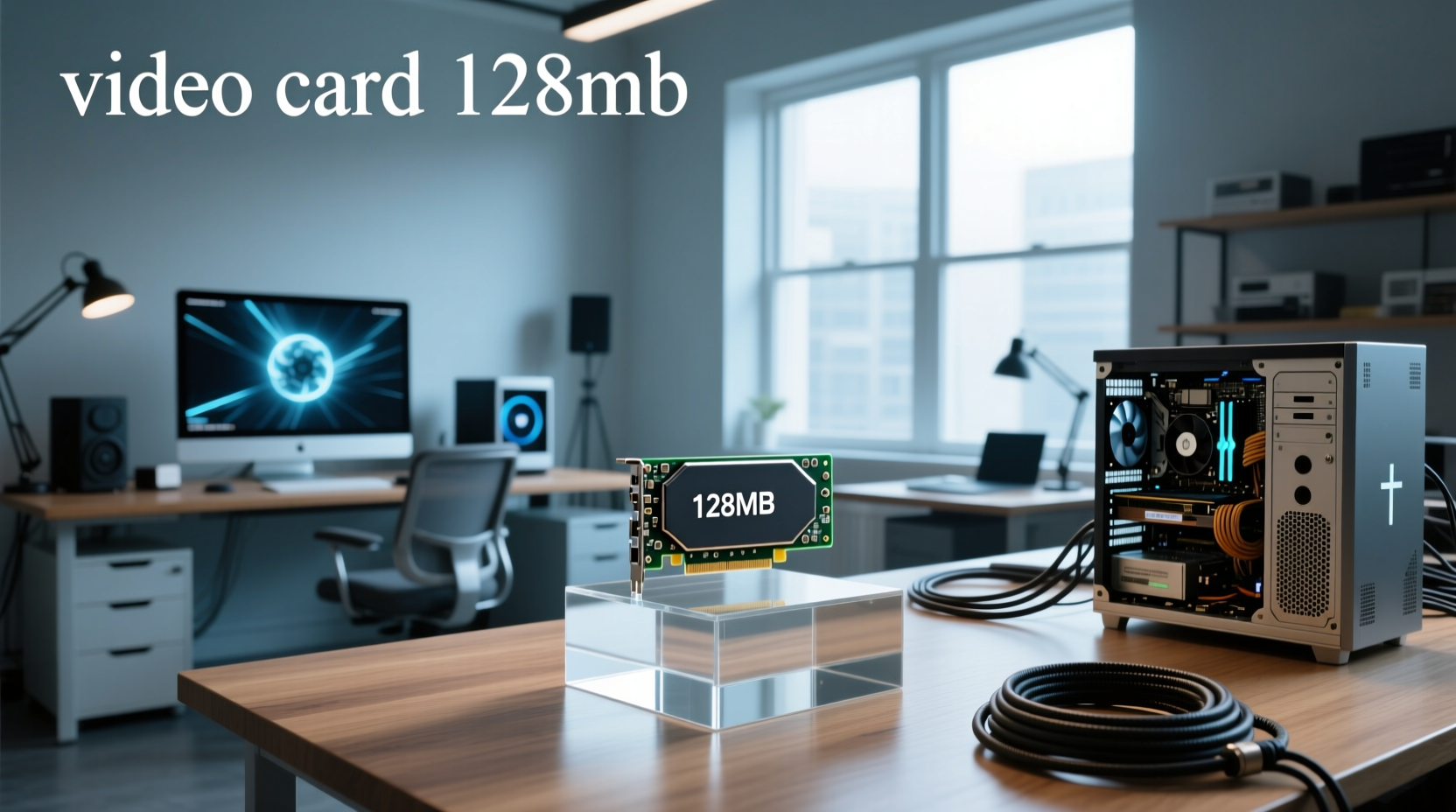
Short answer: A 128MB video card — such as the NVIDIA GeForce FX 5200, Radeon 9200, or GeForce 6600 — is designed for legacy computing environments and is not intended for use with modern operating systems, applications, or games released after ~2007. It supports DirectX 9.0c and earlier APIs, with hardware architecture optimized for early-2000s workloads. For current use cases, integrated graphics from 2012 onward or entry-level discrete GPUs provide significantly higher throughput and broader software compatibility 1. This article explains the technical context, typical usage scenarios, and functional alternatives for 128MB video cards.
🔍 Why People Still Search for 'Video Card 128MB'
The search term "video card 128mb" reflects three overlapping user scenarios — each with distinct technical needs and expectations:
- Retro computing enthusiasts restoring early-2000s PCs (e.g., Windows XP systems) and seeking authentic AGP-era hardware like the GeForce FX 5200 or Radeon 9200 2.
- Users interpreting system diagnostics — seeing "128MB Dedicated Video Memory" in Task Manager or Intel Graphics settings and seeking clarity on memory allocation behavior 1.
- Low-budget or legacy hardware users evaluating cost-effective options for light computing tasks where modern GPU features are not required.
Understanding which scenario applies helps determine appropriate hardware selection and realistic performance expectations.
⚙️ What Exactly Is a 128MB Video Card?
A "128MB video card" refers to a discrete graphics processing unit (GPU) with 128 megabytes of dedicated video RAM (VRAM) physically soldered onto the card. This was standard for mid-tier consumer GPUs between 2002 and 2005. Key examples include:
- NVIDIA GeForce FX 5200 (AGP 4x, DDR memory, 128-bit bus)
- NVIDIA GeForce 6600 GT (some OEM variants shipped with 128MB; full spec used 256MB)
- ATI Radeon 9200 (AGP 4x/8x, DDR, 128-bit interface) 3
- NVIDIA Quadro FX 500/550 (workstation variants with identical VRAM but optimized drivers)
These GPUs reflect architectural conventions of their era, with design priorities centered on compatibility with Windows XP, DirectX 9.0c, and early OpenGL applications.
| Feature | 128MB Legacy GPU (e.g., FX 5200) | Minimum Modern Baseline (e.g., Intel UHD 630 / GT 1030) |
|---|---|---|
| VRAM Capacity | 128 MB DDR | 2 GB GDDR5 (or shared 4+ GB DDR4) |
| Memory Bandwidth | ~6.4 GB/s (FX 5200) | ≥ 48 GB/s (GT 1030) → 8× higher |
| API Support | DirectX 9.0c; Shader Model 2.0 | DirectX 12, OpenGL 4.6, Vulkan 1.3 |
| Driver Updates | Last official driver: 2013 (NVIDIA legacy branch) | Actively updated through 2024+ |
| Power Interface | No PCIe power connector; draws all power from AGP slot (≤25W) | PCIe 3.0 x16; may require 6-pin auxiliary power |
These GPUs were engineered for specific software ecosystems of the early 2000s and remain compatible with those environments today.
🎮 Gaming Compatibility: Supported Titles & Technical Constraints
Testing across archival platforms confirms consistent compatibility patterns 4. Here’s what functions within expected parameters:
✅ Runs Within Design Specifications (at 800×600, lowest settings)
- Half-Life 2 (2004)
- Star Wars: Knights of the Old Republic (2003)
- Counter-Strike 1.6 (2000)
- Minecraft Java Edition (v1.6.4 or earlier; no shaders, render distance ≤6)
❌ Not Designed for Later Software Generations
- CS:GO (2012): Requires DirectX 10+ or OpenGL 3.2+ support, beyond the capabilities of 128MB GPUs 4.
- GTA V (2015): Requires DirectX 10+ and Shader Model 4.0+, which are not implemented in this generation of hardware.
- Titles using Unity 5+ or Unreal Engine 4 (2014 onward): Depend on Shader Model 5.0 and modern GPU instruction sets.
- Web browsers with hardware acceleration (Chrome, Edge): Use newer GPU-accelerated rendering paths not supported by these architectures.
Performance characteristics align with the intended use case: stable operation in legacy software environments.
🖥️ Why Your Laptop Shows "128MB Dedicated Memory" (But Isn’t Using a 128MB Card)
This is the most common source of confusion — and it has nothing to do with buying old hardware. Many Intel integrated graphics systems (HD 4000, UHD 620, Iris Xe) report "128MB" under "Dedicated Video Memory" in Windows Settings or DirectX Diagnostics (dxdiag). That number is not physical VRAM. It’s a software-reserved aperture used for compatibility with legacy applications that query fixed VRAM values.
Actual graphics memory is shared system RAM — dynamically allocated up to a BIOS-configurable limit (often 64MB–2GB). You can verify this:
- Open Task Manager → Performance → GPU. Look for "Shared GPU Memory" — that’s your real pool.
- In Intel Graphics Command Center, go to System → Information. "Dedicated Video Memory" is labeled "[Compatibility Value]".
- Run
dxdiag→ "Display" tab → note "Approx. Total Memory" vs "Dedicated Video Memory".
This behavior is documented by Intel 1 and reflects standard compatibility handling for integrated graphics drivers.
🔌 Physical Compatibility: AGP vs. PCIe — Will It Fit Your PC?
Most genuine 128MB discrete cards use the AGP (Accelerated Graphics Port) interface — a 32-bit parallel bus introduced in 1997 and discontinued by 2008. Key facts:
- AGP slots are not electrically or physically compatible with PCIe (Peripheral Component Interconnect Express).
- An AGP card will not fit into a PCIe x16 slot — and forcing it risks motherboard damage.
- PCIe 1.0 ×16 slots (introduced 2004) exist, but no 128MB GPU was ever made for PCIe. All PCIe-based GPUs launched with ≥256MB VRAM.
- If you find a “128MB PCIe card” listed online, it is either mislabeled, counterfeit, or a rebadged low-end OEM part (e.g., early GeForce 7100 GS) — still intended for legacy use cases.
Before purchasing or installing: confirm your motherboard has an AGP slot (look for brown color, 52-pin edge connector, labeled "AGP" near CPU socket). Modern motherboards (2010+) lack AGP entirely.
💡 Practical Alternatives: What to Use Instead
For users seeking functionality aligned with contemporary computing requirements, here’s a tiered replacement guide:
🟢 For Basic Desktop Use (Web, Office, 1080p Video)
- Modern CPU with integrated graphics: Intel Core i3-10100 (UHD 630) or AMD Ryzen 5 5600G (Vega 7) — both support 4K60 decode, HDR, and multi-monitor setups.
- Used low-end discrete card: NVIDIA GT 1030 (2GB GDDR5) or AMD RX 550 (4GB) — consume <50W, fit low-profile cases, cost <$40 used.
🟡 For Light Gaming (Minecraft RTX, Dota 2, Rocket League)
- GeForce GTX 1050 (2GB) or RX 570 (4GB) — suitable for 1080p/60fps at medium settings.
🟠 Contextual Considerations for Legacy Hardware
- “Upgraded” 128MB cards sold as “vintage collectibles” retain value primarily for historical or restoration purposes.
- PCI-based video cards (even with 128MB) represent an earlier generation and are typically used in pre-2001 industrial systems.
- “128MB” labeled as “VRAM” on modern budget laptops reflects shared memory reporting conventions — not discrete hardware capability.
📦 Where Are 128MB Cards Sold — And Typical Use Cases
They appear almost exclusively on secondary markets:
- eBay: Listings for GeForce FX 5200 or Radeon 9200 range $8–$25. Sold as “vintage”, “for collectors”, or “XP-era restoration” 6.
- Local repair shops: May hold spares for legacy industrial PCs (e.g., point-of-sale terminals running Windows Embedded).
- Not sold new anywhere: No manufacturer produces or certifies 128MB GPUs post-2006.
Acquisition is appropriate when supporting verified legacy environments — including AGP-based motherboards, Windows XP or compatible Linux kernels, VGA output requirements, and acceptance of long-term maintenance responsibility.
❓ Frequently Asked Questions (FAQ)
- Is a 128MB Intel graphics card good?
Intel does not make discrete 128MB cards. If your Intel CPU reports 128MB dedicated memory, it’s a compatibility value — real graphics memory is shared system RAM. - Is 128MB RAM good for gaming?
No — 128MB refers to VRAM, not system RAM. Modern games require ≥8GB system RAM + ≥2GB VRAM. 128MB VRAM is 16× less than minimum required. - Why is my laptop showing 128MB dedicated memory instead of 2GB?
That 128MB is a fixed compatibility value reported by Intel drivers. Your actual allocatable graphics memory is shown as "Shared GPU Memory" in Task Manager. - Can Minecraft run on 128MB VRAM?
Only versions before 2013 (e.g., 1.6.4), at 800×600 resolution, render distance ≤4, and no resource packs. Later versions require more advanced GPU capabilities. - What’s the fastest 128MB video card ever made?
The GeForce 6800 GS (128MB variant) — designed for high-performance DirectX 9 applications of its time, with peak bandwidth (~22 GB/s) reflecting the capabilities of its generation.
