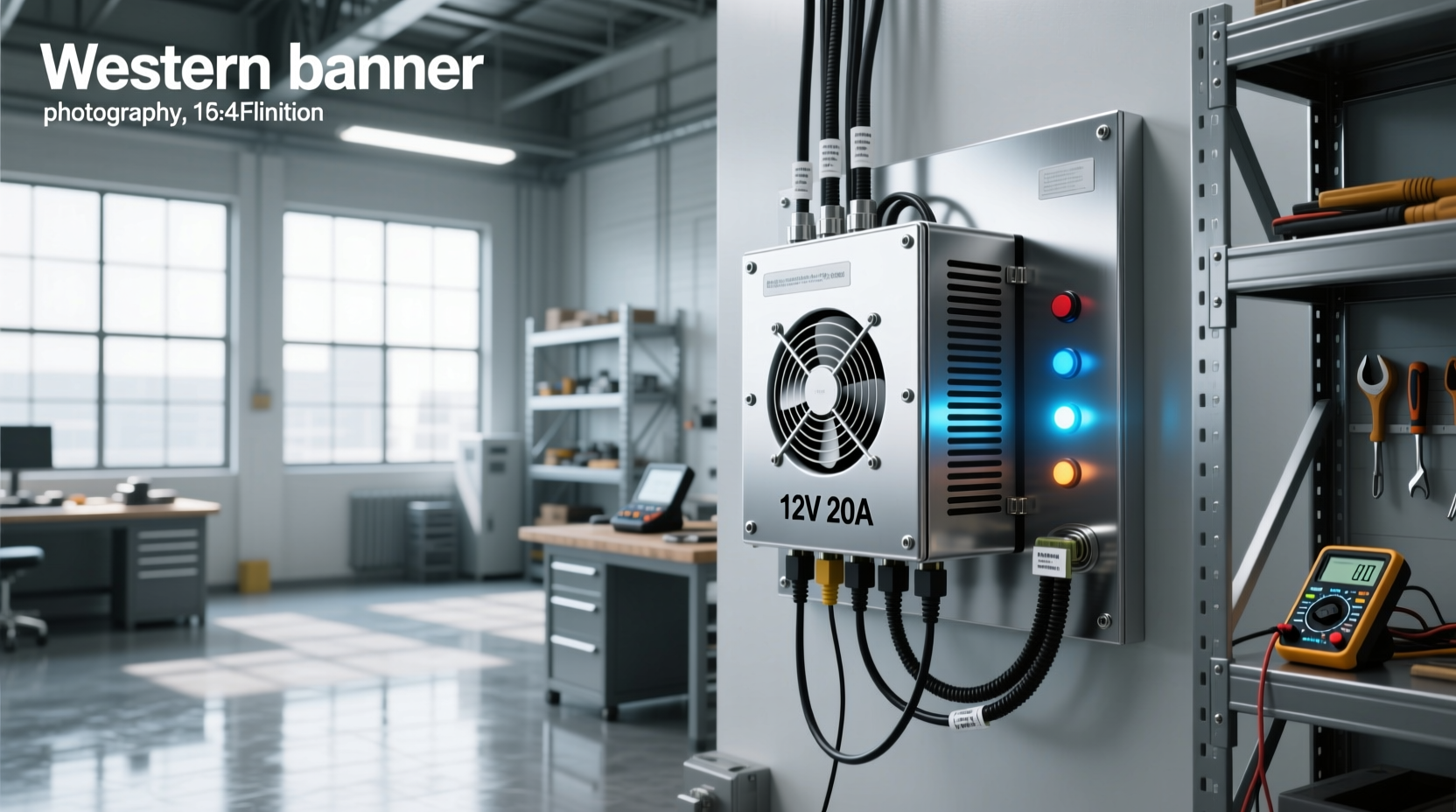
If you’re searching for a 12V 20 amp power supply, your core need isn’t just a product listing — it’s confidence that the unit will safely and reliably deliver continuous 20A at 12V DC under real-world conditions (not just peak or lab-rated specs), without thermal shutdown, voltage sag, or premature failure. This guide cuts through misleading wattage claims (e.g., "240W" vs. verified 20A @ 12V = 240W only if sustained), explains why input voltage range (110V–240V AC), cooling method, and protection circuits matter more than price alone, and gives you a practical checklist to validate any unit before deployment — whether for security camera arrays, high-density LED lighting, amateur radio gear, or embedded electronics prototyping.
Why This Search Matters: The Real-World Gap Between Label and Load
Over 22 million Google results for 12v 20 amp power supply reflect massive demand — but also widespread confusion. Retail listings often emphasize headline numbers (“240W”, “20A”, “12V”) while burying critical operational limits. For example, a $15 switching supply may claim “20A” but only sustain 15A continuously before derating or shutting down 1. Meanwhile, industrial DIN-rail units from Mean Well or TDK-Lambda maintain full 20A output across -25°C to +70°C ambient — but cost 6× more. Your actual requirement depends on three non-negotiable factors: load profile (constant vs. pulsed), environment (enclosed cabinet vs. open bench), and failure tolerance (security footage loss vs. hobbyist LED test).
How a 12V 20A Power Supply Actually Works (No Engineering Degree Required)
A 12V 20A power supply converts alternating current (AC) from a wall outlet (typically 110V or 230V) into stable direct current (DC) at 12 volts, capable of delivering up to 20 amperes of current. Crucially: amperage is not forced — it’s drawn by the connected device. A 12V 20A supply won’t “push” 20A into a 12V 0.5A security camera; it simply provides up to 20A *on demand*. Think of it like a water pipe: voltage is pressure (12 psi), amperage is flow rate (up to 20 gallons/minute), and your device determines how much flows 2.
But capability ≠ reliability. True 20A operation requires:
- Thermal management: Passive aluminum heatsinks fail above ~15A in still air; forced-air cooling (fan) is essential for sustained loads.
- Voltage regulation: Output must stay within ±5% of 12V (i.e., 11.4–12.6V) under full load and line-voltage fluctuations.
- Protection circuitry: Over-current (OCP), over-temperature (OTP), and short-circuit (SCP) shutdown prevent fire or component damage.
Key Specifications Decoded: What to Check (and What to Ignore)
Don’t trust the front label. Verify these six parameters using datasheets — not product pages:
| Specification | What It Means | Red Flag If… | Verified Minimum for True 20A |
|---|---|---|---|
| Continuous Output Current | Max current sustained indefinitely at rated temperature | Listed as “peak”, “momentary”, or missing ambient temp condition | 20A @ 40°C ambient, no derating |
| Efficiency (80 PLUS or similar) | % of AC input converted to usable DC (rest lost as heat) | No efficiency rating, or rated only at 50% load | ≥85% at 100% load (e.g., 80 PLUS Bronze) |
| Cooling Method | How heat is dissipated | “Passive cooling” claimed for >15A units | Thermally controlled fan with auto-speed adjustment |
| Protections | OCP, OTP, SCP, OVP (over-voltage) | Only “short-circuit protection” listed | All four protections explicitly stated in datasheet |
| Hold-up Time | How long output stays stable during AC dropout (critical for CCTV) | Not specified or <10 ms | ≥16 ms per IEC 61000-3-3 |
| EMI/RFI Filtering | Prevents noise from interfering with radios/cameras | No mention of EN 55032 Class B compliance | EN 55032 Class B certified (for residential use) |
Top 4 Real-World Applications — And Why Generic “20A” Units Often Fail
Not all 12V 20A loads are equal. Here’s how application context changes requirements:
📷 Security & CCTV Systems
A 18-camera PoE+ NVR setup may draw 18 × 0.5A = 9A average — but startup surge can hit 15A+ for seconds. Cheap supplies brown out, causing cameras to reboot mid-recording. Solution: Choose units with ≥30A peak surge capacity and ≥20 ms hold-up time. DIN-rail models like MEAN WELL DRP-240-12 are engineered for this 3.
💡 High-Density LED Installations
5m of 60-LED/m RGBWW strip draws ~12A at full white. Add controller overhead and 20% safety margin → 14.4A minimum. But LED drivers cause harmonic distortion; low-quality supplies overheat and flicker. Look for active PFC (Power Factor Correction) and constant-voltage regulation stability ≤±1.5%.
📡 Amateur Radio & Ham Gear
Transceivers like the Yaesu FT-991 draw 20A only during transmit — but idle current is ~0.5A. Voltage ripple must be <50mV p-p to avoid audio noise. Linear supplies (e.g., Astron RS-20A) offer near-zero ripple but run hot; modern switching units with multi-stage filtering (e.g., Samlex SEC-1220) meet spec 4.
🛠️ Industrial Control & PLCs
PLC I/O backplanes require ultra-low noise and immunity to voltage transients. A 12V 20A supply here needs reinforced isolation (≥4kV AC), wide operating temp (-25°C to +70°C), and UL 62368-1 certification — not just CE. Open-frame units (e.g., TDK-Lambda CCG240-12) dominate this segment.
Price vs. Performance: The $15–$300 Reality Spectrum
Price correlates strongly with thermal design, component quality, and regulatory compliance — not just brand name. Below $30, most units:
- Use generic Chinese ICs with no thermal throttling logic
- Derate to 12–15A above 30°C ambient
- Lack EN 55032 EMI filtering (causing WiFi/camera interference)
- Have no safety agency certification beyond basic CE (often self-declared)
Units priced $120–$250 (e.g., MEAN WELL LRS-250-12, TDK-Lambda CCG240-12) provide:
- Full 20A output up to 60°C ambient
- 85–90% efficiency, reducing energy waste and heat
- UL/CSA/EN 62368-1 and EN 55032 Class B certifications
- 5-year warranty (vs. 1 year on budget units)
Pay more only if your use case demands uptime, safety, or regulatory compliance — not for a weekend LED project.
3 Critical Verification Steps Before You Buy (or Deploy)
- Download the official datasheet — not the retailer’s “spec sheet”. Search “[brand] [model number] datasheet PDF”. Verify “Output Current” row specifies “20A” under “Continuous” and lists ambient temperature (e.g., “20A @ 40°C”).
- Check the input voltage range. Many cheap units list “110V–240V” but only deliver full output at 220–240V. True universal input maintains 20A from 90V AC to 264V AC.
- Look for independent certification marks — not just “CE”. UL 62368-1, CSA C22.2 No. 62368-1, or TÜV EN 62368-1 indicate third-party safety testing. Self-declared CE means nothing 5.
Common Misconceptions — Debunked
- “More watts = better supply”: A 300W unit isn’t “stronger” than a 240W one if both deliver 20A at 12V. Excess wattage often means poor efficiency or oversized components.
- “All 20A supplies work for battery charging”: Standard 12V 20A supplies output ~12.0V — insufficient to charge 12V lead-acid (needs 13.6–14.4V) or LiFePO4 (14.2–14.6V). Use dedicated chargers.
- “Fan noise doesn’t matter”: In home offices or bedrooms, a 40 dBA fan is audible. Look for “silent mode” (fan off ≤50% load) or thermally optimized passive designs (rare above 15A).
Frequently Asked Questions
- Can I use a 12V 20A power supply for a 12V 5A device?
- Yes — safely. The device draws only the current it needs. Amperage rating indicates maximum available, not forced delivery.
- Why does my 12V 20A supply get hot and shut down?
- It’s likely overheating due to inadequate ventilation, ambient temperature >40°C, or sustained load >15A without forced cooling. Check derating curves in the datasheet.
- Is a switching or linear 12V 20A supply better?
- Switching supplies are smaller, lighter, and 80–90% efficient — ideal for most uses. Linear supplies have near-zero electrical noise but are heavy, inefficient (~50%), and run very hot — only choose for sensitive analog/radio applications.
- Do I need waterproofing for outdoor use?
- Standard 12V 20A supplies are IP20 (indoor use only). For damp locations (e.g., covered patios), select IP65-rated units. Never use non-rated supplies outdoors — condensation causes corrosion and short circuits.
- How do I calculate total power draw for multiple devices?
- Add each device’s current draw (in amps) at 12V. Multiply sum by 1.2 for safety margin. Example: 10 × 0.8A cameras + 1 × 3A DVR = 11A × 1.2 = 13.2A → a 15A supply is minimum; 20A provides headroom.
