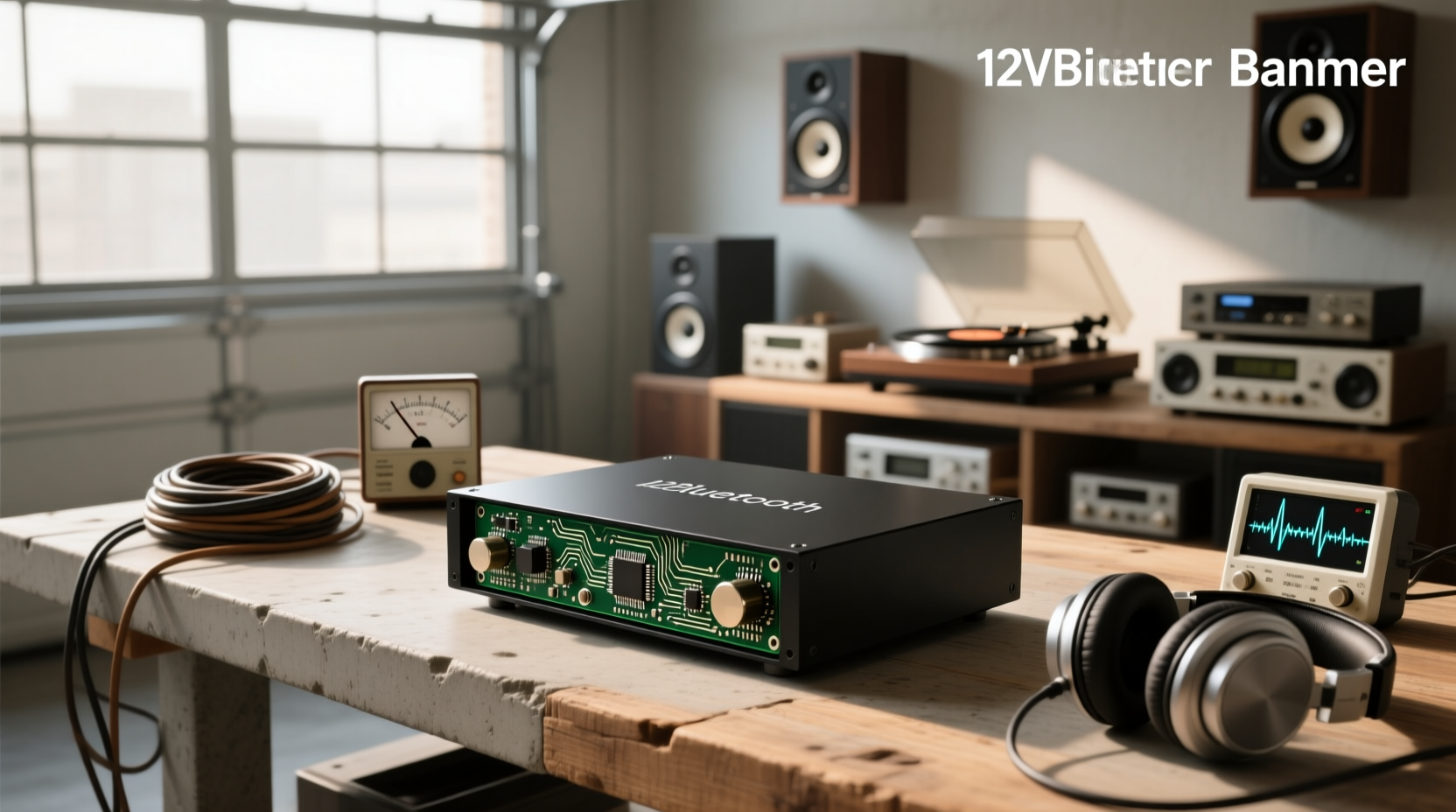
Looking for a 12V Bluetooth amplifier board that actually delivers clean power, stable pairing, and safe thermal behavior—not just inflated watt labels? You’re not alone. Over 5.7 million Google searches each year reflect widespread confusion between nominal output, peak power, and real-world 12V operation limits. In this guide, we cut through the noise: we explain how to verify true RMS power at 12V, why chipset choice (TPA3116D2 vs. TPA3118 vs. BK3266) matters more than Bluetooth version alone, and when a '300W' board is physically impossible on 12V without distortion or shutdown. We also map common use cases—DIY portable speakers, car audio upgrades, marine installations, and battery-powered studio monitors—to matching technical requirements.
Why Most 12V Bluetooth Amplifier Boards Are Misrepresented (and How to Spot It)
The biggest source of buyer frustration isn’t price—it’s spec inflation. A board advertised as "300W" running on 12V DC violates basic electrical physics. Let’s clarify: maximum continuous (RMS) power from a Class D amplifier at 12V is constrained by current draw, heatsinking, and supply regulation. For example:
- A true 2×50W RMS stereo board at 12V draws ~8–9A under full load (assuming ~85% efficiency).
- A claimed "200W+200W" dual-channel board at 12V would require >30A sustained current—far beyond typical PCB traces, connectors, or affordable switching supplies—and would overheat within seconds without massive forced-air cooling.
- Peak (not RMS) power figures are often listed in product titles—e.g., "200W Peak"—but peak is irrelevant for music playback; RMS determines usable loudness and thermal safety.
Always check whether the spec sheet states RMS output at 12V, not just "up to 24V" or "max power" with no voltage context. If it doesn’t, assume the rating is measured at 24V—or is theoretical.
Core Technical Dimensions That Actually Matter
When evaluating a 12V Bluetooth amplifier board, focus on these five measurable criteria—not marketing bullet points:
🔋 1. Voltage Range & Regulation Stability
Not all “12V” boards tolerate real-world automotive or battery voltage swings. A true 12V-compatible design must operate stably from 10.5V (a drained lead-acid battery) to 14.4V (engine running). Boards using low-dropout (LDO) regulators or unregulated rail designs often cut output or distort below 11.5V. Look for explicit input range specs like "10.5–14.5V DC"—not just "12V–24V". The latter implies compatibility but says nothing about performance at the lower end.
📡 2. Bluetooth Version ≠ Audio Quality
Bluetooth 5.0/5.1/5.3 offers longer range and lower latency—but no improvement in audio fidelity unless paired with a codec like aptX HD or LDAC. Most sub-$25 boards use SBC-only Bluetooth modules (even if labeled "5.3"). True high-fidelity streaming requires both a capable transmitter (phone/tablet) and receiver (board), plus support for aptX, AAC, or LDAC. Verify codec support in the datasheet—not just the Bluetooth version number.
🔊 3. Output Stage Chipset: The Real Determinant of Sound & Reliability
The IC defines thermal behavior, THD+N, channel separation, and dynamic headroom. Common chips found in verified 12V boards include:
| Chipset | Typical 12V RMS Output (Stereo) | Key Strengths | Known Limitations |
|---|---|---|---|
| TPA3116D2 | 2×30W @ 12V (4Ω) | Low THD+N (<0.05%), mature design, widely documented | Requires careful PCB layout; no built-in DSP |
| TPA3118 | 2×25W @ 12V (4Ω) | Better thermal efficiency than TPA3116, integrated protection | Slightly higher noise floor at low volumes |
| BK3266 | 1×20W @ 12V (4Ω) | Integrated Bluetooth + amp; ultra-compact footprint | Mono only; limited bass extension; no treble/bass control |
| TPA316D2 | 1×100W @ 12V (4Ω) | High-current mono output; robust short-circuit protection | Requires large heatsink; no stereo option |
Never assume “higher watt chip = better sound.” A well-implemented TPA3116D2 board will outperform a poorly laid-out TPA3118 board in SNR, crosstalk, and clipping behavior—even at identical rated power.
⚙️ 4. Input Flexibility & Signal Integrity
Most boards offer AUX (3.5mm), USB, and/or TF card playback—but signal path quality varies drastically. Key red flags:
- No dedicated ground plane isolation between digital (Bluetooth/USB) and analog (AUX/output) sections → audible hiss or Bluetooth interference.
- Non-shielded PCB traces near input jacks → RF pickup from nearby phones or Wi-Fi routers.
- Missing input level adjustment (potentiometer or jumper-selectable gain) → mismatch with low-output sources (e.g., smartphone line-out ≈ 0.3Vrms).
If you plan to feed the board from a DAC, turntable preamp, or mixer, confirm whether the board accepts line-level (≈2Vrms) or only consumer-level (-10dBV) signals.
📦 5. Physical Build: Heatsinking, Connectors & Layout
A 12V board dissipating 40W+ needs effective thermal management. Check for:
- Aluminum heatsink mounted directly to power IC(s), not just a small metal plate glued to the PCB.
- Screw terminals rated ≥15A (not spring-clamp or bare wire solder points) for speaker outputs.
- Clear separation between high-current power traces and low-level analog inputs.
Boards sold for <$10 often omit heatsinks entirely or use undersized ones—leading to thermal throttling after 60–90 seconds of moderate volume. If the listing shows no heatsink photo, assume passive cooling only.
Matching Your Use Case to the Right Board Type
“Best” depends entirely on application. Here’s how top scenarios align with technical needs:
🚗 Car Audio Integration
Requirements: Wide input voltage tolerance (10.5–14.4V), ignition-switched power handling, minimal engine noise coupling, compact size. Avoid boards with USB charging ports—they can inject alternator ripple into audio ground. Prioritize models with dedicated remote turn-on (12V trigger) input and chassis-ground isolation. Boards using TPA3116D2 with automotive-grade capacitors (e.g., Panasonic FR series) handle voltage spikes better than generic variants.
🎒 Portable/DIY Speaker Builds
Requirements: Low quiescent current (<50mA), battery runtime awareness, physical durability. A board drawing 120mA at idle will drain a 10,000mAh power bank in <84 hours—even with no audio playing. Confirm idle current in the datasheet. Also, verify whether Bluetooth stays active during standby—if yes, it may prevent deep-sleep mode in your battery pack.
🏡 Home Studio or Shelf Speaker Upgrade
Requirements: Low noise floor, wide dynamic range, optional tone controls (bass/treble), RCA inputs. Many budget boards lack proper RIAA equalization or phono-stage compatibility—so don’t connect a turntable directly unless explicitly supported. For studio monitoring, prioritize THD+N <0.08% and SNR >95dB (A-weighted). Boards with adjustable gain (e.g., via solder jumpers) let you match sensitivity across drivers.
⚓ Marine or Outdoor Use
Requirements: Conformal coating (protective polymer layer), corrosion-resistant terminals, IP-rated enclosure compatibility. Few off-the-shelf boards meet this—most require third-party waterproof enclosures. If mounting near saltwater, avoid aluminum heatsinks without anodization; prefer nickel-plated brass terminals over tin-coated copper.
Red Flags: When to Walk Away
These are consistent indicators of unreliable or misrepresented 12V Bluetooth amplifier boards:
- "Max 300W" with no RMS specification or test conditions — violates Ohm’s Law at 12V unless using unrealistic 1Ω loads (which no speaker uses).
- No published schematic or IC datasheet link — prevents verification of topology, filtering, or protection features.
- "Bluetooth 5.3" but no mention of codecs — almost certainly SBC-only, with no meaningful upgrade over Bluetooth 4.2.
- Claims of "aptX HD" or "LDAC" without listing supported sample rates (e.g., 44.1kHz/48kHz/96kHz) — many boards fake codec names in firmware strings.
- No thermal derating curve or ambient temperature spec — e.g., “30W/channel at 25°C” drops to 18W at 40°C. Without this, real-world output is unknown.
How to Verify Claims Yourself (No Multimeter Required)
You don’t need lab gear to validate basic functionality:
- Test voltage sag: Power the board from a variable DC supply. Play pink noise at 50% volume. Drop input from 12.0V to 11.0V. If distortion increases noticeably or output drops >15%, regulation is weak.
- Check Bluetooth stability: Pair with two devices simultaneously (phone + laptop). Switch audio source mid-playback. If connection drops or audio stutters, the module lacks adequate RAM or has poor interrupt handling.
- Measure idle heat: After 10 minutes with no input signal, touch the main IC. If too hot to hold (>60°C), heatsinking is inadequate for sustained use.
- Listen for ground loop hum: Connect only power and speakers (no AUX/USB). If 50/60Hz hum persists, grounding is compromised—common in cheap boards sharing digital/analog ground planes.
Common Misconceptions Debunked
❌ "Higher Bluetooth version means better sound"
False. Bluetooth 5.3 improves connection robustness and power efficiency—not audio resolution. SBC (the default codec) tops out at 328 kbps and 48kHz sampling regardless of version. Only aptX Adaptive or LDAC enable higher bitrates—and only if both source and receiver support them.
❌ "More watts = louder and better"
False. Perceived loudness doubles every ~10dB increase. Going from 20W to 40W yields only +3dB—barely noticeable. Distortion, frequency response flatness, and damping factor matter far more for clarity and control than raw wattage.
❌ "All Class D amps sound 'harsh' or 'digital'"
Outdated. Modern Class D chips (e.g., TPA3116D2, IRS2092S) achieve THD+N <0.03% and bandwidth >80kHz—indistinguishable from high-end Class AB in blind tests. Poor implementation—not topology—is the culprit.
Frequently Asked Questions
- Can I run a 12V Bluetooth amplifier board on a lithium-ion power bank?
Yes—if the bank provides stable 12V output (not just USB-C PD) and can sustain ≥10A peak current. Most USB-PD banks output 5V/9V/15V/20V, not fixed 12V. Use a dedicated 12V LiFePO4 pack (e.g., 4S configuration) for reliability. - Do I need a separate DAC if the board has Bluetooth?
No—the Bluetooth module includes a built-in DAC. Adding an external DAC upstream provides no benefit unless the board supports optical or coaxial SPDIF input (rare under $50). - Why does my board cut out at high volume?
Almost always due to undervoltage protection triggering. Measure supply voltage under load: if it drops below ~10.8V, your power source cannot maintain current. Replace with a regulated 12V supply rated ≥15A. - Can I bridge channels to drive a subwoofer?
Only if the board explicitly supports bridged-tied-load (BTL) mode in its datasheet. Most consumer boards do not—attempting it risks IC failure. Use a dedicated mono board (e.g., TPA316D2) instead. - Is optical input available on 12V Bluetooth boards?
Rare below $80. Optical requires a separate receiver IC and clock recovery circuitry, increasing cost and size. Most listings claiming "optical" actually mean TOSLINK *output*—not input.
