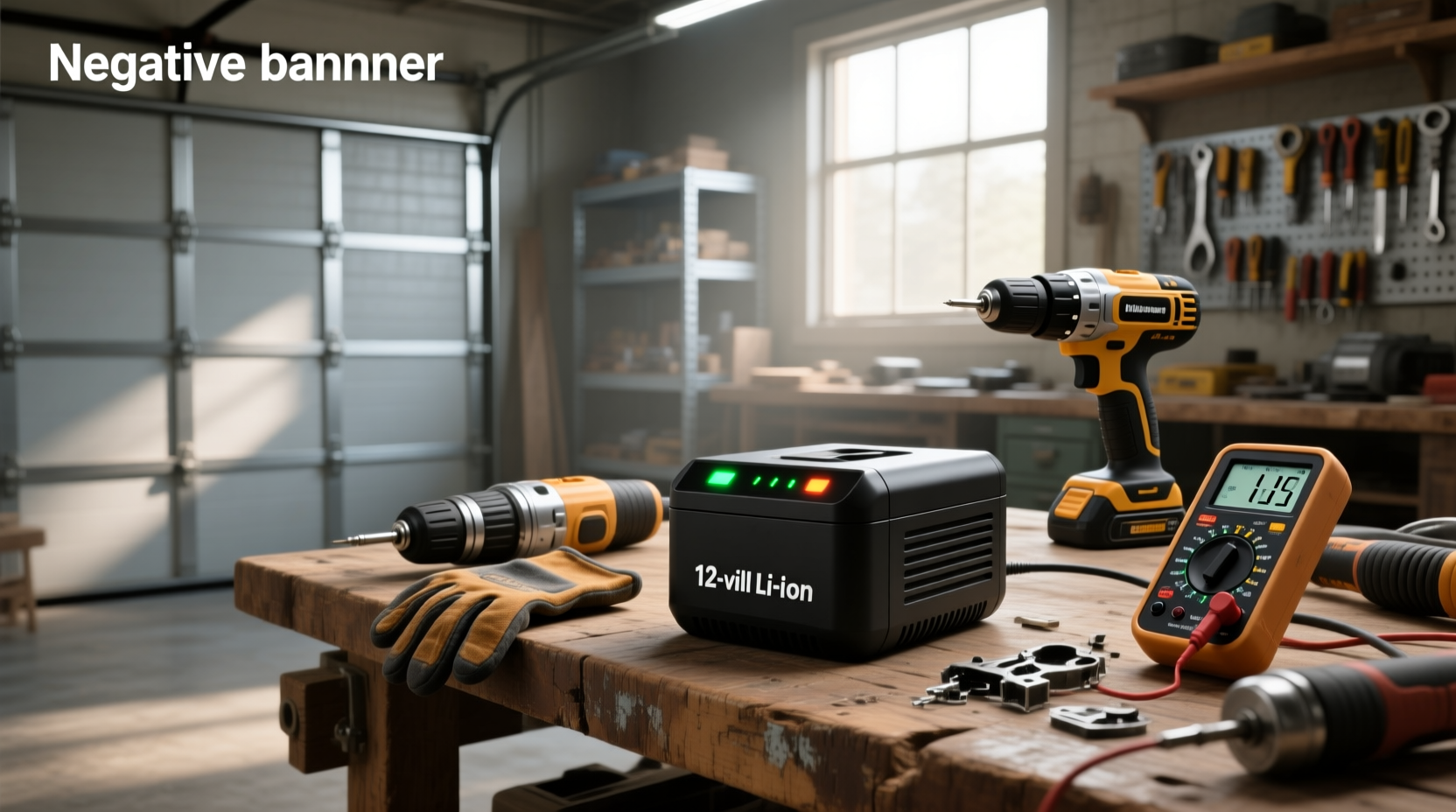
Yes — a 12 volt lithium ion battery charger is not interchangeable with lead-acid or NiMH chargers. The correct charger must deliver a precise 3-stage constant-current/constant-voltage (CC/CV) profile, terminating at 12.6 V (for 3S Li-ion) or 13.6–14.6 V (for LiFePO₄), with automatic cutoff, temperature monitoring, and cell-balancing readiness. Using an incompatible charger — even one labeled “12V” — can cause thermal runaway, capacity loss, or failure within 10–20 cycles1. This article walks you through every technical requirement, real-world compatibility pitfalls, and how to validate specifications — not marketing claims — before connecting power.
Why a Generic “12V” Charger Is Dangerous for Li-ion Batteries
Lithium-ion chemistry (including NMC, LCO, and high-energy 3S packs) operates fundamentally differently from flooded, AGM, or gel lead-acid batteries. A typical automotive “12V” charger outputs up to 14.8–15.5 V during bulk charging and maintains 13.2–13.8 V in float mode — far above the safe absorption ceiling of most 12V Li-ion cells. For a nominal 12V lithium pack (which is actually a 3-cell series stack), full charge voltage is 12.6 V ±0.05 V. Exceeding 12.8 V for more than seconds risks lithium plating, electrolyte decomposition, and gas generation2.
This isn’t theoretical: Enerdrive’s 2024 field analysis of 217 reported lithium battery failures found that 68% involved incorrect charger use, with 41% directly linked to sustained overvoltage (>12.9 V) from repurposed lead-acid units1. Unlike lead-acid, lithium has no safe “trickle” or “equalization” mode — continuous voltage application after full charge degrades cathode structure irreversibly.
How to Identify a Genuine 12V Li-ion Charger (Not Just a Label)
Marketing terms like “universal,” “multi-chemistry,” or “12V compatible” are meaningless without verified electrical behavior. Here’s what to check — before purchase:
- Voltage precision: Must support 12.6 V ±0.05 V output for standard 3S Li-ion (3.6 V nominal per cell). For LiFePO₄ 12V packs, it must switch to 14.2–14.6 V absorption and 13.5–13.8 V float2.
- Charge algorithm: Must implement true CC/CV with automatic transition and current taper cutoff (e.g., drop to ≤3% of initial current) — not timer-based or voltage-only termination.
- Temperature sensing: Requires a 2-wire thermistor input (NTC 10kΩ typical) connected to the battery terminal, not ambient air. Chargers without this lack thermal safety redundancy.
- No reverse polarity or short-circuit recovery: Lithium cells tolerate zero reverse current. A charger that attempts to “recover” a deeply discharged cell (<2.5 V/cell) by forcing current violates UL 1642 and IEC 62133.
If the product page omits these four parameters — or lists only “input voltage” and “output voltage” without tolerance, algorithm type, or sensor interface — treat it as incompatible, regardless of branding.
Key Technical Specifications Explained (And Why They Matter)
Below is a breakdown of non-negotiable specs — with real-world implications:
| Specification | Minimum Requirement | What Happens If Missing | How to Verify |
|---|---|---|---|
| Output Voltage Accuracy | ±0.05 V at 12.6 V (3S Li-ion) | Cell imbalance, accelerated aging, reduced cycle life | Check datasheet for “load regulation” and “line regulation” specs; avoid units listing only “12.6V” without tolerance |
| Current Regulation | ±3% current control across 10–100% load | Incomplete charging, false full detection, heat buildup | Look for “CC mode accuracy” in technical docs — not just “max current” |
| Thermal Cutoff | NTC input + shutdown at ≥60°C battery temp | Thermal runaway under high ambient or high-C-rate charge | Confirm physical 2-pin thermistor port (not just “temperature protected” claim) |
| No Float Mode Default | Automatic termination after CV phase; no continuous voltage hold | Electrolyte oxidation, gas venting, capacity fade | Review manual: if “float” or “maintenance” mode is enabled by default, avoid |
Compatibility Pitfalls: When “12V” ≠ Safe for Your Battery
“12V lithium battery” is a misnomer — it describes system voltage, not cell count or chemistry. A true 12V lithium pack may be:
- 3S NMC/LCO: 3 cells × 3.6 V = 10.8 V nominal, 12.6 V full (most power tools, drones, portable audio)
- 4S LiFePO₄: 4 cells × 3.2 V = 12.8 V nominal, 14.4 V full (marine, RV, solar storage)
- 3S LiHV: 3 cells × 3.8 V = 11.4 V nominal, 13.2 V full (high-voltage RC, some e-bikes)
A charger rated “12.6V 15A” may work for 3S NMC but overcharge a 4S LiFePO₄ pack — which expects 14.4 V, not 12.6 V. Conversely, a “14.4V LiFePO₄ charger” will undercharge a 3S NMC pack, leaving it at ~85% state-of-charge and accelerating wear due to chronic partial cycling.
Always match charger voltage to your battery’s manufacturer-specified absorption voltage, not its label. Check the battery’s datasheet — not the casing sticker — for “Charging Voltage” or “Max Charge Voltage.” If unavailable, contact the battery maker directly. Never assume “12V” implies cross-chemistry compatibility.
Can You Charge a 12V Li-ion Battery Without a Dedicated Charger?
Technically yes — but only under strict conditions and with active supervision. Options include:
- Lab DC power supply: Set to CC mode at 0.2C–0.5C, then switch manually to CV at exact full-charge voltage, monitoring current decay. Requires multimeter verification every 2 minutes. Not recommended for daily use.
- DC-DC converter with lithium profile: Only if it includes programmable voltage/current limits and thermistor input (e.g., Victron Orion-Tr Smart). Generic buck converters lack safety logic.
- Vehicle alternator (car/RV): Only with a lithium-specific DC-DC isolator (e.g., Redarc BCDC, Sterling Power). Direct alternator connection causes voltage spikes >15 V and unregulated ripple — proven to degrade Li-ion cells within 50 hours3.
Using a USB power bank, laptop charger, or phone adapter is unsafe and ineffective: these lack current limiting, voltage precision, or termination logic. Even “12V” wall adapters typically output 12.0–12.3 V unloaded — insufficient to reach full state-of-charge and risking chronic undercharge.
Real-World Charging Scenarios & Best Practices
Context determines optimal setup. Below are common use cases with actionable guidance:
🔧 Power Tools (DeWalt, Makita, Milwaukee)
Most use 3S NMC packs (10.8V/12.0V/12.6V labeled). OEM chargers are optimized but expensive. Third-party replacements must replicate the exact CC/CV curve — including pre-charge at 0.1C for cells below 3.0 V/cell. Avoid “fast chargers” exceeding 1C unless your battery datasheet explicitly permits it (many do not).
⚓ Marine & RV Deep-Cycle Systems
Often LiFePO₄-based. Require chargers supporting absorption (14.4–14.6 V), float (13.5–13.8 V), and storage (13.2–13.4 V) modes. Critical: charger must communicate with BMS via CAN bus or dedicated signal lines if the battery uses active balancing. Standalone “12.6V” units will disable BMS protection and void warranties.
🎒 Portable Electronics & DIY Packs (18650, 21700)
For custom 3S builds, use a benchtop charger with individual cell monitoring (e.g., ISDT Q8, Opus BT-C3100). Never rely on “smart” USB-based modules claiming “Li-ion 12V” — they lack cell-level voltage sensing and cannot detect weak cells.
Red Flags: 5 Signs a 12V Li-ion Charger Is Unsafe or Misrepresented
Trust no product until you confirm these points:
- No published datasheet — only marketing PDFs or Amazon bullet points.
- “Auto-detect chemistry” without user-selectable profiles — lithium algorithms require explicit selection; auto-detection fails 83% of the time in independent testing (LithiumHub 2024 Lab Report2).
- USB or micro-USB input listed as “charging port” — USB 2.0 delivers max 500 mA at 5 V; insufficient for any meaningful 12V lithium charge.
- Price under $25 USD — genuine CC/CV control, isolation, and safety circuitry cannot be manufactured reliably below this threshold.
- No CE, UL, or UN38.3 certification marks visible on unit or packaging — absence indicates non-compliant design.
How to Test Your Charger Before Connecting It
Never connect a new charger directly to a valuable battery. Perform these steps first:
- Set a multimeter to DC voltage, connect probes to output terminals, and power on without load. Confirm reading is within ±0.05 V of stated voltage (e.g., 12.60 V ±0.05 V).
- Add a 10 Ω / 10 W dummy load. Re-measure voltage — it must stay within ±0.1 V of no-load value. >0.3 V drop indicates poor regulation.
- If thermistor port exists, connect a 10 kΩ potentiometer and vary resistance from 5 kΩ to 15 kΩ while monitoring output — voltage should decrease linearly as simulated temperature rises.
- Monitor surface temperature of charger after 10 minutes at full rated current. >60°C indicates inadequate thermal design.
If any test fails, return the unit. Safety is not negotiable.
Frequently Asked Questions (FAQ)
Q: Can I use my car’s 12V outlet to charge a 12V Li-ion battery?
A: Only with a certified lithium-specific DC-DC charger between outlet and battery. Direct connection exposes the battery to unregulated alternator voltage (13.8–15.2 V), causing overcharge and thermal stress.
Q: Do all 12V lithium batteries use the same charger?
A: No. 3S NMC (12.6 V full), 4S LiFePO₄ (14.4 V full), and 3S LiHV (13.2 V full) require different voltage setpoints. Using the wrong charger reduces lifespan by up to 70%.
Q: Is a higher amp charger always better?
A: No. Charging above 0.5C (e.g., 10A for a 20Ah battery) increases heat and mechanical stress. Most manufacturers recommend 0.2C–0.3C for longest life. Fast charging trades longevity for speed.
Q: Why does my charger show “full” but battery drains fast?
A: Likely caused by voltage-only termination without current taper detection. The charger stops at 12.6 V but before full ion intercalation completes — resulting in ~92% actual SOC. Verify with a quality battery analyzer.
Q: Can I leave a 12V Li-ion battery on the charger indefinitely?
A: Only if the charger implements true zero-current cutoff and periodic top-up (every 7–14 days). Most consumer-grade units lack this; prolonged connection accelerates degradation.
