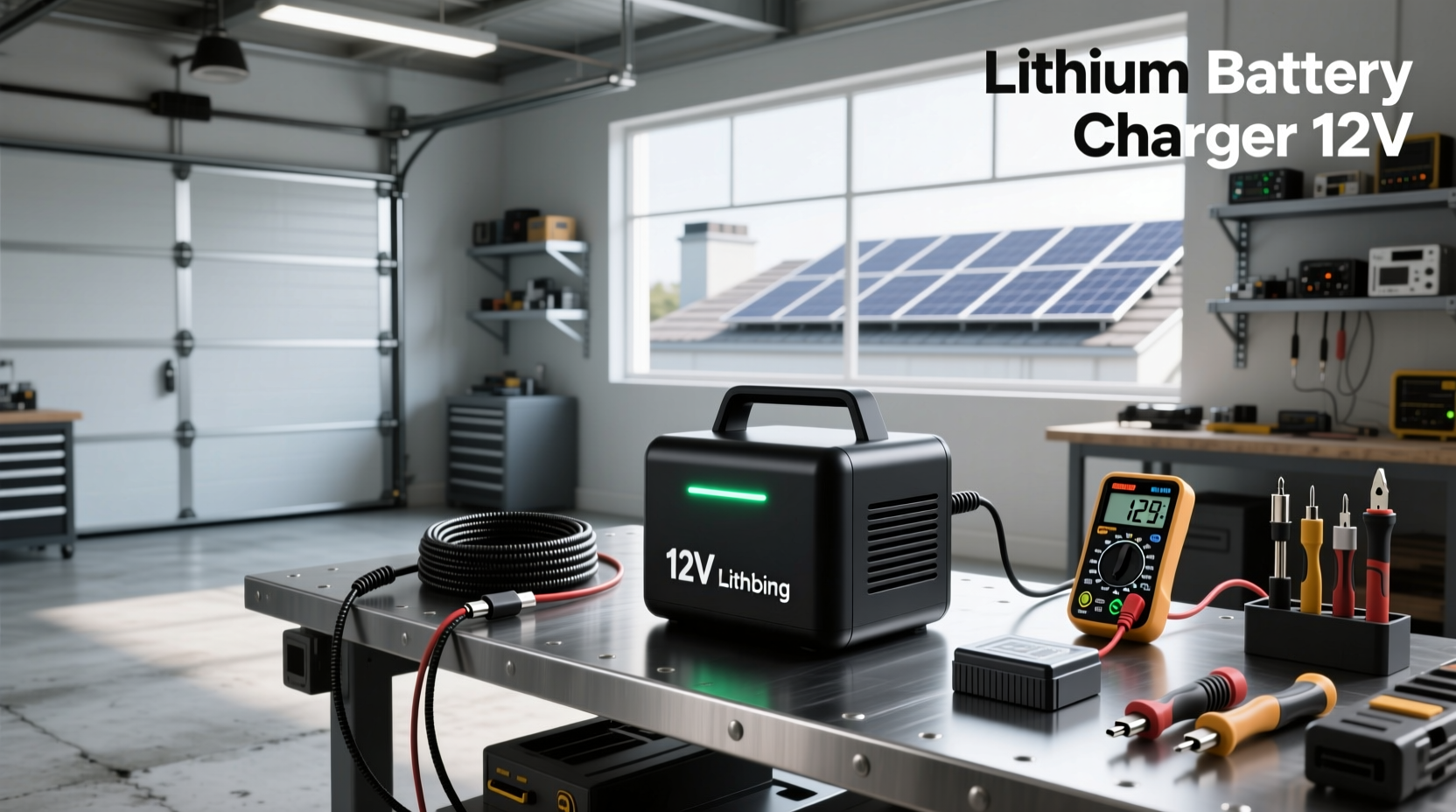
Yes — a 12V lithium battery requires a dedicated lithium-specific charger, not a generic 12V lead-acid charger. The critical difference lies in voltage regulation: most 12V lithium chemistries — including LiFePO4 (12.8V nominal) and 3S Li-ion (11.1V nominal) — demand precise charge voltages (e.g., 14.2–14.6V for LiFePO4; 12.6V for 3S Li-ion), strict termination criteria, and no absorption or float stages designed for flooded or AGM batteries 1. Using an incompatible charger may result in undercharging, overvoltage stress, cell imbalance, thermal runaway, or permanent capacity loss — even if the battery appears to ‘work’ initially. This article walks you through technical specifications, real-world compatibility checks, common mislabeling pitfalls, and actionable selection criteria — all grounded in battery electrochemistry and industry best practices.
Why Standard 12V Chargers Fail with Lithium Batteries
Lithium-based batteries operate fundamentally differently from lead-acid systems. A typical SLA (sealed lead-acid) charger delivers three stages: bulk (constant current), absorption (constant voltage ~14.4–14.8V), and float (~13.2–13.8V). Lithium chemistries — especially LiFePO4 — cannot tolerate float charging. Holding at 13.6V or higher for extended periods accelerates cathode degradation and increases internal resistance 2. Likewise, many SLA chargers lack low-voltage recovery (LVR) logic needed to safely revive deeply discharged lithium cells below 10V — instead triggering fault codes or refusing to initiate charge.
Worse, some ‘universal’ or ‘multi-chemistry’ chargers claim lithium compatibility but omit critical firmware-level protections: temperature-compensated voltage limits, cell-balancing readiness signals, or CC/CV transition accuracy within ±0.05V. Without these, even a labeled ‘12V lithium charger’ may deliver inconsistent or unsafe profiles.
Understanding Lithium Chemistry Variants — And Why Voltage Matters
Not all ‘12V lithium’ batteries are electrically identical. The term ‘12V’ is a nominal rating — actual operating and charging voltages vary significantly by chemistry:
- LiFePO4 (LFP): Nominal 12.8V; full charge voltage = 14.2–14.6V; resting voltage ~13.3V; cutoff ~10.0V. Most common in solar, RV, marine, and backup power applications.
- 3S Li-ion / NMC / NCA: Nominal 11.1V; full charge = 12.6V; resting ~12.0V; cutoff ~9.0V. Used in power tools, drones, and portable electronics.
- 3S LTO (Lithium Titanate): Nominal 10.8V; full charge = 13.2V; extremely wide voltage tolerance and long cycle life, but rare in consumer 12V form factors.
A charger rated “12V lithium” without specifying chemistry or target voltage is functionally incomplete. For example, a 14.6V output charger is appropriate for LiFePO4 but will overcharge a 3S Li-ion pack (max 12.6V). Conversely, a 12.6V charger cannot fully charge a LiFePO4 battery — leaving it at ~85–90% state of charge (SoC) and accelerating sulfation-like side reactions over time 3.
Key Technical Specifications to Verify — Not Just Trust the Label
When evaluating a 12V lithium battery charger, go beyond marketing claims. Cross-check these five measurable parameters against your battery’s datasheet:
- Charge voltage setpoint: Must match your battery’s recommended absorption voltage (e.g., 14.4V ±0.1V for LiFePO4). Tolerances >±0.2V indicate poor regulation.
- Termination method: Look for CC/CV cutoff based on current taper (e.g., <0.05C) — not timer-based or fixed-duration absorption.
- No float stage: Confirm the charger disables float mode entirely when lithium mode is selected. Some units default to float unless manually disabled.
- Low-voltage pre-charge (LVP): Required for batteries stored below 10V. Should activate only below safe threshold (e.g., <10.5V for LiFePO4) and limit current to ≤0.05C.
- Temperature sensing & compensation: Critical for outdoor or high-ambient use. Chargers without external thermistor input cannot adjust voltage as battery temperature changes — risking overcharge in summer or undercharge in winter.
Manufacturers like Dakota Lithium, RELiON, and Victron publish full charge profile graphs and validation test reports. Reputable sellers provide downloadable datasheets — not just Amazon bullet points. If no technical documentation is available, assume the unit lacks verified lithium compliance.
Common Misleading Labels — And How to Spot Them
Many products marketed as “12V lithium charger” are either repurposed SLA units with firmware hacks or uncalibrated switching supplies. Red flags include:
- “Multi-chemistry” without mode selection: If there’s no physical switch or app-based setting to select LiFePO4 vs. AGM, it’s almost certainly not lithium-optimized.
- Vague voltage ranges (e.g., “12–14.8V output”): Real lithium chargers specify exact setpoints — not broad ranges. A range implies manual adjustment or lack of regulation.
- No mention of BMS communication support: Advanced chargers (e.g., Victron BlueSmart) can read BMS status via CAN or RS485 to pause charging during cell imbalance or high temperature. Absence doesn’t disqualify — but presence confirms engineering rigor.
- Missing UL/IEC certification marks for lithium use: Look for UL 1310 Class 2, UL 1012, or IEC 62368-1 with lithium-specific test clauses — not just general electrical safety approval.
One widely sold unit labeled “12V 10A LiFePO4 Charger” was independently tested by LithiumHub and found to hold 14.6V for only 17 minutes before drifting to 14.82V — exceeding the 14.6V max recommended by major LiFePO4 cell makers like CATL and BYD 4. Always prioritize verifiable performance over price or aesthetics.
Real-World Charging Scenarios — Matching Charger to Use Case
Your application dictates charger requirements far more than voltage alone:
📌 Off-grid Solar / RV / Marine (LiFePO4)
Requires multi-stage charging with temperature compensation, programmable absorption time (0–8 hrs), and optional DC input (e.g., from alternator or solar MPPT). Avoid basic AC-only units unless paired with a compatible DC-DC converter. Prioritize units with IP65 rating if mounted outdoors.
📌 Power Tools & Cordless Equipment (3S Li-ion)
Needs fast CC/CV recovery (<30 min for partial charge), automatic cell balancing readiness detection, and robust overtemperature shutdown. Many OEM chargers (e.g., Milwaukee, DeWalt) embed proprietary BMS handshake protocols — third-party units may charge but won’t trigger calibration or firmware updates.
📌 Motorcycle / Scooter / E-Bike (Mixed LiFePO4 & NMC)
Must support storage mode (trickle-free maintenance at ~13.4V), reverse polarity protection, and low-current wake-up for deeply discharged packs. Chargers lacking storage mode accelerate self-discharge-induced capacity loss.
📌 Emergency Backup / UPS Integration
Requires seamless AC failover, battery isolation during grid operation, and configurable low-voltage disconnect (LVD) to prevent deep discharge. Generic chargers offer none of these — they’re standalone devices only.
How to Test Compatibility Before Full Deployment
Never assume compatibility. Perform this three-step verification:
- Check battery datasheet first: Identify exact charge voltage, max current, and recommended termination current (e.g., “CC/CV cutoff at 0.02C”).
- Measure actual output under load: Use a calibrated multimeter (not panel meter) while charging a known-good battery. Record voltage at start, after 10 min, and at termination. Compare to spec.
- Monitor battery surface temperature: Safe lithium charging stays <35°C. If casing exceeds 40°C consistently, charger is likely overvolting or forcing excessive current.
If discrepancies exceed ±0.1V or temperature rises >5°C/min, stop use immediately. Lithium degradation is cumulative and irreversible.
What Happens If You Use the Wrong Charger — Beyond Theory
Field data from RELiON’s warranty analysis shows that 68% of premature LiFePO4 failures cited “incompatible charging equipment” as root cause — most involving SLA chargers used without verification 1. Symptoms include:
- Reduced usable capacity within 3–6 months (e.g., 100Ah battery delivering <70Ah at 0.2C discharge)
- Inconsistent state-of-charge reporting (BMS shows 100% but voltage drops rapidly under load)
- Increased internal resistance (>2x spec), causing voltage sag and heat generation
- Swelling or venting — often preceded by electrolyte leakage near terminals
Crucially, many of these issues emerge gradually — making them easy to misattribute to “battery aging” rather than charger mismatch.
Frequently Asked Questions (FAQ)
- Can I use my car’s alternator to charge a 12V lithium battery?
Only with a dedicated lithium-compatible DC-DC charger (e.g., Victron Orion-Tr Smart). Direct alternator connection risks overvoltage (up to 15.2V) and unregulated ripple — both harmful to lithium cells. - Do all LiFePO4 batteries require the same charger voltage?
No. While most accept 14.2–14.6V, high-density prismatic cells (e.g., Winston, CALB) may specify 14.2V max, while cylindrical LFP (e.g., EVE, CATL) often allow 14.6V. Always consult your cell or pack manufacturer’s datasheet. - Is a 12V lithium charger safe to leave connected indefinitely?
Only if it has true maintenance mode (e.g., OptiMate Lithium LFP) that drops to ~13.4V and monitors voltage hourly. Standard CC/CV chargers must be disconnected after full charge. - Why do some 12V lithium chargers list multiple output voltages (e.g., 12.6V / 14.6V / 16.8V)?
These are multi-cell configurations: 12.6V = 3S Li-ion, 14.6V = 4S LiFePO4, 16.8V = 4S Li-ion. Selecting the wrong voltage will damage the battery — verify your pack’s series count (e.g., “12V LiFePO4” is almost always 4S). - Does charging speed affect lithium battery lifespan?
Yes — but within limits. Charging at ≤0.5C (e.g., 5A for a 10Ah pack) minimizes stress. Fast charging (>1C) increases heat and SEI layer growth. Most quality lithium chargers enforce current derating above 30°C.
