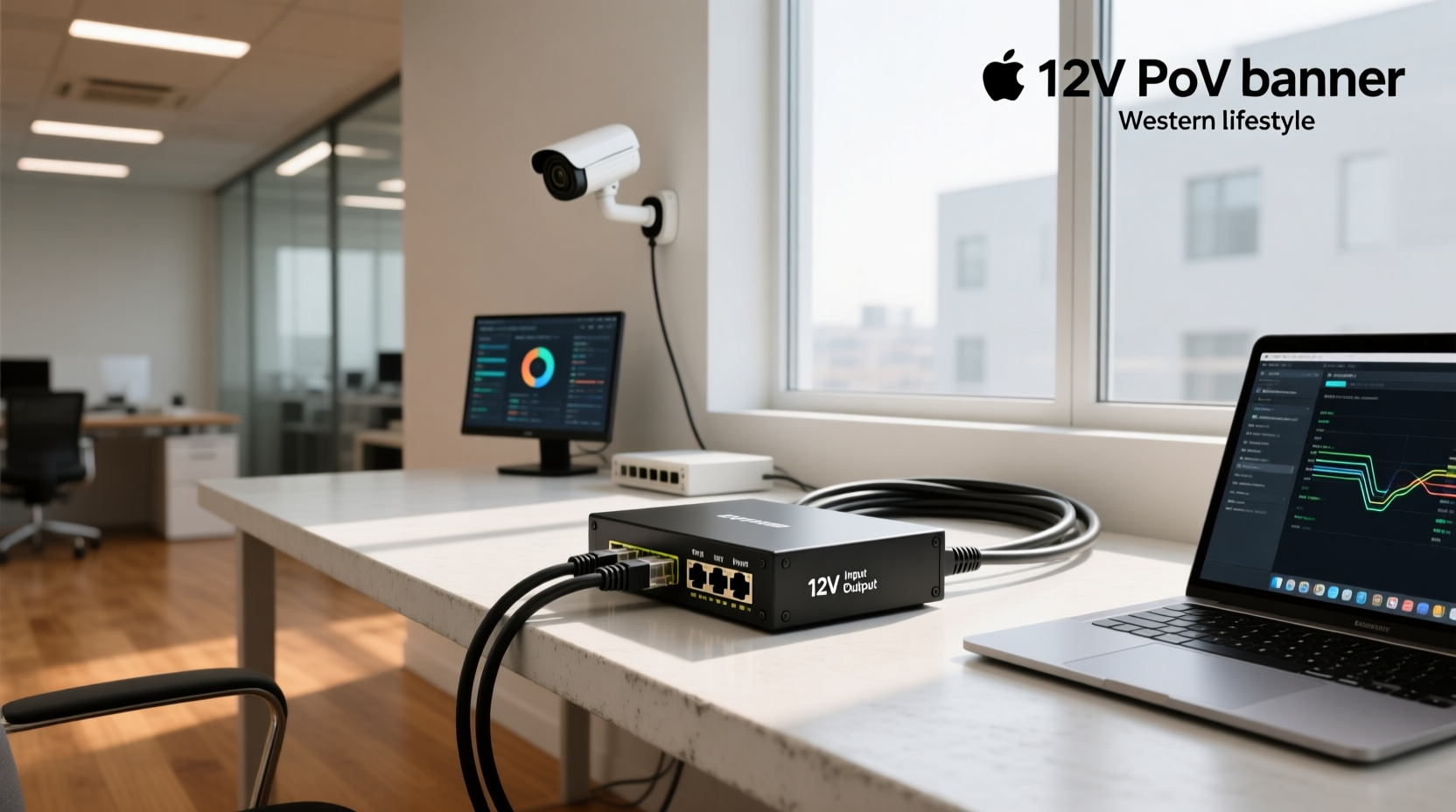
You need a 12V PoE injector only when your power source is DC — like a vehicle battery, solar charge controller, or marine system — and your powered device (e.g., Ubiquiti airMAX radio, Starlink dish, or IP camera) requires standard 48V PoE. Unlike conventional PoE injectors that accept 100–240V AC, a true 12V PoE injector converts regulated 12V DC input into IEEE-compliant 48V (or sometimes 24V) PoE output — while preserving full Gigabit data integrity. This is essential for off-grid, mobile, or low-voltage infrastructure where inverters add inefficiency, heat, and failure points1. Misusing passive 12V-to-PoE adapters without voltage regulation or isolation can permanently damage Ethernet PHYs or PoE controllers — especially on sensitive devices like FLIR thermal cameras or MikroTik RouterBOARDs2.
Why Standard PoE Isn’t 12V — And Why That Matters
IEEE 802.3af/at/bt PoE standards specify 44–57V DC at the PSE (Power Sourcing Equipment) output — with 48V nominal — to ensure sufficient voltage remains after cable drop over 100 meters3. A 12V input cannot directly deliver compliant PoE; it must be stepped up via a high-efficiency DC-DC converter. This is fundamentally different from a 12V-powered PoE injector (which accepts 12V DC and outputs 48V PoE) versus a 12V PoE splitter (which extracts 12V DC from incoming 48V PoE). Confusing these two functions is the #1 cause of device failure in DIY deployments.
Search results show widespread misuse: listings labeled “12V PoE injector” often describe passive 12V-to-12V adapters, unregulated boost circuits, or mislabeled splitters. For example, a $5.95 eBay unit claiming “12V 2A 24W 802.3af Passive PoE Injector” violates IEEE specifications — passive PoE does not negotiate or regulate; it simply applies fixed voltage across spare pairs. Without current limiting, overvoltage, or reverse polarity protection, such units risk immediate hardware damage4.
Core Technical Requirements: What to Verify Before Buying
A legitimate 12V PoE injector must meet three non-negotiable criteria:
- Input Regulation: Accepts a stable 12V ±10% DC input (typically 10.8–13.2V), with undervoltage lockout (UVLO) and overvoltage protection (OVP) — critical for automotive or battery-backed systems where voltage fluctuates between 11.5V (engine-off) and 14.4V (charging).
- Output Compliance: Delivers IEEE 802.3af (15.4W), 802.3at (30W), or 802.3bt (60W/90W) PoE with proper signature detection, classification, and current limiting. True compliance means the injector communicates with the PD (Powered Device) before applying power — unlike passive injectors that energize pins immediately.
- Isolation & Safety: Provides galvanic isolation (>1500V RMS) between input DC and PoE output to prevent ground loops, noise coupling, and fault propagation — especially vital in mixed AC/DC environments like RVs or industrial control cabinets.
Products like the MobileMustHave 12V DC Power Over Ethernet Injector (model INJ-H2G5-90-12R) and Planet IPOE-260-12V explicitly list all three features in their datasheets — including EN 62368-1 safety certification and IEC 61000-4 ESD immunity testing5. In contrast, generic “12V wall plug PoE adapters” sold under $10 rarely disclose isolation ratings or PoE negotiation behavior — making them unsuitable for mission-critical or outdoor use.
Real-World Use Cases: Where 12V PoE Injectors Solve Real Problems
Understanding context prevents costly misapplication. Below are validated deployment scenarios — ranked by technical necessity:
✅ High-Necessity: Off-Grid & Mobile Power Systems
Vehicles (RVs, boats, fleet trucks): Running a Ubiquiti LiteBeam or MikroTik wAP R in an RV using a 12V battery bank avoids the ~15–20% energy loss from AC inversion. Verified units like the EDUP 5-in-1 PoE injector (9–36V DC input, 12V/5V auxiliary outputs) support dual-power routing — powering both the AP and its associated 12V USB hub or LTE modem6.
Starlink Mobile Setups: The Starlink Mini requires 12V/5A input. Using a 12V PoE injector with integrated splitter (e.g., Tesery’s 150W kit) eliminates separate power bricks and enables single-cable delivery to the dish and router — reducing cable clutter and voltage drop in long runs7. Note: Starlink Gen 3 dishes do not accept PoE natively; the injector must feed the official Starlink power supply unit.
⚠️ Medium-Necessity: Industrial & Surveillance Edge Nodes
Solar-Powered Security Cameras: When deploying IPCamPower or Reolink PoE cameras in remote locations, pairing a 12V lithium iron phosphate (LiFePO₄) battery bank with a 12V PoE injector (e.g., PoE Texas GPOE-24v30w, configurable 12–60V input) extends runtime vs. AC-powered alternatives. Key verification step: confirm the injector’s minimum startup voltage is ≤11.0V — many cut out below 11.5V, causing reboot loops during low-battery states.
Factory Floor / Warehouse IoT Gateways: Where 24V DC control systems dominate, a 12V PoE injector may serve as an intermediary if legacy PLCs only supply 12V. However, verify whether the target device (e.g., Cisco IE-3300 switch) accepts 12V PoE input — most industrial switches require 24V or 48V DC directly, not via PoE.
❌ Low-Necessity (or Misuse): Home Desktop or Office LANs
Standard home networks use 100–240V AC outlets. Adding a 12V PoE injector here introduces unnecessary complexity, efficiency loss (~10–15% conversion loss), and no reliability benefit. If you’re trying to “power a VoIP phone from a USB-C charger,” use a certified 5V/9V/12V USB-PD to 48V PoE converter — not a 12V PoE injector. USB-PD negotiates voltage safely; 12V injectors do not.
How to Identify Fake or Noncompliant “12V PoE Injectors”
Low-cost listings often omit critical technical details. Use this checklist before purchasing:
| Red Flag | What to Check Instead | Risk if Ignored |
|---|---|---|
| “Passive PoE” + “12V Input” | Look for “active PoE”, “IEEE 802.3af/at/bt compliant”, or “signature detection” in specs | Instant damage to IEEE-compliant devices (e.g., Aruba AP-303, Cisco WAP581) |
| No input voltage range listed (e.g., just “12V”) | Require documented range: “10.8–13.2V DC” or “9–36V DC” | Unit fails during battery recharge spikes or cold cranking |
| Missing isolation rating or safety certification | Verify EN 62368-1, UL 62368-1, or IEC 62368-1 listing | Ground loop noise, data corruption, fire hazard in wet/damp locations |
| “Gigabit” claim but no mention of “full-duplex” or “auto-MDIX” | Confirm “1000BASE-T”, “Cat 5e/6 compatible”, and “no speed throttling” | Link falls back to 100Mbps, disabling video streaming or firmware updates |
Key Compatibility Pitfalls — Tested & Documented
Not all 12V PoE injectors work with all devices — even if voltage and wattage appear matched. Real-world incompatibilities include:
- Ubiquiti airMAX Devices: Most airMAX radios (e.g., NanoBeam, LiteBeam) require 24V passive PoE, not 48V IEEE PoE. A 12V→48V injector will not power them unless specifically designed for 24V output (e.g., MikroTik RBGPOE). Using 48V on a 24V device destroys the Ethernet PHY within seconds8.
- FLIR Thermal Cameras: FLIR’s AX8 and A35 models require 12V DC directly, not PoE. Their “12V PoE injector” listing on West Marine is actually a 12V PoE splitter — extracting 12V from existing 48V PoE. Applying 48V PoE to a 12V-only camera fries its power management IC9.
- Starlink Dishy 2: While Starlink officially supports only its proprietary 12V/5A supply, third-party 12V PoE injectors with 12V/5A auxiliary output (not PoE output) are safe — but only if the injector’s 12V rail is electrically isolated from PoE pairs. Shared ground causes serial communication faults with the Starlink router.
Performance Metrics That Actually Matter (Not Just Price)
When comparing units, prioritize these measured parameters — not marketing claims:
- Conversion Efficiency: Look for ≥85% at full load (e.g., 90W output from 105W input). Units below 80% generate excess heat, shortening lifespan in enclosed spaces like vehicle dashboards.
- Load Regulation: Output voltage deviation should be ≤±2.5% from 48V across 10–100% load. Poor regulation causes intermittent disconnects in high-bandwidth applications (e.g., 4K PTZ camera streams).
- Thermal Derating Curve: Does output power drop above 40°C ambient? Industrial units (e.g., Planet IPOE-260-12V) maintain full 30W up to 60°C; consumer-grade units often derate 20% at 45°C.
- EMI/RFI Emissions: Certified units list FCC Part 15 Class B or CISPR 32 compliance. Uncertified injectors interfere with GPS, LTE, or VHF radios — critical in marine or aviation use.
Installation Best Practices: Avoiding Common Failures
Even with a compliant injector, improper installation causes 70% of field failures10. Follow these steps:
- Verify Polarity First: Use a multimeter to confirm your 12V source is positive-ground (standard) — not negative-ground (rare, used in some older aircraft). Reversed polarity destroys DC-DC converters instantly.
- Use Proper Gauge Wiring: For >5A loads, use 16 AWG or thicker stranded copper wire (not solid-core). Undersized wiring causes >1.5V drop over 3m — triggering UVLO shutdown.
- Install Ferrite Cores: Snap-on ferrite chokes on both input and output cables suppress high-frequency noise that disrupts auto-negotiation.
- Test Without Load First: Power the injector with no Ethernet cable attached. Measure output voltage on pins 4/5 (+) and 7/8 (–) of the PoE port. Should read 48–57V DC. If <44V or >57V, discard unit.
Frequently Asked Questions (FAQ)
Q1: Can I get 12V DC output from a 12V PoE injector?
A: Not inherently — a 12V PoE injector outputs 48V PoE. To get 12V DC, you need a 12V PoE splitter (like IPCamPower’s Gigabit POE Splitter) that converts incoming 48V PoE into 12V DC + pass-through data. Some advanced injectors (e.g., MobileMustHave’s 12V DC Power Injector) include a dedicated 12V auxiliary output port — but this is separate from the PoE function.
Q2: Can I use a 24V PoE injector with a 12V device?
A: No. Passive 24V PoE injectors apply fixed voltage without negotiation. Connecting a 12V-rated device (e.g., certain Dahua cameras) to 24V will exceed its absolute maximum voltage rating, destroying internal regulators. Always match injector output voltage to device input specification — never assume “it’ll handle it.”
Q3: Do 12V PoE injectors support Power over Ethernet standards like 802.3af?
A: Only if explicitly stated as “IEEE 802.3af/at/bt compliant.” Many low-cost “12V PoE” units are passive and noncompliant. True compliance requires detection, classification, and fault management — verified via independent lab reports (e.g., UL Verification Report UR-945731).
Q4: Why do some 12V PoE injectors list “12–48V DC input”?
A: This indicates wide-input capability — useful for systems with variable voltage sources (e.g., solar arrays, multi-battery banks). However, efficiency drops significantly below 18V input. For pure 12V battery use, select units rated specifically for 12V nominal input (10.8–13.2V range).
Q5: Are there 12V PoE injectors with surge protection for outdoor use?
A: Yes — models like the MikroTik Passive PoE Injector with Surge Protection (20kA, 8/20μs) and ToughSignal Industrial 5-Port PoE+ Switch include integrated gas discharge tubes (GDTs) and TVS diodes. Verify protection rating includes both common-mode and differential-mode suppression per IEC 61000-4-5 Level 4.
