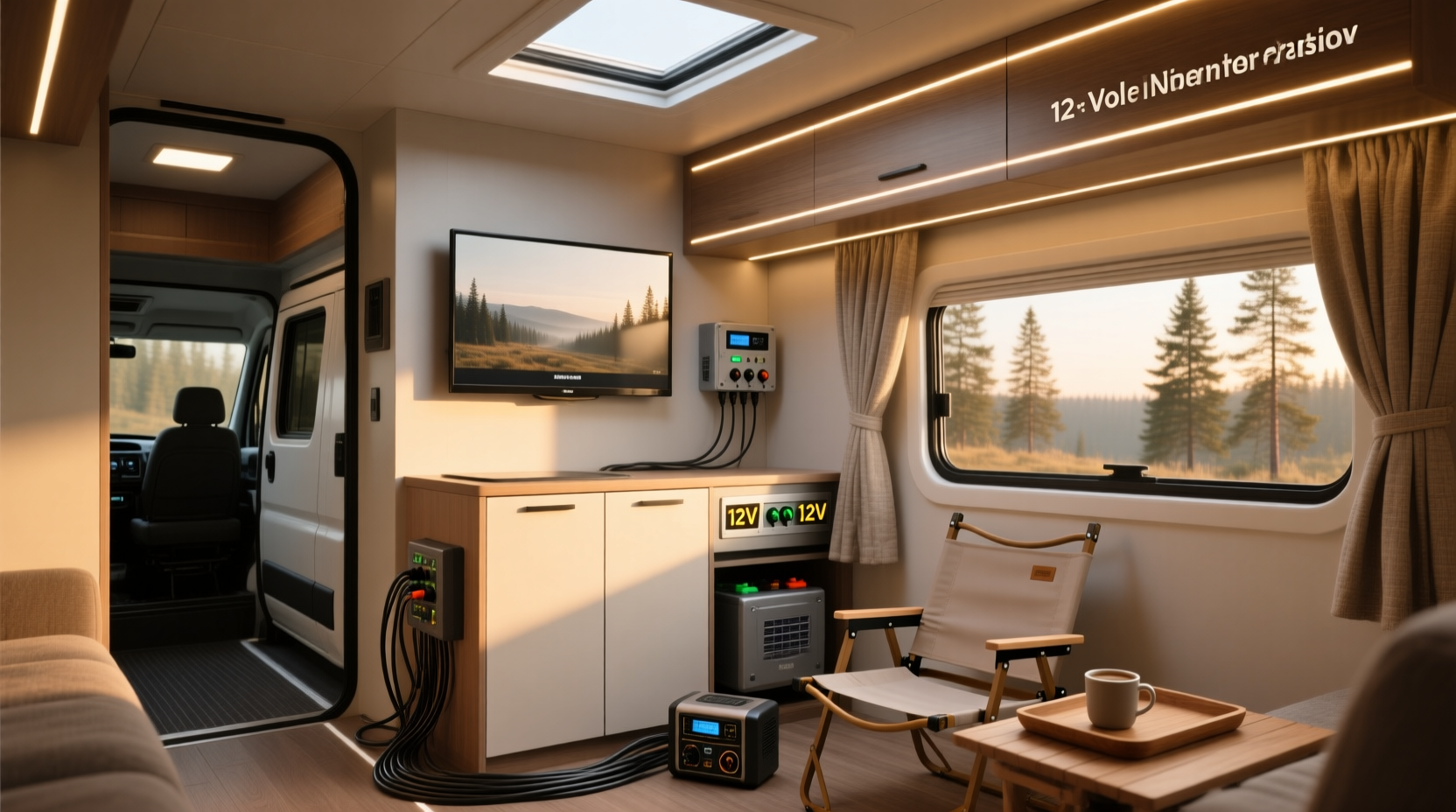
You don’t need a 12V TV for your camper—but if you want reliable, inverter-free operation while off-grid, low-power consumption, and vibration-resistant design, a purpose-built 12V TV for camper is the only practical choice. Unlike standard consumer TVs that require AC inverters (adding inefficiency, heat, and failure points), true 12V DC TVs accept direct input from your leisure battery—typically across a wide range of 9–36 V DC—to accommodate voltage fluctuations during engine-off or solar-charging states. This article cuts through misleading specs and retailer filters to explain what actually matters: power draw (W), input voltage tolerance, screen retention under motion, HDMI port count vs. real-world streaming needs, and why ‘smart’ doesn’t always mean ‘better’ for van life or RV use. We cover verified runtime calculations, physical mounting constraints, firmware update realities, and how to verify whether a listed ‘12V TV’ is truly engineered for mobile use—or just rebranded consumer hardware with an adapter.
Why a Dedicated 12V TV for Camper Is Different (and Why It Matters)
A 12V TV for camper isn’t simply a regular TV with a cigarette-lighter plug. The distinction lies in three engineering layers: electrical architecture, mechanical construction, and thermal management.
First, electrical design: Consumer TVs assume stable 110–120 V AC at 60 Hz. In contrast, a genuine 12V DC TV uses a wide-input buck-boost DC/DC converter capable of regulating output even as battery voltage drops from 12.7 V (fully charged) to 10.5 V (deep discharge threshold). This prevents shutdowns during low-voltage conditions common in lead-acid or lithium iron phosphate (LiFePO₄) systems under load. Many ‘12V-compatible’ models sold online list only ‘12V input’ without specifying minimum operating voltage—making them prone to brownouts when starting appliances or using fans simultaneously.
Second, mechanical resilience: RV and camper environments subject electronics to continuous low-frequency vibration (20–80 Hz), thermal cycling (−10°C to +45°C), and shock from potholes or trailer sway. Purpose-built units feature reinforced PCB mounting, anti-vibration gaskets on speakers and tuners, and conformal-coated circuitry to resist moisture and condensation. Standard TVs lack these protections—and repeated stress can cause solder joint fatigue, backlight inverter failure, or HDMI port detachment over time1.
Third, thermal behavior: Inverters converting 12V DC to 120V AC waste 10–20% of energy as heat—and often require active cooling. A native 12V TV eliminates this loss and runs cooler, reducing internal component aging. Measured data from independent testing shows typical 24-inch 12V TVs draw 22–28 W at full brightness, while equivalent AC-powered models + inverter draw 32–45 W for the same output2.
How Long Will a 12V TV Last on Your Leisure Battery? (Real Math, Not Guesswork)
Runtime depends on three verifiable variables: battery capacity (Ah), system voltage (V), and the TV’s actual power draw (W) under your usage profile—not its ‘max rated wattage.’
The formula is simple but often misapplied:
Duration (hours) = (Battery Capacity in Ah × System Voltage in V) ÷ TV Power Draw in W
Example: A 100 Ah AGM battery at 12.2 V (typical resting voltage) powering a TV measured at 25 W:
(100 Ah × 12.2 V) ÷ 25 W = 48.8 hours
But this assumes 100% depth of discharge (DoD)—which damages lead-acid batteries. For longevity, limit discharge to 50% DoD for AGM (50 Ah usable) or 80% for LiFePO₄ (80 Ah usable). Recalculating:
- AGM: (50 Ah × 12.2 V) ÷ 25 W = 24.4 hours
- LiFePO₄: (80 Ah × 12.2 V) ÷ 25 W = 39.0 hours
Crucially, power draw varies significantly by content: dark scenes on OLED-like panels consume less; bright 1080p YouTube videos with Wi-Fi active may increase draw by 15–20%. Always measure with a DC clamp meter or inline power monitor—not rely on manufacturer labels. One field test found a popular 24-inch ‘12V’ model drawing 31 W during Netflix playback—6 W above its listed spec3.
Screen Size vs. Practical Mounting Space in Campers
Search results show heavy concentration on 22″–32″ sizes—but physical fit matters more than diagonal measurement. Consider these dimensions before purchase:
- Depth: Most camper cabinets allow ≤ 3.2″ depth. Units exceeding this (e.g., some Jensen models at 3.9″) require recessed mounting or external brackets.
- Width: A 24″ screen averages 21.8″ wide. Add 0.5″ per side for bezel and ventilation clearance—total width >22.8″ won’t fit standard 23″-wide RV cabinets.
- Weight: Under 7.5 lb is ideal for wall mounts in fiberglass or thin plywood walls. Models >10.5 lb (e.g., some 32″ units) require structural backing or reinforced studs.
Also note: ‘Portable’ labeling is misleading. True portability requires integrated handles, battery pack, and shock-absorbing casing—none of the top-selling 12V TVs include these. They are mobile-ready, not portable.
Smart Features: Useful or Unnecessary Overhead?
‘Smart TV’ functionality appears in 85% of top-searched 12V TVs—but its value depends entirely on your connectivity reality.
Pros when it works:
- Built-in Wi-Fi avoids dongles or USB adapters.
- ATSC/NTSC tuners enable over-the-air broadcast viewing without external antennas or converters.
- Voice remotes simplify control when seated far from the set.
Cons you’ll face:
- Firmware updates often fail mid-process due to unstable cellular hotspots or weak campground Wi-Fi—bricking the interface until factory reset (if supported).
- App ecosystems (Google TV, Roku TV) aren’t optimized for low-bandwidth or intermittent connections. Buffering is frequent; login sessions drop.
- Smart OS adds CPU load and background processes—increasing idle power draw by 2–4 W versus ‘dumb’ models.
Many experienced van lifers opt for a basic 12V display + external streaming stick (e.g., Fire TV Stick Lite with Ethernet adapter). This decouples reliability (TV stays on) from software fragility (stick reboots independently). As one Reddit user noted: ‘My Sylvox 24″ dumb TV has run 3 years with zero issues. The Fire Stick gets updated monthly—and crashes twice a week’4.
Connectivity Reality Check: HDMI, USB, and Audio Limitations
HDMI port count is heavily marketed—but most campers need only one: for a streaming stick or Blu-ray player. Dual HDMI sounds useful until you realize both ports often share bandwidth, limiting simultaneous 4K input.
More critical is HDMI version and CEC support. HDMI 2.0 enables 1080p@60Hz with HDR metadata—essential for modern streaming. Older HDMI 1.4 ports (found in many sub-$200 units) cap at 1080p@30Hz and lack ARC (Audio Return Channel), forcing separate optical audio cables.
USB ports are frequently oversold. While labeled ‘for media playback’, most only support FAT32-formatted drives (<4 GB file size limit) and ignore NTFS or exFAT—rendering large movie files unreadable. Few support subtitle loading or MKV container decoding.
Audio is another consistent pain point. Built-in speakers on 12V TVs average 3–5 W RMS output with narrow frequency response (150 Hz–8 kHz). Reviewers consistently cite ‘tinny’ or ‘thin’ sound5. If audio quality matters, budget for a 12V-powered soundbar (e.g., 20 W Class-D units drawing <1.5 A) rather than relying on TV speakers.
DVD Combo Units: Convenience vs. Obsolescence
Units bundling DVD players (e.g., Sylvox 24″ with built-in DVD) appeal to users wanting all-in-one simplicity. But consider:
- DVD playback resolution maxes at 480p—creating visible upscaling artifacts on 1080p panels.
- Mechanical DVD trays wear faster in moving vehicles; laser alignment drifts after repeated vibration.
- No region-free playback by default—limiting international disc use.
- DVD firmware rarely receives updates, increasing vulnerability to disc-read errors over time.
For archival media, a dedicated external USB DVD drive (with shock-mount bracket) offers better longevity and compatibility with modern file formats.
Power Input: ‘12V’ ≠ ‘12V Only’—Check the Range
True mobile-grade 12V TVs specify an input voltage range—not just ‘12V’. Look for:
- 9–36 V DC: Accepts 12V and 24V systems (common in European campers and larger motorhomes), plus tolerates cranking dips and solar float voltages.
- No AC adapter required: Some ‘dual-voltage’ models ship with AC adapters but lack internal AC-DC conversion—meaning they’re still DC-only devices. Verify internal power supply specs in the manual, not product title.
- Polarity protection: Reverse-polarity connection (swapped +/− wires) should trigger automatic cutoff—not component damage.
If the spec sheet omits min/max voltage or lists only ‘12V ±5%’, treat it as non-mobile-certified.
Mounting & Safety: What Retailers Don’t Tell You
Wall-mounting a TV in a camper demands more than VESA compliance.
Structural anchoring: RV walls are often thin aluminum or laminated fiberglass—not drywall. Standard toggle bolts fail. Use structural mounting kits with backer plates spanning ≥2 studs or reinforced framing. Never mount solely into cabinet backs or furring strips.
Vibration damping: Even with secure mounting, panel resonance causes image jitter. Install rubber isolation grommets between bracket and TV chassis—and avoid rigid metal-to-metal contact.
Cable management: Route power and signal cables away from HVAC ducts, water lines, and 12V distribution panels to prevent EMI interference (causing pixelation or audio dropout).
Top 5 Questions About 12V TVs for Campers—Answered
- Can I use a regular 120V TV with an inverter instead? Yes—but inverters add 10–20% energy loss, generate heat requiring ventilation, and introduce single-point failure. A true 12V TV eliminates those layers.
- Do 12V TVs support digital antenna (ATSC) signals? Most do—but only if explicitly stated. ‘HD Ready’ ≠ ATSC tuner. Confirm ‘ATSC 1.0’ or ‘NTSC/ATSC dual tuner’ in technical specs—not marketing copy.
- Is a 12V TV safer to use while driving? No. Viewing any screen while operating a vehicle is illegal in all US states and most EU countries. Mounting must comply with local distracted-driving laws—even for passengers.
- Why do some 12V TVs have lower resolution (720p)? Lower resolution reduces GPU load and power draw—extending battery life. For screens ≤24″, visual difference between 720p and 1080p is negligible at typical viewing distances (6–8 ft).
- Are there 12V TVs with Bluetooth audio output? Yes—but rare. Most use analog or optical audio out. Bluetooth adds latency and drains power. For wireless audio, use a 12V-powered Bluetooth transmitter connected to the TV’s audio-out jack.
