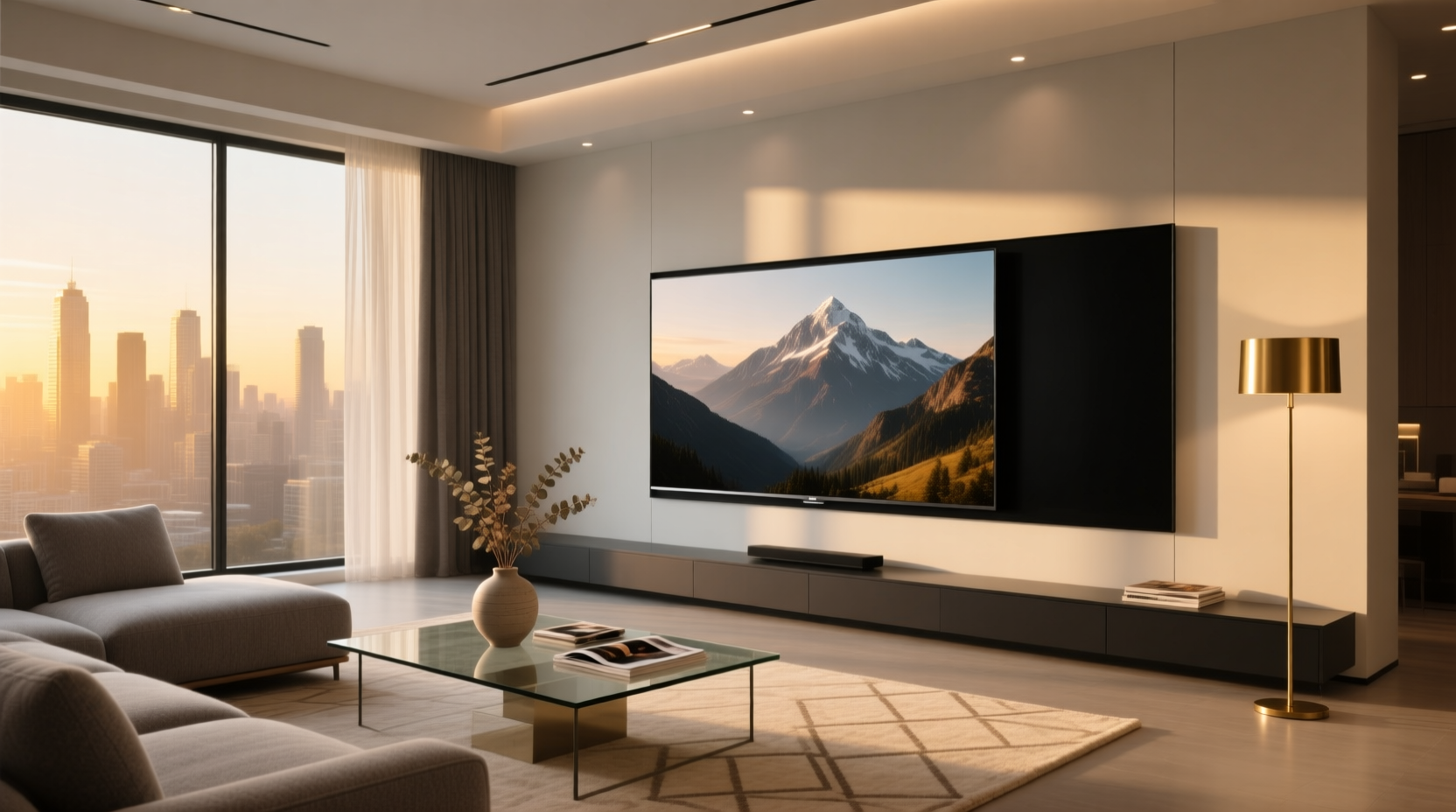
There is no mass-market, plug-and-play 130-inch TV available to consumers as of mid-2026—despite widespread search interest in “130 inches tv.” What exists are commercial direct-view LED video walls (e.g., LG LAA015F, Samsung F-DV130HE), all-in-one DVLED signage systems, and the Samsung Micro RGB R95H prototype unveiled at CES 2026 1. These units range from $33,000 to over $219,000, require structural reinforcement, HVAC cooling, professional calibration, and are not sold through mainstream retail channels like Best Buy or Home Depot for residential use 2. If you’re searching for a 130-inch TV for your living room, this guide explains exactly what’s physically possible, financially realistic, and technically viable—so you can make informed decisions about size, mounting, resolution, and compatibility.
Why ‘130 Inches TV’ Searches Don’t Match Reality
The phrase “130 inches tv” reflects strong aspirational demand—but it masks critical technical and practical distinctions. Google’s top results show a mix of consumer-facing marketing language (e.g., “Samsung 130” Class”) and commercial B2B product listings (e.g., “LG 130" Full HD Digital Signage Monitor”) 3. This distinction reflects different design priorities: consumer TVs emphasize ease of use, smart features, and home integration, while commercial displays prioritize brightness, durability, and content management for enterprise environments. The root issue is diagonal measurement ambiguity: a 130-inch diagonal does not mean a 130-inch-wide screen—it means the corner-to-corner distance across a rectangle with an aspect ratio (typically 16:9) that yields ~113 inches wide × ~64 inches tall. That footprint alone exceeds most residential wall widths, doorways, and ceiling heights.
What Actually Exists Today: Three Distinct Categories
As of Q2 2026, devices labeled “130-inch” fall into three non-interchangeable categories—each with different technology, purpose, and ownership model:
1. Commercial Direct-View LED Video Walls (DVLED)
These are modular panels (e.g., AWALL C Series, Samsung F-DV130HE) assembled into a seamless large-format display. They use surface-mounted LEDs with pixel pitches ranging from 1.2mm to 2.5mm. Resolution is fixed at Full HD (1920×1080) for most 130″ configurations—not 4K or 8K—because higher pixel density would require thousands of individual modules and exponentially increase cost and complexity. These units are designed for professional AV applications and feature robust input options including DisplayPort, HDBaseT, and proprietary video processors. Installation requires certified technicians, structural anchoring, and dedicated power circuits. Pricing starts at $33,000 (AWALL) and climbs to $126,241 (Samsung F-DV130HE) 4.
2. All-in-One DVLED Signage Systems
Products like the LG LAA015F-CMS or Akwil FHDQ130 bundle panels, power supplies, controllers, and mounting hardware into a single SKU. They retain the same 1920×1080 resolution and commercial-grade input options but simplify logistics. Their “smart” functionality is optimized for scheduled content delivery via external software (e.g., LG webOS Signage). Dimensions are consistent: ~113.2″ W × 63.7″ H × 4.3″ D (287.5 × 161.8 × 10.9 cm), requiring minimum wall clearance of 6″ behind for ventilation 5. Weight ranges from 148–300+ lbs—reflecting their engineered durability for continuous operation in demanding environments.
3. Samsung Micro RGB R95H Prototype (Not for Sale)
Unveiled at CES 2026, the Samsung 130-inch Micro RGB TV is a single-panel, consumer-intended concept using individually addressable red, green, and blue micro-LEDs—bypassing color filters for wider color volume (100% BT.2020) and higher peak brightness 1. It features Vision AI processing, a matte anti-glare surface, and integrated audio (14 bass drivers). Samsung confirms it is “designed for future availability,” with industry analysts estimating a potential 2027–2028 launch window 6. Its projected price range ($30,000–$50,000) remains preliminary and reflects early-stage development considerations.
Key Technical Constraints You Can’t Ignore
Before assuming a 130-inch display fits your space or needs, verify these five hard constraints:
• Viewing Distance & Visual Acuity
For native 1080p resolution (the standard for current 130″ units), the minimum recommended viewing distance is 16–20 feet (4.9–6.1 m). At closer distances, individual pixels become visible, degrading perceived sharpness. A 4K version would lower that to ~10–13 feet—but no production 130″ 4K DVLED system exists today. Human visual acuity (20/20) resolves ~60 pixels per degree; at 10 feet, a 130″ 1080p screen delivers only ~28 PPD—well below the threshold for “retina” perception 7.
• Structural Load & Wall Integrity
A fully assembled 130″ DVLED wall weighs between 148–300+ lbs (67–136 kg), depending on bezel depth and cooling design. Mounting requires anchoring into wall studs spaced no more than 16″ apart, with load-rated toggle bolts or through-wall brackets. Drywall alone cannot support it. Most residential walls use 2×4 framing—insufficient for distributed loads exceeding 200 lbs without engineering review.
• Power & Thermal Management
These displays consume 1,200–3,500 watts continuously—comparable to a central air conditioner. They generate significant heat and require ambient temperatures below 86°F (30°C) and airflow of ≥200 CFM. Installing one in an enclosed entertainment center or unventilated alcove risks thermal throttling, color shift, and premature LED degradation.
• Content Compatibility & Scaling Limitations
Native 1080p input means upscaling 4K or HDR10+ content introduces artifacts, haloing, and motion blur. Unlike consumer TVs, DVLED systems lack advanced AI upscalers (e.g., Samsung NQ4, LG α11). External processors (e.g., Matrox Extio, Datapath FX4) add $2,000–$8,000 and introduce latency—making them unsuitable for gaming or live sports.
• Calibration & Maintenance
Unlike self-calibrating OLEDs, DVLED walls require annual photometric calibration using tools like Klein K10-A or X-Rite i1Display Pro. Panel aging causes uneven luminance over time; replacement modules cost $1,200–$3,800 each and must be matched by batch number to avoid visible seams.
What You Should Consider Instead (Practical Alternatives)
If your goal is immersive scale without commercial infrastructure, these alternatives deliver better value, reliability, and compatibility:
- 100–115″ Consumer QLED/Mini-LED TVs: Models like the Samsung QN115QNAF (115″, $26,999) or Hisense 100″ QD6 ($1,349) offer true 4K resolution, full smart platforms (Tizen, Fire TV), HDMI 2.1, and Dolby Atmos decoding—all in a single, serviceable unit 8.
- Laser TV Projectors (120–150″): Devices like the Hisense PX2-PRO (120″ ALR screen, $3,999) or Xiaomi Mi Laser Projector 2 (150″, $2,499) provide true cinema-scale images with 4K HDR, low input lag (<20ms), and daylight-viewable brightness (2,400–4,300 ANSI lumens). They install in minutes and require only a blank wall or ALR screen.
- Modular MicroLED Kits (for Enthusiasts): Companies like Daktronics or Leyard offer sub-100″ MicroLED tiles (P0.9–P1.5) for custom installations. While still $15,000+, they allow incremental scaling and repair—unlike monolithic 130″ panels.
Common Misconceptions—Debunked
Misconception #1: “130-inch TVs are just bigger versions of regular TVs.”
Reality: Consumer TVs max out at 115″ due to glass substrate limitations in LCD/OLED manufacturing. Anything larger uses discrete LED modules—not a single panel. There is no “TV” form factor at 130″.
Misconception #2: “Resolution scales linearly with size.”
Reality: A 130″ 1080p screen has the same pixel density (≈17 PPI) as a 55″ 1080p TV. Upscaling doesn’t create detail—it interpolates. Higher resolution requires smaller pixel pitch, which increases cost exponentially (e.g., P1.2 vs. P2.5 costs ~3.2× more per sq. ft).
Misconception #3: “You can mount it like a standard TV.”
Reality: VESA patterns don’t exist for 130″ DVLED. Mounting uses custom steel frames bolted to floor/wall anchors. UL listing requires third-party structural certification—often mandated by local building codes.
How to Verify Claims Before Committing
When evaluating any “130-inch TV” listing, ask vendors for:
- FCC ID and ENERGY STAR certification number (absence indicates non-consumer device);
- Full dimensional drawing (including service access zones and thermal exhaust paths);
- Power consumption spec sheet (measured at 100% white window, not “typical use”);
- Warranty terms (commercial DVLED warranties cover parts only, not labor or calibration);
- Reference installations (request photos/videos of completed residential projects—not trade show demos).
Frequently Asked Questions
- Can I buy a 130-inch TV at Best Buy or Amazon?
No. As of 2026, no major U.S. retailer stocks a true 130-inch consumer TV. Listings labeled “130-inch” are commercial DVLED systems intended for business buyers—not home users. - What’s the smallest room that can fit a 130-inch display?
Minimum room depth: 20 feet (6.1 m) for comfortable viewing at 1080p. Minimum wall width: 120 inches (305 cm) to accommodate bezels and service clearance. Ceiling height must exceed 72 inches (183 cm) for safe mounting. - Is Samsung’s 130-inch Micro RGB TV available for purchase?
No. It remains a CES 2026 prototype with no announced release date, pricing, or distribution channel. Samsung states it is “designed for future availability,” not current sale 1. - Do 130-inch TVs support HDMI 2.1 or Apple AirPlay?
No. Commercial DVLED systems use DisplayPort 1.4 or HDBaseT inputs. None include HDMI 2.1, eARC, AirPlay, Chromecast, or Alexa built-in. Streaming requires external media players (e.g., NVIDIA Shield) connected via HDMI-to-DisplayPort converters. - How much does professional installation cost?
Typical range: $5,000–$15,000. Includes structural assessment, custom mounting frame fabrication, electrical circuit upgrade (dedicated 240V/30A line), thermal management ducting, and factory calibration.
