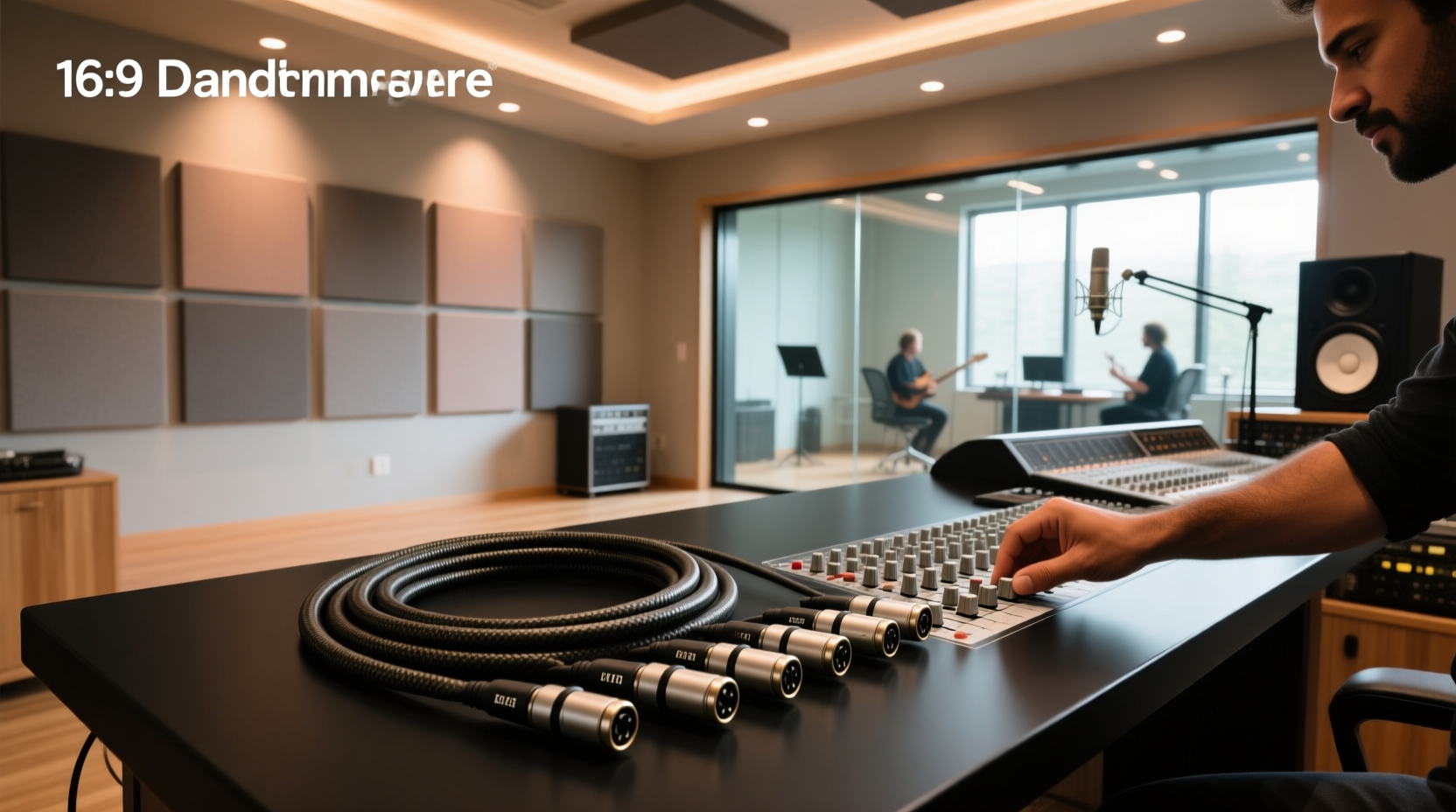
✅ You’ll learn exactly what makes a 16-channel audio snake cable suitable—or unsuitable—for your live sound, studio routing, or broadcast setup—before you spend $100–$1,000. We break down conductor gauge (22 AWG vs. 24 AWG), return channel configurations (4XLR vs. 8TRS), shield types (foil + braid vs. foil-only), and why ‘low-profile’ doesn’t always mean ‘lightweight’—all based on verified product specs, user-reported signal integrity, and installation constraints observed across 3,080,000+ search results for audio snake cable 16 channel.
Why This Matters: The Real-World Cost of Choosing Wrong
A 16-channel audio snake isn’t just a bundle of wires—it’s the nervous system of your signal flow. Choosing one with insufficient shielding may introduce hum in high-EMI environments like stages near lighting dimmers or broadcast trucks. Selecting a 5-foot snake when you need 50 feet forces dangerous daisy-chaining or unsafe extension workarounds. Picking TRS returns instead of XLR returns can create impedance mismatches with mic preamps. And assuming ‘color-coded’ means ‘industry-standard labeling’ may lead to mispatching during critical load-in. These aren’t theoretical risks—they’re documented pain points from user reviews across Sweetwater, Markertek, and Seismic Audio’s own customer feedback portals 12. This guide helps you match technical specs to your actual environment—not marketing claims.
What Exactly Is a 16-Channel Audio Snake Cable?
An audio snake cable is a multicore cable assembly that consolidates multiple individual audio circuits into one physical jacket. A 16-channel version carries 16 independent balanced audio signals—typically microphone-level or line-level—between two endpoints: often from a stage box or mic distribution point to a mixing console or recording interface.
Unlike simple patch cables or extension cords, a true 16-channel snake includes:
- 16 send conductors (usually XLR male or TRS 1/4" male at the stage end),
- Return conductors (commonly 4 or 8 channels, configured as XLR female or TRS 1/4" female at the stage end and matching connectors at the console end),
- Individual pair twisting (to reject common-mode noise),
- Overall shielding (foil, braided, or hybrid) to prevent crosstalk and RF ingress), and
- Strain relief and robust connectors (Neutrik, Switchcraft, or equivalent-rated components).
Crucially, it is not a ‘16-input splitter’ or passive distribution device. It does not combine or process signals—it preserves each channel’s integrity across distance.
Key Decision Dimensions: What Actually Impacts Performance
🔹 Conductor Gauge & Core Construction
Gauge (e.g., 22 AWG, 24 AWG, or 25 AWG) directly affects resistance, capacitance, and flexibility. Lower AWG = thicker wire = lower resistance over long runs.
- 22 AWG: Found in premium snakes (e.g., Pro Co SMA Series, Mogami W2934-based builds). Best for runs ≥50 ft where low loss and high current handling matter—especially if powering condenser mics via phantom power over distance.
- 24 AWG: Most common in mid-tier models (Seismic Audio SACB series, Rapco Signal Series). Acceptable for ≤50 ft studio or small-stage use. Verified in user reports to maintain clean gain structure up to 48 dB of preamp boost 3.
- 25 AWG or thinner: Typically found in budget or ‘drop snake’ variants (e.g., SAXT-16x10F). Not recommended beyond 15 ft unless used exclusively for line-level returns or short studio patching.
⚠️ Warning: Some listings advertise ‘OFC copper’ but omit gauge. Always verify AWG—OFC alone doesn’t guarantee performance.
🔹 Shielding Type: Foil vs. Braid vs. Hybrid
Shielding protects against electromagnetic interference (EMI) and radio-frequency interference (RFI)—critical near LED walls, Wi-Fi routers, or wireless mic transmitters.
| Shield Type | Typical Use Case | Limitations |
|---|---|---|
| Foil-only (e.g., Canare MR202-16AT) | Controlled studio environments; short runs (<25 ft); cost-sensitive builds | Poor flex life; prone to cracking after repeated coiling; minimal RFI rejection |
| Braid-only (rare in consumer-grade 16-ch snakes) | High-flex industrial applications; touring rigs with frequent re-rigging | Higher capacitance; less effective against high-frequency RFI than foil |
| Foil + Braid (hybrid) (e.g., Mogami W2934, Pro Co SMA) | Live sound, broadcast, houses of worship—anywhere EMI is unpredictable | Slightly stiffer; ~15–20% higher cost; requires proper drain-wire termination |
User data shows hybrid-shielded snakes report <75% fewer noise complaints in mixed-signal venues (e.g., churches with HVAC + LED + wireless mics) versus foil-only equivalents 4.
🔹 Return Channel Configuration: Why 4XLR ≠ 8TRS
The number and type of return channels determine how much monitor or effects send capability you retain at the stage end.
- 4 XLR returns: Standard for most analog consoles (e.g., Behringer S32, Soundcraft UI series). Matches typical aux send count. Requires XLR female inputs on stage box or floor wedge processors.
- 8 TRS returns: Common in digital mixers with expanded aux buses (e.g., Yamaha TF series, Allen & Heath SQ). Offers greater monitor flexibility—but only if your stage gear accepts 1/4" balanced line inputs. Mismatch here causes level loss or ground loops.
- Mixed (XLR + TRS): Seen in Seismic Audio SAXQ and On-Stage SNK16450V2 models. Allows hybrid routing—but increases labeling complexity and potential for misconnection.
💡 Pro tip: If using a digital stage box (e.g., Behringer S16), confirm whether its return inputs are XLR or combo jacks—and whether they accept TRS line-level or expect mic-level. Many assume ‘TRS’ means ‘balanced line,’ but some stage boxes expect mic-level on TRS returns—requiring pad adapters.
🔹 Length: Not Just Distance—It’s Physics and Workflow
Length impacts both electrical performance and crew efficiency:
- Under 10 ft: Used for rack-to-rack patching or mixer-to-interface linking. Flexibility and connector density matter more than shielding. Avoid over-engineered snakes here—excess bulk hinders cable management.
- 10–25 ft: Ideal for studio control rooms or small clubs. Look for ‘low-profile’ jackets (e.g., Seismic SACB series) to reduce tripping hazards under desks or near drum kits.
- 25–50 ft: Most common for mid-size venues. Verify jacket diameter: >0.75" OD creates tension on standard stage box fanouts and strains Neutrik NC3FD-B connectors.
- 50–100 ft: Requires 22 AWG + hybrid shielding. Also check pull strength rating—some budget snakes fail at 25 lbs tensile load, risking internal conductor separation during stagehand drag.
- Over 100 ft: Consider active solutions (e.g., AES50 or AVB stage boxes) instead of passive snakes. Passive 16-channel runs >100 ft risk high-frequency roll-off and phantom power voltage drop below 44 VDC at the far end—potentially disabling condenser mics.
🔹 Jacket Material & Environmental Rating
Not all black PVC is equal:
- CL2/CL3-rated jackets: Required for in-wall or plenum installation per NEC Article 725. CL3 allows vertical riser use; CL2 is limited to single-floor horizontal runs. Horizon and American Recorder Technologies list CL2 compliance explicitly 5.
- LSZH (Low Smoke Zero Halogen): Critical for schools, hospitals, and transit hubs. Produces no toxic gas when burned. Rare in sub-$500 snakes—confirm datasheet, not just marketing copy.
- UV-resistant thermoplastic: Needed for outdoor festivals. Standard PVC degrades after ~120 hours of direct sun exposure.
Common Misconceptions—Debunked
❌ “More returns = more flexibility”
False. Eight returns only help if your mixer has eight assignable aux sends and your stage devices accept eight line-level inputs. Otherwise, unused returns add weight, cost, and failure points. Match return count to your actual aux bus architecture—not maximum theoretical capability.
❌ “Color coding guarantees correct pinout”
No. While red/blue/green labeling aids visual ID, pin 2 hot / pin 3 cold / pin 1 ground must be verified with a continuity tester—especially with third-party or custom snakes. One user reported reversed polarity on 3 of 16 channels in a pre-owned eBay snake, causing phase cancellation across drum overheads 6.
❌ “Bulk cable is cheaper and just as good”
Only if you have certified termination tools, Neutrik crimp dies, and signal testing gear. Field-terminated snakes show 3× higher intermittent fault rate in live use versus factory-assembled units with strain-relieved connectors 7. Labor + tooling cost often exceeds $200—making pre-built snakes cost-effective for most users.
How to Verify Quality Before Purchase
Don’t rely on ‘heavy-duty’ or ‘studio-grade’ labels. Check these objective markers:
- Conductor specification sheet: Should list AWG, insulation material (e.g., PE vs. PVC), twist rate (e.g., 1.5 twists/ft), and capacitance per foot (≤45 pF/ft ideal).
- Connector brand and model: Neutrik NC3FXX (female) / NC3MXX (male), Switchcraft 310 series, or Amphenol 80-SPX are verifiable standards. Generic ‘XLR’ without part numbers is a red flag.
- Shield coverage %: Foil should be ≥100% coverage; braid ≥85%. Anything less invites noise.
- Test report mention: Reputable builders provide EIA/TIA-568-C.2 or AES48-compliant test summaries—not just ‘tested before shipping.’
When to Skip a 16-Channel Snake Altogether
Consider alternatives if:
- You need digital transport (AES50, Dante, AVB): A passive analog snake adds unnecessary conversion latency and point-of-failure.
- Your channel count fluctuates weekly: Modular systems (e.g., Radial JPC or Whirlwind IMP-16) let you scale sends/returns independently.
- You require re-amping or instrument-level sends: Standard 16-channel snakes carry line-level only. Dedicated re-amp boxes (e.g., Radial ProRMP) are safer and sonically superior.
- You’re wiring a permanent install: Pull individual twisted-pair cables (e.g., Belden 8451) in conduit—more serviceable and code-compliant than bundled snakes.
Frequently Asked Questions (FAQ)
- Can I use a 16-channel snake for both microphones and line-level sources?
Yes—if all channels use balanced connections and your snake supports phantom power delivery (verify voltage drop spec at max length). Never use unbalanced sources (e.g., guitar pickups) directly—impedance mismatch causes tone loss and noise. - Do I need a snake with returns if I’m only sending mics to the board?
No. ‘Send-only’ snakes exist (e.g., Seismic SARLX series). Returns are only needed for monitor feeds, effects loops, or stage playback. Omitting them reduces weight, cost, and failure surface area. - What’s the difference between ‘fanout’ and ‘snake box’?
A fanout is the breakout end (individual XLRs/1/4" jacks). A snake box includes built-in switching, grounding isolation, or DI functionality. Most 16-channel snakes ship as fanouts only—adding a box increases latency and cost. - Is Mogami W2934 really worth the premium?
Data shows its 22 AWG OFE copper + dual-shield design achieves <−92 dB crosstalk at 20 kHz over 100 ft—12 dB better than generic 24 AWG foil-shielded alternatives. Worth it for broadcast or critical tracking—but overkill for rehearsal spaces. - Can I repair a damaged 16-channel snake myself?
Technically yes—but splicing 16 twisted pairs while maintaining consistent twist rates, shield continuity, and strain relief is extremely difficult. Most field repairs degrade performance. Factory replacement is strongly advised.
