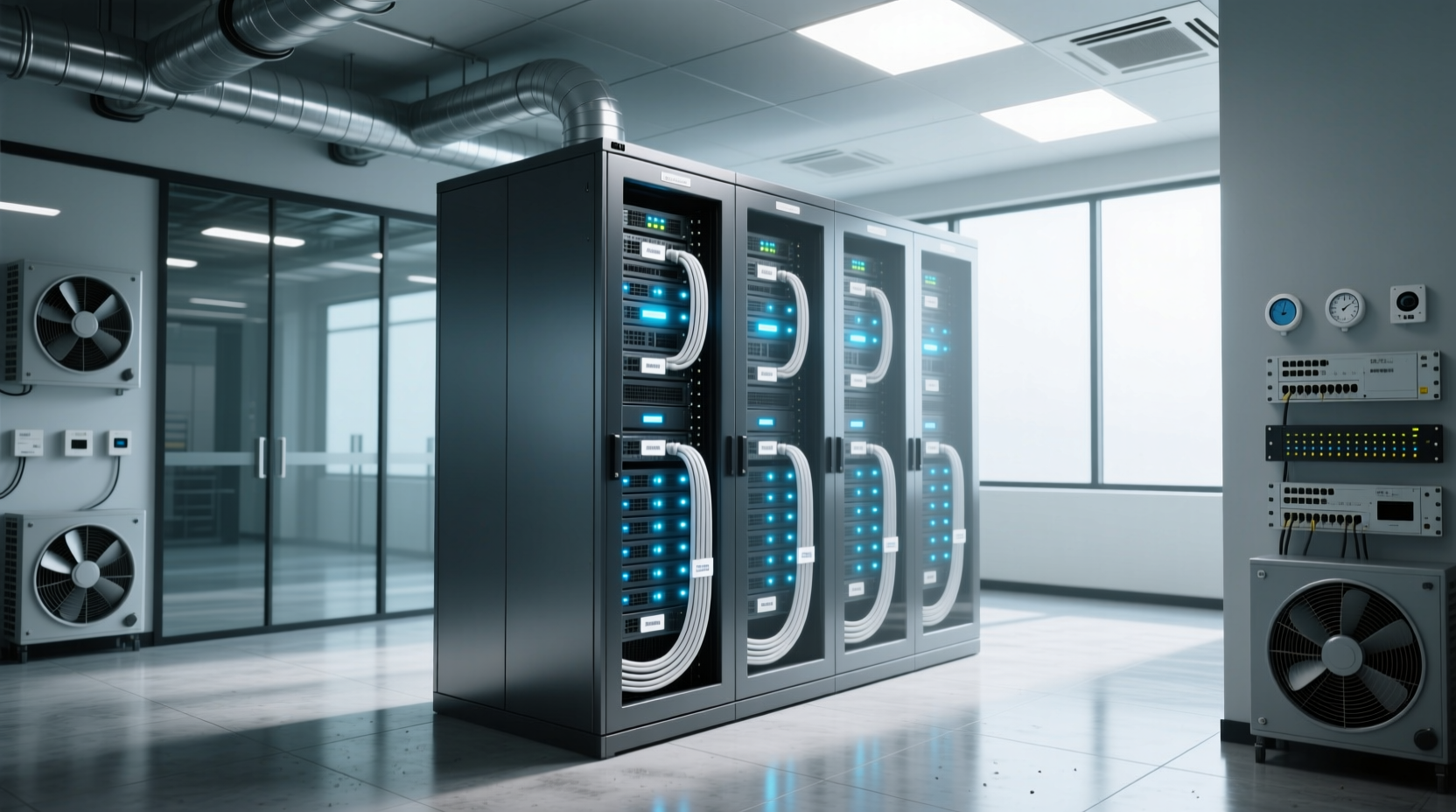
Choosing the right 16U server cabinet means understanding not just height—but how depth, load rating, mounting style, and enclosure type affect your actual deployment. A true 16U cabinet provides exactly 28 inches (711 mm) of vertical rack unit space, but its usability depends on four non-negotiable factors: internal usable depth (not just overall depth), static vs. dynamic load capacity, front-to-back airflow clearance, and whether it’s designed for wall-mount stability or floor-standing equipment density. Whether you’re building a home lab, securing AV gear in a studio, or deploying edge IT in a small office, misjudging any of these leads to overheating, cable strain, or structural compromise—especially with heavy switches, NAS units, or dual-PSU servers.
Why '16U' Alone Tells You Almost Nothing — And What Actually Matters
The "U" (rack unit) is standardized: 1U = 1.75 inches (44.45 mm). So 16U equals 28 inches (711 mm) of vertical mounting space1. But search results show cabinets ranging from $88 to $1,400 — a 16x price spread — because the U-height is only one dimension. What creates functional differences are:
- Internal depth: Ranges from 17″ (VEVOR open-frame) to 31.5″ (Jameco solid cabinet). A 22″ deep switch won’t fit in a 19″-deep cabinet—even if labeled "16U".
- Material gauge & construction: Entry-level units use 1.2 mm cold-rolled steel; commercial-grade use ≥1.5 mm with reinforced mounting rails and welded corners.
- Load capacity type: Static (stationary) vs. dynamic (with casters). A cabinet rated for 500 lbs statically may support only 200 lbs when rolling — critical for mobile labs or conference setups.
- Ventilation design: Open-frame racks (no side panels or doors) maximize airflow but offer zero dust or physical protection. Enclosed cabinets with perforated doors or top/bottom vents balance cooling and security.
16U Server Cabinet Dimensions: Beyond Height — Measuring What Fits
Manufacturers often list "overall dimensions," but what matters is usable interior space. Here’s how to verify real fit before ordering:
| Dimension Type | Typical Range (16U Units) | Why It Matters |
|---|---|---|
| Height (U) | 28″ (711 mm) — exact by standard | Fixed. All certified 16U cabinets meet this. Verify rail hole spacing matches EIA-310-D spec. |
| Width (front panel) | 19″ (483 mm) — industry standard | Must match all 19″ rack-mount gear. Non-standard widths cause mounting misalignment. |
| Internal depth | 17″–31.5″ (432–800 mm) | Measure from front mounting rail to rear rail — not outer casing. Critical for deep gear (e.g., UPS, blade chassis). |
| Overall depth | 21″–35″ (533–889 mm) | Includes frame, door swing, and rear clearance. Impacts room layout and aisle width. |
| Front-to-back clearance | 0″ (wall mount) to ≥4″ (floor-standing) | Affords airflow behind gear. Enclosed cabinets need ≥2″ rear gap for convection cooling. |
For example: A 16U wall-mount cabinet like the Lowell LWR1623 lists 23″ depth — but its internal depth is only 20.5″, leaving just 1.5″ behind a 19″-deep device. That’s insufficient for most enterprise switches with rear exhaust fans2. Always request CAD drawings or internal depth specs — not just “23″ D” marketing copy.
Floor-Standing vs. Wall-Mount: Not Just About Space — It’s About Physics
Search results show both types priced similarly, but their engineering constraints differ fundamentally:
Floor-Standing Cabinets
- Stability priority: Base width ≥24″ prevents tipping with top-heavy loads (e.g., stacked UPS + network core).
- Caster quality matters: Look for dual-wheel, 4″ swivel casters with brake locks and ≥150 lbs per wheel rating. Cheap 2″ casters deform under 200+ lbs.
- Weight distribution: Heavy gear (servers, storage) belongs on lower U positions. Top-heavy loading increases forward torque — a common cause of caster failure.
Wall-Mount Cabinets
- Structural anchoring is non-negotiable: Must be bolted into wall studs (not drywall anchors) — especially above 100 lbs. A 16U cabinet holding two 30-lb switches + patch panels easily exceeds 120 lbs.
- Depth limitation: Most wall-mount units max out at 23″ internal depth. Deeper gear requires floor-standing or custom cantilever brackets.
- Service access: Front-door-only access makes rear cable management harder. Look for removable rear rails or hinged side panels.
Tip: If mounting near HVAC vents or windows, confirm cabinet finish (powder-coated steel vs. painted) resists condensation corrosion — a frequent failure point in humid basements or garages.
Open Frame vs. Enclosed: When Ventilation Beats Security (and Vice Versa)
Over 60% of low-cost 16U listings are open-frame (no doors, no side panels). They’re popular for home labs and AV racks — but here’s what’s rarely disclosed:
- Airflow efficiency: Open frames allow unrestricted front-to-back airflow — ideal for passive-cooled NAS or fanless mini-PCs. But they provide zero dust filtration. In dusty environments (workshops, rental offices), fan filters clog in weeks.
- Security trade-off: No lockable doors = no physical access control. PCI-DSS and HIPAA require locked enclosures for any device storing regulated data.
- EMI shielding: Enclosed cabinets with conductive gaskets reduce electromagnetic interference — essential near medical equipment or broadcast gear.
- Noise containment: Perforated door cabinets cut fan noise by 3–5 dB(A) vs. open frame — measurable in shared offices or studios.
Bottom line: Choose open frame only if you prioritize thermal headroom, have full environmental control, and accept zero physical security. Choose enclosed if gear contains sensitive data, operates in uncontrolled spaces, or must meet compliance requirements.
Load Capacity: Why “500 lbs” Is Meaningless Without Context
Many budget cabinets advertise “500 lbs capacity” — but that figure is almost always static, evenly distributed, center-loaded. Real-world loading is uneven and dynamic:
- Dynamic load (with casters): Typically 40–60% of static rating. A 500-lb static cabinet may safely roll only 250 lbs.
- Point-load limits: Rails aren’t rated for concentrated weight. Mounting a 45-lb 2U UPS at the very top creates high moment force — risking rail deformation.
- Thermal derating: At 40°C ambient, steel strength drops ~15%. High-temp environments (attics, mechanical rooms) require 20%+ safety margin.
Always check the manufacturer’s load chart, not just headline numbers. Reputable brands (Middle Atlantic, Tripp Lite, Eaton) publish charts showing max load per U position and caster configuration3. If no chart exists, assume conservative derating: use ≤70% of stated capacity.
Key Features That Impact Long-Term Reliability — Not Just First Cost
Price gaps between $90 and $700 16U cabinets reflect durability decisions made at the factory level. Focus on these four features:
1. Rail Construction
Look for square-hole rails with captive nuts (not threaded studs). Captive nuts prevent stripping during repeated gear swaps — a major pain point in test labs or AV staging. Threaded rails wear out after ~10–15 insertions.
2. Cable Management
Integrated vertical channels (not just tie-points) keep fiber and power separated. Avoid cabinets with only rear D-rings — they encourage tangled loops that block airflow.
3. Grounding Integrity
True IT-grade cabinets include bonded grounding points (≥6 AWG wire lugs) and continuity-tested rails. DIY grounding kits added post-purchase often fail resistance tests (<1 ohm required by NEC Article 250).
4. Finish Quality
Powder coating > spray paint. Salt-spray tested finishes (ASTM B117) last 5× longer in coastal or industrial areas. Check for coating thickness: ≥2.5 mils is commercial grade.
Who Should (and Shouldn’t) Buy a 16U Server Cabinet?
✅ Ideal for:
- Small business IT closets housing 1–2 switches, firewall, UPS, and VoIP PBX
- Home labs running homelab clusters (Proxmox, TrueNAS, Pi-hole) with <5 active devices
- Recording studios consolidating audio interfaces, mic preamps, and DSP units
- Edge deployments: retail POS hubs, kiosk controllers, or IoT gateways in temperature-controlled spaces
❌ Avoid if:
- You need >30″ depth for full-size UPS or blade servers (16U is too shallow — consider 22U+)
- Your environment exceeds 35°C ambient or has high dust/humidity without climate control
- You require NEMA 12/IP54 protection (standard 16U cabinets are NEMA 1/IP20 at best)
- You plan to mount >300 lbs of gear without verifying floor structural capacity (concrete slab vs. raised floor)
How to Verify a 16U Cabinet Meets Your Needs — A 5-Step Checklist
- Measure your deepest device (including connectors and cables) — add 1.5″ minimum rear clearance.
- Weigh all gear — include rails, shelves, and future expansion. Apply 1.5× safety factor for dynamic loads.
- Confirm wall stud location and spacing (for wall-mount) or floor load rating (for floor-standing).
- Review airflow paths: Will gear exhaust into cabinet dead space? Does cabinet allow front intake / rear exhaust routing?
- Request test reports: UL 60950-1 (safety), CSA C22.2 No. 60950-1, or IEC 60950-1 certification documents — not just “CE marked.”
Frequently Asked Questions (FAQ)
- What are the exact internal dimensions of a standard 16U server cabinet?
- Height: 28.0″ (711 mm); Width: 19.0″ (483 mm) front mounting width. Internal depth varies widely — commonly 17″ to 31.5″. Always confirm internal rail-to-rail depth, not overall cabinet depth.
- Can I mount a 16U cabinet on drywall without studs?
- No. Drywall anchors cannot safely support >50 lbs long-term. Wall-mount cabinets require direct attachment to wood or metal studs spaced ≤24″ apart. Use a stud finder and verify anchor torque specs.
- Is 16U enough for a small business firewall, switch, and UPS?
- Yes — if gear depth ≤22″ and total weight ≤300 lbs. Prioritize depth over height: many compact firewalls (e.g., pfSense boxes) are 1U–2U but 16″–18″ deep.
- Do I need locking doors on a 16U cabinet?
- Required for PCI-DSS, HIPAA, or any environment with public access. Even in private offices, locks prevent accidental reboots or cable disconnection by non-IT staff.
- What’s the difference between 2-post and 4-post 16U racks?
- 2-post racks (telco style) support lightweight gear with front-mount only. 4-post cabinets (server style) provide front/rear rail support, side panel options, and higher load capacity — standard for IT deployments.
