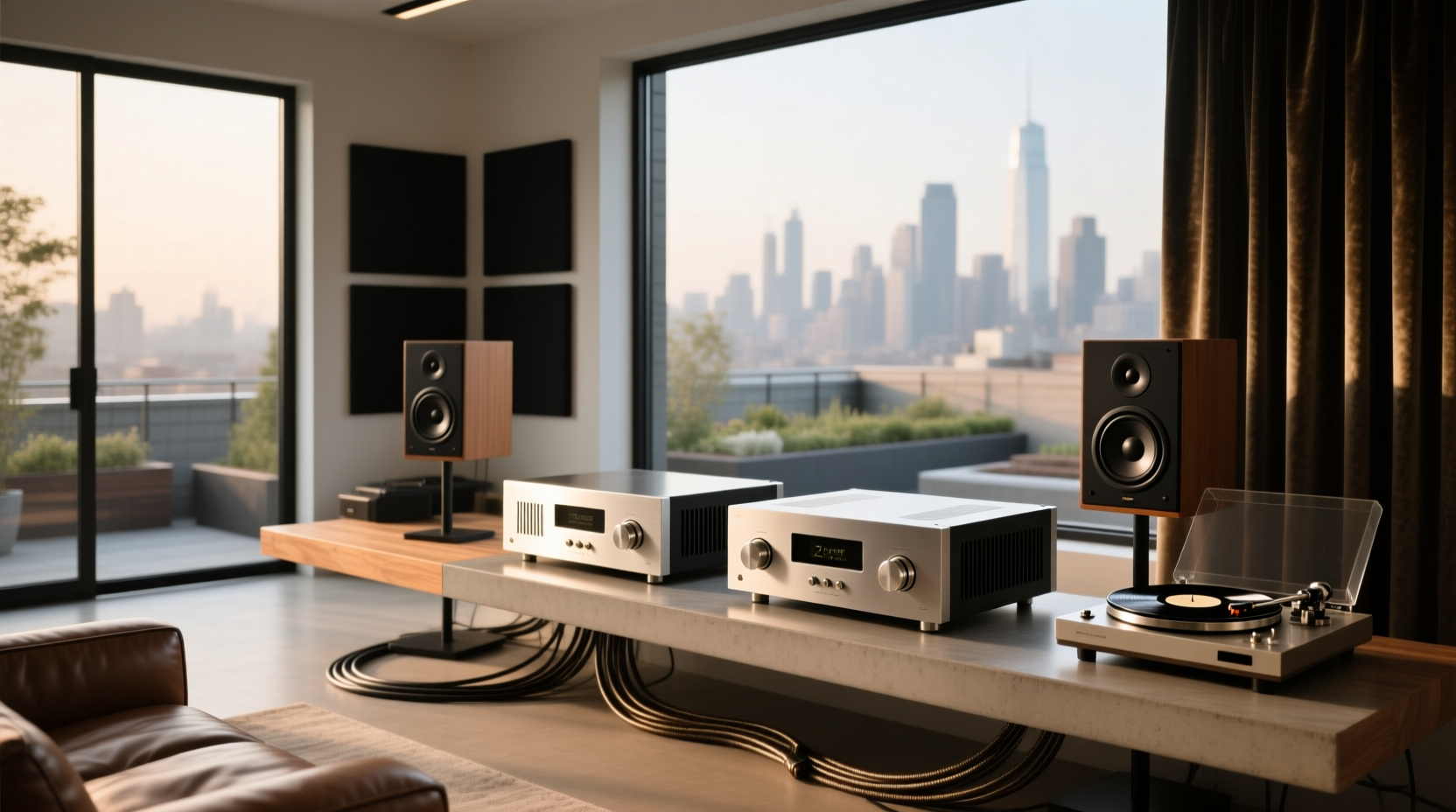
You’ll get stereo sound, reliable power delivery to two speakers, and flexible integration in home audio, car systems, or PA setups — but only if you match the amplifier’s specs (RMS power, impedance range, input sensitivity) to your speakers and use-case. This guide explains exactly what a 2-channel amplifier is, how to wire it safely, when it’s the right choice — and when it isn’t.
Why This Matters: The Real-World Use Cases for 2-Channel Amplifiers
A 2-channel amplifier is not just “half of a 4-channel unit.” It’s a purpose-built solution for stereo signal paths — whether powering bookshelf speakers in a living room, driving component tweeters and woofers in a high-fidelity car audio system, or serving as a dedicated front-channel amp in a hybrid home theater setup. Unlike multi-channel receivers, standalone 2-channel amps prioritize signal integrity, thermal stability, and clean power delivery per channel — critical for listeners who value dynamic range, low distortion, and consistent output under load 1. They’re also commonly used in bi-amping configurations, where separate channels drive high- and low-frequency drivers on the same speaker cabinet — a technique that improves control and reduces intermodulation distortion 2.
What Does “2 Channel” Actually Mean?
The term refers to two independent, electrically isolated amplification circuits — each with its own input stage, gain control, output stage, and speaker terminals. Each channel processes one signal path: typically left (L) and right (R) in stereo applications. This is fundamentally different from mono-block amplifiers (single-channel, high-power units often used for subwoofers) or bridged-mono modes (where two channels combine into one higher-voltage output — not standard on all models).
Crucially, “2 channel” does not mean “supports only two speakers total.” It means the device has two output channels — and each channel can drive multiple speakers if wired correctly. However, doing so requires careful attention to total load impedance and power distribution — topics we’ll cover in depth below.
How Many Speakers Can a 2-Channel Amplifier Drive?
There is no fixed upper limit — but there is a strict electrical limit defined by impedance and power handling. A 2-channel amp rated for 4–8 Ω loads can safely drive:
- One 8 Ω speaker per channel (standard stereo setup)
- Two 8 Ω speakers in parallel per channel → 4 Ω total load per channel
- Four 8 Ω speakers (two per channel, both in parallel) → still 4 Ω per channel
- Six speakers total — e.g., three 8 Ω speakers wired in series-parallel per channel — only if the resulting net impedance stays within the amp’s specified range
⚠️ Warning: Mismatched impedances cause real-world problems. If you connect a 2 Ω load to an amp rated for minimum 4 Ω, it may overheat, trigger protection circuits, or fail prematurely. Likewise, connecting mismatched speakers (e.g., 4 Ω tweeter + 8 Ω woofer on the same channel without proper crossover isolation) causes uneven power distribution — the lower-impedance driver draws more current and risks thermal damage 3.
2-Channel vs. 4-Channel: When to Choose Which?
The decision hinges on system architecture — not just speaker count. Here’s how to decide:
| Factor | 2-Channel Amplifier | 4-Channel Amplifier |
|---|---|---|
| Primary Use Case | Stereo listening (home, desktop, studio), bi-amping, front-stage enhancement in surround systems | Full car audio systems (front components + rear coaxials), multi-zone audio, basic surround (with external processor) |
| Power Per Channel | Typically higher RMS per channel at same price point (e.g., 150W × 2 vs. 75W × 4) | Lower per-channel output unless premium-tier; often optimized for compact installation |
| Heat Dissipation | Better thermal headroom due to fewer channels in same chassis volume | Higher cumulative heat; requires robust ventilation in enclosed spaces (e.g., car trunks) |
| Signal Path Purity | Less crosstalk, dedicated power supply filtering per channel | Shared power supply and PCB traces increase potential for channel interference |
| Upgrade Flexibility | Easier to integrate into high-end stereo chains (preamp → amp → speakers) | Often bundled with built-in crossovers and bass boost — convenient but less transparent |
💡 Pro Tip: In car audio, many installers use a 2-channel amp for front components (tweeter + woofer, bi-amped) and a separate mono or 2-channel subwoofer amp — rather than stretching a 4-channel unit across all drivers. This preserves headroom and avoids compromising midrange clarity for bass demand.
Wiring Configurations: Series, Parallel, and Bi-Amping
Understanding wiring is non-negotiable. Incorrect connections risk equipment failure — and void warranties.
Parallel Wiring (Most Common)
Connect positive (+) terminals of all speakers on one channel together, and all negatives (−) together. Total impedance drops: two 8 Ω speakers = 4 Ω; three 8 Ω = ~2.67 Ω. Only do this if your amp supports the resulting load.
Series Wiring
Chain speakers: Amp (+) → Speaker 1 (+) → Speaker 1 (−) → Speaker 2 (+) → Speaker 2 (−) → Amp (−). Impedances add: two 8 Ω = 16 Ω. Safe for most amps — but reduces maximum power output significantly (power ∝ V²/R).
Bi-Amping (Dual Amplification)
Requires speakers with separate high- and low-frequency terminals (e.g., dual binding posts). One channel powers the tweeter (via passive or active high-pass filter), the other powers the woofer (low-pass filtered). This eliminates passive crossover losses and gives tighter control over driver dynamics 2. Not all 2-channel amps include built-in filters — verify if external DSP or crossover networks are needed.
Key Specifications to Verify Before Buying
Don’t rely on peak or PMPO ratings — focus on these verified metrics:
- RMS Power (Watts per channel, at stated THD and impedance): Measured continuously, not momentarily. E.g., “120W RMS × 2 at 8 Ω, 0.08% THD” is far more meaningful than “500W peak.”
- Frequency Response (e.g., 20 Hz – 20 kHz ±0.5 dB): Indicates how evenly the amp reproduces tones across audible spectrum.
- Signal-to-Noise Ratio (SNR, ≥100 dB typical): Higher = quieter background, especially critical for low-volume listening.
- Damping Factor (≥200 typical): Reflects the amp’s ability to control speaker cone motion — vital for tight bass response.
- Input Sensitivity & Impedance (e.g., 200 mV–2 V, 10 kΩ min): Must match source output (DAC, preamp, head unit). Too low sensitivity causes clipping; too high may underdrive.
🔍 Verification Step: Cross-check spec sheets against independent lab tests (e.g., Audio Science Review, InnerFidelity) — manufacturer claims sometimes omit measurement conditions (e.g., “1 kHz only,” “1 channel driven”).
Common Pitfalls & How to Avoid Them
Ground Loops
Connecting two amplifiers (e.g., a stereo amp + subwoofer amp) without proper grounding often introduces 50/60 Hz hum. This occurs when multiple devices create voltage differences between ground paths. Solution: Use a single-point star ground, isolate inputs with transformers or optical isolators, or employ a ground loop isolator — never cut safety grounds or use “cheater plugs” 4.
Overloading Power Supplies
High-current 2-channel amps (especially Class AB or high-power Class D) draw substantial current. In cars, undersized wiring (not just the amp’s fuse rating) causes voltage sag, triggering protection mode. Rule of thumb: For amps >500W RMS total, use 4 AWG or thicker power cable, with proper fusing ≤18″ from battery.
Mismatched Speaker Sensitivity
An efficient 92 dB/W/m speaker needs far less power than an 84 dB/W/m model to reach the same volume. Pairing a low-sensitivity speaker with an underpowered 2-channel amp leads to clipping — which damages tweeters faster than outright over-powering. Always compare speaker sensitivity (dB @ 1W/1m) with amp RMS output.
Real-World Scenarios: Which 2-Channel Amp Fits Your Setup?
Home Stereo (Passive Speakers)
Look for: Balanced XLR inputs, adjustable gain, high damping factor (>300), and stable operation down to 4 Ω. Avoid units with only RCA inputs and no front-panel controls if using with a DAC/preamp chain.
Car Audio (Front Components)
Look for: Compact chassis, conformal-coated PCBs (for humidity resistance), built-in adjustable high-pass filters (to protect tweeters), and stable 14.4V operation (not just 12V). Remote turn-on input is mandatory.
Desktop/Studio Monitoring
Look for: Low-noise design, short signal path, and neutral tonal balance. Avoid heavy tone controls — they mask recording flaws. USB-powered mini-amps are convenient but rarely deliver true 2-channel fidelity above 20W/channel.
PA / Live Sound Support
Look for: SpeakON outputs, fan-cooled thermal management, and bridgeable outputs (if subwoofer reinforcement is needed later). Note: Most “2-channel PA amps” are Class D and optimized for reliability over audiophile refinement.
Frequently Asked Questions (FAQ)
- Can I run four speakers on a 2-channel amplifier? Yes — if wired in parallel per channel and the resulting impedance stays within the amp’s rated range (e.g., two 8 Ω speakers per channel = 4 Ω load). Always verify power distribution to avoid overloading individual drivers.
- What’s the difference between a 2-channel amplifier and a stereo receiver? A stereo receiver includes a built-in AM/FM tuner, preamp section, and often digital inputs — but compromises on amplifier section quality and cooling. A dedicated 2-channel amp focuses solely on clean, high-current amplification with superior build and thermal design.
- Do I need a separate DAC if my source is digital? Yes — unless the 2-channel amp has native digital inputs (optical, coaxial, USB) and an integrated DAC. Most analog-input-only amps require an external DAC to convert digital signals from computers, streamers, or TVs.
- Can I bridge a 2-channel amplifier to power a subwoofer? Only if explicitly designed for bridged-mono operation (check manual for “bridgeable” label and wiring diagram). Not all 2-channel amps support this — forcing it risks output stage failure.
- Is Class D worse than Class AB for 2-channel use? No — modern Class D offers comparable THD+N, wider bandwidth, and higher efficiency. The key is implementation: well-designed Class D amps (e.g., with GaN transistors and advanced feedback) outperform budget Class AB in noise, heat, and transient response.
