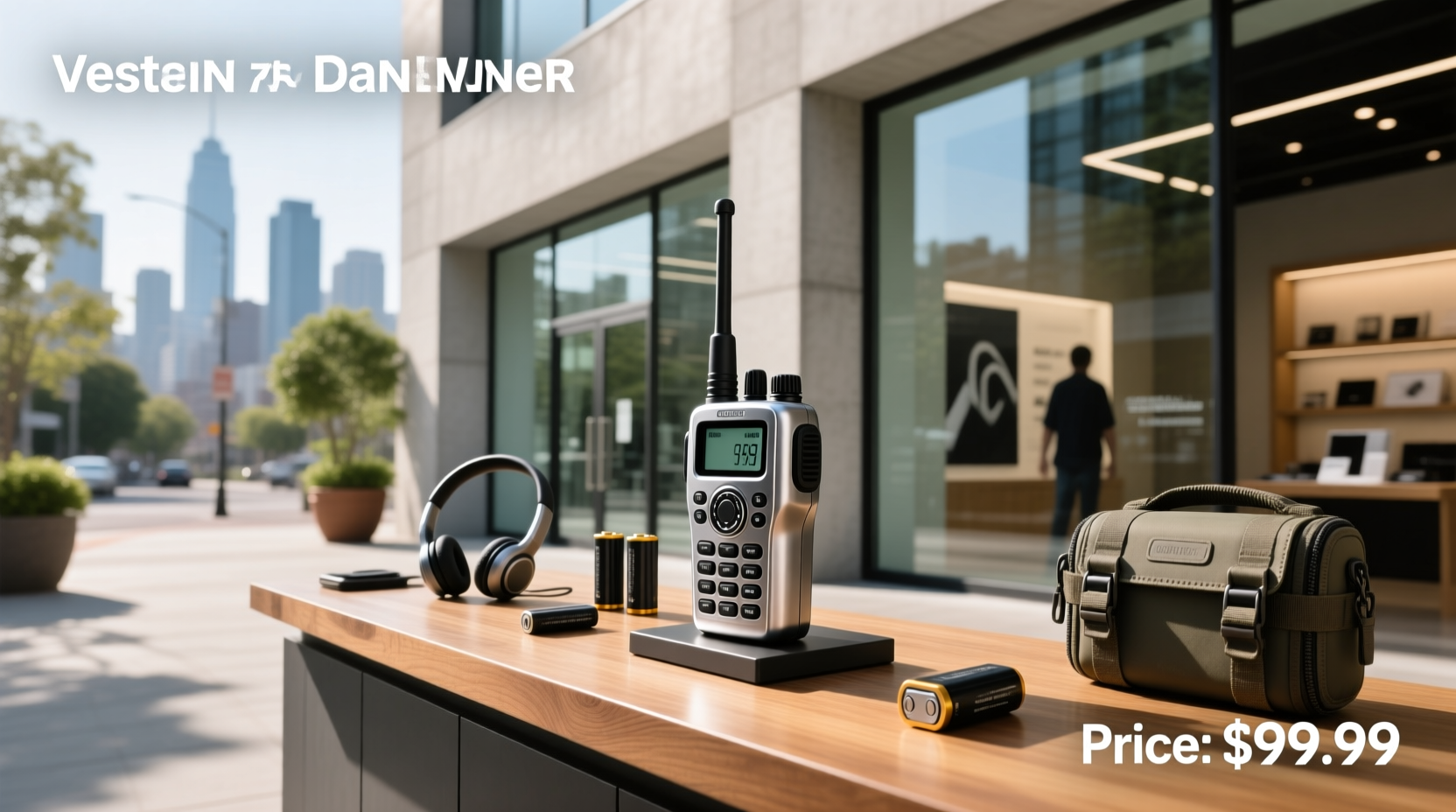
Buying a two-way radio isn’t like buying headphones or power banks: price alone tells you almost nothing about real-world value. A $35 FRS pair from a big-box retailer and a $320 UHF business radio may both be labeled "2-way radios," but they differ fundamentally in regulatory compliance, RF engineering, build integrity, and operational lifespan. If you’re searching for 2 way radio price, what you actually need is a transparent, use-case-driven cost framework — not just a list of prices. This guide breaks down exactly how much you’ll pay for consumer-grade walkie-talkies (FRS/GMRS), ruggedized prosumer units, licensed commercial analog/digital radios, and LTE-based nationwide systems — and crucially, why each tier costs what it does. We cover FCC licensing implications, realistic range vs. advertised specs, battery technology trade-offs, and how features like water resistance or programmable channels directly impact unit cost — all grounded in publicly available retail data, technical standards, and user-reported field performance.
Why 2-Way Radio Prices Vary So Dramatically: The Core Drivers
The 2 way radio price spectrum — from under $25 to over $700 per unit — reflects fundamental differences in design intent, regulatory requirements, and engineering investment. Unlike consumer electronics where cost often correlates with brand prestige or marketing spend, two-way radio pricing is tightly coupled to verifiable hardware and compliance attributes. Four factors dominate the cost structure:
- Regulatory class & licensing requirement: FRS radios operate license-free at ≤2 W on fixed frequencies; GMRS requires an FCC license (though many users operate without one); commercial UHF/VHF radios must comply with Part 90 rules and often require site-specific licensing — adding certification, programming, and support overhead.
- Durability & environmental rating: Consumer models typically lack IP ratings; professional units carry IP54–IP68 certifications for dust/water ingress protection, requiring sealed gaskets, reinforced chassis, and conformal-coated circuit boards — raising manufacturing costs significantly.
- Transmit power & antenna efficiency: Advertised “36-mile range” assumes line-of-sight over flat terrain with zero obstructions — physically impossible in urban or wooded environments. Real-world range depends on effective radiated power (ERP), antenna gain, and receiver sensitivity — all of which scale with component quality and RF shielding, not just wattage.
- Radio architecture & feature set: Analog-only units are simpler and cheaper; digital (DMR, NXDN) radios require dual-mode chipsets, encryption modules, and advanced audio processing. Programmable memory banks, full alphanumeric displays, voice prompts, and USB-C charging add measurable BOM (bill-of-materials) cost.
Consumer-Grade Radios: $20–$80 per Pair (FRS & GMRS)
This segment dominates search results for 2 way radio price queries — and for good reason: it’s where most first-time buyers start. These are almost exclusively Family Radio Service (FRS) devices, sometimes bundled with GMRS capability (though legally, GMRS transmission requires an FCC license 1). Key traits:
| Feature | Typical Spec | Price Impact | Reality Check |
|---|---|---|---|
| Transmit Power | 0.5–2 W (FRS max = 2 W) | Low-cost Class D amplifiers | Higher wattage ≠ longer range in practice; signal degrades rapidly near buildings or trees |
| Battery | Rechargeable NiMH or Li-ion (1200–2000 mAh) | Li-ion adds ~$3–$5/unit vs. NiMH | Most last 8–12 hours on medium volume; no hot-swap capability |
| Range Claim | "16–36 miles" (advertising standard) | No impact — purely marketing | Realistic outdoor range: 0.5–2 miles; indoor/urban: 300–800 ft 2 |
| Water Resistance | "Water resistant" (no IP rating) | Negligible cost premium | Rain exposure may cause corrosion; not submersible or washable |
Examples: Midland GXT1000VP4 ($89.99), Cobra RX680 ($89.95), Radtel RT12 ($29.99). All are sold as multipacks (2–8 units), lowering per-unit cost but offering no scalability — you can’t add a ninth radio to the group without compatibility risk. These radios use fixed, non-programmable channels and lack privacy codes that function reliably beyond short distances. They’re ideal for backyard use, camping trips, or event coordination among 4–6 people — but unsuitable for security patrols, construction sites, or any scenario demanding consistent channel access or interference rejection.
Prosumer / Outdoor-Grade Radios: $80–$200 per Unit (GMRS-Licensed & Enhanced FRS)
This tier bridges the gap between casual use and light commercial needs. Radios here are typically GMRS-capable (5 W output), include detachable antennas, offer programmable CTCSS/DCS tones, and often carry IP54 or IP55 ratings. They’re marketed to preppers, off-road enthusiasts, and small business owners who need better reliability than FRS but don’t require full Part 90 certification.
Key differentiators:
- Antenna design: Replaceable 6–12" whip antennas with higher gain (e.g., 3–5 dBi) improve ERP without increasing transmit power — a cost-effective range boost absent in FRS models.
- Battery capacity: 2200–3000 mAh Li-ion packs deliver 14–18 hours of mixed-use runtime, with some supporting external power banks via micro-USB.
- Channel flexibility: Up to 50 programmable memories let users store repeater offsets, weather channels, or priority talkgroups — critical when operating across varied terrain.
- FCC ID transparency: Reputable brands publish full FCC ID numbers (e.g., Midland GXT67: IYD-GXT67), allowing verification of certified power output and frequency stability — a red flag if missing.
Price drivers here include antenna quality (a $15 aftermarket antenna can outperform stock), battery chemistry (Li-ion vs. NiMH), and whether the unit includes a desktop charger or only USB cable. Note: While GMRS license fees are nominal ($35 for 10 years), enforcement has increased since 2022 — unlicensed operation risks fines up to $10,000 per violation 3. Many retailers omit this detail, creating buyer risk.
Commercial-Grade Radios: $200–$600+ per Unit (UHF/VHF Analog & Digital)
These are true two-way radios — engineered for daily mission-critical use in security, warehousing, hospitality, and municipal services. They operate under FCC Part 90 regulations, require licensed frequencies (often coordinated through local frequency coordinators), and undergo rigorous type acceptance. Pricing reflects industrial-grade components, not just features.
Three structural cost elements define this tier:
- RF front-end quality: High-selectivity filters reject adjacent-channel interference; temperature-compensated crystal oscillators maintain frequency accuracy across -20°C to +60°C — unlike consumer units that drift >5 ppm outside 20°C.
- Mechanical robustness: MIL-STD-810G shock/vibration testing, IP67 sealing (submersible to 1m for 30 min), and stainless-steel fasteners ensure multi-year service life — versus 12–18 months typical for FRS units.
- Software ecosystem: Programming software, fleet management tools, and over-the-air updates require ongoing development investment — baked into hardware cost. A Motorola CP100d ($259–$566) isn’t priced for its keypad; it’s priced for its 10-year firmware support roadmap and integration with dispatch consoles.
Digital radios (DMR Tier II, P25 Phase 1) command 20–40% premiums over analog equivalents due to dual-mode transceivers, AES encryption engines, and spectral efficiency — enabling two voice slots per 12.5 kHz channel. However, digital doesn’t automatically mean “better”: in weak-signal conditions, analog degrades gracefully (fading audio); digital cuts out abruptly (“cliff effect”). Choose digital only if your organization plans multi-site trunking or encrypted comms — not just for perceived modernity.
Specialized & LTE-Based Systems: $200–$1,000+ per Unit (Nationwide & Hybrid)
For users needing coverage beyond line-of-sight — across counties, states, or disaster zones — traditional radios hit physical limits. LTE-based Push-to-Talk (PTT) systems bypass RF propagation constraints entirely, using cellular networks for near-unlimited range. But this convenience comes with layered costs:
- Hardware cost: Devices like Rapid Radios’ TWD25 ($199.95) or TWD50 ($299.95) integrate LTE modems, GPS, and hardened casings — more akin to ruggedized smartphones than radios.
- Recurring service fees: Monthly plans range $15–$35/user, covering data, PTT server access, and location tracking. No “one-time purchase” model exists — total cost of ownership (TCO) over 3 years often exceeds $1,000 per unit.
- Infrastructure dependency: Performance collapses in cellular dead zones — common in rural areas, underground parking, or during network congestion (e.g., post-disaster). Pure RF radios remain essential backups.
Hybrid radios (e.g., Kenwood TK-3501LTE) combine UHF analog + LTE fallback — but cost $600–$800 and require dual provisioning. They’re justified only for first responders or logistics fleets with strict SLAs — not for general business use.
How to Avoid Overpaying (or Under-Buying)
Before selecting based on 2 way radio price, ask three diagnostic questions:
- What’s your maximum required range — in your actual environment? Measure distance between your farthest communication points *on foot*, noting terrain, building density, and elevation changes. If ≤500 ft indoors or ≤1 mile outdoors, FRS suffices. If >1 mile with obstructions, GMRS or commercial UHF is mandatory.
- How many users will share the system — and will they grow? FRS multipacks top out at 8–12 units with no central control. Commercial systems scale to hundreds via repeaters or IP infrastructure — but require professional site surveys and licensing.
- What’s your failure tolerance? If losing comms means safety risk (e.g., security guard patrol), invest in IP67-rated units with 24-hour battery life and redundant charging. If it’s for festival staff coordinating lunch breaks, FRS is cost-optimal.
Red flags in listings: “36-mile range” without specifying test conditions; “waterproof” without IP rating; “programmable” without stating memory capacity or software requirements; “GMRS-ready” without clarifying license necessity. Always verify FCC ID on fcc.gov/oet/ea/fccid — counterfeit units frequently misstate power output and violate emission masks.
Regional & Retail Considerations
While 2 way radio price varies little by geography for online purchases, local availability impacts support. Rural areas often lack authorized service centers for Motorola or Kenwood — meaning repairs take 2–4 weeks vs. next-day turnaround in metro regions. Some dealers bundle free programming with purchase; others charge $25–$50 per radio. Always confirm whether quoted price includes antennas, batteries, chargers, and programming — many “$199” radios exclude the desktop charger ($35–$60 separately).
Online marketplaces display inflated “MSRP” prices next to deep discounts (e.g., “$130 → $109.95”), obscuring true value. Cross-reference FCC IDs and model numbers across vendor sites — identical units often differ in firmware version or included accessories. For example, the Midland MXT115 MicroMobile appears at $199.99 on Tractor Supply and $219.99 on Midland’s direct site — same hardware, different warranty terms (1 year vs. 2 years).
Frequently Asked Questions
- Is there a legal difference between “walkie-talkie” and “two-way radio”? Yes — “walkie-talkie” is a generic term for handheld portable radios, usually consumer-grade. “Two-way radio” is the technical category encompassing all half-duplex voice communication devices, including mobile, base station, and repeater systems. Legally, FCC rules apply to the device’s operating parameters — not its colloquial name.
- Do I need a license for my two-way radio? FRS radios (≤2 W, fixed antenna) require no license. GMRS radios (up to 50 W, detachable antenna) require a $35 FCC license valid for 10 years. Commercial UHF/VHF radios operating under Part 90 require site-specific licensing — managed by a licensed frequency coordinator.
- Why do advertised ranges never match real-world performance? Range claims assume ideal conditions: 6-ft antenna height, zero obstacles, flat terrain, and perfect atmospheric ducting. In practice, concrete walls attenuate signal by 10–20 dB; dense foliage absorbs 5–15 dB; and urban canyons cause multipath cancellation. Realistic range is best estimated using path loss calculators like those from the FCC’s OET Bulletin 65.
- Can I use a cheap Baofeng UV-5R as a GMRS radio? No — Baofeng UV-5Rs are amateur-band transceivers (144–148 MHz / 430–450 MHz) with no GMRS certification. Their wideband TX filters emit spurious emissions outside allocated channels, violating FCC Part 97 and Part 95 rules. Using them on GMRS frequencies risks interference and enforcement action.
- Does higher wattage always mean better range? Not necessarily. At VHF/UHF frequencies, antenna efficiency and placement matter more than raw power. A 5 W radio with a poor ground-plane antenna performs worse than a 2 W unit with a tuned 1/4-wave whip. Receiver sensitivity (measured in dBm) is equally critical — many budget radios sacrifice RX performance to hit low price points.
