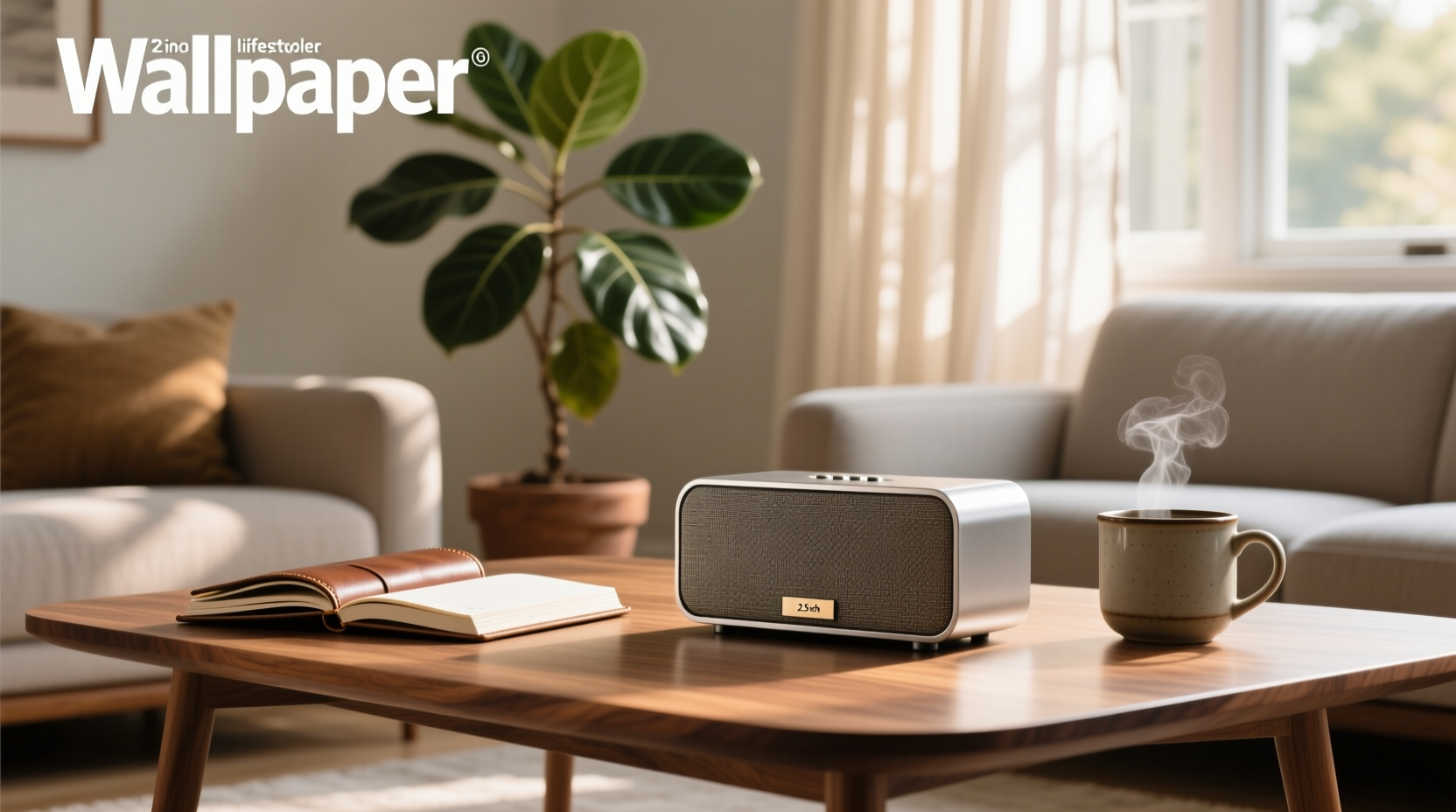
You’re not buying a ‘2.5 inch speaker’—you’re selecting a full-range driver with specific physical, electrical, and acoustic constraints. Unlike larger woofers or tweeters, the 2.5″ (63.5 mm) diameter defines a narrow performance envelope: it delivers usable midrange and upper bass (down to ~100–120 Hz), but cannot reproduce deep sub-bass (<60 Hz) without enclosure tuning or active assistance. Most 2.5″ speakers are rated 4–15W RMS, 4Ω or 8Ω impedance, and 82–88 dB sensitivity—making them ideal for low-power amplifiers, battery-powered devices, embedded systems, and space-constrained DIY projects like portable Bluetooth speakers, desktop soundbars, or narrow-column home theater surrounds 1. This guide cuts through marketing noise to clarify what matters—and what doesn’t—when evaluating or integrating a 2.5 inch speaker.
Why Size Alone Doesn’t Tell the Whole Story
The ‘2.5 inch’ label refers only to the nominal diameter of the speaker’s cone assembly—not its actual acoustic output, frequency range, or power capability. In practice, this measurement is derived from the outer edge of the cone plus surround, and varies slightly between manufacturers (e.g., 65 mm vs. 66 mm listed on AliExpress listings 2). More critically, physical size correlates only indirectly with performance:
- Excursion limits: Small cones have shallow voice coil travel, restricting low-frequency extension and dynamic headroom.
- Magnet structure: A compact frame often means smaller ferrite or neodymium magnets—impacting motor strength (BL product) and damping control.
- Thermal mass: Smaller voice coils heat faster under sustained load, increasing risk of thermal compression or failure above rated RMS power.
So while a 2.5″ speaker fits where an 8″ cannot, it also trades off output, linearity, and bandwidth. Recognizing this trade-off is essential before committing to a design or purchase.
Key Technical Specifications — And Why Each One Matters
When comparing 2.5 inch speakers across Alibaba, eBay, or specialty suppliers, focus on these four verified, measurable parameters—not marketing claims like ‘crystal-clear highs’ or ‘thunderous bass.’
1. Impedance (Typically 4Ω or 8Ω)
This is the speaker’s nominal AC resistance at a reference frequency (~1 kHz). It determines compatibility with your amplifier or audio source:
- 4Ω speakers draw more current and are common in automotive and high-efficiency portable designs—but require amplifiers rated for 4Ω loads to avoid overheating or shutdown.
- 8Ω speakers are safer for general-purpose headphone amps, Raspberry Pi DACs, or vintage receivers—but may produce lower volume from the same voltage due to reduced current draw.
Never assume ‘lower impedance = louder.’ Mismatching can damage equipment. Always verify your amplifier’s minimum stable load rating before connecting.
2. Power Handling (RMS vs. Peak)
Look for RMS (continuous) rating—not peak or PMPO. Realistic ratings for 2.5″ drivers range from 3W to 15W RMS:
| Power Rating | Typical Use Case | Risk of Overdrive |
|---|---|---|
| 3–5W RMS | USB-powered desktop speakers, IoT audio alerts, wearable feedback units | Distortion begins at ~7W; voice coil deformation likely above 10W |
| 8–10W RMS | Compact Bluetooth enclosures, DIY bookshelf satellites, rear-channel surrounds | Acceptable thermal margin up to 12W short-term; sustained >10W risks glue failure |
| 12–15W RMS | High-output portable PA modules, custom car door panels (with passive radiator) | Requires robust heatsinking; rare in stock units—verify datasheet test conditions |
Many listings claim ‘15W’ without specifying whether it’s RMS, program, or peak. If no RMS value appears in the spec sheet—or if only ‘15W MAX’ is stated—assume conservative derating: treat it as ≤8W RMS for reliable operation 3.
3. Sensitivity (dB @ 1W/1m)
This measures how efficiently the speaker converts electrical input into acoustic output. For 2.5″ models, typical values fall between 82 dB and 88 dB. A 3 dB increase doubles perceived loudness—but achieving higher sensitivity often sacrifices low-end linearity or durability. Example:
- An 85 dB speaker driven by 1W produces ~85 dB SPL at 1 meter.
- To reach 91 dB (twice as loud), you’d need 4W—well beyond most 5W-rated units’ safe limit.
Don’t prioritize sensitivity over thermal stability unless your application demands maximum output from minimal power (e.g., solar-powered trail markers).
4. Frequency Response (Not Just ‘Full Range’)
‘Full range’ is misleading. No 2.5″ driver reproduces 20 Hz–20 kHz linearly. Realistic measured response (±3 dB) for quality units is 120 Hz–18 kHz—and even that assumes proper baffle mounting and no cabinet resonance. Below 120 Hz, output rolls off rapidly (typically −12 dB/octave). That’s why many DIY builders pair 2.5″ drivers with passive radiators or small ports to extend usable bass by 15–25 Hz—without adding active components 4. Always request or locate published anechoic measurements—not just ‘20–20k’ brochures.
Top 5 Real-World Applications — And What to Watch For
Understanding context prevents mismatched expectations. Here’s how 2.5 inch speakers perform across common scenarios:
✅ Compact Desktop Audio Systems
Ideal for space-limited setups (e.g., dual-monitor workstations, studio control surfaces). Choose 8Ω, 5–8W RMS units with ≥84 dB sensitivity. Mount in rigid, non-resonant enclosures (MDF or 3 mm aluminum) with internal damping. Avoid plastic project boxes—they ring audibly below 300 Hz.
✅ Portable Bluetooth Speakers (DIY or OEM)
Most commercial ‘ultra-compact’ Bluetooth speakers use 2.5″ drivers paired with passive radiators. Critical checks: Does the listing specify enclosure volume? Without ≥0.3 L net internal volume, bass response collapses. Also confirm battery voltage matches driver impedance—e.g., a 4Ω unit fed by a 5V Class-D amp will clip earlier than an 8Ω unit on the same supply.
✅ Car Audio Tweeter/Midrange Replacements
In factory door panels or sail panels, 2.5″ drivers serve as dedicated midranges—not standalone full-range units. They rely on external crossovers (typically 2.5–4 kHz high-pass) and often require custom baffles. Never wire directly to factory head unit outputs without impedance matching or level attenuation.
❌ Home Theater Front LCR Channels
Not recommended. Even in well-tuned cabinets, 2.5″ drivers lack the cone area and excursion needed for cinematic dialogue clarity at reference levels (85 dB SPL continuous). Reserve them for rear/surround duties only—and always pair with a subwoofer for LFE content.
❌ High-Fidelity Hi-Fi Listening (Standalone)
While some audiophile-grade 2.5″ units exist (e.g., Tang Band W2-800), they demand precise crossover design, time-aligned waveguides, and room correction. As a plug-and-play solution, they introduce more distortion and coloration than similarly priced 4″ or 5.25″ alternatives. Only consider if cabinet depth is absolutely constrained (<80 mm).
How to Verify Authenticity & Avoid Common Pitfalls
Online marketplaces list thousands of 2.5 inch speakers—but many share identical photos, inflated specs, or unverified certifications. Use these steps before ordering:
- Request the manufacturer’s datasheet—not just a product page PDF. Legitimate suppliers provide Thiele–Small parameters (Fs, Qts, Vas, BL, Re).
- Check for consistency in labeling: A genuine 4Ω unit should measure ~3.2–3.8Ω DC resistance (Re) with a multimeter. Values >4.5Ω suggest mislabeled 8Ω units.
- Review shipping origin and compliance markings: Units shipped from China without CE/FCC ID numbers may lack EMI shielding—causing interference with Wi-Fi or Bluetooth in close proximity.
- Avoid ‘100% neodymium magnet’ claims without weight or Gauss rating. Tiny magnets rarely exceed 1,200 Gauss surface field—yet some listings imply industrial-grade strength.
If no technical documentation is available, assume worst-case derating: reduce stated power by 40%, add ±5 dB tolerance to sensitivity, and expect usable bass only down to ~150 Hz.
Enclosure Design Essentials for 2.5″ Drivers
Unlike larger speakers, 2.5″ units are highly sensitive to baffle edge diffraction and cabinet resonances. Key principles:
- Baffle thickness: Minimum 12 mm MDF or equivalent. Thin plywood (≤6 mm) flexes audibly at midrange frequencies.
- Internal bracing: At least one cross-brace per 100 cm² cabinet surface area—especially critical for volumes >0.4 L.
- Port tuning (if used): For bass extension, port length must be calculated using Vas and Fs—not guessed. A 2.5″ driver with Vas = 0.6 L and Fs = 140 Hz tunes optimally to ~110 Hz in 0.35 L net volume.
- Sealing: All joints must be airtight. Use silicone sealant—not tape—on internal seams. Leaks cause 6–10 dB loss below 200 Hz.
For beginners: Start with sealed (acoustic suspension) alignment. It’s more forgiving, requires no port calculations, and yields tighter transient response—ideal for speech and instrument detail.
Frequently Asked Questions (FAQ)
Q1: Can I use a 2.5 inch speaker with a smartphone or laptop headphone jack?
A: Yes—but only with an external amplifier. Direct connection lacks sufficient voltage swing and current drive. Use a Class-D board (e.g., PAM8403) or USB-C DAC+amp combo rated for your speaker’s impedance.
Q2: Do I need a crossover with a 2.5 inch full-range driver?
A: Not strictly—but highly recommended for multi-driver systems. Even ‘full range’ units exhibit rising response above 5 kHz; a simple 2nd-order high-pass (12 dB/octave) at 4 kHz protects against harshness and tweeter fatigue.
Q3: Why do some 2.5 inch speakers sound ‘boomy’ while others sound ‘thin’?
A: Boominess usually indicates cabinet resonance or port tuning too low for the driver’s Fs. Thinness suggests insufficient mid-bass reinforcement (lack of cabinet gain) or excessive damping material absorbing 200–500 Hz energy.
Q4: Are 2.5 inch speakers suitable for outdoor use?
A: Only if explicitly rated IP54 or higher. Standard units lack weather-sealed surrounds or corrosion-resistant frames. Humidity degrades paper cones and adhesives within weeks.
Q5: How long do 2.5 inch speakers typically last under normal use?
A: 5–10 years with proper thermal management. Lifespan drops sharply if operated >80% of RMS rating continuously or exposed to >85% RH environments.
