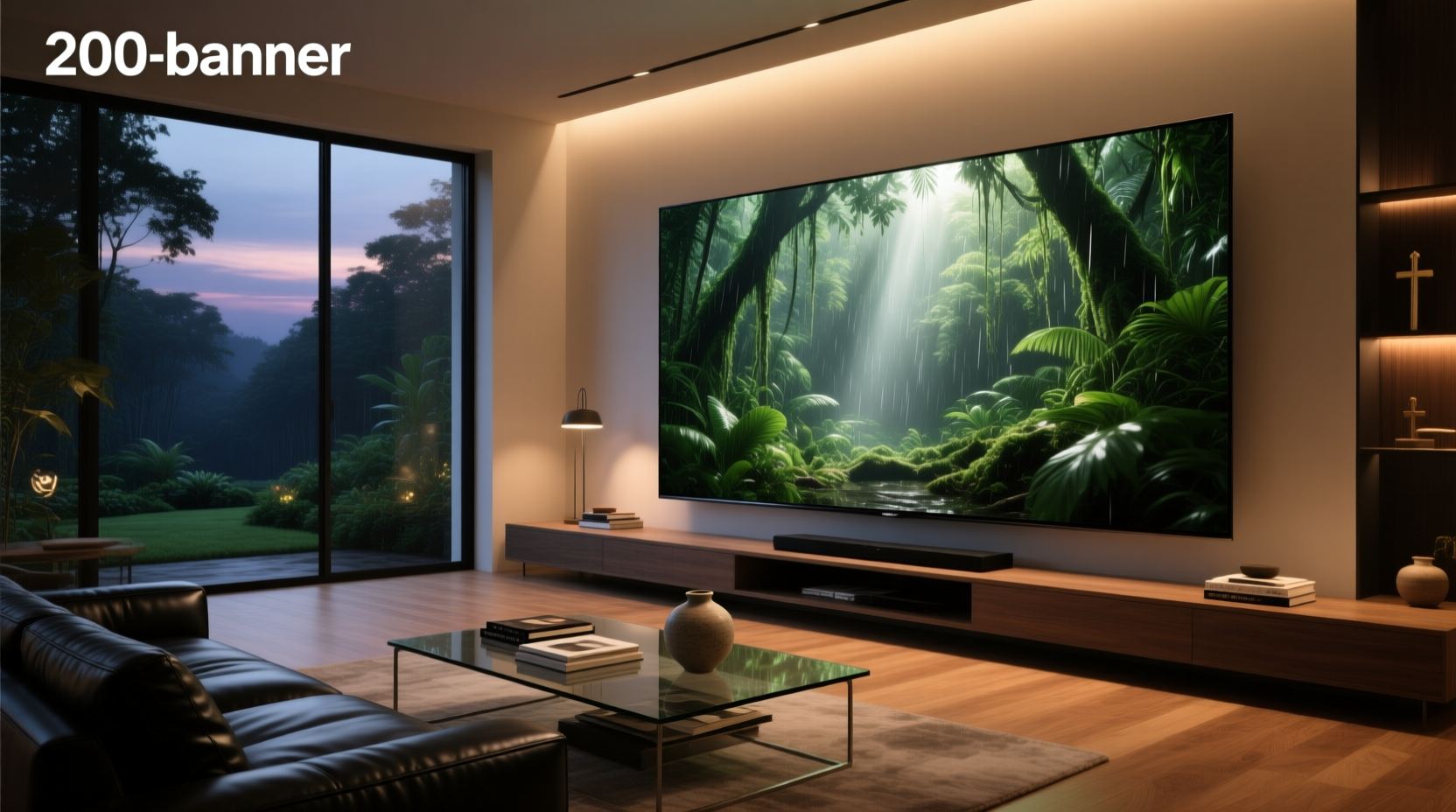
You cannot buy a true 200-inch consumer television in the form of a single-panel LCD, OLED, or QLED display — not from Samsung, LG, Sony, or any major brand. What users searching for tv 200 inch actually encounter are either modular LED video walls (typically P1.5–P2.5 pixel pitch), ultra-short-throw projection systems with 200-inch screens, or commercial-grade direct-view displays designed for control rooms and lobbies. A diagonal measurement of 200 inches (≈5.08 m) corresponds to a physical screen area of roughly 4.43 m wide × 2.49 m tall (16:9 aspect ratio) — far exceeding residential wall dimensions, structural load capacity, and standard shipping logistics 1. This article clarifies what a "200-inch TV" really means, compares viable implementation paths, outlines real-world constraints (space, power, viewing distance, ambient light), and helps you avoid costly misalignment between expectation and technical feasibility.
Why There Is No True 200-Inch Consumer TV Panel
The largest mass-produced flat-panel TVs available globally as of 2025 top out at 115 inches (Samsung QN90F Neo QLED) and 100 inches (LG QNED86 series) 23. Even these require reinforced wall mounts, dedicated circuitry (20A minimum), and ≥4.5 m viewing distance for optimal visual comfort. Scaling beyond 115 inches introduces fundamental engineering barriers:
- Glass substrate limits: Current Gen 10.5+ LCD/OLED fabs max out at ~3.5 m width — insufficient for a monolithic 200-inch panel without visible seams or yield loss.
- Thermal & power density: A hypothetical 200-inch OLED would draw >2,000W continuously and generate heat impossible to dissipate safely in a living room environment.
- Logistics & installation: A single-panel 200-inch display would weigh ≥350 kg, exceed standard elevator height/width, and require crane-assisted hoisting — incompatible with residential building codes in most US, EU, and APAC jurisdictions.
Thus, every product marketed as a "200-inch TV" online (e.g., on Alibaba.com or Vietnamese B2B LED portals) is either:
- A modular LED video wall assembled from hundreds of small SMD cabinets (e.g., P2.5 or P1.86 pixel pitch), calibrated as a unified canvas;
- A projection-based system pairing an ultra-short-throw (UST) laser projector with a 200-inch ambient-light-rejecting (ALR) screen;
- An industrial direct-view display rated for 24/7 operation in commercial venues — not certified for home use under FCC Part 15 or CE RED directives.
Real-World Dimensions: What 200 Inches Actually Measures
Diagonal measurement alone is misleading without context. For a 16:9 aspect ratio — the universal standard for broadcast, streaming, and Blu-ray — a 200-inch screen has precise physical dimensions:
| Dimension | Imperial | Metric |
|---|---|---|
| Diagonal | 200 in | 5.08 m |
| Width | 174.5 in (14.5 ft) | 4.43 m |
| Height | 98.2 in (8.2 ft) | 2.49 m |
| Viewing Area | — | 11.03 m² (118.7 ft²) |
These numbers are non-negotiable. If your wall is only 4.0 m wide, a true 200-inch 16:9 display will not fit — even before accounting for bezel, mounting frame, ventilation clearance, or service access. Some vendors advertise "200-inch equivalent" using 4:3 or 21:9 ratios, but those distort cinematic content and violate ATSC/ITU-R BT.709 standards. Always verify aspect ratio and full-frame dimensions before quoting or ordering 4.
Two Viable Paths to 200-Inch Display: LED Walls vs. Projection
When users search for tv 200 inch, they’re usually seeking immersive scale — not necessarily a specific technology. Here’s how each solution performs across critical decision criteria:
✅ LED Video Walls: Brightness, Modularity, Lifespan
Commercial LED walls (e.g., HacoLED, LEDHD, LED68) dominate the 200-inch segment because they scale linearly: add more cabinets, increase size. Key facts:
- Pixel pitch matters most: P2.5 (2.5 mm spacing) is the practical lower limit for residential viewing at ≥3.5 m distance. P1.5 delivers cinema-grade clarity but costs 2.5× more and requires professional calibration.
- Brightness & contrast: Typical nits range 800–1,500 cd/m² — sufficient for daytime use in controlled lighting. Unlike projectors, LED walls suffer zero ambient light washout.
- Lifespan & maintenance: Rated for 100,000 hours to half-brightness. Individual modules can be replaced; no lamp or laser source degradation.
- Drawbacks: Visible scan lines at close range; higher power draw (1,200–2,500W); requires dedicated HVAC cooling; no built-in tuner or smart OS (needs external media player).
✅ Projection Systems: Cost Efficiency, Flexibility, Room Integration
High-end UST laser projectors (e.g., Hisense PX3, XGIMI Horizon Ultra, Epson LS800) paired with motorized ALR screens deliver 200-inch images at significantly lower entry cost:
- Minimum throw distance: Most UST models require only 20–25 cm from wall — enabling flush mounting behind a retractable screen.
- Screen quality is decisive: A $300 white screen will look washed out; a $1,800 Da-Lite Cinema Vision or Stewart Firehawk G4 ALR screen preserves contrast and black levels in lit rooms.
- Resolution reality: While marketed as “4K”, most UST units use pixel-shifting — native resolution is often 2718×1528. True 3840×2160 panels exist but cost ≥$8,000.
- Drawbacks: Requires total light control for best results; screen surface must be perfectly flat; projector lamps/lasers need replacement every 20,000–30,000 hours.
Space, Power, and Structural Requirements You Can’t Ignore
Before committing to a 200-inch display, verify these three non-negotiable prerequisites:
📐 Wall & Room Dimensions
Your primary wall must accommodate not just screen width (4.43 m), but also:
- ≥15 cm clearance on left/right for service access and thermal expansion;
- ≥30 cm above/below for mounting rail anchoring and cable management;
- Minimum viewing distance: 3.5–4.5 m for P2.5 LED or 4K UST projection (THX recommends 1.2× screen height = 3.0 m; SMPTE suggests 1.6× = 4.0 m). Sitting closer causes visible pixels or scan lines.
⚡ Electrical Infrastructure
A 200-inch LED wall draws 1,500–2,800W continuously — comparable to an electric oven. Standard 15A/120V circuits (US) or 10A/230V (EU) will trip instantly. Required upgrades:
- Dedicated 20A or 30A circuit (US) / 16A or 20A circuit (EU);
- Hardwired connection (no power strips);
- Ground-fault circuit interrupter (GFCI) protection if installed near moisture sources (e.g., basement).
🏗️ Structural Integrity
Weight distribution is critical:
- LED wall (P2.5, 200″): ~180–220 kg including frame and power supplies — requires anchor bolts into wall studs or concrete, not drywall toggles;
- Projection screen (200″ fixed-frame ALR): ~45–65 kg — needs reinforced wall framing or ceiling suspension points;
- Always consult a licensed structural engineer if mounting to masonry, plaster, or lightweight partitions.
Price Realities: Why "$1,000" Listings Are Misleading
Alibaba.com listings showing "200-inch LED TV from $1,000" reflect bare cabinet pricing — excluding essential components:
- Controller & sending card: $300–$900 (required to process HDMI 2.1 signals and drive pixel mapping);
- Power supplies: $200–$500 (one per 4–6 cabinets; must match local voltage and include surge protection);
- Calibration & configuration: $800–$2,500 (professional color matching, gamma tuning, bezel alignment);
- Shipping & import duties: Often exceeds $1,200 for 200″ shipments — plus customs brokerage fees.
A turnkey, calibrated 200-inch P2.5 LED wall starts at **$18,000–$26,000 USD** (excluding tax and installation). A premium UST + ALR screen package ranges **$6,500–$12,000**, depending on projector tier and screen material 5. Budget figures below $5,000 indicate either outdated tech, counterfeit components, or missing line items.
Common Misconceptions & Critical Red Flags
Consumers frequently misinterpret marketing claims. Watch for these warnings:
- "200-inch Smart TV" with Android OS preloaded: No genuine LED wall runs Android natively. Any such claim indicates a low-resolution media player box bundled — not integrated intelligence.
- "4K resolution guaranteed": Verify native resolution, not interpolated. P2.5 at 200″ yields ~1920×1080 effective resolution — not 3840×2160.
- No IP rating listed: Indoor-rated LED (IP20) fails in humid basements or sunrooms. Outdoor-rated (IP65) adds 35–50% cost but enables covered patios.
- Vague warranty terms: Reputable vendors offer ≥36-month parts/labor coverage. Anything less than 24 months signals component risk.
How to Verify Vendor Credibility Before Ordering
Given the high cost and complexity, due diligence is mandatory:
- Request a live demo: Ask for video of the exact model running real 4K HDR content — not stock renders.
- Confirm cabinet origin: Top-tier modules come from Nationstar, Lextar, or Silan — not unbranded OEMs.
- Validate calibration protocol: Reputable integrators provide a Delta E <3 report and photometric test sheet.
- Review installation documentation: Look for detailed CAD drawings, power schematics, and thermal dissipation specs — not generic PDF brochures.
Frequently Asked Questions (FAQ)
Q: Can I install a 200-inch LED wall myself?
A: No. It requires certified electrical work, structural anchoring verification, pixel-level alignment, and multi-point color calibration — all outside DIY scope.
Q: Is a 200-inch projector screen better than LED for gaming?
A: LED walls offer lower input lag (<4 ms) and higher refresh rates (3840 Hz sub-frame), making them superior for competitive gaming. Projectors typically lag 16–40 ms and lack variable refresh rate (VRR) support at this size.
Q: Do I need special permits to mount a 200-inch display?
A: In most US municipalities and EU member states, permanent structural modifications over 100 kg require building department review — especially in condos or historic districts.
Q: Can I watch regular TV channels on a 200-inch LED wall?
A: Yes — but only via external hardware: ATSC 3.0 tuner box, streaming stick, or AV receiver. LED walls have no built-in tuners or broadcast decoding.
Q: What’s the smallest room that fits a 200-inch display comfortably?
A: Minimum room depth: 4.5 m (for viewing distance); minimum width: 5.0 m (to accommodate screen + side clearance); ceiling height: ≥3.0 m (to avoid neck strain).
