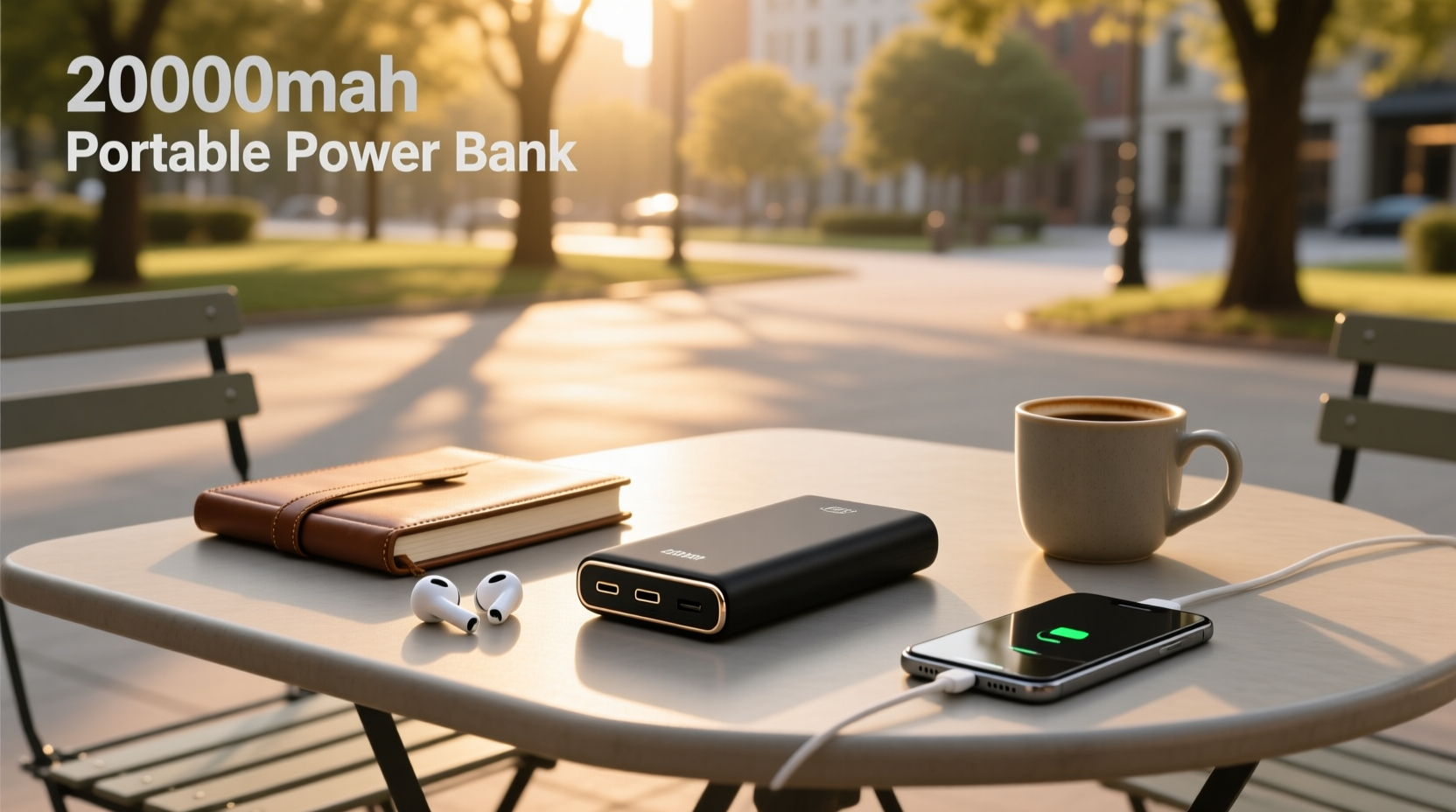
When you search for a 20000mAh portable power bank, what you really need isn’t just a number—it’s clarity on actual usable energy, real-world charging performance, and whether it fits your specific use case: long-haul travel, remote work, outdoor adventures, or daily multi-device carry. A 20000mAh rating is the internal battery cell capacity, not the amount delivered to your devices. Due to voltage conversion (3.7V → 5V/9V/20V), circuit losses, and battery aging, expect only 11,500–14,500mAh of effective output—roughly 3 full charges for a modern smartphone (e.g., iPhone 15 or Galaxy S24), 1.5–2 full charges for a 10-inch tablet, and one full charge for lightweight laptops like the MacBook Air M1/M2 (with USB-C PD support) 1. This article cuts through marketing noise to help you objectively assess capacity claims, charging speed trade-offs, safety certifications, and regulatory constraints—so you invest in reliability, not redundancy.
Why the Label ‘20000mAh’ Is Misleading Without Context
The mAh (milliampere-hour) rating printed on a power bank reflects the nominal capacity of its lithium-ion or lithium-polymer cells at 3.7V. But consumer devices accept power at standardized voltages: 5V (USB-A), 9V (Quick Charge), or 20V (USB-C Power Delivery for laptops). Converting from 3.7V to these output voltages incurs inherent energy loss—typically 15–25%—due to DC-DC conversion inefficiency. That means a 20000mAh battery pack stores about 74Wh (20,000 × 3.7 ÷ 1000 = 74 watt-hours), but only ~55–63Wh is practically deliverable to your phone or laptop. This explains why many users report getting fewer charges than expected: they’re comparing raw mAh to device battery size (e.g., “My 4,500mAh phone should get 4.4 charges”) without accounting for conversion loss or variable discharge curves.
Real-world testing confirms this. Independent lab measurements by Anker and EcoFlow show that even premium 20000mAh units deliver between 12,200–14,100mAh to a 5V load (like a smartphone), depending on ambient temperature, cable quality, and charge stage 2. Budget models often fall below 11,000mAh under identical conditions—especially after 200–300 charge cycles. Always prioritize output wattage (W) and USB-C Power Delivery (PD) compliance over mAh alone when evaluating fast-charging capability.
Key Technical Dimensions You Must Compare (Not Just mAh)
A 20000mAh portable power bank is a system—not a single spec. To make an informed decision, evaluate these five interdependent parameters:
- ✅ Output Power (W): Determines how quickly it charges high-demand devices. A 22.5W output can fully recharge an iPhone 15 in ~90 minutes; 30W+ is needed for iPad Pro or MacBook Air. Look for USB-C PD 3.0 or PPS (Programmable Power Supply) support for adaptive voltage negotiation.
- ✅ Input Speed (W): How fast it recharges itself. A 20000mAh unit with only 15W input takes >12 hours to refill—unacceptable for frequent travelers. Aim for ≥30W input (e.g., USB-C PD 30W) to achieve full recharge in under 5 hours.
- ✅ Port Configuration: Dual USB-C ports (one input, one output) allow simultaneous charging and discharging—a critical feature for field work. Avoid models with only USB-A outputs if you own newer Android phones or MacBooks.
- ✅ Battery Chemistry & Safety: Lithium-polymer (Li-Po) cells are lighter and more stable than older Li-ion but cost more. Check for UL 2056, CE, FCC, or RoHS certification—not just “CE” logos printed on casing. Unverified brands often skip thermal cutoffs or overvoltage protection.
- ✅ Physical Constraints: Weight ranges from 320g (ultra-slim) to 480g (high-wattage dual-port models). Dimensions matter for pocketability: units under 150 × 70 × 20 mm fit most jacket pockets; thicker designs require a bag or backpack compartment.
Use Case Mapping: When a 20000mAh Power Bank Makes Sense (and When It Doesn’t)
Not every scenario benefits from maximum capacity. Here’s how to match capacity to need:
| Scenario | Recommended Capacity | Why 20000mAh Fits (or Doesn’t) |
|---|---|---|
| Daily commuter with phone + earbuds | 5,000–10,000mAh | Overkill. Adds unnecessary weight; 10,000mAh lasts 2–3 days and fits in palm. 20000mAh doubles bulk with minimal added utility. |
| Weekend traveler (2–3 days, no access to outlets) | 15,000–20,000mAh | Ideal. Powers phone (2x), tablet (1x), and wireless earbuds (3x) across 72 hours. Built-in cables reduce clutter. |
| Remote worker using laptop + phone + peripherals | 20,000mAh minimum (with ≥45W PD) | Required. A 20000mAh unit with dual 45W USB-C PD ports can run a MacBook Air for ~5 hours and keep your phone topped up—no wall outlet needed. |
| Backcountry hiking / camping | 20,000mAh + solar input | Only viable if paired with a certified solar panel (≥15W) and MPPT charge controller. Pure 20000mAh units deplete fast without sun; verify IP rating (e.g., IP67) if exposed to weather. |
| Air travel (carry-on) | ≤27,000mAh (100Wh) | 20000mAh (~74Wh) is universally permitted in cabin baggage. Units >27,000mAh (100Wh) require airline approval—and most airlines prohibit >100Wh without prior consent 3. |
Red Flags to Spot Before Buying Any 20000mAh Portable Power Bank
Low-cost listings often hide critical compromises. Watch for these warning signs:
- ❌ No listed watt-hour (Wh) rating: Legitimate manufacturers disclose Wh (e.g., “74Wh”) alongside mAh. Omission suggests non-compliance with IATA/FAA labeling standards.
- ❌ “65W output” with only one USB-C port: Physically impossible. True 65W requires two independent 32.5W circuits—or a single 65W port sharing bandwidth with others. Verify per-port ratings in the spec sheet, not marketing banners.
- ❌ “Built-in cable” with non-detachable USB-C: If the cable breaks, the entire unit becomes unusable. Prefer models with replaceable or modular cables—even if slightly pricier.
- ❌ Missing safety certifications: “CE” stamped on casing ≠ certified. Genuine certification includes a notified body number (e.g., “CE 0197”). Search the number in the EU NANDO database.
- ❌ Price under $30 USD for 20000mAh: Technically unsustainable. Even basic BMS (Battery Management System), certified ICs, and UL-listed cells cost more. Sub-$30 units almost certainly use recycled or uncertified cells with fire risk.
How to Verify Real-World Performance (Not Just Spec Sheets)
Manufacturers control test conditions: room temperature (25°C), new batteries, premium cables, and low-resistance loads. To assess true behavior:
- Check third-party teardowns: Sites like iFixit or ChargerLab publish internal photos, component analysis, and efficiency graphs. A genuine 20000mAh unit will show ≥4 parallel 5000mAh cells—not 2 × 10000mAh with inflated labeling.
- Review discharge curves: On platforms like KitGuru or Android Authority, look for charts showing voltage drop over time. Healthy units maintain ≥4.2V until ~80% discharged; steep drops indicate poor cell quality.
- Test with a USB power meter: Plug a $15 USB-C power meter (e.g., Cable Matters or PowKitty) between the power bank and device. Record actual input watts during the first 10 minutes and last 10 minutes of charging. A 30W-rated unit delivering <22W consistently is underperforming.
- Validate cycle life claims: Reputable brands specify “500 cycles to 80% capacity.” Ask for test reports or check if they comply with IEC 62133-2 (secondary lithium cells standard).
Regulatory & Airline Compliance: What You Must Know Before Flying
A 20000mAh portable power bank is classified as a lithium-ion battery under IATA Dangerous Goods Regulations. Its watt-hour rating determines transport rules:
- ≤100Wh (≈27,000mAh at 3.7V): Allowed in carry-on baggage without approval. Must be protected from short circuit (original packaging or insulated terminals). No limit on quantity—but airlines may restrict to two per passenger.
- 100–160Wh: Requires airline approval. Not permitted in checked baggage. Most major carriers (Delta, Lufthansa, Singapore Airlines) deny approval for >100Wh unless for medical devices.
- >160Wh: Prohibited on all passenger aircraft.
Note: The 20000mAh label implies ~74Wh—well within safe limits. However, some counterfeit units mislabel capacity. Always confirm Wh via physical label or manufacturer datasheet—not just product page text.
Long-Term Ownership: Degradation, Warranty & Repairability
Lithium-based batteries degrade predictably. After 500 full charge cycles, expect 70–80% of original capacity. That means your 20000mAh unit delivers only ~10,000–12,000mAh after 1.5–2 years of daily use. To extend lifespan:
- Store at 40–60% charge if unused for >1 month.
- Avoid charging above 85% or discharging below 15% regularly.
- Never leave in hot cars (>35°C) or direct sunlight—heat accelerates degradation 2–3×.
Warranty coverage varies widely. Premium brands offer 18–24 months with capacity guarantee (e.g., “≥80% capacity at 12 months”). Budget units often provide only 6–12 months with no capacity clause. Check if replacement includes return shipping—and whether firmware updates (for PD negotiation logic) are supported post-purchase.
Frequently Asked Questions
- Can a 20000mAh power bank charge a MacBook?
Yes—if it supports USB-C Power Delivery (PD) ≥45W and your MacBook model accepts PD charging (MacBook Air M1/M2/M3, MacBook Pro 13-inch M1/M2). Older Intel MacBooks require MagSafe or higher wattage (60W+); verify compatibility before purchase. - How long does a 20000mAh power bank last on a single charge?
It depends on usage. At idle (no load), self-discharge is ~1–2% per month. Under active use, a 20000mAh unit powers an iPhone 15 (~4,500mAh) about 3 times, a Galaxy Tab S9 (~8,000mAh) ~1.7 times, or a 13-inch MacBook Air (~5,000mAh battery, 12–15Wh usage/hour) for ~4–5 hours of light work. - Is fast charging harmful to my phone’s battery?
Modern smartphones regulate incoming power—fast charging only occurs when battery is <80% and temperature is optimal. Once above 80%, charging slows to preserve longevity. A 20000mAh power bank with PD 3.0/PPS is safer than older QC-only models because it negotiates voltage precisely. - Do I need a power bank with wireless charging?
No—wireless charging on power banks is inefficient (often ≤7.5W output, 40% energy loss) and heats devices. Reserve it for emergency top-ups. Prioritize wired USB-C PD for speed and reliability. - Why do some 20000mAh power banks weigh less than others?
Weight differences stem from cell type (Li-Po vs. Li-ion), casing material (aluminum vs. plastic), and circuit density. Lighter units may sacrifice durability or thermal management—check reviews for surface temperature during sustained 30W output.
