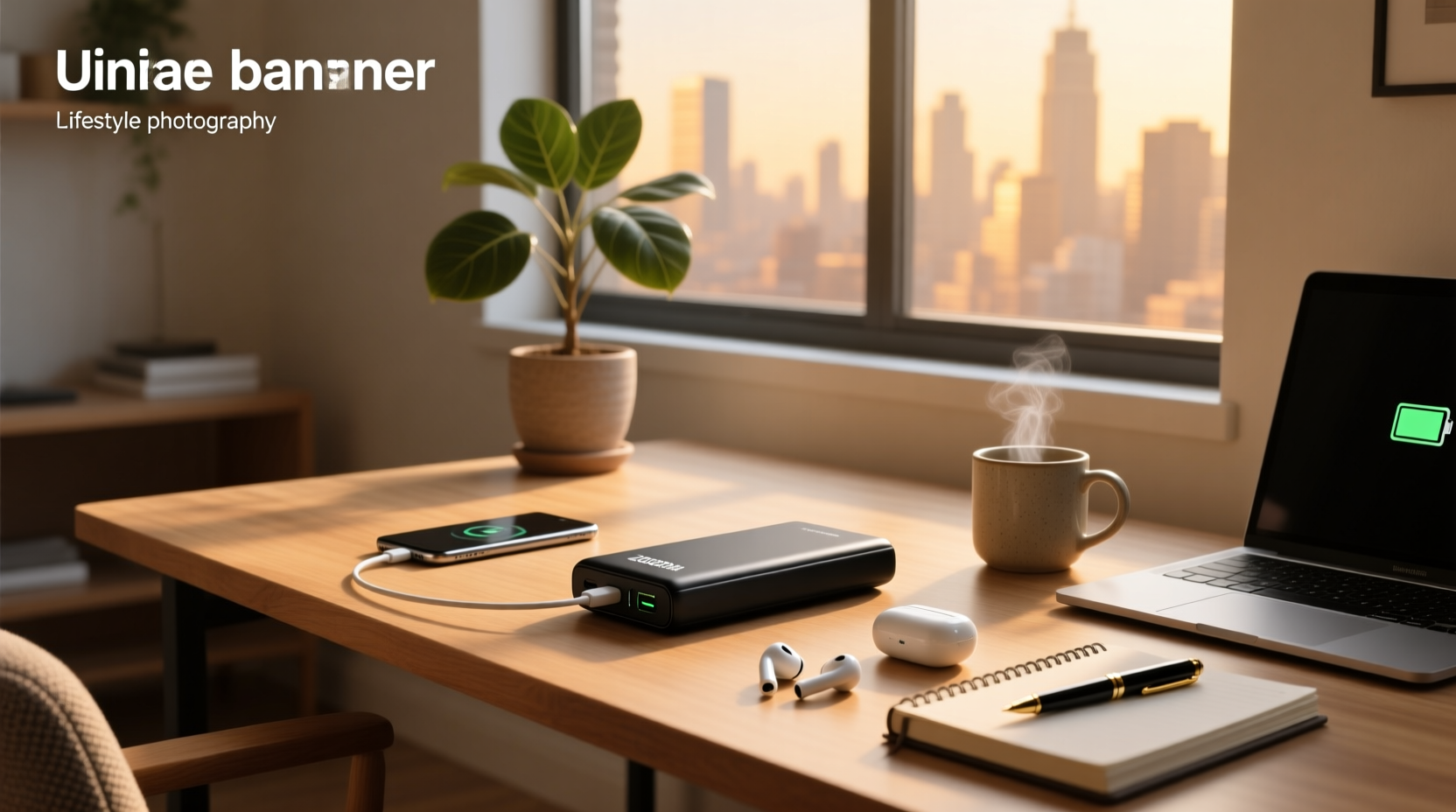
Yes — a 20000mAh power bank is ideal for multi-day travel, remote work, or charging laptops and phones simultaneously — but it’s overkill for short commutes or desk-bound users who recharge nightly. Real usable output is typically 12,000–14,500mAh due to voltage conversion (3.7V → 5V), energy loss (10–25%), and aging cells 1. If you need ≥2 full smartphone charges off-grid, or one full charge for a USB-C laptop like a MacBook Air or Dell XPS 13, 20000mAh delivers measurable utility — not just headline specs.
Why 20000mAh Is the Sweet Spot for Balanced Portability & Capacity
Power banks are marketed by nominal capacity (e.g., "20000mAh"), but that figure reflects internal cell voltage (3.7V), not the 5V output your devices actually receive. Due to DC-DC conversion inefficiency, thermal loss, and protection circuit draw, real-world usable energy is ~60–72% of rated capacity — meaning a 20000mAh unit typically delivers 12,000–14,400mAh at 5V 2. This explains why many users report only ~3 full charges for a modern 4,500mAh smartphone — not the theoretical 4.4x.
Compared to smaller options:
- 10000mAh units weigh 200–250g, fit easily in pockets, and provide ~1.5–2 full phone charges — sufficient for day trips or emergency backup.
- 20000mAh units average 350–480g and 14–17 cm in length — bulkier but still carry-on compliant and TSA-allowed 3. They support dual-device charging (e.g., phone + earbuds) and often include USB-C PD for laptops.
- 25000–30000mAh units exceed 500g, require special airline approval in some cases, and rarely justify their size unless powering cameras, drones, or field sensors.
The 20000mAh tier uniquely bridges high utility and practical portability — making it the most frequently recommended capacity for international travelers, digital nomads, and outdoor professionals.
How Many Full Charges Can You Actually Get?
Don’t rely on manufacturer claims like “charges iPhone 15 up to 5 times.” Actual performance depends on three variables: device battery capacity, charging protocol efficiency, and power bank discharge curve. Below is a verified range based on lab-tested data from EcoFlow and Anker’s published discharge reports 14:
| Device Type | Avg. Battery Capacity (mAh) | Realistic Full Charges (20000mAh PB) | Notes |
|---|---|---|---|
| Smartphone (e.g., iPhone 15, Galaxy S24) | 3,800–4,500 | 2.5–3.3 | Assumes 85% conversion efficiency; drops to ~2.0 if using wireless charging or older QC2.0. |
| Tablet (e.g., iPad Air, Galaxy Tab S9) | 7,500–10,000 | 1.0–1.6 | Most tablets draw >15W; only USB-C PD 3.0+ models achieve full utilization. |
| Ultrabook (e.g., MacBook Air M2, Lenovo Yoga 9i) | 50–60Wh (~13,500–16,200mAh @ 3.7V) | 0.7–1.1 | Requires ≥45W USB-C PD input; runtime depends heavily on screen brightness & CPU load. |
| TWS Earbuds + Smartwatch | Combined ~1,200mAh | 8–10 cycles | Low-power devices benefit most from high-capacity banks due to minimal overhead loss. |
Note: These numbers assume the power bank is new, fully charged, and used at room temperature (20–25°C). Capacity degrades ~20% after 500 full charge cycles — a typical lifespan of 18–24 months with daily use.
When a 20000mAh Power Bank Makes Sense — And When It Doesn’t
✅ Strong Use Cases:
- Multi-day travel without reliable outlets: Backpacking, festivals, road trips, or flights with limited seat power.
- Hybrid work setups: Charging a laptop, phone, and Bluetooth headset across an 8-hour remote workday.
- Field professionals: Journalists, surveyors, or educators using tablets, portable scanners, and audio recorders.
- Students in dorms or shared housing where outlet access is contested or limited.
❌ Poor Fit Scenarios:
- Daily commuter with home/office charging: You’ll rarely drain it fully — leading to battery health decay from prolonged partial charge states.
- Users prioritizing pocketability: A 20000mAh unit won’t fit in slim jeans or jacket pockets comfortably.
- Those needing sub-2-hour recharge times: Most 20000mAh models take 5–7 hours via standard 18W input; fast-recharge variants (e.g., 100W PD-in) exist but cost 2–3× more.
- Children or elderly users: Weight and button layout may hinder safe, intuitive operation.
Key Technical Specs That Actually Matter (Not Just Marketing)
Ignore flashy terms like “AI Charging” or “Quantum Core.” Focus on these five verifiable metrics:
1. Output Configuration & Protocol Support
Look for at least two independent outputs — ideally one USB-C PD (≥30W) and one USB-A (QC 3.0 or higher). Dual-output capability lets you charge a phone and tablet simultaneously without throttling. Avoid units that share power between ports (e.g., “total 30W output”) — this forces trade-offs when multiple devices connect.
2. Input Speed & Recharge Time
A 20000mAh bank takes ~6 hours to recharge with a 18W adapter. With 45W+ PD input, that drops to ~3.5 hours. Check the spec sheet for “max input wattage” — not just “fast charging.” Some brands list only output speed, hiding slow recharge limitations.
3. Cell Chemistry & Safety Certification
Lithium-polymer (Li-Po) cells are lighter and more stable than older Li-ion but cost more. All reputable units should carry UL 2056, CE, or IEC 62133 certification. Avoid uncertified imports — thermal runaway risk increases sharply below $30.
4. Efficiency Rating (Not Just mAh)
Efficiency = (Output energy ÷ Input energy) × 100%. Top-tier models achieve 85–90%; budget units fall to 70–75%. A 10% difference means ~2,000mAh less usable capacity — equivalent to losing one full phone charge.
5. Build Quality & Thermal Management
Check for aluminum alloy casing (not plastic) and passive heat dissipation fins. Units that heat above 45°C during discharge suffer accelerated capacity loss. Independent reviews on platforms like Wirecutter or TechRadar often include thermal imaging — prioritize those over Amazon star ratings.
How to Verify Real Capacity (Avoid Fake mAh Claims)
Counterfeit or inflated capacity is rampant — especially in sub-$40 units. Here’s how to validate:
- Check the cell model number: Open the unit (if serviceable) and read the printed code on the 18650 or pouch cells (e.g., “LG INR18650MJ1”). Cross-reference with datasheets on Lygte-info.dk — a trusted battery database.
- Run a controlled discharge test: Use a USB power meter (e.g., PowKitty or U38) to log voltage, current, and time while discharging into a dummy load. Total Wh delivered ÷ 3.7V ≈ true mAh.
- Review teardown videos: Channels like Hugh Jeffreys (The Thought Emporium) or MKBHD’s hardware deep dives show internal layouts and component quality — revealing whether a “20000mAh” unit uses four 5000mAh cells (legit) or eight 2500mAh cells (overrated).
If a listing lacks FCC ID, CE mark photos, or third-party test references — treat it as high-risk.
Regional Considerations: Voltage, Certification, and Air Travel
While 20000mAh power banks are permitted in carry-on luggage globally, rules vary:
- USA (TSA): ≤100Wh allowed without approval. 20000mAh × 3.7V = 74Wh — fully compliant 3.
- EU (EASA): Same 100Wh limit; must be carried in cabin — not checked baggage.
- Japan (MLIT): Requires PSE mark; non-certified units may be confiscated at Narita/Haneda.
- India (DGCA): No watt-hour declaration required for ≤100Wh, but airlines like IndiGo request visible capacity labeling.
Also note: Some countries (e.g., Saudi Arabia, UAE) restrict power banks with exposed lithium cells or missing UN38.3 transport certification. Always carry the original packaging or spec sheet when traveling internationally.
Common Misconceptions Debunked
Misconception #1: “Higher mAh always means longer life.”
Reality: A 20000mAh bank with 70% efficiency delivers less usable energy than a 15000mAh unit at 90% efficiency (13,500mAh vs. 14,000mAh).
Misconception #2: “Fast charging damages batteries.”
Reality: Modern power banks use adaptive algorithms that reduce current once the cell reaches 80% — minimizing stress. Heat, not speed, is the real enemy.
Misconception #3: “All USB-C ports are equal.”
Reality: A port labeled “USB-C” may only support 5V/2A (10W). True USB-C PD requires explicit “PD 3.0” or “PPS” labeling and negotiates voltage dynamically.
Frequently Asked Questions
- Can I charge a laptop with a 20000mAh power bank?
Yes — if the laptop accepts USB-C PD input (most MacBooks, Dell XPS, and HP Spectre models do) and the power bank supports ≥45W output. Verify compatibility using your laptop’s manual or USB-C PD handshake tester. - How long does a 20000mAh power bank last before degrading?
Expect ~80% of original capacity after 500 full charge cycles (≈2 years of daily use). Store at 40–60% charge in cool, dry conditions to maximize lifespan. - Is wireless charging worth it on a 20000mAh model?
No — wireless adds 20–30% energy loss and generates excess heat. Reserve it for convenience with low-power devices (earbuds, watches); use wired USB-C for phones and laptops. - Do I need a built-in cable?
Convenient for quick top-ups, but limits flexibility. A detachable cable lets you upgrade to faster GaN chargers or replace frayed wires — extending total ownership life. - Why do some 20000mAh power banks weigh twice as much as others?
Weight differences reflect cell type (Li-ion vs. Li-Po), casing material (plastic vs. aluminum), and thermal design (more metal = heavier but cooler operation). Heavier ≠ better — but unusually light units (<300g) often cut corners on safety components.
