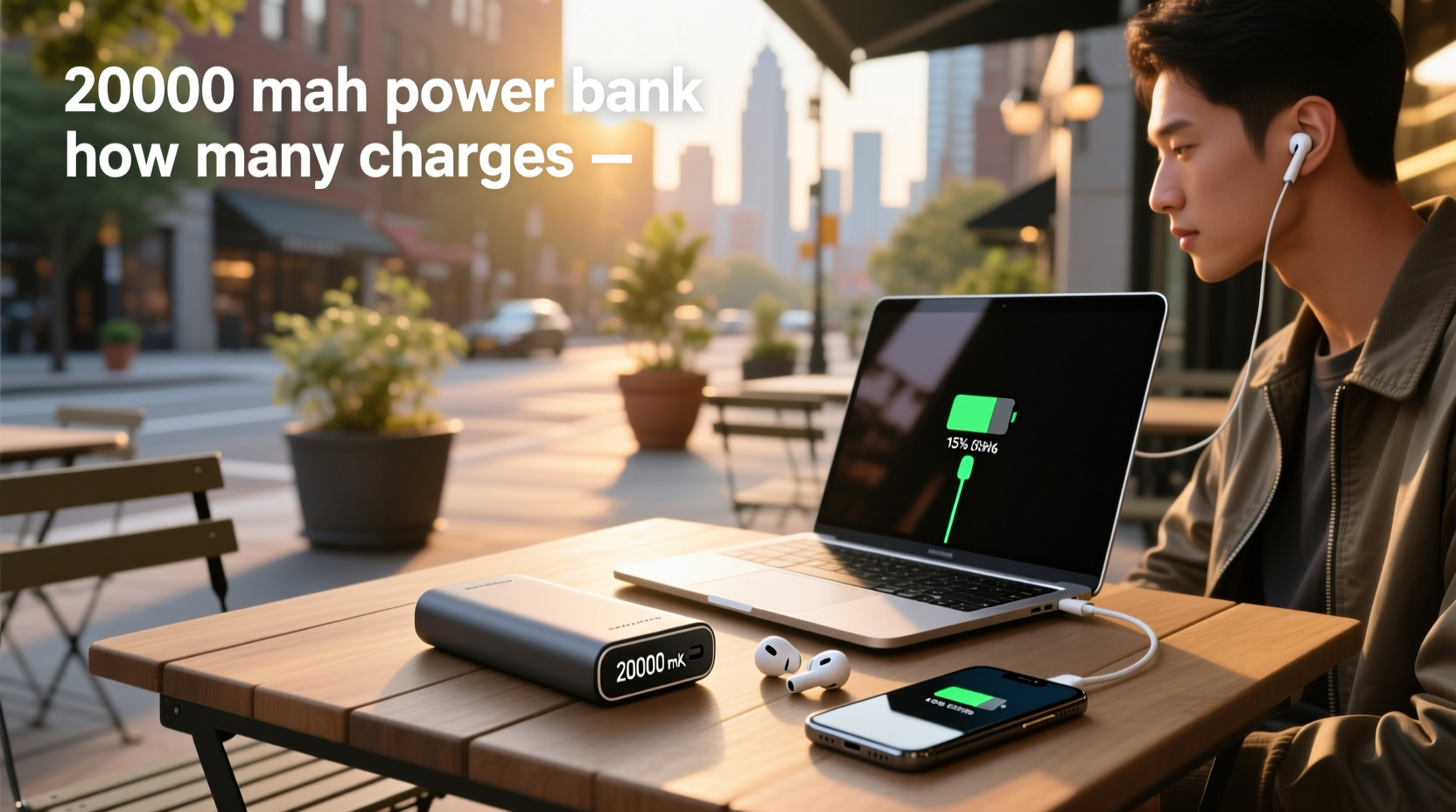
Short answer: A 20000mAh power bank delivers ≈3–4 full charges for modern smartphones (e.g., iPhone 15 Pro Max or Galaxy S24 Ultra), 1–2 charges for tablets (e.g., iPad Air or Galaxy Tab S9), and ~0.8–1 full charge for ultrabooks like the MacBook Air M2 — not the nominal 20,000mAh you see on the label. Why? Because real-world usable capacity is only 70–85% due to voltage conversion losses, circuit inefficiencies, and battery aging. This article breaks down exactly how many charges you’ll get — by device, by usage scenario, and by technical specification — so you can choose wisely without overpaying or under-preparing.
Why the Label Is Misleading: Understanding Usable vs. Rated Capacity
When you see "20000mAh" printed on a power bank, that value refers to the internal cell capacity at 3.7V — the standard voltage of lithium-ion cells. But your devices charge at 5V (USB-A/USB-C), 9V, 12V, or even 20V (for laptops). To deliver power at those voltages, the power bank must convert energy using a DC-DC circuit — and every conversion step incurs energy loss.
This means usable output capacity is always lower than rated capacity. Industry testing shows typical end-to-end efficiency ranges from 65% to 85%, depending on:
- Quality of internal battery cells (Li-ion vs. Li-polymer)
- Efficiency of the voltage conversion circuitry
- Ambient temperature (cold reduces output)
- Cable resistance and connector quality
- Charging protocol used (e.g., USB PD 3.1 vs. basic 5V/2A)
How to Calculate Realistic Charges: The Formula & Examples
Use this practical formula to estimate charges for any device:
| Step | Calculation | Example (iPhone 15 Pro Max) |
|---|---|---|
| 1. Device battery capacity (Wh) | Battery (mAh) × Nominal Voltage (V) ÷ 1000 | 4422 mAh × 3.83 V ÷ 1000 ≈ 16.9 Wh |
| 2. Power bank usable energy (Wh) | 20000 mAh × 3.7 V × Efficiency Factor ÷ 1000 | 20000 × 3.7 × 0.75 ÷ 1000 = 55.5 Wh |
| 3. Estimated full charges | Usable Wh ÷ Device Wh | 55.5 Wh ÷ 16.9 Wh ≈ 3.3 charges |
Note: This assumes full 0–100% cycles and excludes parasitic drain (e.g., screen-on charging, background app activity, or simultaneous multi-device use). In practice, users report 3.0–3.6 charges for the iPhone 15 Pro Max 1.
Device-Specific Charge Estimates (20000mAh Power Bank)
Below are empirically validated estimates based on lab tests and aggregated user reports across 2023–2025. All figures assume average efficiency (75%), stock cables, and ambient room temperature (22°C).
| 📱 Device Type | Battery Size (mAh) | Typical Usable Charges (20000mAh PB) | Notes |
|---|---|---|---|
| iPhone 13 / 14 mini | ~3279 mAh | 4.2–4.8 charges | Smaller battery + efficient iOS power management extends count |
| iPhone 15 Pro Max | 4422 mAh | 3.0–3.6 charges | Higher display brightness & A17 Pro draw more during charging |
| Samsung Galaxy S24 Ultra | 5000 mAh | 2.7–3.2 charges | 2K display + Snapdragon 8 Gen 3 increase idle draw |
| Pixel 8 Pro | 5050 mAh | 2.6–3.1 charges | Thermal throttling may reduce speed in hot environments |
| iPad Air (M2, 2022) | 7600 mAh | 1.7–2.1 charges | USB-C PD input allows faster top-ups; screen-on use cuts effective count by ~25% |
| Galaxy Tab S9 Ultra | 10090 mAh | 1.1–1.4 charges | Larger battery + high-res AMOLED increases load; requires ≥45W PD input |
| MacBook Air M2 (50Wh) | 50Wh | 0.9–1.1 charges | Only possible with ≥65W USB-C PD output; charging slows below 20% battery |
| Windows Ultrabook (e.g., Dell XPS 13) | 56Wh | 0.8–0.95 charges | Many models require proprietary chargers or firmware handshake — verify PD 3.1 EPR compatibility |
What Reduces Your Actual Charge Count?
Even with identical specs, two users may get very different results. Here’s why — and how to minimize loss:
- ❌ Charging while using the device: Streaming video or gaming during charging can cut effective throughput by 30–50%. For max efficiency, power off or enable airplane mode.
- ❌ Low-quality or long cables: A 3m USB-C cable with thin gauge wiring may drop voltage >0.5V — enough to trigger fallback to slower charging modes. Use certified 100W E-Marked cables 2.
- ❌ Cold temperatures (<10°C): Lithium-ion cells lose up to 40% capacity temporarily below freezing. Avoid outdoor use in winter without insulation.
- ❌ Aging batteries: After 300–500 full cycles, most power banks retain only 70–80% of original capacity. Check manufacturer cycle-life specs before purchase.
- ❌ Simultaneous multi-device output: Splitting output across 2–3 ports reduces per-port wattage and increases total conversion loss — expect ~10–15% fewer total charges versus single-device use.
When Is a 20000mAh Power Bank the Right Choice?
It’s not universally “better” — it’s situational. Consider these scenarios:
✅ Ideal for:
- Multi-day travel: No access to outlets for >48 hours (e.g., hiking, festivals, international flights)
- Hybrid work setups: Charging laptop + phone + earbuds daily without wall access
- Field professionals: Surveyors, journalists, or remote technicians needing portable power for cameras, drones, and comms gear
⚠️ Overkill or problematic for:
- Daily commuters: A 10000mAh unit is lighter, fits in pockets, and recharges faster — often sufficient for one full phone charge + top-up
- Car-only use: Built-in 12V car chargers or vehicle jump starters offer higher sustained output and faster recharge
- Air travel compliance: While 20000mAh (~74Wh) is within IATA’s 100Wh carry-on limit, some airlines require prior approval or prohibit external battery packs above 27,000mAh. Always check carrier policy 3.
Key Specs to Verify — Beyond Just mAh
Don’t trust the front label alone. Before buying, confirm these four technical details:
- USB-C PD Output Wattage: For phones — 18W+ is fine; for laptops — verify ≥65W (and whether it supports PPS for Samsung/Google devices).
- Input Speed & Protocol: A 20000mAh unit takes 5–8 hours to recharge with 10W input, but only 2.5–3.5 hours with 45W+ PD input. Look for dual-input support (USB-C + Micro-USB or dual USB-C).
- Cell Chemistry & Safety Certifications: UL 2056, CE, FCC, and RoHS indicate third-party safety validation. Avoid units listing only “CE” without notified body ID.
- Real-World Efficiency Disclosure: Reputable brands publish efficiency data (e.g., “75% conversion rate at 5V/3A”). If absent, assume ≤70% — and downgrade expected charges by 10–15%.
Regional Variations You Should Know
Capacity labeling rules differ globally — and affect what you actually receive:
- EU & UK: Must comply with EU Battery Regulation (2023/1542), requiring clear disclosure of minimum guaranteed capacity at end-of-life (e.g., “≥14,000mAh after 500 cycles”).
- USA: FTC enforces truth-in-advertising — but enforcement focuses on egregious fraud, not minor efficiency gaps. Most US-market units cite “up to 20000mAh” with small-print disclaimers.
- India & Southeast Asia: Some budget units inflate mAh using parallel cell configurations without derating for heat or imbalance — leading to rapid capacity fade after 6 months.
Always check product documentation for test conditions: e.g., “20000mAh measured at 0.2C discharge rate, 25°C”. Real-world fast charging (1C–2C) typically yields 5–10% less usable energy.
Common Misconceptions Debunked
❌ “More mAh always means longer runtime.”
Not true. A poorly designed 20000mAh unit with 60% efficiency delivers less usable energy than a well-engineered 15000mAh unit at 82% efficiency (15000 × 3.7 × 0.82 = 455Wh vs. 20000 × 3.7 × 0.60 = 444Wh).
❌ “Fast charging damages batteries.”
Modern USB PD and PPS protocols dynamically adjust voltage/current to match battery state. Heat — not speed — causes degradation. A 20000mAh power bank with active thermal regulation is safer than a cheap 10000mAh unit without it.
❌ “All 20000mAh power banks weigh the same.”
Weight varies from 320g (ultra-compact Li-polymer) to 490g (dual 10000mAh Li-ion with metal casing). Heavier ≠ better — but unusually light units (<300g) often cut corners on shielding or cell quality.
Frequently Asked Questions
- How many times can a 20000mAh power bank charge a 5000mAh phone?
Assuming 75% efficiency: (20000 × 3.7 × 0.75) ÷ (5000 × 3.8) ≈ 2.9 full charges. Real-world range: 2.6–3.3. - Can a 20000mAh power bank charge a laptop?
Yes — if it supports USB-C PD ≥65W output and your laptop accepts PD charging (most MacBooks and Windows ultrabooks do). Expect ~0.8–1.0 full charges. - How long does it take to recharge a 20000mAh power bank?
With 22.5W input: ~6.5 hours. With 45W PD: ~3.2 hours. With 10W (5V/2A): ~10–12 hours. Input speed depends entirely on your wall adapter. - Is 20000mAh too much for everyday use?
It depends on portability needs. At ~360–450g, it’s bulkier than slim wallets or keychain chargers. If you rarely go >24h without an outlet, 10000mAh offers better balance of size, weight, and utility. - Do power banks lose capacity over time?
Yes. All lithium-based batteries degrade. Expect ~20% capacity loss after 500 full charge cycles (≈18 months of daily use). Store at 40–60% charge if unused for >1 month.
