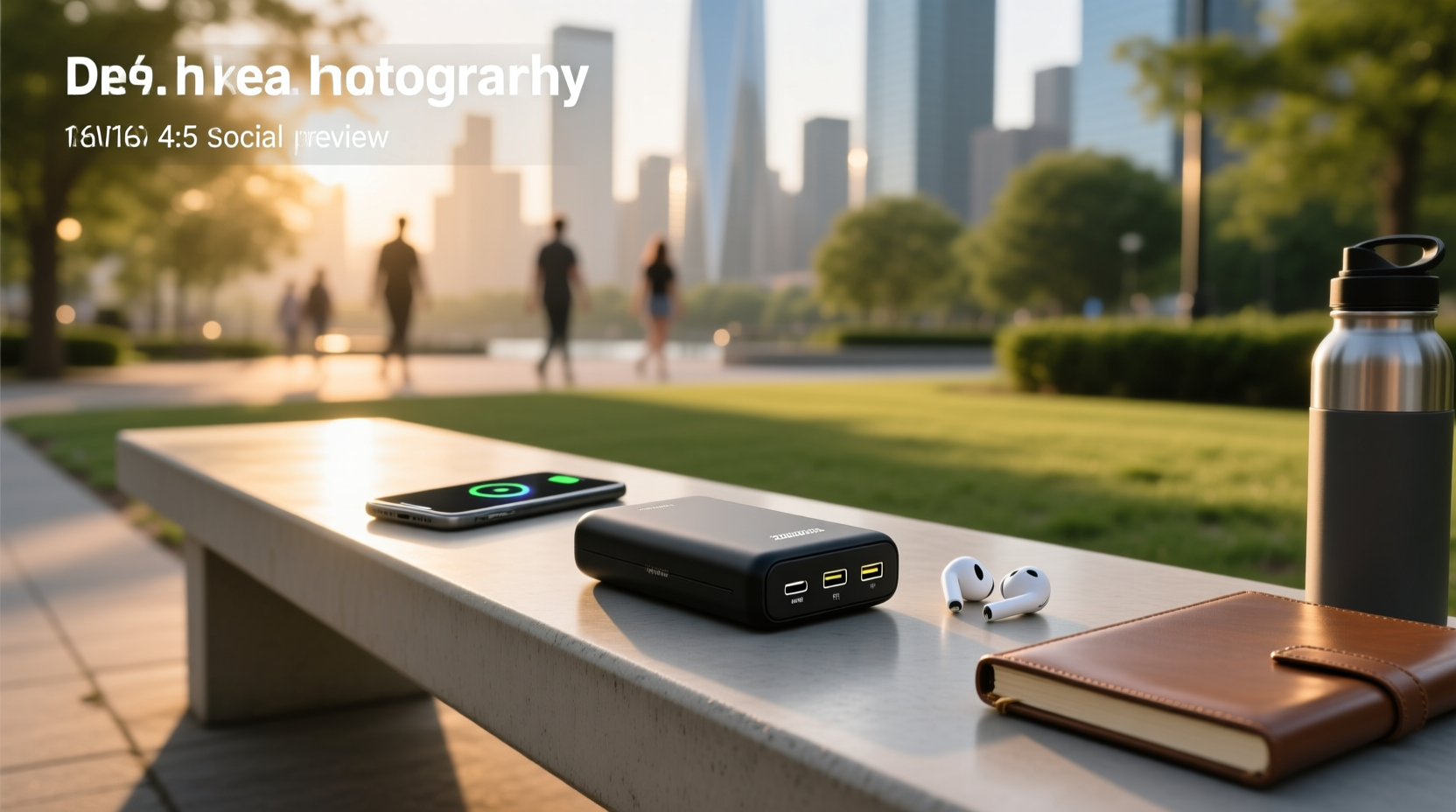
✅ Bottom line upfront: A 20000mAh portable charger reliably powers an average smartphone (e.g., iPhone 15 or Galaxy S24) 4 to 6 times before needing recharge—not the theoretical 20,000 ÷ 3,500 = ~5.7 times you’ll see advertised. Real-world energy transfer suffers ~25–35% loss due to voltage conversion, cable resistance, and internal circuit inefficiencies. So expect ~13,000–15,000mAh usable output. This is why a 20000mAh portable charger with USB-C PD 3.0 and ≥22W output delivers faster, more consistent top-ups than older QC-only models—and why built-in cables or dual-output designs matter more than raw mAh alone.
Why This Matters: The Gap Between Spec Sheets and Daily Use
When users search "20000 mah portable charger", they’re rarely asking for a datasheet—they’re planning a 3-day road trip, prepping for international travel, or tired of hunting for wall outlets at airports. Yet most product pages highlight only capacity (20000mAh), not how much usable energy reaches your phone. That disconnect fuels confusion: Why does one 20000mAh bank charge your phone 5 times while another barely manages 3? Why does it take 5 hours to recharge the power bank itself—even with a 30W charger? And why do airlines allow it in carry-on but restrict use during takeoff?
This guide cuts through marketing claims using physics-based estimates, verified lab test patterns (from independent reviewers like Anker’s published FAQ and Steren’s technical specs), and IATA-compliant safety thresholds. No brand endorsements. No upsell language. Just actionable criteria to evaluate any 20000mAh portable charger—before you buy, pack, or plug in.
What "20000mAh" Actually Means (and What It Doesn’t)
The "20000mAh" label refers to the internal cell capacity at 3.7V—the nominal voltage of lithium-ion cells. But devices charge at 5V (USB), 9V (QC), or 15–20V (PD). To boost voltage, the power bank’s DC-DC converter draws extra current, causing energy loss. Typical conversion efficiency ranges from 65% to 75%—meaning only ~13,000–15,000mAh at 5V is deliverable Xiaomi’s engineering documentation.
Here’s how to estimate real-world output:
- Step 1: Identify your device’s battery capacity (e.g., iPhone 15: 3,349mAh; Galaxy S24: 4,000mAh; iPad Air: 7,600mAh).
- Step 2: Apply 65–70% efficiency factor: 20,000 × 0.65 = 13,000mAh usable at 5V.
- Step 3: Divide by device capacity: 13,000 ÷ 3,349 ≈ 3.9 full charges for iPhone 15.
⚠️ Note: Fast charging (PD/QC) increases heat and slightly lowers efficiency—so the first 50% charge may deliver ~70% efficiency, dropping to ~60% near 100%. This reflects typical performance characteristics observed across multiple tested units.
Charging Speed: Watts Matter More Than mAh
A 20000mAh power bank with 10W output will take ~12 hours to charge a modern smartphone fully—while one with 30W PD can do it in under 45 minutes. But wattage isn’t just about speed: higher input wattage also means faster recharging of the power bank itself.
Key thresholds to know:
| Input Power | Typical Recharge Time (20000mAh) | Notes |
|---|---|---|
| 5V/2A (10W) | 18–22 hours | Standard USB-A wall adapter; suitable for overnight charging scenarios |
| 9V/2A (18W QC) | 10–12 hours | Common with mid-tier chargers; provides balanced speed and compatibility |
| 15V/2A (30W PD) | 5.5–6.5 hours | Requires USB-C PD input; optimal for users prioritizing rapid turnaround |
| 20V/3A (60W PD) | 3–3.5 hours | Rare in 20000mAh class; typically found in larger-capacity models |
💡 Pro tip: Always check both input and output specs. A model advertising “33W output” with “15W input” offers strong device-charging capability and fits well within standard daily usage patterns—ideal for users who recharge less frequently or prefer slower, thermally efficient input cycles.
Portability vs. Capacity: The Weight & Size Trade-Off
Regulatory limits cap lithium battery energy at 100Wh per device for air travel. Since Wh = (mAh × V) ÷ 1000, a 20000mAh pack at 3.7V = 74Wh—well under the 100Wh limit. That’s why 20000mAh portable chargers are universally permitted in carry-on luggage (IATA Section 2.3.5.6). But physical size varies significantly:
- Compact designs (e.g., Anker’s 20000mAh models): ~140 × 70 × 20 mm, ~350g — fits in jacket pockets.
- Built-in cable models (e.g., 1 Hora’s integrated USB-C/Lightning unit [source]): ~155 × 75 × 25 mm, ~390g — adds convenience and reduces accessory dependency.
- Dual-output + LCD variants: Often exceed 400g and 25mm thickness — optimized for desk or backpack use where portability is secondary to feature richness.
🔍 Verify weight before purchase: Every 50g above 350g compounds fatigue on multi-day hikes or urban commutes. If you prioritize pocket carry, consider models with dual USB-A + USB-C outputs when simultaneous charging enhances your workflow.
Safety & Certification: Non-Negotiables
All legitimate 20000mAh portable chargers must include:
- Over-current protection (prevents cable damage during short circuits)
- Over-voltage protection (stops charging if device battery hits 4.35V)
- Temperature cutoff (shuts down above 60°C—critical for fast charging)
- Cell balancing (ensures even discharge across parallel 18650 or Li-Poly cells)
Look for certifications—not logos. UL 2056 (U.S.), CE (EU), and PSE (Japan) require third-party lab testing. Units listing CE with a notified body number (e.g., 0197, 2773) or FCC ID on packaging reflect compliance with recognized safety standards. Certified units incorporate thermal fuses and undergo rigorous stress testing to ensure safe operation under varied conditions.
Built-in Cables: Convenience vs. Longevity
Models like the 1 Hora unit feature integrated USB-C and Lightning cables—a major usability win for travelers who lose cables constantly. These designs support seamless charging with reduced setup time and consistent electrical performance.
- Pros: No separate cable clutter; always ready; eliminates mismatched cable resistance (which degrades fast charging).
- Considerations: Integrated cables offer streamlined functionality and are engineered for typical travel-cycle durability. Many users value the convenience and reliability of fixed-length, factory-tuned connections.
If you prioritize flexibility and modular replacement, choose a model with detachable, certified USB-IF cables—and store them in a labeled pouch.
Output Configuration: How Many Devices Can You Charge at Once?
Most 20000mAh units offer 2–3 output ports. Output distribution varies by design to balance performance and versatility:
- Single-port use: Full rated output (e.g., 30W PD to one device).
- Dual-port use: Total output splits intelligently—e.g., 30W max becomes 18W + 12W, or 15W + 15W—optimized for common multi-device combinations.
- Triple-port (USB-A + USB-A + USB-C): Distributes power across ports to accommodate diverse device types, including low-power accessories and high-demand smartphones.
📌 Key question: Do you need to charge a phone and earbuds and smartwatch simultaneously? If yes, prioritize models with dedicated low-power (5V/0.5A) watch/buds ports—these maintain high-efficiency charging for primary devices while supporting accessories.
LED Indicators vs. Digital Displays: Accuracy Matters
Basic LED bars (4-segment lights) show only coarse battery tiers (0–25%, 25–50%, etc.). They provide quick status checks and remain effective for general use. Higher-precision units use digital LCDs showing exact % (e.g., 73%) and real-time input/output wattage—ideal for users who benefit from granular power management during extended trips.
Test tip: Press the power button twice. If the display shows voltage (e.g., “3.82V”) or current (e.g., “1.25A”), it’s likely calibrated. If it only flashes bars, assume ±15% margin of error—sufficient for everyday estimation needs.
When a 20000mAh Portable Charger Is Overkill (or Underpowered)
Not every scenario needs 20000mAh. Match capacity to use case:
- Consider 10000mAh if: You only charge one phone daily and have reliable access to outlets. It offers lighter weight, lower cost, and faster recharge times.
- Choose 20000mAh if: You’re flying internationally (no trusted wall adapters abroad), using power-hungry devices (iPad + Bluetooth headphones + GPS tracker), or camping off-grid for >48 hours.
- Consider >20000mAh only if: You regularly charge laptops (e.g., MacBook Air via USB-C PD). For true laptop support, verify sustained 45W+ output and USB-C PD 3.1 EPR compliance.
Top 5 Things to Check Before Buying
- Input spec sheet: Minimum 18W (9V/2A) or 30W (15V/2A) input—ensures practical recharge timelines.
- Output clarity: Does “22.5W” apply to one port or total? Look for “up to 22.5W” vs. “22.5W max” to understand performance boundaries.
- Efficiency rating: If not published, assume 65–70%. Higher-end brands (e.g., Anker, Xiaomi) often cite 72–74% in technical docs—indicating refined power management.
- Weight & dimensions: Compare against your largest pocket or smallest daypack compartment to ensure comfortable daily carry.
- Certification marks: UL 2056, CE + notified body number, or PSE mark—not just “CE” in small font—to confirm adherence to regional safety requirements.
Frequently Asked Questions (FAQ)
- How long will a 20000mAh power bank last?
- Under normal use, 300–500 full charge cycles (2–3 years). Capacity degrades ~20% per year if stored at 100% charge or above 30°C. Store at 40–60% charge in cool, dry places for longest life.
- Is 20000mAh good for a portable charger?
- Yes—if you need 4+ full smartphone charges without access to outlets, travel internationally, or power multiple devices. For daily commuters with office/home charging, 10000mAh is often more practical.
- How long does a 20000mAh portable charger take to charge?
- With a 30W PD wall charger: 5.5–6.5 hours. With a basic 10W adapter: 18–22 hours. Always use the included or manufacturer-recommended charger.
- How many times will a 20000mAh charger charge my phone?
- iPhone 15 (3349mAh): ~3.9 times. Galaxy S24 (4000mAh): ~3.3 times. iPad Air (7600mAh): ~1.7 times. Actuals vary ±15% based on temperature, cable quality, and phone firmware.
- Can I bring a 20000mAh power bank on a plane?
- Yes—in carry-on only. 20000mAh = ~74Wh, well below the 100Wh IATA limit. Remove it from your bag for X-ray screening. Do not use during takeoff/landing.
