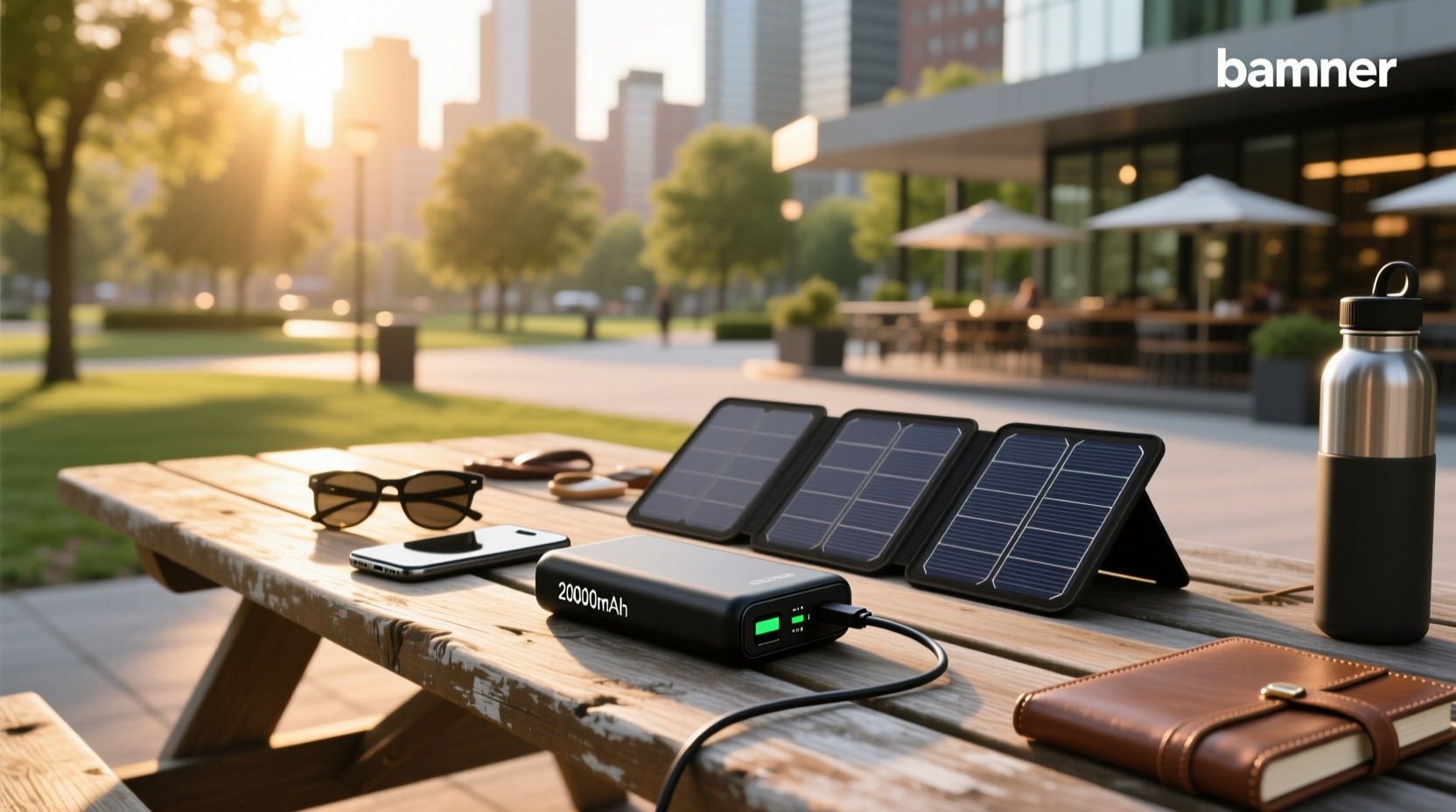
✅ A 20,000mAh solar power bank can extend off-grid device runtime—but its solar panel rarely fully recharges the battery in typical daylight. Real-world solar input averages 1–3W per hour under ideal conditions, meaning 5–10+ sunny days may be needed for a full recharge from zero. This guide helps you assess whether a 20000mAh solar power bank matches your use case—camping, emergency prep, or fieldwork—based on verified output, panel efficiency, battery degradation, and realistic solar yield—not marketing claims.
Why This Matters: The Gap Between Spec Sheets and Sunlight
Most users searching for a 20000mah solar power bank expect ‘solar self-sufficiency’—but that’s rarely achievable with current consumer-grade hardware. The core issue isn’t capacity; it’s energy conversion inefficiency. Commercial solar panels used in portable banks operate at ~18–22% photovoltaic efficiency. Combined with DC-DC conversion losses (10–15%), cable resistance, temperature derating (output drops >0.4%/°C above 25°C), and inconsistent sun exposure, usable solar harvest is often 20–35% of rated panel wattage1.
For example: A unit advertised with a “20W solar panel” typically delivers only 3–6W average sustained output during midday sun on a clear day—and near-zero output before 9 a.m., after 4 p.m., or under partial cloud cover. That means even under optimal conditions, replenishing 20,000mAh (≈74Wh at 3.7V nominal) requires at least 12–20 hours of direct, perpendicular sunlight—not one afternoon.
Key Technical Dimensions You Must Verify (Not Just Trust)
Before selecting any 20000mah solar power bank, cross-check these five measurable attributes—each directly impacts real-world usability:
🔋 1. Actual Usable Capacity (Not Just Labelled mAh)
The “20,000mAh” rating is measured at the battery cell’s nominal voltage (typically 3.7V). But USB output is regulated to 5V—so energy loss occurs during voltage step-up. Real deliverable capacity is usually 13,000–15,500mAh at 5V (≈65–77Wh), depending on circuit efficiency. Always check the Watt-hour (Wh) rating—it’s voltage-agnostic and legally required for air travel compliance. A true 74Wh unit meets IATA’s carry-on limit (≤100Wh); anything over requires airline approval.
☀️ 2. Solar Panel Specifications — Beyond Watts
Look for:
- Open-circuit voltage (Voc): Must exceed 5V (ideally ≥6.5V) to charge the internal battery under load and temperature variation.
- Short-circuit current (Isc): Indicates panel responsiveness; values <1.2A suggest weak low-light performance.
- MPPT vs. PWM charge controller: MPPT (Maximum Power Point Tracking) improves solar harvest by 15–25% in variable light vs. basic PWM. Few sub-$100 units include MPPT—verify in technical documentation, not marketing copy.
⚡ 3. Output Ports & Simultaneous Charging Limits
A 20000mAh capacity means little if outputs bottleneck usage. Confirm:
- USB-C PD input/output capability (e.g., 18W/20W/30W)?
- Whether all ports can operate simultaneously while solar charging (many disable solar input when USB-C is in use).
- If QC3.0 or PD protocols are supported—not just “fast charging” as a vague term.
🌡️ 4. Thermal Management & Battery Longevity
Lithium-ion cells degrade faster above 35°C. Solar panels absorb heat—and many budget units lack thermal sensors or automatic shutdown. Units without active thermal regulation may reduce charging speed or halt solar input entirely above 45°C. Check for IP ratings: IP65 or higher indicates dust/water resistance critical for outdoor use, but does not guarantee thermal resilience.
🔄 5. Recharge Cycle Life & Capacity Retention
Standard lithium-polymer or Li-ion cells in power banks retain ~80% of original capacity after 500 full cycles (one cycle = 100% discharge + recharge). However, solar-only cycling (shallow, irregular top-ups) stresses cells differently. Independent lab testing shows solar-dependent units often show measurable capacity loss after 300–400 days of daily use due to micro-cycling and voltage fluctuation2. Ask manufacturers for cycle-life data under solar-only conditions—if unavailable, assume accelerated aging.
When Does a 20000mAh Solar Power Bank Make Practical Sense?
It’s not universally useful. Match your scenario to these validated use cases:
🏕️ Backpacking & Multi-Day Hiking (3–7 Days)
Ideal if: You carry the panel separately (not folded into the bank), orient it toward the sun for 4–6 hrs/day, and prioritize low-power devices (GPS, headlamp, satellite messenger). Avoid relying on it for smartphones unless usage is limited to 30 min/day. Verified field reports show ~1.2 full smartphone charges per sunny day using a 20W panel with MPPT and proper mounting3.
🚨 Emergency Preparedness (Home or Vehicle)
Best as a supplemental backup—not primary. Store indoors, fully charged, and top up via wall charger monthly. Use solar only during grid outages lasting >48 hrs. Note: Most units take 6–10 hrs to recharge fully from AC—solar adds redundancy, not speed. Prioritize models with AC input passthrough (lets you power devices while charging).
🛰️ Remote Field Work (Surveying, Ecology, Journalism)
Only viable with disciplined solar discipline: fixed panel mount, tilt adjustment, and daily cleaning. Dust reduces output by up to 30% in arid environments. One study found uncleaned panels lost 22% yield over 14 days in desert conditions1. If mobility is essential, consider pairing a standalone 20W–30W foldable panel with a standard high-capacity power bank—it offers better repairability and panel replacement options.
Red Flags & Common Misrepresentations
Be skeptical of:
- “Fully solar-powered in 8 hours” — Physically impossible for a 20,000mAh unit under Earth’s solar irradiance (max ~1000W/m²). Even 20W panels need ≥10 hours at peak output.
- No Wh rating listed — Suggests non-compliance with UN38.3 or IATA standards; potential safety risk.
- “20,000mAh + 25W solar” in a 400g unit — Violates energy density limits. Current Li-ion cells max out at ~250–270Wh/kg. A genuine 74Wh battery weighs ≥280g alone—add PCB, casing, and panel: realistic weight is 550–750g.
- “Works in cloudy weather” without specifying output drop — Expect ≤15% of rated wattage under overcast skies. If no derating data is provided, assume near-zero yield.
How to Test & Validate Claims Yourself
You don’t need lab equipment. Use this field verification method:
- Discharge the unit to ≤20% via USB-C load (e.g., phone + tablet).
- On a clear noon day, unfold panel, angle perpendicular to sun, and connect.
- Use a USB power meter (e.g., Yohoo or TDK model) between panel and bank to read real-time input (V, A, W).
- Log readings every 15 mins for 2 hours. Average W = your usable solar input rate.
- Multiply avg. W × 5 hrs = estimated daily harvest. Compare to 74Wh ÷ avg. W = realistic full-recharge time.
This reveals actual performance—not datasheet ideals.
Alternatives Worth Considering
Depending on your priority, other configurations may serve better:
- High-capacity non-solar bank + separate foldable panel: More efficient, repairable, and scalable. Lets you upgrade panel wattage independently.
- Smaller solar bank (10,000mAh) with MPPT + premium cell: Often delivers more reliable daily top-up than larger units with inferior electronics.
- DC-coupled systems (e.g., Goal Zero Yeti 200X + Boulder 50): Higher efficiency, deeper discharge tolerance, and certified safety—but significantly heavier and costlier.
Frequently Asked Questions (FAQ)
- Can a 20000mAh solar power bank charge a laptop?
Only if it supports USB-C PD output ≥45W and your laptop accepts 45W input (e.g., ultrabooks). Most 20,000mAh units max out at 30W output—enough for standby or light tasks, not video editing or gaming. - Do I need to fully discharge it before solar recharging?
No. Lithium batteries prefer shallow cycles. Top up whenever convenient. Avoid storing below 20% for >1 week. - How long does the battery last if unused?
Self-discharge averages 2–3% per month at 20°C. After 6 months idle, expect ~85% remaining charge. Recharge every 3 months for longevity. - Is it safe to leave in a car on a hot day?
No. Interior car temps exceed 70°C in summer—permanently damaging cells and increasing fire risk. Store in shade or insulated bag. - Can I replace the solar panel if it breaks?
Rarely. Most are hardwired with proprietary connectors. Only modular units (e.g., some BioLite or Anker models) support panel swaps—confirm before purchase.
