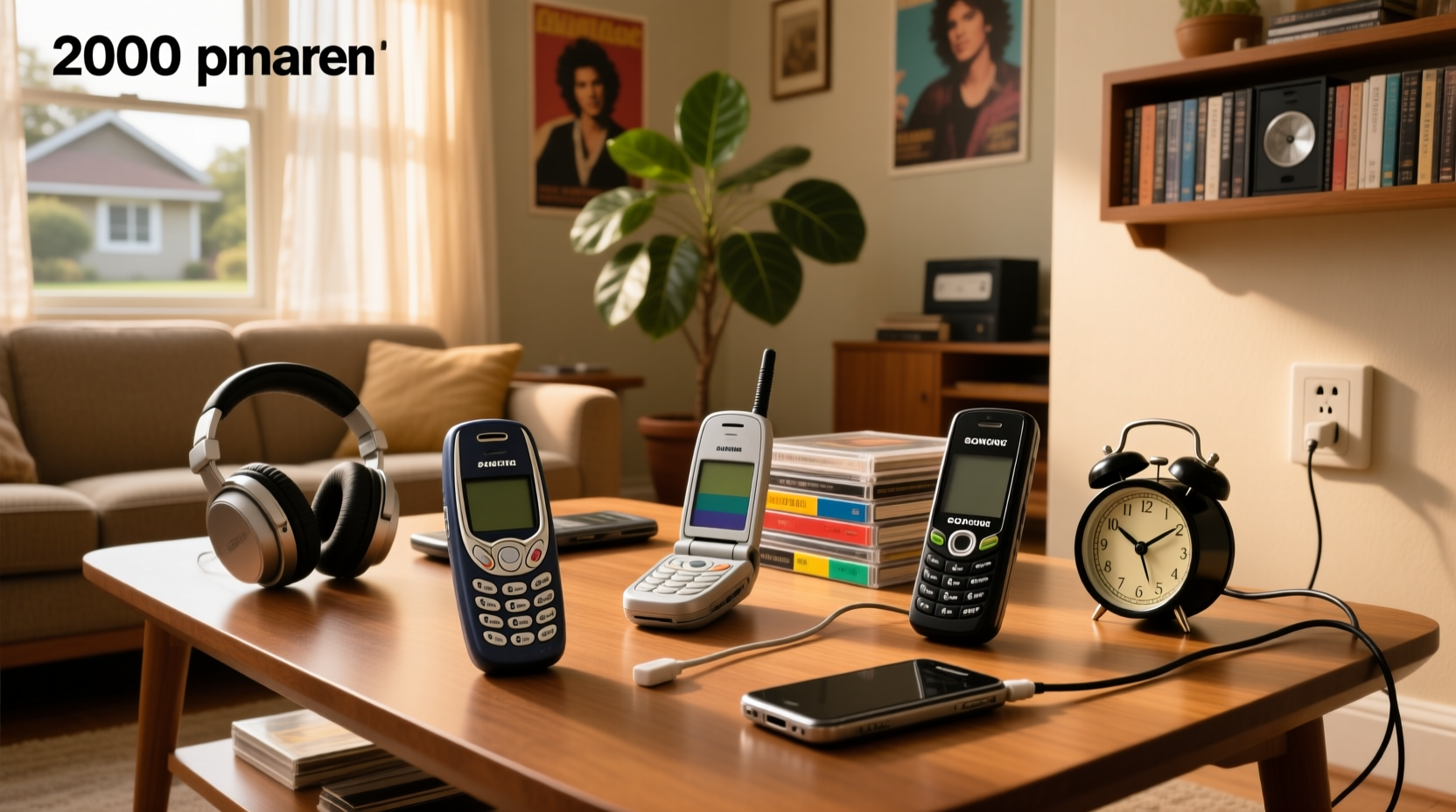
Looking for mobile phones 2000s — not just nostalgia, but a clear, evidence-based breakdown of which models defined the decade, why they mattered technically and culturally, and how their design, connectivity, and capabilities compare to today’s expectations? This guide answers exactly that. You’ll learn which devices pioneered real-world 3G adoption 1, which introduced the first mass-market camera phone in North America 1, and why the Nokia 3310 reflected a deliberate engineering philosophy that prioritized battery life, repairability, and universal usability. We cover launch years, hardware specs, regional availability differences, and what ‘smartphone’ actually meant before iOS or Android existed.
Why the 2000s Were the Defining Decade for Mobile Evolution
The 2000s (2000–2009) weren’t just a transition period — they were the foundation layer of modern mobile computing. Unlike the 1990s, where phones were voice-only accessories, or the 2010s, where smartphones became pocket computers, the 2000s established the core trade-offs still relevant today: form factor vs. function, network capability vs. battery life, and brand ecosystem vs. interoperability. Global mobile penetration rose from ~10% in 2001 to ~60% by 2009 1. That growth wasn’t driven by one device — it was enabled by divergent, purpose-built designs serving distinct user needs: students needing long battery life and SMS reliability; business users demanding email sync and physical keyboards; teens prioritizing customization and multimedia; and early adopters testing nascent data services.
Key Mobile Phone Categories of the 2000s
Understanding the 2000s requires moving beyond ‘dumb phone vs. smartphone’. The era featured four dominant categories — each with distinct technical constraints, use cases, and lifecycle expectations:
📱 Feature Phones (2000–2006)
These were the workhorses — devices built around voice, SMS, and basic utilities (alarm, calculator, notes). Key traits included:
- Monochrome or CSTN color displays (typically 128×128 to 176×220 pixels)
- Removable Ni-MH or Li-Ion batteries (often rated for 300–500 hours standby)
- No app stores; software limited to preloaded Java ME (J2ME) apps — games like Snake II or simple utilities
- No continuous data connection; GPRS was ‘always-on’ only in theory — real-world usage involved manual connection triggers
⚙️ Flip & Slider Phones (2003–2008)
Form factor innovation peaked here. These designs addressed ergonomic and functional needs:
- Mechanical protection: Flipping closed shielded keypads and screens from scratches and pocket damage.
- Space optimization: Sliders (e.g., Samsung D600, 2005) exposed numeric keypads only when needed, enabling larger screens without increasing footprint 3.
- Brand differentiation: The Motorola Razr V3 (2004) used aircraft-grade aluminum and laser-etched keypad — a design approach emphasizing premium materials in a category historically dominated by plastic 4. Its 13.9mm thickness set a new benchmark for slimness while maintaining functionality.
📷 Camera Phones (2002–2007)
The Sanyo 5300 (2002) was the first camera phone commercially available in North America — with a 0.3-megapixel sensor and no flash 1. Crucially, it lacked onboard storage: photos were sent directly via MMS or viewed on-device only. True utility arrived later: the Sony Ericsson K700i (2004) added 1GB Memory Stick Duo support and a dedicated camera button; the Nokia N70 (2005) bundled a 2-megapixel sensor with Carl Zeiss optics — the first mainstream phone to treat imaging as more than a novelty. Image quality evolved steadily throughout the decade, with improvements in lens design, low-light sensitivity, and processing capabilities.
🌐 Early Smartphones (2002–2009)
‘Smartphone’ had no consistent definition then. It meant different things across platforms:
- BlackBerry OS (2002–2009): Prioritized push email, physical QWERTY keyboards, and enterprise security. Devices like the BlackBerry 7100t (2004) supported integration with corporate infrastructure through standardized protocols.
- Palm OS (Treo 650, 2004): Combined PDA functionality (calendar, contacts syncing via desktop) with cellular voice — offering seamless synchronization workflows for productivity-focused users.
- Windows Mobile (HTC Universal, 2005): Ran desktop-like apps (Pocket Excel, Word), supporting familiar productivity tools on mobile hardware.
- iOS debut (iPhone, 2007): Not a ‘smartphone upgrade’ — it redefined interaction. No physical keyboard, capacitive multi-touch, inertial scrolling, and WebKit browser capable of rendering full desktop sites. The iPhone 3G (2008) added GPS and App Store — establishing a scalable model for third-party application distribution 5.
How Network Technology Shaped Device Capabilities
You can’t understand 2000s phones without understanding their networks. Bandwidth, latency, and billing models dictated what devices could realistically do:
📡 2G (GSM/GPRS/EDGE)
Standard through 2005. Max theoretical speeds: GPRS = 40 kbps, EDGE = 236 kbps. Real-world throughput averaged 15–40 kbps — enough for email and WAP browsing, but not video. Data plans were metered per KB (not MB), often costing $0.01–$0.05 per KB. This economic and technical context influenced device design priorities — favoring efficiency and reliability over bandwidth-intensive features.
📶 3G Launch & Rollout (2003–2008)
Third-generation networks began commercial deployment in Japan (2001), followed by the UK (2003), US (2004), and EU (2005–2007). Key 3G standards:
- UMTS (WCDMA): Used by most GSM carriers; offered 384 kbps downlink initially, later upgraded to 7.2 Mbps (HSPA).
- CDMA2000 1xEV-DO: Dominant in North America (Verizon, Sprint); similar speeds but incompatible infrastructure.
3G required new radios, antennas, and power management — meaning early 3G phones (e.g., Sony Ericsson W950i, 2006) incorporated updated hardware architectures to support higher-speed data. Battery life management evolved alongside network capability, with manufacturers optimizing power delivery systems to maintain usability across generations. Coverage expanded progressively: In 2005, initial 3G service was available in select metropolitan areas, growing steadily through carrier investment and spectrum allocation.
Regional Differences You Can’t Ignore
There was no global ‘2000s phone’. Hardware, software, and even naming varied significantly by market:
🌍 Europe & Asia-Pacific
GSM dominance meant near-universal SIM card compatibility. Nokia and Sony Ericsson led in feature sets: FM radio (standard by 2005), microSD expansion (introduced on Nokia 6630, 2004), and dual-band (900/1800 MHz) or tri-band (900/1800/1900 MHz) support. Japanese models advanced rapidly: Sharp’s 903SH (2006) featured 3.2-megapixel cameras, 1seg TV tuner, and fingerprint sensors — demonstrating region-specific innovation paths.
🇺🇸 North America
Carrier lock-in was common. Phones were sold subsidized with 2-year contracts — unlocking required carrier permission (and often a fee). CDMA networks (Verizon, Sprint) used RUIM cards instead of SIMs, reflecting infrastructure diversity. T-Mobile’s Sidekick (2002) stood out: designed for teens, with swivel screen, instant messaging focus, and cloud-synced contacts — illustrating how service ecosystems shaped device functionality.
🇿🇦 Africa & Emerging Markets
Nokia 1100 and 1110 dominated — recognized for ruggedness, ultra-low power draw, and multilingual support. In Zambia, Alcatel and Bosch phones gained traction due to localized distribution channels and repair networks — highlighting the importance of service infrastructure alongside technical specifications. Durability and battery life remained central considerations across diverse usage environments.
Common Misconceptions About 2000s Phones
Let’s clarify what the record shows — not what memory romanticizes:
❌ ‘All Nokia Phones Were Indestructible’
Only specific models (3310, 1100, 1110) earned durability recognition. Later N-series smartphones (N95, 2007) used materials optimized for multimedia performance and compact form factors — reflecting evolving design priorities across product lines. The 3310’s reputation stemmed from thick polycarbonate construction, minimal internal flex cables, and a sealed battery compartment — characteristics aligned with its target use case.
❌ ‘The iPhone Invented the Touchscreen Phone’
Motorola unveiled a black-and-white resistive touchscreen prototype in 2000 1. Palm’s Treo 180 (2002) shipped with a resistive touchscreen + stylus. These early implementations laid groundwork for interface evolution, with capacitive multi-touch and gesture-aware software emerging as complementary advancements later in the decade.
❌ ‘Camera Phones Replaced Digital Cameras Immediately’
No. Early camera phones had limitations: no optical zoom, modest low-light performance, and no RAW capture. Consumer digital cameras (like Canon PowerShot A75, 2003) offered 3x optical zoom, dedicated exposure controls, and 3–5 megapixels — providing distinct value propositions. Camera phones and digital cameras coexisted, each serving complementary roles in personal imaging workflows.
How to Identify Authentic 2000s Phones Today (For Collectors or Researchers)
If you’re verifying a device’s era or authenticity:
- Check FCC ID or CE mark: Look for certification dates on label under battery — e.g., ‘FCC ID: IY5RAZR’ confirms Motorola Razr V3 (2004).
- Verify chipset generation: Qualcomm MSM6275 (2005) or TI OMAP 1710 (2004) indicate mid-decade devices; earlier chips like Philips Nexperia PNX4000 (2002) point to early 2000s.
- Examine software version: Symbian OS v7.0s (Nokia 6600, 2003) vs. v9.2 (N95, 2006) provides reliable dating.
- Avoid ‘retro’ reissues: Modern Nokia-branded ‘3310’ models (2017+) use MediaTek chipsets and run KaiOS — not the original Series 30 platform.
Why This History Still Matters Today
Understanding 2000s mobile phones isn’t about nostalgia — it’s about recognizing foundational trade-offs that persist:
- Battery vs. capability: Today’s 5G modems present similar engineering challenges — prompting OEMs to balance peak speed with energy efficiency.
- Form factor constraints: Foldables echo the flip/slider logic: balancing screen size with portability and mechanical reliability.
- Network dependency: Just as 3G rollout dictated usable features in 2005, 5G SA (Standalone) deployment now influences whether mmWave or sub-6GHz delivers intended performance benefits.
When evaluating modern devices, ask the same questions 2000s engineers did: What problem does this solve for the user — not the spec sheet? What compromises does this enable — and are they acceptable in daily use?
Frequently Asked Questions
- What was the most popular phone brand in the 2000s? Nokia held ~40% global market share from 2001–2007, driven by volume sales of entry-level and mid-tier feature phones like the 1100 and 6300. Motorola peaked at ~20% in 2004–2005, largely due to Razr V3 demand 7.
- What cell phones were available in 2004? Key models included Nokia 6230 (color screen, Bluetooth, MMC slot), Motorola Razr V3 (ultra-thin flip), Sony Ericsson K700i (2MP camera, Memory Stick Duo), and Samsung X427 (slider with VGA camera) — all running on 2G networks, with early 3G trials in select cities.
- Why is Gen Z buying dumb phones today? Not for nostalgia — but for reduced distraction, longer battery life (7–14 days), and lower cost. Modern ‘dumb phones’ like the Nokia 2720 Flip run KaiOS, supporting WhatsApp and Google Maps — bridging 2000s simplicity with essential 2020s services.
- Were there any Android phones in the 2000s? Yes — the HTC Dream (T-Mobile G1), launched October 2008, was the first commercially available Android device. It ran Android 1.0, had a slide-out QWERTY keyboard, and introduced foundational elements of the Android ecosystem.
- How much did a typical 2000s phone cost? Subsidized prices ranged from $0–$100 with 2-year contract. Unlocked prices: Nokia 3310 ($130, 2000), Motorola Razr V3 ($500, 2004), iPhone (original, $499–$599, 2007) — all without mandatory data plans (unlike today’s $30+/month minimum).
