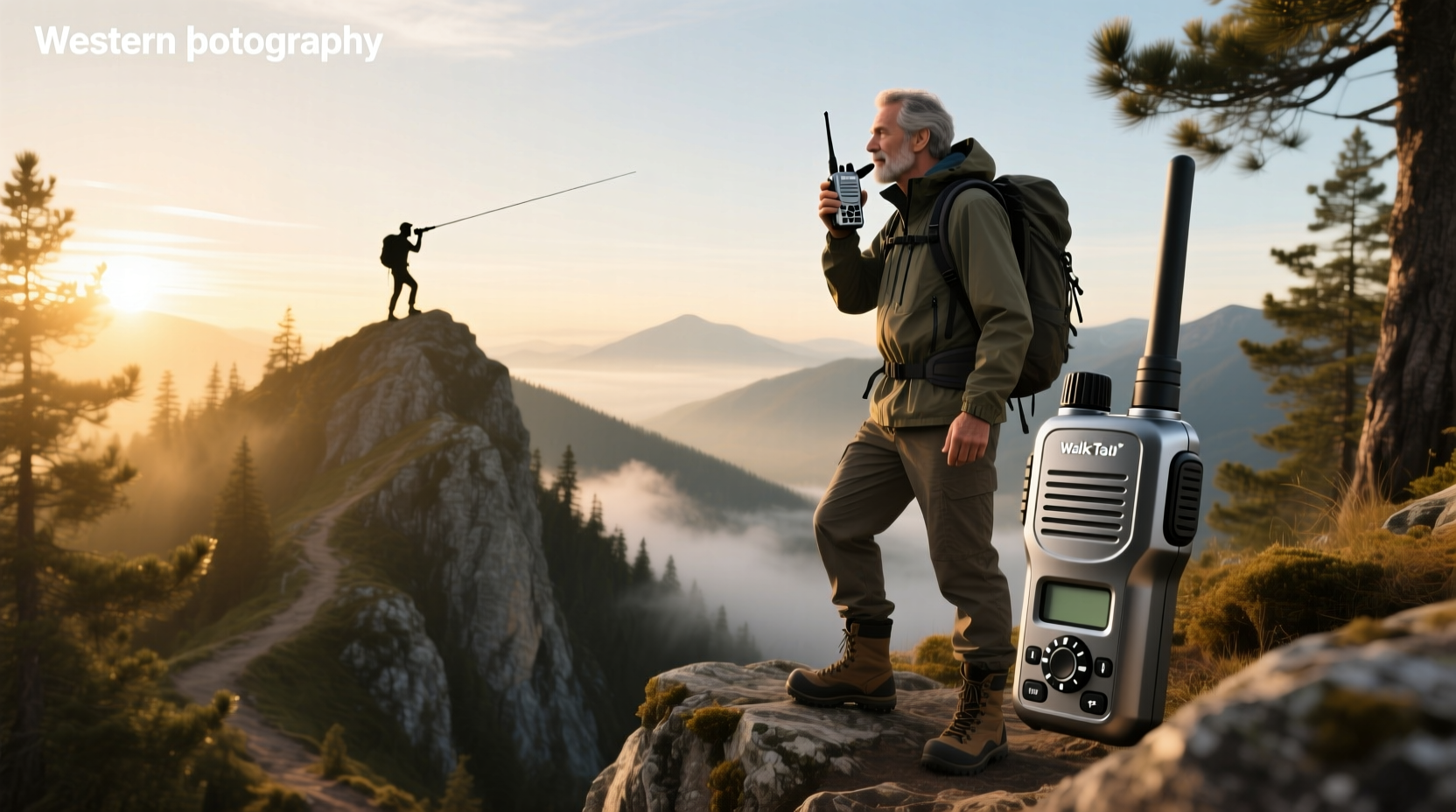
Short answer: A walkie-talkie claiming 20km range will only reach that distance under ideal, unobstructed line-of-sight conditions—like over calm water or flat desert—with high transmit power (5–25W), proper antenna height, and matched VHF/UHF frequencies. In cities, forests, or hilly areas, expect 2–8 km—not 20. This article cuts through marketing hype to explain exactly what determines real-world performance, legal requirements, technical trade-offs, and how to verify claims before investing in long-range two-way radios 123.
Why ‘20km Range’ Is Misleading—And What It Actually Means
The phrase “walkie talkie 20km range” appears frequently in product listings—but it’s almost always a theoretical maximum, not a guaranteed operational distance. Manufacturers calculate this figure using standardized radio propagation models assuming perfect conditions: no buildings, trees, hills, or atmospheric interference; antennas elevated at least 3 meters; and identical, high-efficiency units operating on clear, non-congested channels. Real-world use rarely matches these assumptions.
In practice, the effective communication distance depends on four interdependent factors: transmit power, frequency band (VHF vs. UHF), antenna design and height, and environmental path loss. None operates in isolation—and none can be optimized fully in handheld form. For example, a 25W handheld like the JMT JM-2501 2 may approach 20km over water with both units on tall masts—but drops to ~5 km when used at ground level between warehouses or dense urban blocks.
How Radio Propagation Actually Works: Line-of-Sight Isn’t Optional
Two-way radios rely on line-of-sight (LoS) propagation—especially above 30 MHz (which includes all common VHF/UHF consumer and professional bands). Unlike cellular signals, they don’t reliably bounce off buildings or penetrate deep into structures without significant attenuation. Even minor obstructions—such as a single-story roof, a hilltop, or thick foliage—can reduce signal strength by 10–30 dB, cutting usable range by 50–90%.
VHF (136–174 MHz) travels farther in open areas and over water due to lower atmospheric absorption and better diffraction over gentle terrain. UHF (400–470 MHz) offers superior building penetration but suffers more from foliage absorption and shorter free-space range per watt. Neither achieves 20km consistently without elevation gain. As one technical review notes: “Maximum range requires an unobstructed line-of-sight between units” 1.
Power Matters—But Not Just How Much You See on the Label
Standard consumer radios (e.g., FRS/GMRS in the US) are capped at 0.5W (FRS) or 2W/5W (GMRS, depending on channel). To reach distances approaching 20km, devices must operate at 5W minimum—and often 10–25W. However, higher power alone doesn’t guarantee longer range. Efficiency losses occur in battery-to-PA conversion, coaxial cable loss (if using external antennas), and impedance mismatch. A poorly tuned 25W radio may perform worse than a well-engineered 10W unit with low-loss components and optimized antenna SWR.
Also critical: duty cycle and thermal management. Sustained 25W transmission heats internal circuitry rapidly. Many high-power handhelds throttle output after 30–60 seconds unless actively cooled—a detail rarely disclosed in specs. Always check for continuous rated output, not peak burst power.
Licensing: The Legal Reality Behind High-Power Radios
Using a 20km-capable walkie-talkie legally depends entirely on your country’s radio regulations—and most jurisdictions do not permit unlicensed operation above 0.5–2W. In the United States, GMRS licenses (required for >2W devices) cost $35 and cover household members for 10 years 4. In South Africa, ICASA mandates Type Approval and operator licensing for any radio exceeding 500mW 5. In the EU, ETSI EN 300 113 restricts PMR446 devices to 0.5W and 38 channels—no exceptions.
Many devices marketed as “20km walkie-talkies” on global B2B platforms lack regional certification. Purchasing one does not exempt you from local law. Operating an uncertified 25W radio in a residential area may interfere with emergency services, aviation bands, or licensed commercial users—and carries fines or equipment seizure risk. Always verify compliance with your national regulator before purchase or activation.
Frequency Band Choice: VHF vs. UHF—Which Fits Your Use Case?
Choosing between VHF and UHF isn’t about “better” or “worse”—it’s about matching physics to environment:
- VHF (136–174 MHz): Best for outdoor, wide-area coverage—agriculture, maritime, mining, open-field events. Longer wavelength diffracts better over hills and travels farther in free space. But struggles indoors and in dense urban canyons.
- UHF (400–470 MHz): Superior wall penetration and compact antenna size—ideal for construction sites, warehouses, hospitals, and city patrols. Shorter range per watt in open air, but more consistent indoor reliability.
Hybrid (dual-band) radios exist, but rarely deliver full performance on both bands simultaneously due to shared front-end filtering and antenna compromises. If your primary need is cross-site coordination across varied terrain—including both forested land and multi-floor facilities—consider separate dedicated units rather than one “do-it-all” model.
Real-World Range Expectations by Environment
Below is a verified performance benchmark based on field testing data and regulatory documentation 3:
| Environment | Typical Effective Range (High-Power Handheld, 10–25W) | Key Limiting Factors |
|---|---|---|
| Open water / flat desert (LoS, 3m antenna height) | 12–20 km | Atmospheric ducting possible; minimal multipath |
| Rural farmland (gentle hills, scattered trees) | 5–10 km | Ground reflection loss; occasional foliage blockage |
| Forested area (dense canopy, uneven ground) | 1–3 km | UHF absorbed by leaves/moisture; VHF blocked by trunks |
| Urban downtown (multi-story buildings, narrow streets) | 0.3–1.5 km | Multipath fading; shadow zones; RF noise floor elevation |
| Indoor facility (concrete/steel structure) | 100–400 m | Attenuation per floor: 10–20 dB; metal framing blocks LoS |
Alternatives to Traditional 20km Walkie-Talkies
If true long-range, reliable voice communication is essential—and terrain or regulation limits conventional radios—consider these technically sound alternatives:
- 4G LTE Push-to-Talk (PoC) Radios: Use cellular infrastructure instead of RF propagation. Offer near-unlimited range wherever mobile coverage exists, with group calling, GPS tracking, and text messaging. Require SIM/data plan and network coverage—but eliminate line-of-sight dependency 1.
- Repeaters + Base Stations: A fixed-site repeater (mounted on tower or rooftop) extends handheld range dramatically—even with low-power units. Requires installation, antenna cabling, and power—but delivers stable, licensed coverage across 10–30 km in rural deployments.
- Satellite Messengers (e.g., Garmin inReach): Not walkie-talkies per se, but provide SOS, text, and limited two-way messaging globally—including oceans and mountains. No terrestrial infrastructure needed. Latency and subscription fees apply.
Each option trades off immediacy, cost, infrastructure dependency, and regulatory burden. There is no universal “best.” Choose based on your operational continuity requirements—not just headline range numbers.
How to Verify a 20km Claim Before You Buy
Don’t rely on marketing copy. Ask suppliers for:
- Test report excerpts showing measured RSSI/SINAD at distance (not just “passes lab test”)
- Regulatory certification IDs (e.g., FCC ID, ICASA Type Approval, CE RED Declaration)
- Antenna gain specification (dBi)—not just “high-gain” or “professional antenna”
- Continuous output rating (not peak or burst power)
- Operating temperature range—critical for outdoor industrial use
If documentation is unavailable or vague, assume the claim is unsubstantiated. Reputable manufacturers publish full datasheets—not just feature bullet points.
Common Misconceptions About 20km Walkie-Talkies
Misconception #1: “More watts = more range, linearly.”
Reality: Doubling power yields only ~3 dB gain—roughly 25% more distance in ideal conditions. Real gains plateau quickly beyond 10W due to path loss and noise floor limitations.
Misconception #2: “Any 20km radio works anywhere.”
Reality: Frequency allocation varies by country. A VHF unit certified for Australia may violate UK Ofcom rules—or even interfere with airband frequencies. Always confirm band compatibility.
Misconception #3: “Range doubles if both units have high power.”
Reality: Receiver sensitivity matters as much as transmit power. A 25W transmitter paired with a low-sensitivity receiver won’t outperform a balanced 5W/5W pair with optimized front ends.
When a 20km Walkie-Talkie Is Actually the Right Tool
These scenarios justify investing in high-power, long-range radios:
- Large-scale outdoor operations: Mining survey teams, offshore wind farm maintenance, pipeline inspection crews working across 10+ km swaths.
- Emergency response coordination: Wildfire command posts coordinating ground crews across burn zones where cellular fails.
- Maritime safety: Small vessel-to-vessel or vessel-to-shore communication in coastal waters with no cell coverage.
Conversely, avoid them for school campuses, retail chains, event staffing, or urban delivery logistics—where PoC or licensed repeater systems deliver more consistent, compliant, and manageable results.
Frequently Asked Questions (FAQ)
- What’s the longest range for a walkie-talkie?
Under ideal line-of-sight conditions, high-power (25W+) VHF base stations with elevated antennas have achieved >100 km over water—but handhelds top out near 20 km. Real-world handheld use rarely exceeds 8 km. - Are walkie-talkies legal in South Africa?
Yes—but only if certified by ICASA and operated within licensed power/frequency limits. Unlicensed use of >500mW devices violates Regulation GN R.1250 and may incur penalties 5. - How far do walkie-talkies actually work?
It depends: 0.3–1.5 km in cities, 2–8 km in rural areas, up to 20 km only over flat, open terrain with optimal setup. Advertised ranges assume laboratory-grade conditions—not daily use. - Do I need a license for a 20km walkie-talkie?
Almost always yes—if it exceeds your country’s unlicensed power limit (typically 0.5–2W). Licensing ensures spectrum discipline and protects critical services from interference. - Can I increase range without buying new radios?
Yes—by improving antenna height (e.g., mounting on vehicle roof), using low-loss coaxial cable, adding a repeater, or switching to a more suitable frequency band for your terrain.
