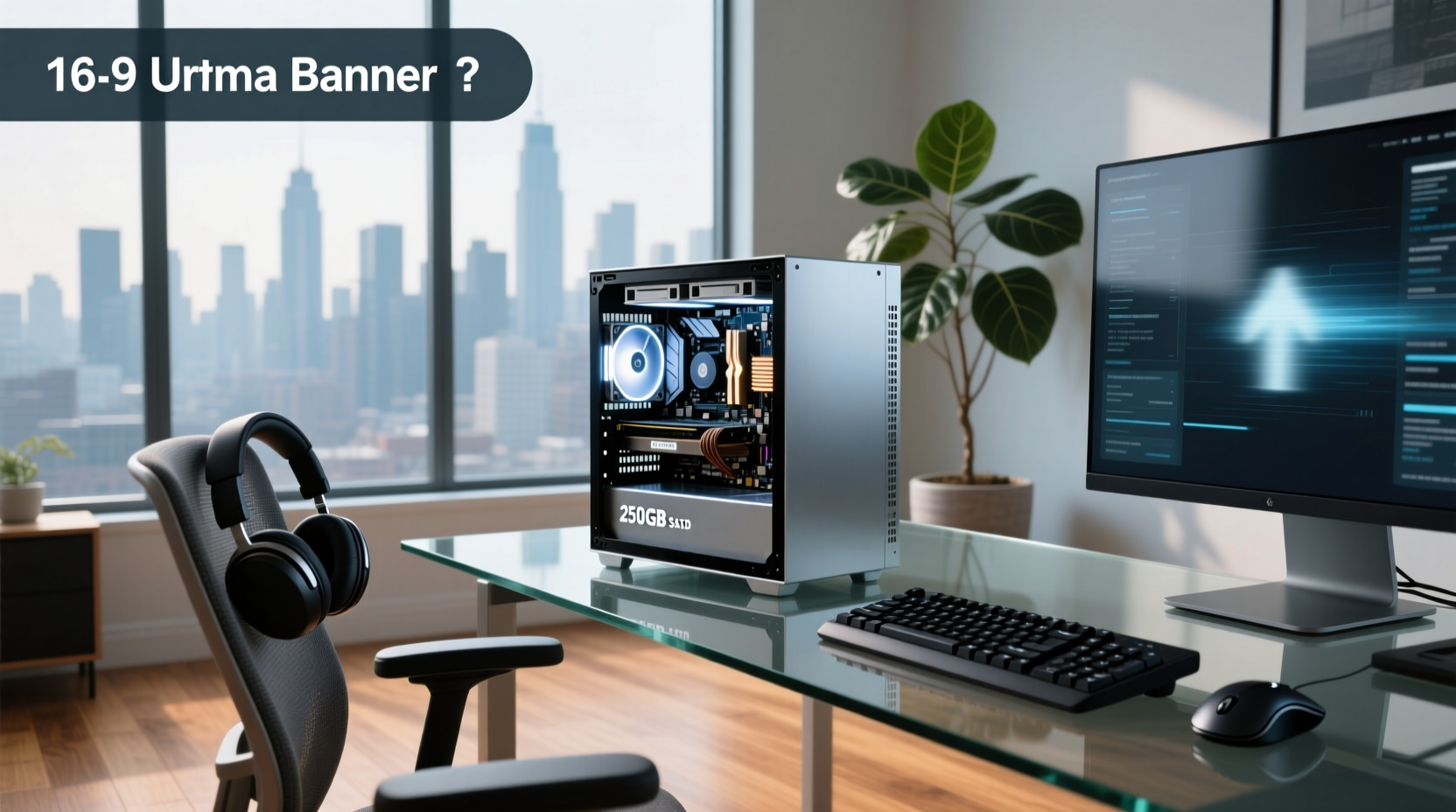
Yes — a 250GB SATA SSD is still viable as a system drive for Windows 10/11 in basic-to-moderate use cases, but only if you manage storage proactively and avoid installing large games, media libraries, or professional software locally. In 2024, it remains the most cost-effective entry point for boot-drive upgrades (250gb ssd sata price typically $25–$80 used/refurbished, $45–$95 new), delivering ~5x faster boot times and application responsiveness versus traditional HDDs 1. However, its practicality depends entirely on your workload, not just specs like 250gb ssd sata specs (SATA III 6 Gb/s, 2.5-inch, 7mm height, sequential read up to 560 MB/s, write up to 530 MB/s).
Why Users Search for '250GB SATA SSD' — Decoding Real Intent
The 7.5 million+ monthly Google searches for 250gb ssd sata reflect three overlapping user profiles:
- Budget-conscious upgraders: Older laptops or desktops (2012–2018) with SATA-only motherboards seeking maximum performance gain per dollar;
- Secondary/internal storage buyers: Those adding a dedicated OS drive while retaining an existing HDD for bulk storage;
- Replacement purchasers: Users replacing failed 250GB OEM SSDs (e.g., in Dell Inspiron, HP Pavilion, Lenovo ThinkPad T440 series) where physical form factor and interface compatibility are non-negotiable.
Crucially, search refinements — "under $50", "used", "500–550 MB/s write speed", "WD Blue", "Samsung 850 EVO" — signal strong price sensitivity and preference for proven reliability over bleeding-edge speed 2. The absence of "NVMe" or "M.2" filters confirms these users are working within hardware constraints — not choosing between technologies.
What Exactly Fits in 250GB? A Realistic Capacity Breakdown
Raw capacity ≠ usable space. After formatting and system overhead, expect ~232 GB available. Here’s how that allocates in practice:
| Component | Typical Size (Windows 11) | Notes |
|---|---|---|
| Windows 11 OS + updates (clean install) | 28–35 GB | Increases by ~5–8 GB/year with cumulative updates; optional features (Media Feature Pack, Hyper-V) add 1–3 GB each |
| Page file & hibernation file | 8–16 GB | Configurable; default is ~1.5× RAM size (e.g., 12 GB for 8 GB RAM) |
| Default app installations (Edge, Store, Photos, etc.) | 4–6 GB | Can be reduced via PowerShell removal (e.g., Get-AppxPackage *xbox* | Remove-AppxPackage) |
| Antivirus & security suite | 1–3 GB | Lightweight options (Microsoft Defender) use <1 GB; third-party suites (Bitdefender, Kaspersky) require 2–3 GB |
| User profile (Documents, Desktop, Downloads) | Variable (often 10–40 GB) | Highly dependent on habits; cloud sync (OneDrive, Dropbox) reduces local footprint |
| Browser cache & extensions | 1–5 GB | Chrome alone can exceed 3 GB without periodic cleanup |
| Free space reserve (recommended) | 15–20 GB | SATA SSDs need ≥10% free space for optimal wear leveling and garbage collection; below 5% causes measurable slowdowns 3 |
Total baseline usage: ~70–110 GB. This leaves 120–160 GB for applications, games, and personal files — enough for 2–3 AAA titles (e.g., Cyberpunk 2077: 70 GB, Elden Ring: 60 GB), but not sustainable long-term without offloading or external storage.
Performance Reality Check: SATA Speed Limits vs. Real-World Gains
All 250GB SATA SSDs share the same fundamental bottleneck: the SATA III interface caps sequential throughput at ~550 MB/s. No amount of NAND tuning or DRAM cache changes this ceiling. What differs is consistency under load:
- SLC caching behavior: Budget drives (e.g., Crucial BX500, SanDisk Ultra) use pseudo-SLC cache (typically 5–15 GB). Once exhausted during large file transfers, sustained write speeds drop to 50–150 MB/s — slower than some modern HDDs.
- Endurance rating: Measured in TBW (Terabytes Written). Entry models often specify 60–150 TBW (e.g., WD Blue SA510: 150 TBW), while premium models (Samsung 870 EVO: 150 TBW) include better wear-leveling algorithms and higher-quality TLC NAND.
- Random I/O (4K QD1): More critical than sequential speed for OS responsiveness. Top-tier 250GB SATA SSDs achieve 10,000–15,000 IOPS read / 2,000–3,500 IOPS write — 3–5× faster than HDDs in everyday tasks like opening apps or switching tabs.
For users upgrading from a 5400 RPM HDD, the perceived improvement is dramatic regardless of model tier. But comparing two 250GB SATA SSDs head-to-head reveals minimal real-world differences in boot time (<2 sec variance) or application launch latency. Prioritize reliability and warranty (3–5 years) over marginal spec advantages.
When a 250GB SATA SSD Makes Sense — And When It Doesn’t
✅ Strong fits:
- Legacy systems: Laptops/desktops without M.2 slots or SATA port multipliers (e.g., MacBook Pro 2012–2015, Dell OptiPlex 3020, HP EliteDesk 800 G1).
- Thin-client or kiosk deployments: Where OS + lightweight POS/browser app is the sole workload.
- Temporary or secondary drives: As a bootable diagnostic drive, recovery partition host, or dedicated Linux installation.
❌ Avoid if:
- You regularly install >2 large games simultaneously or store raw photo/video assets locally.
- Your device supports NVMe M.2 — even budget NVMe drives (e.g., Kingston NV2 250GB) offer 2–3× faster random access and cost only ~$10–$15 more 4.
- You rely on full-disk encryption (BitLocker, FileVault) — older SATA controllers may lack hardware-accelerated AES, causing CPU bottlenecks during encryption/decryption.
Key Selection Criteria — Beyond Price and Brand
Don’t default to the cheapest listing. Verify these four technical attributes before purchasing:
- NAND type: Prefer 3D TLC NAND (standard since ~2016) over legacy 2D MLC or planar TLC. Avoid QLC-based 250GB drives — they’re rare at this capacity but suffer from low endurance and slow writes when full.
- DRAM cache presence: Drives with dedicated DRAM (e.g., Samsung 870 EVO, Crucial MX500) maintain consistent 4K random performance under sustained load. DRAM-less models (e.g., Crucial BX500, WD Blue SA510) rely on host memory (HMB), which works only on Windows 10/11 with compatible drivers.
- Firmware update support: Check manufacturer’s website for recent firmware releases (e.g., Samsung Magician, Crucial Storage Executive). Outdated firmware can cause compatibility issues with newer motherboards or reduce TRIM efficiency.
- Physical compatibility: Confirm thickness (7mm standard; some ultra-thin laptops require 5mm or include 9.5mm adapter) and screw hole alignment. A misfit SSD won’t seat properly or may damage the SATA connector.
Used & Refurbished Market: Risks and Rewards
With many listings priced <$35 (eBay, specialty resellers), buying used 250GB SATA SSDs is common — but carries unique risks:
- Wear unknown: Unlike HDDs, SSDs don’t emit audible warnings before failure. Tools like CrystalDiskInfo show ‘Health Status’ and ‘Total LBAs Written’, but values can be reset or inaccurate on older firmware.
- Cloning complications: Pre-owned drives may retain partition schemes or hidden recovery partitions incompatible with your system. Always perform a secure erase (
hdparm --user-master u --security-set-pass p /dev/sdXthenhdparm --user-master u --security-erase p /dev/sdX) before reuse. - Warranty voidance: Most manufacturers void warranties on resold units. Only purchase from sellers offering ≥90-day return windows and clear photos of original packaging/labels.
Top-performing legacy models worth considering secondhand: Samsung 850 EVO (2015), 860 EVO (2018), Crucial MX300 (2016). Avoid pre-2014 models (e.g., 830, 840) due to outdated controller firmware and limited TRIM support.
Installation & Optimization: Getting Full Value
A 250GB SATA SSD delivers maximum benefit only when configured correctly:
- Enable AHCI mode: In BIOS/UEFI, verify SATA operation is set to AHCI — not IDE or RAID — to allow native command queuing (NCQ) and TRIM support.
- Verify TRIM is active: Run
fsutil behavior query DisableLastAccessandfsutil behavior query DisableLastAccessin Command Prompt (Admin). Both should return 0. Then confirm TRIM status:fsutil behavior query DisableLastAccess→ should say “DisableLastAccess = 0”. - Disable hibernation if unused:
powercfg /h offfrees ~8 GB (equal to RAM size) and eliminates hiberfil.sys fragmentation. - Move user folders: Relocate Documents, Pictures, and Downloads to a secondary HDD or NAS using Properties → Location tab — preserves SSD space without breaking app paths.
Alternatives Worth Considering
If your use case stretches 250GB limits, evaluate these alternatives before stepping up to 500GB:
- 250GB NVMe M.2: Requires M.2 slot and PCIe 3.0 x2/x4 support. Offers 1,500–2,500 MB/s reads — ideal for video editing scratch disks or portable workstations. Price premium: ~$10–$20 over SATA.
- External 250GB USB 3.2 Gen 2 SSD: Solves internal bay limitations. Look for models with UASP support and ≥420 MB/s sustained speeds (e.g., Sabrent Rocket Nano). Adds portability but introduces cable dependency.
- Hybrid approach: Keep 250GB SATA SSD as boot drive + add 1TB 2.5-inch HDD ($35–$45) for bulk storage. Total cost: <$100, retains all benefits of SSD responsiveness with ample capacity.
Frequently Asked Questions
- Can I use a 250GB SATA SSD as my only drive?
Yes, but only if your total software + data footprint stays under ~180 GB. Monitor free space weekly; below 20 GB, performance degrades noticeably. - Is there a speed difference between 250GB and 500GB SATA SSDs of the same model?
No meaningful difference. Larger capacities often have more NAND packages, improving parallelism slightly, but real-world gains are <1% in boot/application loads. - Do I need special cloning software to migrate from HDD to 250GB SATA SSD?
Yes — use tools that support sector-by-sector cloning with resizing (e.g., Macrium Reflect Free, Clonezilla). Never use Windows built-in backup — it doesn’t optimize SSD alignment. - Will a 250GB SATA SSD work in a PS4 or Xbox One?
PS4 supports 2.5-inch SATA SSDs (up to 2TB) — yes, with significant load-time improvements. Xbox One S/X requires proprietary blade SSDs; 2.5-inch SATA is physically incompatible. - How long does a 250GB SATA SSD last?
Under typical office use (~10 GB written/day), expect 5–8 years. Heavy workloads (video rendering, database logging) may reduce lifespan to 3–4 years. All reputable models include SMART monitoring — check attribute 177 (Wear_Leveling_Count) regularly.
