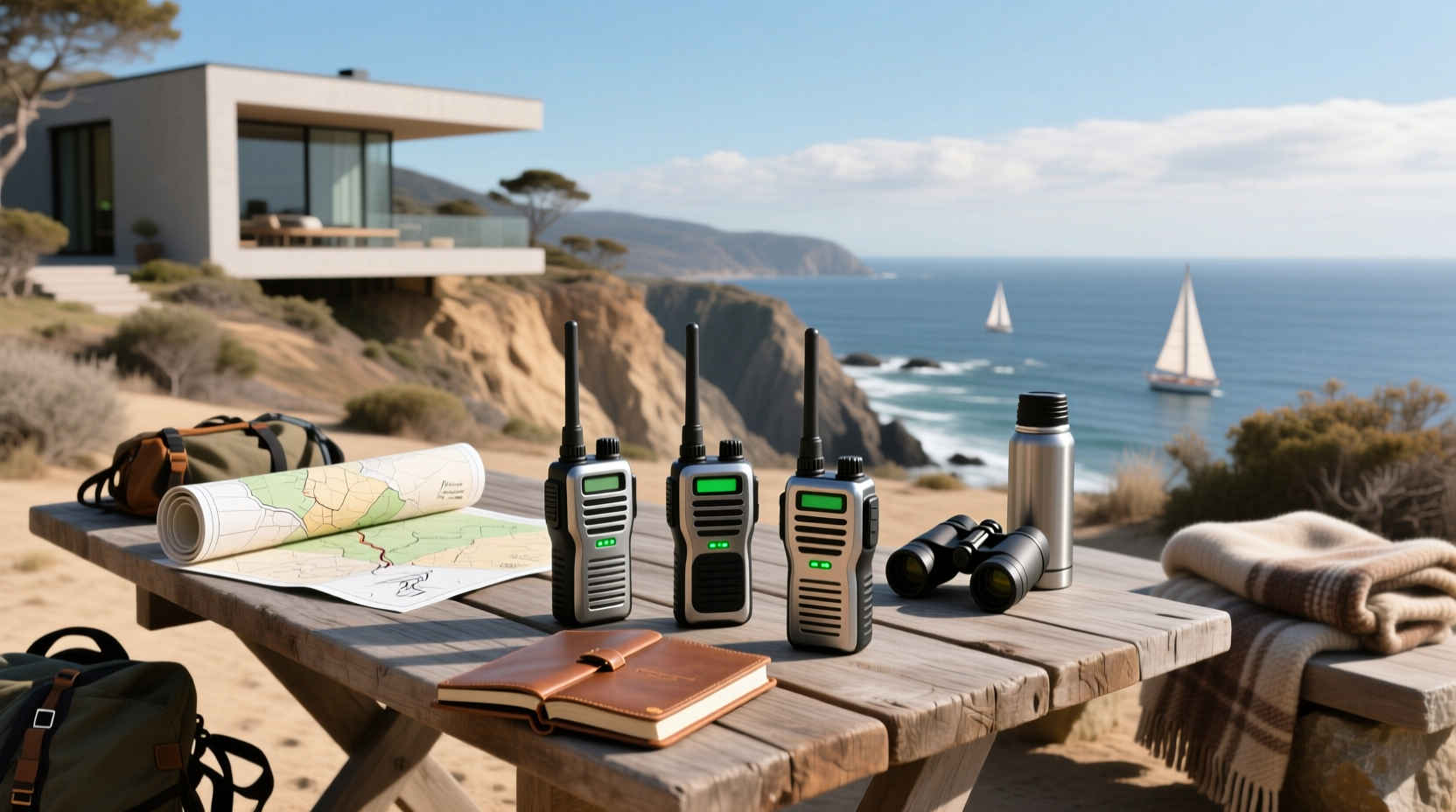
Yes — you can absolutely use three walkie talkies together, and in fact, most consumer-grade FRS/GMRS radios sold as "3-pack" sets are designed precisely for this purpose. But the reality is far more nuanced than simply unboxing and pressing PTT: actual usable range rarely matches advertised specs (e.g., "25-mile range" often drops to under 1 mile in urban or wooded areas1), battery life differs significantly between NiMH and Li-ion models, and regulatory compliance — especially around GMRS licensing — affects legal operation and signal reliability. This guide cuts through marketing claims to help you choose a functional, compliant, and truly interoperable 3-unit setup — whether for family outings, event staffing, construction sites, or kids’ play.
Why People Search for “3 Walkie Talkies” — And What They’re Really Asking
The keyword “3 walkie talkies” reflects a clear purchase intent rooted in group coordination needs — not technical curiosity. Analysis of search refinements and related queries shows users consistently filter by:
- Quantity: “3 pack”, “18 pack”, “2 pack” — indicating group size drives selection
- Use case: “For kids”, “water resistant”, “voice activated”, “long range”
- Technical constraints: “FRS”, “GMRS”, “UHF”, “rechargeable”, “under $80”
- Trust signals: “4 and up rating”, “free shipping”, “on sale”, “Walmart”, “Best Buy”
Crucially, People Also Ask reveals four foundational concerns behind the search:
- “Can you have three walkie-talkies?” → Interoperability and setup simplicity
- “What is the farthest distance a walkie-talkie can reach?” → Realistic range expectations vs. marketing claims
- “Is a walkie-talkie illegal?” → Regulatory compliance (especially GMRS licensing)
- “Can the police track a walkie-talkie?” → Privacy and transmission transparency
These aren’t abstract questions — they represent real decision barriers. A parent buying for a scout troop needs reliable voice activation and child-safe channels; a contractor managing a job site requires weather resistance, long battery life, and license-compliant power output; a festival volunteer needs lightweight, USB-C rechargeable units with clear audio in noisy environments. This article addresses each scenario with evidence-based criteria — not brand endorsements.
How Three Walkie Talkies Actually Work Together
At the core, walkie talkies operate on shared radio frequencies. When three units are set to the same channel and privacy code (CTCSS/DCS), they form a single communication group. No pairing, Bluetooth, or app is required — just matching settings.
However, compatibility isn’t guaranteed across brands or generations. Key interoperability requirements include:
- Same frequency band: FRS (Family Radio Service) and GMRS (General Mobile Radio Service) share 22 channels (channels 1–7 and 15–22), but only FRS is license-free in the U.S. GMRS channels (15–22) allow higher power (up to 5 W) and repeater use — but require an FCC license2.
- Matching CTCSS/DCS tones: Even on the same channel, mismatched privacy codes block audio — a common cause of “why won’t my third unit talk?”
- No proprietary protocols: Some budget brands use non-standard digital signaling or encryption, preventing cross-brand use. Stick to FRS/GMRS-certified units listed in the FCC ID database3.
✅ Pro tip: Before buying a 3-pack, verify the FCC ID (printed on device or packaging) at FCC OET Equipment Authorization Search. If it lists “FRS” or “FRS/GMRS”, it’s interoperable with other certified units on matching channels/tones.
Real-World Range: Why “25 Miles” Is Meaningless Indoors
Advertised range (e.g., “28-mile range”) assumes ideal conditions: flat terrain, zero obstructions, 6+ ft antenna height, and no RF interference. In practice, range collapses dramatically:
| Environment | Typical Effective Range (FRS) | Key Limiting Factors |
|---|---|---|
| Open rural field (line-of-sight) | 1–2 miles | Antenna efficiency, transmitter power (max 2 W for FRS) |
| Suburban neighborhood (houses, trees) | 0.25–0.75 miles | Building attenuation (~20–40 dB loss per wall), foliage absorption |
| Dense urban area (high-rises) | 100–500 feet | Multipath distortion, RF noise from Wi-Fi/cell towers |
| Indoors (multi-floor home) | 1–3 floors, ~100 ft | Concrete floors (>30 dB loss), metal framing, HVAC ducts |
A 2025 Outdoor Gear Lab range test confirmed that even top-tier FRS units achieved just 0.6 miles in mixed suburban terrain — less than 3% of their “25-mile” claim1. For reliable indoor or campus-wide coverage, prioritize units with higher sensitivity (-120 dBm or better) and low-noise receivers, not headline range numbers.
Battery Life & Power: Li-ion vs. NiMH — What Actually Lasts
Most 3-packs now ship with built-in Li-ion batteries — but runtime varies widely based on usage patterns:
- Continuous transmission: Drains battery fastest (e.g., 2–4 hours on high-power GMRS mode)
- Intermittent use (1:5 transmit:listen ratio): Typical for hiking/events — 12–24 hours
- Standby only (no VOX, backlight off): Up to 72+ hours
NiMH AA/AAA units offer flexibility (replaceable cells) but suffer from voltage sag and self-discharge (up to 30% per month). Li-ion packs deliver stable voltage and lower self-discharge (<5%/month) — but degrade after ~300–500 cycles. Check if replacement batteries are available: many budget brands solder cells in place, making repair impossible.
⚠️ Watch for “USB-C rechargeable” claims without specifying capacity. A 1200 mAh unit lasts ~40% less than an 1800 mAh unit under identical load — yet both may be marketed identically. Always compare mAh ratings in product specs, not just “rechargeable” labels.
Licensing: When You Need an FCC License (and When You Don’t)
This is where most buyers unknowingly risk noncompliance. In the U.S.:
- FRS (Channels 1–14): License-free. Max 2 W output. Fixed antennas only.
- GMRS (Channels 15–22): Requires FCC license ($35, valid 10 years, covers entire household). Allows up to 5 W output and detachable antennas.
- Hybrid radios: Many “FRS/GMRS” units support both — but using GMRS channels without a license violates FCC rules2. Penalties include fines up to $20,000 per violation.
✅ Action step: If you need >2 W power or repeater access, apply for a GMRS license at FCC ULS. For casual family use, stick to FRS-only channels (1–14) — no license needed, and full interoperability guaranteed.
Water Resistance, Build Quality, and Voice Activation: Separating Features From Hype
“Water resistant” is commonly misused. True protection requires IP ratings:
- IP54: Dust-protected + splashing water (suitable for rain/hiking)
- IP67: Dust-tight + immersion up to 1m for 30 min (required for marine or heavy-duty use)
- No IP rating: “Water resistant” may mean only basic gasketing — unreliable in damp conditions
Voice activation (VOX) is useful for hands-free operation but highly sensitive to ambient noise. In windy or crowded settings, false triggers drain battery and cause missed messages. Most reliable units let you adjust VOX sensitivity — avoid models with fixed, non-adjustable VOX.
Build quality correlates strongly with drop-test certification (MIL-STD-810G). Units passing this standard survive repeated 1.2m drops onto concrete — critical for kids’ sets or job sites. Check for independent lab reports, not just “military grade” marketing copy.
3-Packs for Specific Users: Matching Features to Real Needs
For families with children (ages 4–12):
Prioritize safety and simplicity: fixed FRS-only channels (no GMRS confusion), large buttons, flashlight, low-power mode to extend battery, and non-toxic materials. Avoid units with >100 mW output — excessive power offers no benefit and increases ear fatigue.
For outdoor enthusiasts (hiking, camping, skiing):
Focus on battery life (≥1800 mAh Li-ion), NOAA weather alerts (with alert tone), and wide temperature tolerance (-20°C to 60°C). Skip “long-range” claims — instead, verify receiver sensitivity and antenna gain (dBi).
For professionals (event staff, warehouse, security):
Require programmable channels, priority scan, emergency alarm, and rugged IP67/MIL-STD builds. Rechargeable trays (for all 3 units simultaneously) beat individual USB cables. Avoid consumer-grade “rechargeable” packs with 2-slot chargers — swapping units mid-shift breaks workflow.
Red Flags to Avoid When Buying a 3-Pack
Not all 3-packs deliver equal value. Steer clear of:
- Unverified range claims: Any unit advertising >2 miles in urban specs without citing test methodology is misleading.
- No FCC ID visible: Legally required on all U.S.-sold radios. Absence suggests uncertified, potentially non-interoperable hardware.
- “Unlimited range” or “nationwide PTT” marketing: Physically impossible for handheld FRS/GMRS devices — indicates either scam or reliance on cellular backup (which isn’t a walkie talkie).
- Non-replaceable batteries with no capacity spec: Makes long-term ownership unsustainable.
- Missing CTCSS/DCS programming: Limits group coordination — you can’t create sub-channels for different teams.
Frequently Asked Questions (FAQ)
- Can I mix and match different brands in a 3-unit setup?
Yes — if all units are FCC-certified for FRS/GMRS, use the same channel and CTCSS tone, and avoid proprietary features like encrypted digital modes. - Do I need a license for 3 walkie talkies?
No — if you only use FRS channels (1–14). A GMRS license is required only when transmitting on channels 15–22. - Why does my third walkie talkie not receive clearly?
Check battery level (weak power reduces receiver sensitivity), CTCSS tone match, and physical obstructions. Try resetting all units to factory defaults and reprogramming together. - Can walkie talkies work indoors between floors?
Yes — but expect reduced range. Concrete floors and metal studs attenuate signal sharply. Units with high receiver sensitivity (-118 dBm or better) perform best. - Are rechargeable 3-packs worth it over AA battery models?
For frequent use: yes — lower long-term cost and consistent voltage. For occasional use: AA models offer longer shelf life and easier field replacement.
