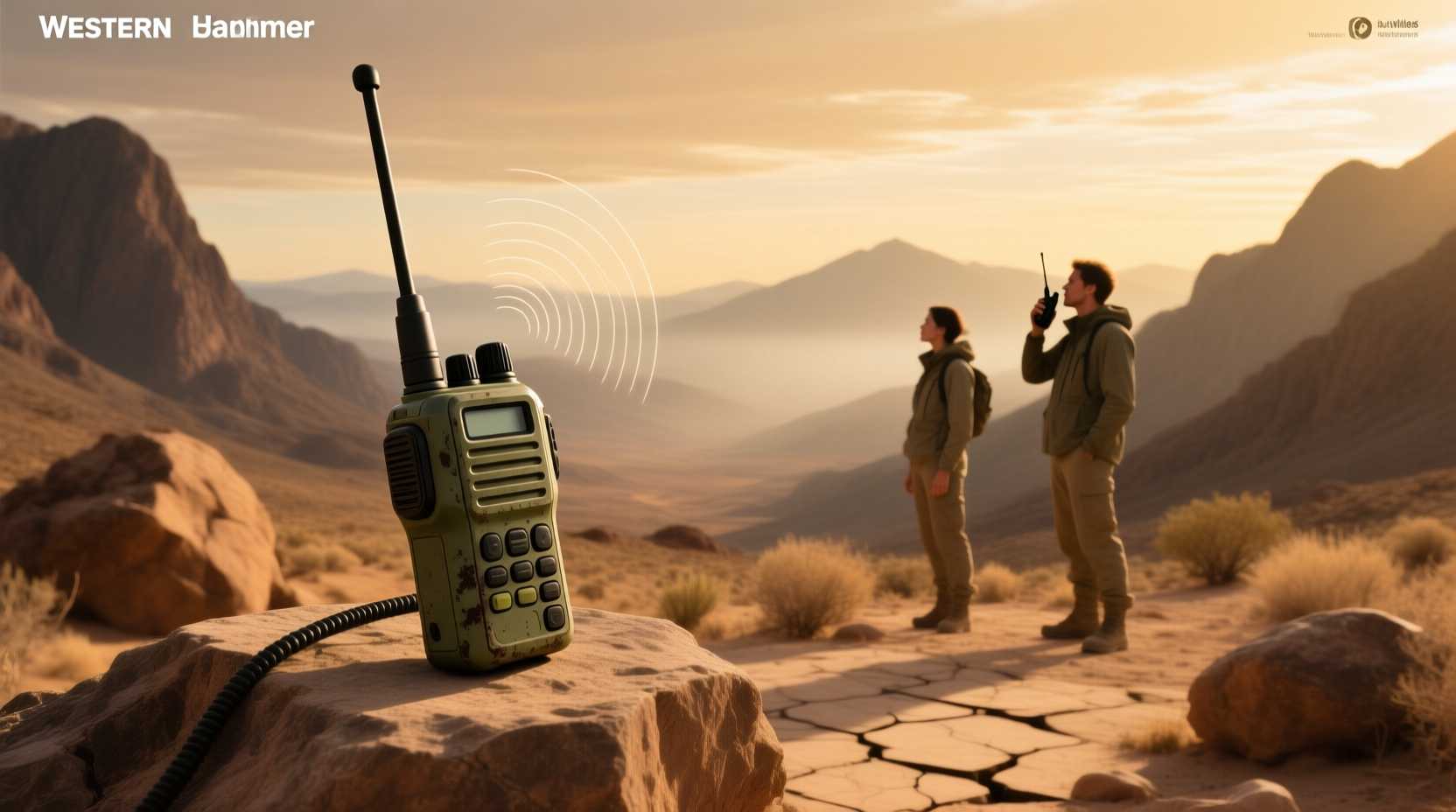
Short answer: No handheld walkie-talkie—FRS, GMRS, or amateur radio—can transmit 3000 miles directly over the air. What’s marketed as "3000-mile range" on e-commerce platforms, social media, or online marketplaces often refers to PoC (Push-to-Talk over Cellular) devices that use 4G/5G networks or Wi-Fi, not radio propagation 1. This distinction is critical: if you need cross-country or global voice communication without infrastructure assumptions, you’re not shopping for a walkie-talkie—you’re selecting a cellular-connected communication terminal with PTT functionality. Understanding this difference supports informed purchasing decisions and effective deployment in remote or mission-critical scenarios.
Why "3000 Miles" Is Misleading—And Why It Matters
The phrase "long range walkie talkies 3000 miles" reflects a widespread misunderstanding rooted in marketing language, not physics or regulation. Radio wave propagation is governed by well-established limits: antenna height, transmit power, frequency band, terrain, atmospheric conditions, and receiver sensitivity. Even under ideal line-of-sight conditions (e.g., mountaintop to mountaintop), VHF/UHF handheld radios—standard in consumer FRS/GMRS models—top out at roughly 30–40 miles 2. In real-world use—forests, urban canyons, valleys—the typical reliable range drops to 1–5 miles 3.
So where does "3000 miles" come from? It’s a shorthand used by vendors to describe PoC radios: Android-based handhelds with SIM slots or Wi-Fi capability that route voice via cellular data networks—just like a smartphone app. These devices don’t extend radio range; they bypass radio limitations entirely. Their effective coverage depends on cellular network availability, not antenna gain or wattage. That means they work across states—or continents—if roaming agreements exist and signal is present. But they fail completely where there’s no cell tower or Wi-Fi access point.
How Real Long-Range Communication Actually Works
There are only three technically viable ways to achieve voice or text communication across distances exceeding 100 miles—and none involve traditional walkie-talkie architecture:
✅ Option 1: PoC Radios (Best for 3000-Mile Use Cases)
What they are: Handheld devices running Android OS with built-in LTE/5G modems, GPS, and PTT software (e.g., Hytera P50, Motorola WAVE PTX, or OEM units available through global B2B channels). They function like two-way radios—but rely on carrier networks, not RF spectrum.
Key facts:
- Require active SIM card with data plan (often monthly subscription)†
- Work anywhere with cellular coverage—including rural highways, national parks with partial service, and international destinations with compatible roaming
- Support group calling, location sharing, emergency alerts, and encrypted channels
- Do not require FCC Part 90 licensing (unlike licensed GMRS repeater systems), but do require compliance with local telecom regulations (e.g., Ofcom approval in the UK)
†Some vendors claim "no monthly fee"—but these usually rely on unlicensed Wi-Fi hotspots or proprietary mesh networks with severe scalability and latency limits. Independent testing shows most such claims lack verification 4.
✅ Option 2: Satellite Messengers (For Zero-Cell Areas)
What they are: Devices like Garmin inReach Mini 2 or Zoleo that connect to commercial satellite constellations (Iridium or Globalstar). They send text messages and SOS signals globally—even over oceans and polar regions.
Key facts:
- No voice calls: All major consumer satellite messengers support only text-based communication (including preset replies and email forwarding)
- Require subscription plans ($11.99–$64.99/month depending on features)
- Latency ranges from 1–5 minutes per message; unsuitable for real-time coordination
- GPS-enabled and ruggedized for extreme environments
While often grouped with “long-range radios” in outdoor guides, satellite messengers serve a fundamentally different purpose: assured last-resort messaging, not team coordination.
✅ Option 3: Licensed Repeaters + High-Gain Antennas (Niche, Technical)
What it is: A GMRS or MURS system extended using FCC-licensed repeaters mounted on tall towers or buildings, combined with high-gain directional antennas and amplifiers.
Key facts:
- Maximum practical range: ~100–200 miles under optimal geography and repeater placement
- Requires formal license application (GMRS license costs $35, valid for 10 years in the US)
- Not portable: Infrastructure-dependent and expensive to deploy/maintain
- Still subject to line-of-sight constraints and spectrum congestion
This approach is used by public safety agencies and large industrial sites—not individuals seeking plug-and-play 3000-mile capability.
What You’ll See Online—and Why It Confuses Buyers
A quick search for "long range walkie talkies 3000 miles" returns results mixing technical reality, influencer hype, and vendor copywriting. Here’s how to decode them:
| Source Type | Typical Claim | Reality Check |
|---|---|---|
| E-commerce product listings | "3000 Mile Range", "Unlimited Distance", "Worldwide Coverage" | Most refer to PoC radios requiring SIM/data. Verify LTE band support (B2/B4/B5/B12/B13/B66/B71 for US; B1/B3/B7/B20/B28 for EU) and confirm compatibility with your carrier or regional network requirements. |
| TikTok / YouTube demos | "We tested it across 3 states!" or "No bars? Still works!" | Rarely disclose whether test used pre-loaded Wi-Fi networks, cached maps, or offline mode (which disables PTT). Many videos show devices working near roads with known cell coverage—not true wilderness. |
| Outdoor blogs (e.g., Outdoor Life) | "Best long-range walkie talkies for hiking" | Usually review FRS/GMRS models with realistic range expectations (≤5 miles). May mention PoC/satellite as supplements—not replacements—for short-range radios. |
Key Decision Factors: What to Check Before Buying
Don’t assume “3000 miles” means universal coverage. Evaluate each device against your actual environment and use case:
📍 Coverage Verification (Non-Negotiable)
Ask: Does this device work where I need it? Steps to verify:
- Identify the cellular bands supported (check spec sheet—not marketing copy)
- Cross-reference with your carrier’s coverage map (e.g., Verizon’s Coverage Map or T-Mobile’s Map)
- If traveling internationally, confirm roaming agreements (e.g., AT&T’s World Connect vs. T-Mobile’s Magenta MAX)
- Test with a borrowed unit—or rent one—for ≥48 hours in your target area before purchase
🔐 Regulatory Compliance
Using non-compliant radios carries legal risk:
- US: FRS devices must be type-accepted by FCC (look for FCC ID on label). GMRS requires license. PoC devices must comply with Part 2 and Part 22 rules for cellular terminals.
- UK/EU: Baofeng UV-5R-style radios are illegal without Ofcom license. PoC radios must carry CE marking and meet RED Directive (2014/53/EU).
- Australia: ACMA requires RCM mark; unauthorized transmission may incur fines up to AUD $222,000.
When purchasing from global B2B platforms, request full compliance documentation—not just “CE certified” stickers.
🔋 Battery & Durability Realities
PoC radios consume significantly more power than analog walkie-talkies due to constant network registration, GPS polling, and screen use. Expect:
- 8–12 hours of mixed PTT/call usage (vs. 24–48 hrs for FRS radios)
- Reduced runtime in cold temperatures (<5°C / 41°F)
- IP67 or IP68 rating required for outdoor reliability—and third-party test reports help validate performance claims
Common Misconceptions—Debunked
Misconception #1: "More watts = more range."
False for handhelds. Doubling output power (e.g., from 2W to 4W) yields only ~3 dB gain—less than doubling real-world range. Terrain and antenna efficiency dominate performance.
Misconception #2: "Repeaters fix everything."
Repeaters extend range—but require line-of-sight to both user radios *and* backhaul connectivity (usually cellular or fiber). Deploying one in remote areas adds cost, power, and maintenance complexity.
Misconception #3: "Satellite radios do voice."
Consumer-grade satellite messengers (inReach, Zoleo, SPOT) do not support voice. Only specialized, expensive, and heavily regulated systems (e.g., Iridium Extreme 9575, Inmarsat IsatPhone) offer voice—but with 2+ second latency, limited battery life, and $1,500+ hardware cost.
When to Choose What: Practical Recommendations
Choose FRS/GMRS radios if: You’re coordinating within a campsite, construction site, or festival—range ≤5 miles, no infrastructure dependency, low cost, instant setup.
Choose PoC radios if: Your team operates across counties/states, relies on cellular coverage (e.g., trucking fleets, event security, utility crews), needs group dispatch, location tracking, or encrypted comms—and accepts monthly data fees.
Choose satellite messengers if: You enter true off-grid zones (backcountry, maritime, desert expeditions) where cellular is absent, and your priority is emergency signaling—not real-time voice coordination.
Consider carefully if: You expect a single device to deliver long-distance voice comms without SIM, subscription, or infrastructure—and haven’t verified coverage in your exact operating area.
Frequently Asked Questions (FAQ)
- What’s the longest range for a walkie-talkie?
Under ideal line-of-sight conditions with repeaters and high-gain antennas, licensed GMRS systems reach up to ~200 miles. Unaided handhelds max out at ~40 miles—and typically deliver 1–5 miles in practice. - Is there a walkie-talkie that reaches 1000 miles?
No standalone radio achieves 1000 miles over airwaves. Devices claiming this use cellular or satellite networks—not radio transmission. They are communication terminals, not walkie-talkies. - Do they make 100-mile range walkie-talkies?
Not as true handhelds. 100-mile range requires licensed repeater infrastructure, fixed base stations, and favorable topography. Consumer “100-mile” claims are marketing approximations—not verified field performance. - Is Baofeng illegal in the UK?
Yes—unless operated under an Ofcom-issued license. Baofeng UV-5R and similar dual-band radios transmit outside permitted PMR446 frequencies and exceed power limits for license-free use. - Can I use a PoC radio without a SIM card?
Only if connected to Wi-Fi—but coverage is limited to hotspot range. Most PoC features (location, group sync, emergency alert) require cellular registration. Standalone Wi-Fi mode lacks redundancy and scalability.
