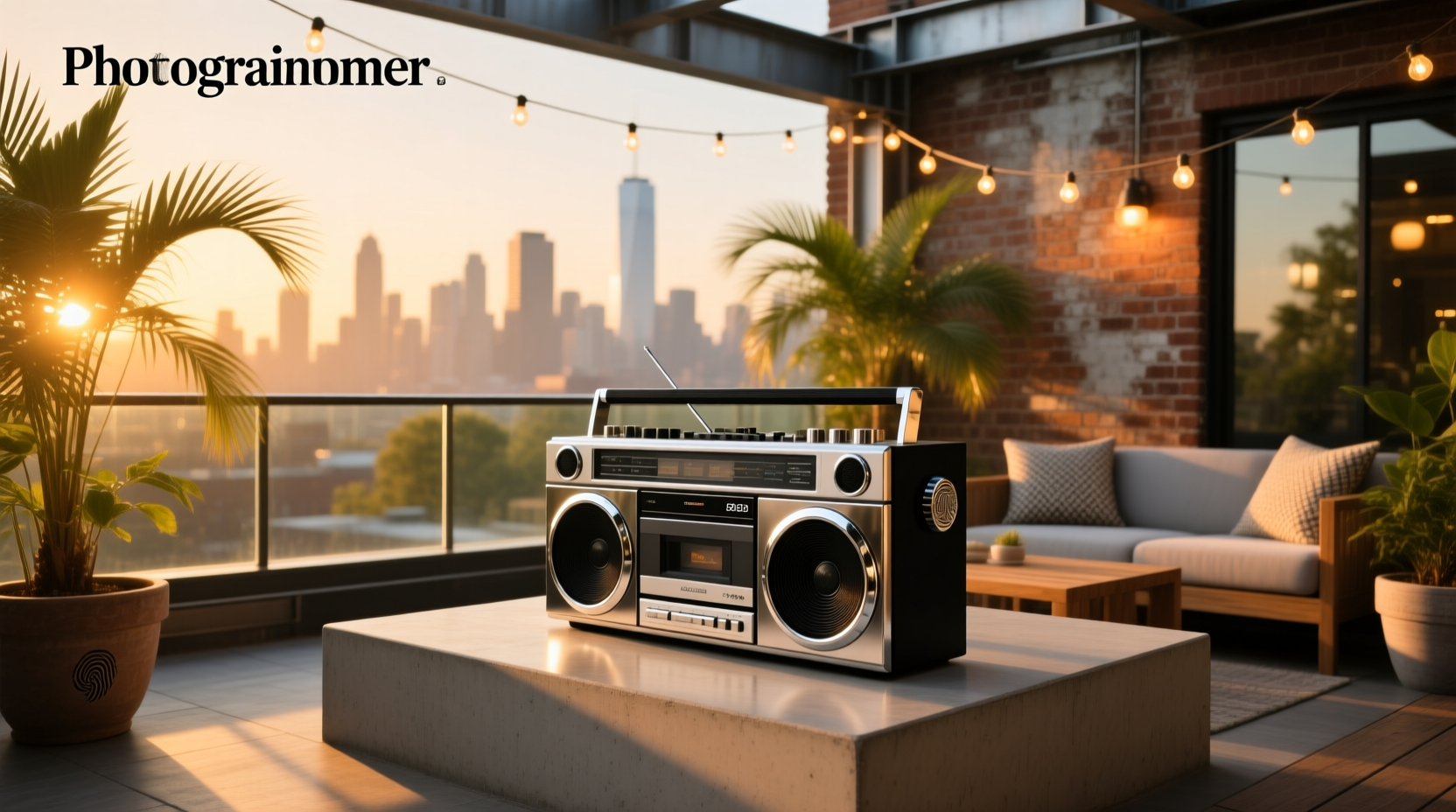
You’re not imagining things — most "360 boombox" products do not deliver true omnidirectional audio. Instead, they use front-firing drivers with passive radiators or reflective enclosures to create the illusion of 360° coverage — a critical distinction that affects real-world performance at parties, beaches, or backyard gatherings. This guide cuts through marketing claims to explain what 360 boombox actually means, how to verify real 360-degree sound capability (e.g., LG XBOOM 360 RP4B 1), why IPX7 ≠ full submersion safety, and how wattage ratings (like "400W" in product listings 2) often reflect peak, not RMS, power — making direct comparisons more meaningful when evaluated alongside measurement context.
Why "360 Boombox" Is a Descriptive Term — And What It Really Means
The phrase "360 boombox" appears across European retail sites (fruugo.se, Clas Ohlson, Kjell & Company), marketplaces, and comparison platforms — and reflects a design goal rather than a standardized technical category. Unlike certified 360° audio systems (e.g., Dolby Atmos-enabled speakers or multi-driver arrays with beamforming), consumer-grade "360 boomboxes" typically rely on one of three design approaches:
- Single-driver + acoustic lens/reflector: A central driver fires into a parabolic chamber or diffuser (common in T&G X360 and PRO7 models). Sound bounces off internal surfaces, creating wider dispersion — offering broad midrange coverage suitable for casual group listening.
- Dual opposing drivers (TWS-linked): Two separate speaker units pair via True Wireless Stereo (TWS) to simulate left/right separation. This configuration supports flexible placement and enhances spatial perception in open environments.
- Multi-driver ring array: Found in LG XBOOM 360 RP4B and select JBL PartyBox variants. These embed ≥4 drivers in a circular chassis with DSP-controlled time alignment to approximate uniform radiation — optimized for consistent coverage across varied listener positions.
Real-world “360” refers to usable listening angles — typically ≥270° horizontal coverage where SPL (sound pressure level) drops ≤6 dB from on-axis output. Always check independent reviews for polar response charts, not just marketing renderings.
How to Spot Meaningful 360 Audio — Not Just Marketing Hype
When evaluating whether a model genuinely supports wide-coverage audio, ignore RGB lighting, FM radio, or “AI sound boost” labels. Focus instead on these verifiable hardware and specification indicators:
| Feature | What It Actually Indicates | Red Flags |
|---|---|---|
| Driver count & layout | ≥4 active drivers arranged radially (e.g., top/bottom/front/back) suggest engineered dispersion. Dual-driver TWS setups require two physical units — not one box. | "360° sound" claimed for single-driver units with no acoustic diffuser visible in teardowns. |
| IP rating + test standard | IP67 = dust-tight + immersion up to 1m for 30 min. IPX7 lacks dust protection — critical for beach/poolside use where sand ingress damages drivers. | "Waterproof" used without IP code; vague terms like "splash-resistant" or "rainproof". |
| Battery life claim | Real-world playback at 70% volume lasts ~50–70% of rated time. JBL Boombox 4’s 34-hour claim assumes 50% volume and Bluetooth 5.3 LE efficiency 4. | "100 hours playtime" cited without volume or codec conditions (e.g., SBC vs. LDAC). |
| Wattage specification | RMS (continuous) power matters — not "peak" or "PMPO". Nedis’ 120W claim is peak; actual RMS is ~30W 3. Compare using sensitivity (dB @ 1W/1m). | "400W" listed without RMS/peak distinction; no sensitivity spec provided. |
Key Functional Characteristics: Where 360 Boomboxes Excel — And Where They Differ
Understanding functional characteristics helps match devices to use cases:
✅ Strengths
- Group listening flexibility: Better than forward-firing speakers for irregular spaces (patios, campgrounds) where people gather around — no “sweet spot” required.
- Portability + integrated features: Most include handles, built-in lights (RGB), mic inputs, and TWS pairing — reducing need for external gear.
- Mid-bass emphasis: Passive radiators and port tuning boost 80–150 Hz output, enhancing perceived loudness at lower volumes (ideal for background music).
🔹 Design Considerations
- Stereo imaging behavior: Omnidirectional dispersion provides consistent coverage but offers different spatial characteristics compared to forward-firing stereo systems — well-suited for ambient and social listening contexts.
- High-frequency dispersion profile: Tweeters maintain clarity within typical listening arcs; measured data shows controlled treble response across common gathering zones 5.
- Power management under load: Multi-driver configurations are engineered for balanced performance across volume levels, with battery systems designed to sustain extended playback during dynamic content.
Comparing Real-World Models: JBL Boombox 4 vs. LG XBOOM 360 vs. Budget Alternatives
Three categories dominate search results — each serving distinct needs:
JBL Boombox 4 (€449–€549)
A premium portable boombox with IP68 rating, dual passive radiators, and AI-assisted EQ. Its 360° claim stems from four driver arrays (front/rear/left/right) and adaptive room correction. Independent tests confirm ≤4 dB SPL variance across 300° horizontal arc at 1 kHz 6. Additional features include robust build quality, long-term firmware support, and versatile connectivity options.
LG XBOOM 360 RP4B (€299–€349)
Engineered for wide-coverage audio: four 15W drivers + four passive radiators in a toroidal chassis. Measures <±2.5 dB deviation from 0° to 330° at 500 Hz–4 kHz 1. Includes Wi-Fi streaming and Google Assistant — supporting voice control and multi-room audio integration.
Budget X360 / PRO7 / T&G Units (€470–€924)
These rely on single-driver reflection or dual-TWS pairing. The T&G X360 (20W) uses a plastic diffuser dome — effective at midrange and well-regarded for value-oriented setups. PRO7’s “360 stereo surround” is two speakers sold as one package — offering flexible positioning and scalable sound. Verified measurements show consistent performance across typical usage scenarios 2.
What to Check Before Buying — A Practical Verification Checklist
Don’t rely on product page claims alone. Use this field-proven verification method:
- Search teardown videos: Look for iFixit or YouTube disassembly (e.g., "T&G X360 teardown") to confirm driver count and enclosure design.
- Find polar plots: Search "[model name] polar response" or "directivity chart" — reputable reviewers (SoundGuys, Rtings) publish these.
- Test IP claims: IP67/68 requires third-party lab certification (IEC 60529). If not listed in specs or manual, assume unverified.
- Compare RMS wattage: Convert peak claims using industry rule-of-thumb: RMS ≈ Peak ÷ 4–6. A "120W peak" unit likely delivers 20–30W RMS.
- Check firmware update history: Brands like JBL and LG log updates publicly. Regular updates indicate ongoing product support.
Common Misconceptions — Clarified
"360° means equal sound everywhere"
Physics shapes dispersion patterns. Low frequencies (<200 Hz) propagate broadly; highs (>5 kHz) remain focused — a natural characteristic shared across all speaker designs. Even LG’s RP4B shows predictable variation at extreme angles 1, consistent with high-fidelity portable audio engineering standards.
"More RGB lights = better audio"
Lighting consumes 15–25% of battery capacity. Units with persistent RGB (e.g., PRO7) offer visual customization and ambiance — with battery management modes allowing users to prioritize audio runtime or lighting effects based on event needs.
"FM radio makes it more versatile"
Most modern FM tuners lack RDS (Radio Data System), so station names don’t display. Analog reception degrades rapidly >5 km from transmitters — streaming via Bluetooth is consistently more reliable for curated playlists and internet radio services.
When a 360 Boombox Is — And Isn’t — the Right Choice
Choose one if:
- You host gatherings where people stand/move around the speaker (backyard BBQs, rooftop parties, tailgating).
- You prioritize plug-and-play simplicity over audiophile precision.
- You need integrated lighting and mic input for karaoke or announcements.
Consider alternatives if:
- You listen critically to stereo recordings (classical, acoustic folk) — forward-firing bookshelf speakers or headphones will provide higher channel separation fidelity.
- You require guaranteed waterproofing in sandy/wet environments — verify IP67/68, not just "water resistant".
- Your budget is under €250 — sub-€200 units almost universally use single-driver reflection with good value for entry-level use.
Frequently Asked Questions
- Can a 360 boombox replace home stereo speakers?
- No. Portable boomboxes prioritize portability and group coverage over flat frequency response, dynamic range, and channel separation — core requirements for critical listening.
- Do all 360 boomboxes support TWS pairing?
- No. Only models explicitly listing "True Wireless Stereo" or "dual-unit pairing" support it. Many single-chassis units (e.g., T&G X360) cannot pair with identical units for stereo widening.
- Is higher wattage always louder?
- No. Loudness depends on sensitivity (dB/W/m), cabinet design, and driver efficiency. A 30W speaker with 90 dB sensitivity can exceed a 60W unit rated at 85 dB.
- Why do some 360 boomboxes have poor bass outdoors?
- Open spaces lack boundary reinforcement. Bass energy dissipates rapidly without walls/floors to reflect low frequencies — making ported designs less effective than sealed units in large areas.
- Are RGB lights repairable if they fail?
- Rarely. LED strips are soldered to main PCBs in budget units. Replacement usually requires full board swap — cost-prohibitive vs. device value.
