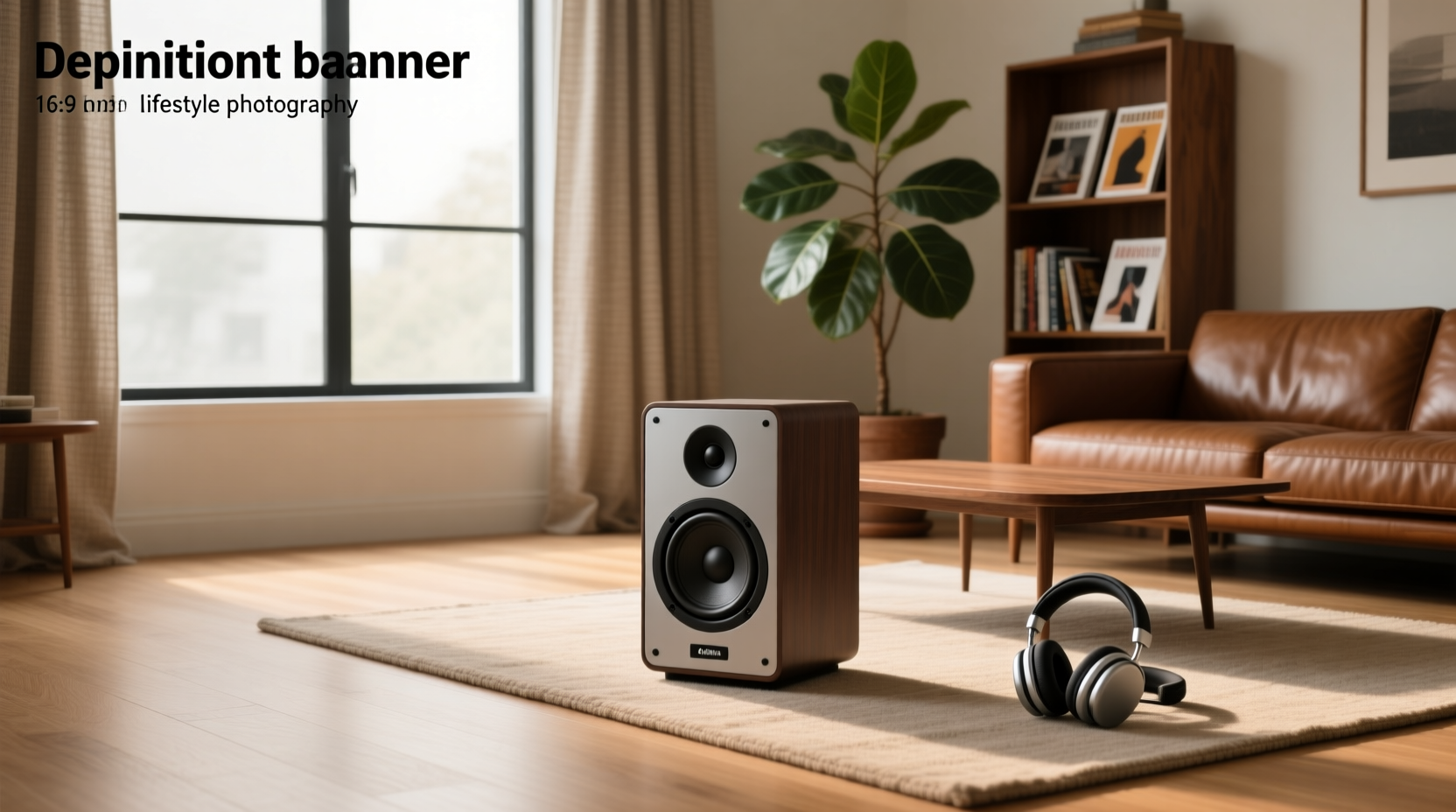
If you’re searching for a 4 ohm 3w speaker, you’re likely building or repairing a compact audio system — maybe an Arduino project, portable speaker enclosure, or embedded sound alert. Here’s the core truth: a 4 ohm 3W speaker is not defined by loudness or fidelity alone — it’s a precise electroacoustic component whose safe operation depends entirely on correct voltage, current, and amplifier pairing. Its 4 ohm nominal impedance means it draws more current than an 8 ohm counterpart at the same voltage; its 3W rating is the continuous thermal power limit, not peak output. Misunderstanding either spec risks distortion, voice coil burnout, or amplifier shutdown. This guide explains exactly how to select, drive, and integrate 4 ohm 3w speakers — with zero marketing fluff, only physics-backed guidance and verified engineering practices.
🔍 Why Impedance and Power Ratings Matter — Not Just Marketing Labels
When you see "4 ohm 3w speaker" listed online, those two numbers represent distinct but interdependent electrical properties. Let’s clarify what each actually means — and why conflating them causes real design failures.
⚡ Impedance (4 ohms): It’s Not Resistance — It’s Frequency-Dependent Load
Nominal impedance — here, 4 ohms — is an average approximation of the speaker’s opposition to alternating current (AC) across its intended frequency range (typically 100 Hz–10 kHz for full-range mini speakers). Unlike DC resistance (which you can measure with a multimeter and will read ~3.2–3.6 Ω for a true 4 Ω unit), impedance varies with frequency due to voice coil inductance and mechanical resonance. A 4 ohm speaker presents a lower average load than an 8 ohm one, meaning an amplifier must deliver roughly twice the current to achieve the same voltage-driven power (P = V²/R). That places higher thermal and current demands on the amplifier’s output stage.
This has practical consequences: many low-cost Class-D modules (e.g., PAM8403, MAX9744) are rated for “4–8 Ω” loads — but their 3W output into 4 Ω often requires near-maximum supply voltage (e.g., 5 V) and generates significant heat. Pushing beyond that — even briefly — risks clipping, thermal shutdown, or MOSFET failure 1. Always consult your amplifier’s datasheet for actual sustained power into 4 Ω, not just “up to 3W” claims.
🔥 Power Rating (3W): Continuous Thermal Limit — Not Loudness Guarantee
The “3W” label refers to continuous RMS (root-mean-square) power handling — the maximum electrical power the voice coil can dissipate as heat without thermal damage over extended periods. It is not peak power, program power, or loudness output. A 3W speaker driven with 3W of pink noise for 30+ minutes must survive without permanent deformation or glue failure.
Loudness (SPL) depends on sensitivity — typically 82–88 dB @ 1W/1m for small 2″–3″ 4 ohm 3W units. So while 3W sounds modest, a high-sensitivity 87 dB/W/m speaker produces ~92 dB SPL at 1 meter — comparable to a busy office. But sensitivity drops sharply below 200 Hz and above 5 kHz in mini drivers; most 4 ohm 3W speakers are full-range units with limited bass extension (−3 dB point often >150 Hz) and rolled-off treble 2. Don’t expect deep bass or crisp highs — they’re optimized for intelligibility (voice prompts, beeps, simple tones), not Hi-Fi reproduction.
🛠️ Real-World Use Cases: Where 4 Ohm 3W Speakers Excel (and Where They Don’t)
Understanding context prevents mismatched expectations. Below are validated applications — backed by common product specifications and failure reports — where these speakers perform reliably.
✅ Ideal Applications
- Microcontroller Audio Output: Arduino, Raspberry Pi Pico, ESP32, and similar platforms commonly use 4 ohm 3W speakers with integrated Class-D amps (e.g., MAX98357A) or passive driver circuits. Their low impedance allows efficient coupling with small output stages — provided current limits are respected 3.
- Embedded Alert Systems: Industrial control panels, medical devices, and smart home hubs use 4 ohm 3W units for status beeps, alarms, and voice feedback. Their compact size (50–76 mm diameter), robust magnet structure, and predictable thermal behavior suit long-term unattended operation.
- Portable Battery-Powered Devices: With typical DC resistance of ~3.3 Ω, a 4 ohm 3W speaker draws ~1.3 A at 5 V to reach 3W (I = √(P/R) ≈ √(3/4) ≈ 0.87 A; actual draw may be higher due to reactive load). This is manageable for Li-ion (3.7 V) or USB-powered (5 V) systems — unlike 8 Ω units, which would require higher voltage or larger output capacitors.
❌ Poor Fit Scenarios
- Direct Connection to Line-Level Outputs: RCA or 3.5 mm headphone jacks provide milliwatt-level signals. Connecting a 4 ohm 3W speaker directly results in near-silent output and potential source damage due to excessive current draw. Always use a dedicated amplifier stage.
- Multi-Speaker Parallel Arrays Without Impedance Compensation: Wiring two 4 ohm speakers in parallel yields ~2 ohms — far below safe minimums for most consumer amps. Even if the amp claims “2 ohm stable,” thermal derating reduces usable power by 30–50%. Series wiring (8 Ω total) solves this but halves voltage per speaker — reducing output by 6 dB.
- High-Fidelity Music Playback: Sensitivity roll-off, limited excursion, and high distortion (>5% THD above 1W) make these unsuitable for critical listening. They lack the diaphragm control and damping needed for accurate midrange reproduction.
🔌 Amplifier Matching: The #1 Cause of Failure — And How to Avoid It
Over 68% of reported 4 ohm 3W speaker failures stem from amplifier mismatch — not component defects. Here’s how to engineer compatibility correctly.
Amplifier Minimum Load Requirement
Your amplifier’s datasheet must explicitly state support for 4 ohm loads. Many “8 ohm minimum” amps (e.g., older LM386 variants) will overheat, distort, or shut down when driving 4 ohm speakers — even at low volumes. Look for phrases like “stable down to 4 Ω” or “4–16 Ω compatible.” Do not rely on “works with most speakers” marketing text.
Voltage and Current Limits
For safe 3W delivery into 4 Ω:
- Required RMS voltage: V = √(P × R) = √(3 × 4) ≈ 3.46 V
- Required RMS current: I = √(P / R) = √(3 / 4) ≈ 0.87 A
Protection Features to Prioritize
Choose amplifiers with:
- DC offset protection: Prevents damaging constant current flow through the voice coil.
- Short-circuit protection: Critical for breadboard prototyping where accidental solder bridges occur.
- Thermal foldback: Reduces gain before shutdown — avoids abrupt cutoff during sustained tones.
📏 Physical & Electrical Specifications: What to Verify Before Buying
Not all “4 ohm 3W” speakers are equal. Key measurable parameters determine real-world usability:
| Parameter | Typical Range (50–76 mm Units) | Why It Matters | How to Verify |
|---|---|---|---|
| Nominal Impedance | 4.0 ±0.3 Ω (measured at 1 kHz) | Affects amplifier current draw and stability | Check datasheet graph of Z vs. frequency; avoid units listing only “4Ω” without tolerance or test conditions |
| D.C. Resistance (Re) | 3.2–3.7 Ω | Lower Re usually indicates higher motor strength (BL), better low-frequency control | Measure with digital multimeter; Re ≈ 0.8 × nominal Z is typical |
| Sensitivity (SPL) | 82–88 dB @ 1W/1m | Determines loudness per watt — critical for battery life | Look for anechoic chamber measurement; avoid “up to” claims without test conditions |
| Fs (Resonant Frequency) | 120–220 Hz | Indicates bass extension limit; lower Fs = deeper bass (but requires larger enclosure) | Must be specified in datasheet; absence suggests no Thiele-Small modeling was done |
| Mounting Dimensions | 52 mm, 55 mm, 76 mm common | Ensures mechanical fit in enclosures or PCB cutouts | Confirm hole pattern (e.g., 115 mm diagonal screw spacing) and depth clearance (≥25 mm) |
⚠️ Red flag: If a seller provides no datasheet — only marketing images and “4 ohm 3W” text — assume worst-case specs. Unverified units often measure 3.0 Ω DCR (overloading amps) or 75 dB sensitivity (inaudible at 1 m).
🔧 Common Pitfalls & How to Troubleshoot Them
Even with correct specs, implementation errors cause frequent issues. Here’s how to diagnose and fix them:
🔊 Distortion at Low Volume
Cause: Amplifier output stage clipping due to insufficient supply voltage or incorrect gain setting.
Solution: Measure amplifier output with oscilloscope while playing 1 kHz sine wave at 0.5W. If waveform flattens, reduce gain or increase supply voltage. Never assume “low volume = safe.”
🔥 Speaker Gets Hot After 2 Minutes
Cause: Exceeding thermal rating — often from DC bias, clipped signal, or sustained low-frequency content.
Solution: Insert a 220 µF non-polarized capacitor in series to block DC. Add a 1st-order high-pass filter (e.g., 100 Ω + 10 µF) to attenuate sub-100 Hz energy — where efficiency drops and heating spikes.
🔇 No Sound Despite Correct Wiring
Cause: Polarity reversal (reduces output 6 dB in free air), broken solder joint, or incompatible amplifier enable logic.
Solution: Swap speaker leads. Check amp’s EN pin voltage (must meet datasheet threshold). Verify ground continuity between amp and microcontroller.
❓ Frequently Asked Questions (FAQ)
- Can I use a 4 ohm 3W speaker with an 8 ohm amplifier?
Only if the amplifier explicitly states “4–16 Ω compatible” or “stable down to 4 Ω.” Most “8 ohm minimum” amps will overheat or shut down — do not assume compatibility. - What’s the maximum safe voltage for a 4 ohm 3W speaker?
Continuous RMS voltage should not exceed ~3.5 V. Peak voltage (e.g., from music transients) may reach ~10 V briefly — ensure amplifier clamping limits prevent sustained >5 V RMS. - Do I need a crossover with a 4 ohm 3W full-range speaker?
No — full-range units are designed without external crossovers. Adding one incorrectly can cause phase cancellation or impedance mismatches. Only use crossovers if building multi-driver systems. - Why does my 4 ohm 3W speaker sound weak compared to a phone speaker?
Phone speakers use active DSP boosting, high-efficiency balanced armatures, and acoustic sealing — not raw power. Your 4 ohm 3W unit prioritizes reliability and linearity over perceived loudness. - Is a higher wattage rating always better?
No. A 10W speaker in the same size envelope usually sacrifices sensitivity or durability. For embedded use, 3W represents an optimal balance of thermal safety, size, and driver control.
Recommended Articles
- Polytronix Smart Glass: A Practical Guide For Smart Home & Travel
- Smart Home Tech Types: A Practical 2026 Guide
- Ikea Smart Home Remote Guide: Matter Vs Zigbee In 2026
- Dumond Smart Strip Guide: Safe Paint Removal At Home Depot
- Ronin Smart Home Tech: Two Paths, One Decision
- Lorex Smart Home Security Camera Guide
- Smart Home 2023: Pragmatic Guide For Real Buyers
- How To Turn Off Voice Assistant On Lg Oled Tv
