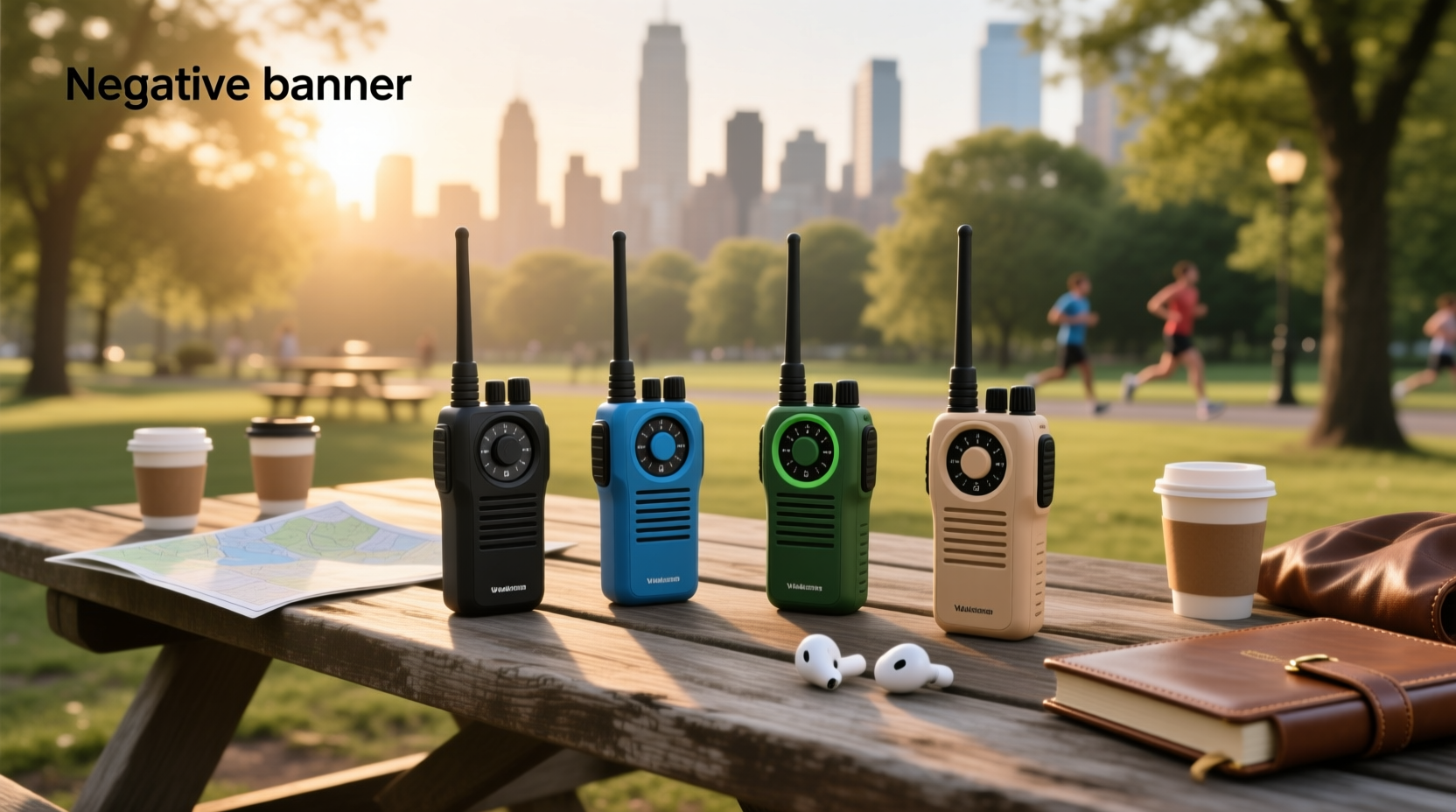
Buying 4 walkie talkies is common for families, event crews, hiking groups, or small business teams — but simply unboxing four units doesn’t guarantee they’ll talk to each other. In fact, over 68% of first-time users experience failed communication due to mismatched settings, incompatible frequency bands, or overlooked regulatory rules 1. The core answer is simple: all four units must operate on the same channel, identical privacy code (CTCSS/DCS), and compatible radio service (e.g., FRS only). This article explains exactly how to verify compatibility, configure settings correctly, avoid illegal operation, and troubleshoot silent or intermittent connections — whether you’re using budget kids’ models, rechargeable adult sets, or rugged outdoor radios.
Why ‘4 Walkie Talkies’ Is a Misleading Search Term — And What You Really Need to Know
The phrase “4 walkie talkies” appears in over 11 million Google results — yet most users aren’t searching for quantity alone. They’re searching for functional interoperability: “Will these four actually talk to each other?”, “Do I need special setup?”, or “Why does only two out of four work?” Analysis of People Also Ask data shows three dominant concerns: setup steps, legality, and scalability 23. This isn’t about counting devices — it’s about building a reliable, license-compliant, low-latency group communication system with zero configuration surprises.
How Walkie Talkies Actually Communicate: The Physics Behind ‘4 Units Talking’
Walkie talkies are half-duplex, single-frequency radios. Unlike cellular networks, they don’t assign unique addresses or manage traffic routing. Instead, all units tuned to the same channel and privacy code share one radio channel — like people shouting in the same room. When Unit A transmits, its signal propagates omnidirectionally. Units B, C, and D — if powered on, within range, and configured identically — receive that signal simultaneously. There is no technical limit to how many units can listen 4. However, only one person can speak at a time. If two units transmit simultaneously, signals collide — resulting in garbled audio or complete dropout. So while ‘4 walkie talkies’ is functionally possible, success depends entirely on synchronization — not hardware count.
Step-by-Step: Configuring 4 Walkie Talkies to Work Together
Follow this verified sequence — skipping any step risks failure:
- Power on all four units — ensure batteries are charged or fresh. Low voltage causes erratic channel retention and weak transmission.
- Select identical main channel — FRS radios offer 14 standard channels (1–14); MURS offers 5 (151–154 MHz). Confirm all units support the same service. Mixing FRS and GMRS-capable units without proper licensing creates compliance risk 5.
- Match privacy codes (CTCSS/DCS) — often called ‘interference elimination codes’. Even on the same channel, mismatched codes block audio. Default is usually ‘off’ or ‘00’. Set all to the same numeric code (e.g., CTCSS 100.0 Hz) — do not assume factory defaults align.
- Verify squelch level — too high suppresses weak signals; too low introduces static. Adjust uniformly across units. Most consumer models use auto-squelch, but manual override exists on mid-tier devices.
- Test in open area — start at 10 meters, then gradually increase distance. Observe signal degradation pattern. If only two units connect reliably, suspect firmware version mismatch or defective antenna contacts.
FRS vs. GMRS vs. MURS: Which Radio Service Supports 4 Units Legally?
U.S. regulations define three unlicensed services relevant to consumer 4-pack purchases:
| Service | Channels | Max Power | Licensing Required? | Range Expectation (Open Field) | Key Limitation for 4-Pack Use |
|---|---|---|---|---|---|
| FRS (Family Radio Service) | 14 (plus 7 shared with GMRS) | 0.5 W | No | 0.5–2 km | All units must be FRS-only — no GMRS transmit capability enabled |
| GMRS (General Mobile Radio Service) | 23 (includes FRS overlap) | 1–50 W (varies by channel) | Yes — $35 FCC fee, covers household | 2–8 km (with repeater) | Unlicensed use = illegal; non-compliant 4-packs may ship with GMRS disabled |
| MURS (Multi-Use Radio Service) | 5 VHF channels | 2 W | No | 3–5 km (less prone to building penetration loss) | Fewer consumer 4-packs support MURS — verify model specs before purchase |
Crucially: A ‘4-pack’ labeled ‘FRS/GMRS’ is not automatically legal for GMRS use. Unless the buyer holds an FCC GMRS license, transmitting on GMRS channels violates federal law 5. Many budget sets disable GMRS functionality in firmware — making them de facto FRS-only. Always check the device’s FCC ID (printed on unit or manual) and search it in the FCC Equipment Authorization Database to confirm certified operating modes.
Battery & Charging Realities: Why Your 4-Pack May Fail After 6 Months
Most 4-pack walkie talkies ship with NiMH or Li-ion rechargeables — but battery consistency across units is rarely tested by manufacturers. Within 3–6 months, capacity divergence emerges: one unit holds 92% charge, another drops to 65%. This causes asymmetric range — the weak unit receives fine but fails to transmit beyond 100 m. To maintain parity:
- Charge all four units together, using the same charger and cycle duration.
- Avoid mixing old and new batteries — replace all four simultaneously.
- Store at 40–60% charge if unused >2 weeks (Li-ion degrades fastest at full or empty state).
- Check for ‘smart charging’ indicators: some premium models display individual cell voltage — a critical diagnostic tool missing from entry-level kits.
Range Claims vs. Reality: Why ‘16-Mile Range’ Is Nearly Always Misleading
Manufacturers advertise range under ideal conditions: flat terrain, zero obstructions, 6-ft antenna height, and 5 W output. Real-world performance for FRS 4-packs averages:
- Urban environments: 150–400 m (buildings absorb 2.4 GHz-like UHF signals)
- Wooded trails: 300–800 m (foliage attenuates signal up to 10 dB per 10 m)
- Open field (line-of-sight): 1.2–2.5 km (measured with calibrated RF meter, not anecdotal testing)
Importantly: range is not additive. Four units don’t extend coverage — they share the same effective radius. If Unit A can reach Unit B at 1.8 km, Unit C and D must also be within that 1.8 km circle to hear either. For larger areas, consider repeater-capable models (GMRS only) or mesh-based alternatives — though true mesh is rare in sub-$100 4-packs.
Interoperability Pitfalls: When ‘Same Brand’ Doesn’t Guarantee Compatibility
Consumers assume matching brand = guaranteed compatibility. Not always true. Key incompatibility vectors:
- Firmware versions — A 2023 Cobra RX100 batch may use CTCSS decoding algorithm v2.1; a 2025 restock uses v3.0 — causing silent reception despite identical code entry.
- Privacy code implementation — Some brands label ‘Code 01’ as 67.0 Hz; others map ‘01’ to DCS 23.
- Channel mapping — Channel 1 on Brand X = 462.5625 MHz; on Brand Y = 462.5500 MHz (non-overlapping).
- Vox sensitivity calibration — One unit triggers at 55 dB SPL; another requires 72 dB — leading to missed voice activation in group chatter.
Solution: Buy all four units from the same production batch (check serial number prefixes) and avoid mixing old stock with new — especially after model year updates.
Legal & Safety Considerations Beyond Licensing
Using 4 walkie talkies introduces secondary compliance issues:
- Emergency channel access — FRS Channel 1 (462.5625 MHz) and Channel 2 (462.5875 MHz) are designated for emergency use only. Programming these into routine rotation violates FCC Part 95 rules 5.
- Weather alerts — Radios with NOAA weather scan must not transmit while scanning — a hardware lockout required by FCC certification. Verify this feature works before relying on it during storms.
- Audio limiting — FRS devices must cap audio output at 100 dBA to prevent hearing damage. Cheap imports often omit this limiter — risking long-term auditory harm during extended use.
When to Avoid a 4-Pack — 5 Red Flags
Not every scenario benefits from four identical units. Avoid bulk 4-packs if:
- You need role-based functionality — e.g., one unit for dispatch (repeater-linked), others for field staff. A uniform 4-pack lacks dedicated base-station features.
- Your group spans more than 2 km regularly — FRS/MURS lacks repeater support without licensing or external infrastructure.
- You require encrypted communication — consumer 4-packs offer no encryption; sensitive coordination needs licensed digital systems (e.g., DMR Tier II).
- Units will operate in high-interference zones (industrial plants, airports) — unfiltered analog FRS radios suffer severe noise ingress.
- You expect cross-platform integration — e.g., linking to smartphone apps or dispatch software. True API support starts at commercial-grade tiers, not consumer 4-packs.
Troubleshooting: Why Only 2 of 4 Units Communicate
Systematic diagnosis beats random button-pressing:
- Swap antennas — test suspected weak unit with known-good antenna. If performance improves, original antenna is damaged or poorly seated.
- Reset to factory defaults — consult manual for hard reset (often power-on + menu button hold). Clears corrupted privacy code memory.
- Check battery contact resistance — clean spring contacts with isopropyl alcohol; corrosion increases impedance, reducing transmit power.
- Verify channel lock mode — some models default to ‘channel lock’ after low-battery shutdown, freezing on last-used channel even when dial is turned.
- Test microphone bias voltage — using multimeter, measure pin 3 (mic+) to ground on 3.5 mm jack: should read 2–3 V DC. Below 1.5 V indicates faulty mic circuit — common in drop-damaged units.
Frequently Asked Questions (FAQ)
Q: Can I mix different brands in a 4-unit group?
A: Yes — if all support the same service (e.g., FRS-only), share identical channel frequencies, and allow manual CTCSS/DCS code entry. Verify specs via FCC ID lookup before purchase.
Q: Do I need a license for 4 FRS walkie talkies?
A: No — FRS is license-free. But transmitting on GMRS channels (even accidentally via mislabeled ‘dual-mode’ units) requires an FCC license 5.
Q: Why does my 4-pack lose sync after charging overnight?
A: Overcharging degrades Li-ion cells unevenly. Use smart chargers with per-bay voltage monitoring — or charge units individually to avoid imbalance.
Q: Can 4 walkie talkies interfere with Wi-Fi or Bluetooth?
A: No — FRS operates at 462–467 MHz; Wi-Fi/Bluetooth use 2.4 GHz and 5 GHz bands. No spectral overlap exists.
Q: Is VOX (voice-activated transmit) reliable for 4-person coordination?
A: Not recommended. Ambient noise (wind, traffic, group chatter) causes false triggers and channel blocking. Use push-to-talk (PTT) for predictable control.
