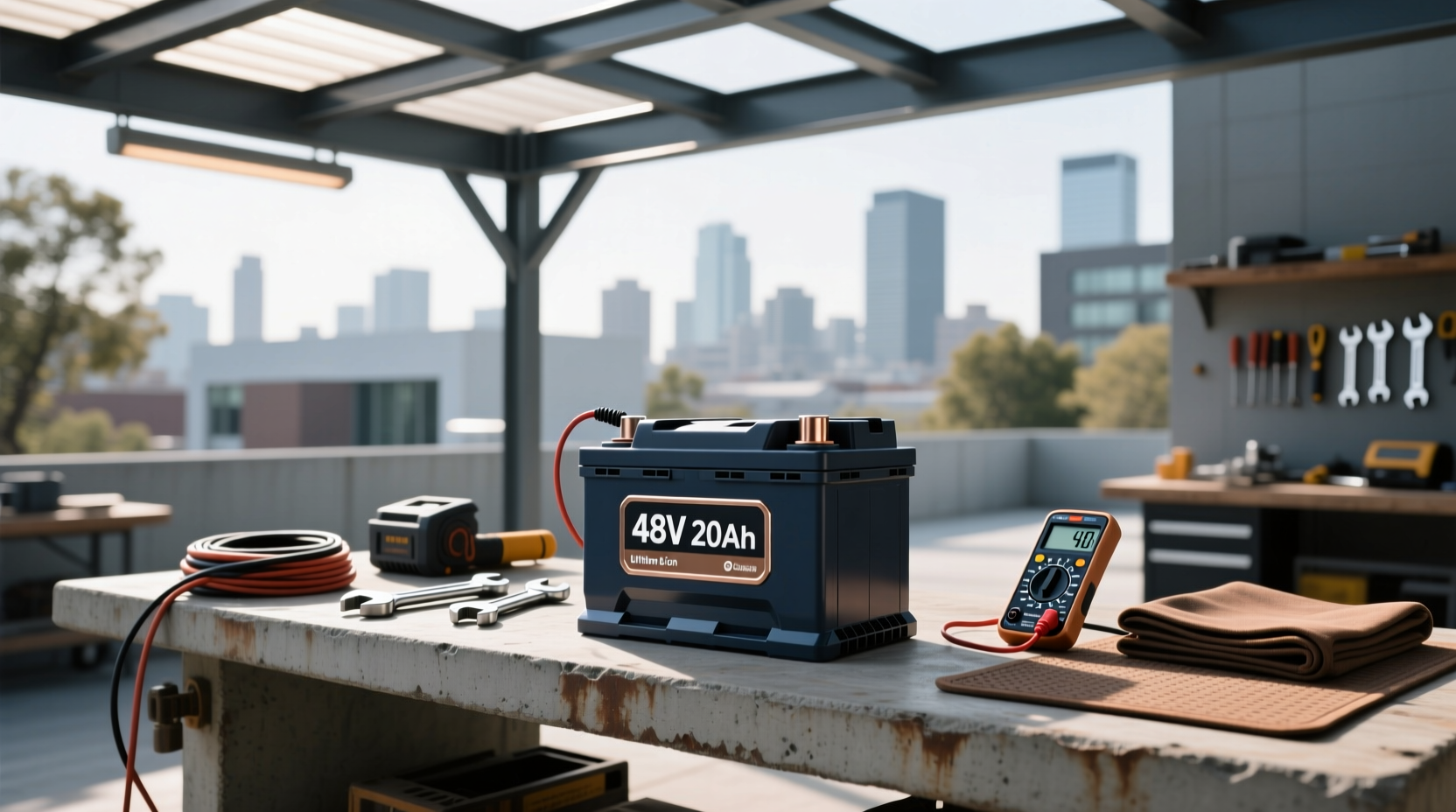
If you’re searching for a 48V 20Ah battery, you likely need reliable, high-energy storage for an e-bike, light EV, or off-grid solar setup — and you want to avoid overpaying for mismatched specs or underperforming cells. A true 48V 20Ah lithium (Li-ion or LiFePO₄) battery delivers 960 watt-hours (Wh) of usable energy (48V × 20Ah), supports continuous loads up to 500–1,000W, lasts 1,500–2,500 full charge cycles, and typically powers 40–50 km per charge on mid-drive e-bikes 1. But not all 48V 20Ah labels reflect real-world performance: voltage sag, BMS quality, cell grade, and thermal management dramatically affect safety, longevity, and actual range. This guide cuts through ambiguity — explaining what the numbers mean, how to validate claims, where this battery fits (and doesn’t fit), and exactly what to inspect before purchase.
Why the 48V 20Ah Format Dominates Mid-Power Applications
The 48V 20Ah battery configuration strikes a widely adopted engineering balance between power delivery, efficiency, and regulatory compliance. At 48 volts, the system operates above the 36V threshold that triggers stricter electrical safety classifications in most regions (e.g., EU EN 62133, UL 2271), yet remains below 60V — the common limit for ‘low-voltage’ exemption from arc-flash labeling and heavy-duty insulation requirements. Combined with 20 amp-hours, it yields 960Wh: enough energy to run a 500W e-bike motor for ~1.9 hours at full load, or supply ~1.2 kWh/day to a small solar backup system with 85% round-trip efficiency. That’s why it’s standard in Class 2/3 e-bikes, light electric scooters, portable power stations (under 2kWh), and residential solar battery banks for critical-load circuits 2.
Crucially, 48V reduces current draw versus lower-voltage equivalents. For example, delivering 1,000W at 24V requires ~42A; at 48V, it’s only ~21A. Lower current means smaller gauge wiring, reduced resistive losses (I²R), cooler operation, and longer cable runs without voltage drop — a practical advantage for DIY solar integrations or frame-mounted e-bike packs.
Understanding the Two Main Chemistries: Li-ion vs. LiFePO₄
When you see “48V 20Ah”, the underlying cell chemistry is never specified in the label — but it dictates safety, lifespan, temperature tolerance, and cost. Here’s how they compare:
| Feature | Lithium-ion (NMC/NCA, e.g., 18650/21700) | LiFePO₄ (LFP) |
|---|---|---|
| Nominal Voltage per Cell | 3.6–3.7V | 3.2V |
| Full Pack Voltage Range | 44.4V (12S) – 54.6V (13S) | 44.8V (14S) – 58.8V (14S) |
| Cycle Life (to 80% capacity) | 500–1,000 cycles | 2,000–3,500 cycles |
| Thermal Stability | Moderate; thermal runaway risk above 60°C | High; stable up to 270°C; no oxygen release |
| Energy Density (Wh/kg) | 150–220 Wh/kg | 90–120 Wh/kg |
| Low-Temp Performance (-10°C) | ~65% capacity retention | ~80% capacity retention |
| Typical BMS Protection Needs | Over-voltage, over-current, temp cutoff critical | Cell balancing more critical; less sensitive to overcharge |
For e-bikes used daily in temperate climates, NMC-based 48V 20Ah packs offer higher energy density and lighter weight — often 5–7 kg total. But for solar storage, marine use, or applications where fire risk must be minimized (e.g., indoor battery cabinets), LiFePO₄ is objectively safer and lasts 2–3× longer 3. Never assume chemistry from voltage or Ah alone: always confirm via datasheet or manufacturer spec sheet — not marketing copy.
Decoding the “20Ah” Label: Real Capacity vs. Advertised Capacity
A “20Ah” rating is meaningless without context. Industry-standard capacity is measured at a specific discharge rate (usually C/5 or 0.2C = 4A for a 20Ah pack) and temperature (25°C). But many budget packs list capacity measured at ultra-light loads (C/20 = 1A) — inflating Ah by 5–10%. Worse, some omit whether the rating is for initial capacity or end-of-warranty (e.g., “20Ah @ 500 cycles”).
Here’s how to verify real-world usability:
- Check the discharge curve: A genuine 48V 20Ah LiFePO₄ pack should hold ≥46V for >80% of its discharge time under 20A load. If voltage drops below 45V within 30 minutes at 20A, the cells are likely degraded or undersized.
- Review BMS current limits: A 20Ah pack rated for only 25A continuous discharge cannot safely power a 1,000W e-bike motor (which draws ~21A at 48V) during hill climbs — let alone handle 30–40A surge peaks. Look for BMS-rated continuous current ≥30A and peak ≥60A.
- Confirm cell origin and grade: “Grade A” cells (from Panasonic, Samsung SDI, CATL, or EVE) have consistent capacity, low internal resistance (<15 mΩ), and documented cycle data. “Unbranded” or “white-label” cells may test at 18–19Ah after 50 cycles — even if labeled 20Ah.
BMS: The Non-Negotiable Component — What to Inspect
The Battery Management System (BMS) is the single most important component in any 48V 20Ah lithium pack — more critical than brand or casing. It’s not optional firmware; it’s hardware-level protection that prevents fire, explosion, and premature failure. A minimal-spec BMS for this configuration must include:
- Per-cell voltage monitoring (not just pack voltage): Essential for detecting weak cells before imbalance causes thermal runaway.
- Active or passive balancing: Passive balancing (100mA bleed) suffices for LiFePO₄; active balancing (>500mA transfer) is preferred for NMC in high-cycling applications.
- Temperature monitoring at multiple points: At least two sensors — one on top plate, one near discharge FETs — with automatic cut-off at ≥65°C.
- Short-circuit protection (<500µs response) and over-current lockout (recoverable or non-recoverable based on severity).
Ask for the BMS model number (e.g., “JBD SP12S020”) and cross-reference it with independent teardowns or datasheets. Avoid packs listing only “smart BMS” or “intelligent protection” with no technical specs — those often use generic, untested Chinese ICs with inconsistent firmware.
Real-World Applications: Where a 48V 20Ah Battery Fits — and Where It Doesn’t
✅ Ideal for:
- E-bikes with mid-drive motors (250–500W): Provides 40–65 km range depending on assist level, terrain, and rider weight. Compatible with Bosch, Shimano, and aftermarket controllers using 42–54V input range.
- Light electric motorcycles/scooters (up to 3 kW peak): Sustains urban commuting with regenerative braking support — if BMS supports bidirectional current.
- DC-coupled solar storage for critical loads: Powers refrigerators, LED lighting, and comms gear for 12–24 hours when paired with a 1.5–2 kW inverter. Requires LiFePO₄ chemistry and RS485/CAN communication for PV charge controller integration.
- Mobile workstations (e.g., field survey gear, drone charging stations): Delivers clean, stable 48V DC for PoE++ switches, spectrum analyzers, or medical devices requiring low-noise power.
❌ Not suitable for:
- High-power inverters (>2 kW): A 20Ah pack discharging at 40A (1.92 kW) will heat rapidly; sustained >30A loads accelerate degradation and risk BMS shutdown.
- Direct replacement in 36V or 52V systems: Voltage mismatch can damage controllers, motors, or displays. Never force-fit unless explicitly validated by both battery and vehicle OEMs.
- Sub-zero environments without heating: Standard Li-ion loses >40% capacity below -10°C; even LiFePO₄ needs integrated heating pads for reliable operation below -15°C.
- UL-listed medical or aviation equipment: Consumer-grade 48V 20Ah packs lack the redundancy, traceability, and certification required for Class II medical devices or FAA Part 91 applications.
Price Reality Check: Why Quotes Range from $220 to $680
Alibaba.com listings show wide price dispersion for “48V 20Ah” — from $220 to over $680 USD 3. This reflects three objective variables:
- Cell type and origin: Grade-A LiFePO₄ cells (EVE LF280K) cost ~$75–$95 for 20 cells (14S); NMC 21700s (Samsung 50E) cost ~$80–$110. White-label cells cost <$35 — but often deliver <18Ah after 100 cycles.
- BMS sophistication: Basic 14S BMS: $12–$18. Industrial-grade with CAN bus, Bluetooth logging, and active balancing: $45–$75.
- Enclosure and IP rating: Aluminum extrusion + IP65 gasketing adds $30–$50 vs. basic plastic housing. Waterproof connectors (GX12, XT90-S) add $8–$15.
If a pack sells for <$250, verify: Does it include test reports? Is the BMS programmable? Are cells individually laser-marked? No verifiable answers = high risk of misrepresented specs.
Installation & Safety: Non-Optional Steps
Never connect a 48V 20Ah battery without verifying these four items first:
- Voltage compatibility: Measure open-circuit voltage (OCV) — should read 53.2–54.6V for a fully charged LiFePO₄ pack; 52.8–54.0V for NMC. If OCV <51V, cells may be damaged or deeply discharged.
- Polarity and connector type: Confirm pinout matches your device (e.g., Anderson SB50 vs. GX16). Reversed polarity destroys controllers instantly.
- Fusing: Install a Class T or ANL fuse (50–60A) within 18 inches of the positive terminal. No exceptions.
- Mounting stability: Vibration above 5g accelerates cell delamination. Use rubber isolators and M5+ stainless bolts — never zip ties or double-sided tape.
Also: Store at 30–50% state-of-charge if unused >30 days. Fully charged Li-ion degrades 2–3× faster at 25°C than at 40% SOC.
Top 5 Red Flags to Reject a 48V 20Ah Battery Listing
- ❌ No published datasheet — only marketing PDFs with stock images.
- ❌ “20Ah” stated without discharge rate (e.g., “20Ah @ 0.2C”) or temperature conditions.
- ❌ BMS described only as “intelligent” or “advanced” — no model number, current rating, or balancing method.
- ❌ Cells listed as “high-capacity” or “premium grade” without manufacturer name (e.g., “Samsung”, “Molicel”, “CATL”).
- ❌ Warranty offered as “2 years” with no cycle count limit — legitimate warranties specify “2 years or 1,000 cycles, whichever comes first”.
Frequently Asked Questions (FAQ)
Q1: Can I charge a 48V 20Ah LiFePO₄ battery with a standard 48V lead-acid charger?
No. Lead-acid chargers apply bulk voltage up to 58.8V and use absorption/float stages incompatible with LiFePO₄. Using one risks overcharge, cell venting, or fire. Always use a lithium-specific charger with CC/CV profile and 54.8V max output.
Q2: How long does a 48V 20Ah battery last on an e-bike?
Range varies: 35–45 km with pedal assist level 2 on flat terrain; 25–35 km with throttle-only use or hills. Real-world efficiency is ~12–18 Wh/km — not the theoretical 960Wh ÷ 12 = 80 km often advertised.
Q3: Is it safe to parallel two 48V 20Ah batteries to get 40Ah?
Only if both packs are identical (same cells, BMS, age, and SOC within 0.1V), and connected via fused, balanced busbars — not simple Y-cables. Mismatched packs cause current backfeed, overheating, and BMS faults. Not recommended without professional integration.
Q4: What’s the difference between 48V 20Ah and 52V 20Ah?
52V nominal implies higher cell count (13S vs. 14S LiFePO₄ or 14S vs. 13S NMC), yielding ~25% more power at same current. But 52V systems require compatible controllers and may exceed e-bike legal voltage limits in EU/UK (max 48V). Verify local regulations before upgrading.
Q5: Do I need a battery heater for winter use?
Yes, if operating below 0°C. Charging LiFePO₄ below 0°C causes copper shunting and permanent capacity loss. A thermostatically controlled pad (activated at 5°C) is essential for reliability and safety.
