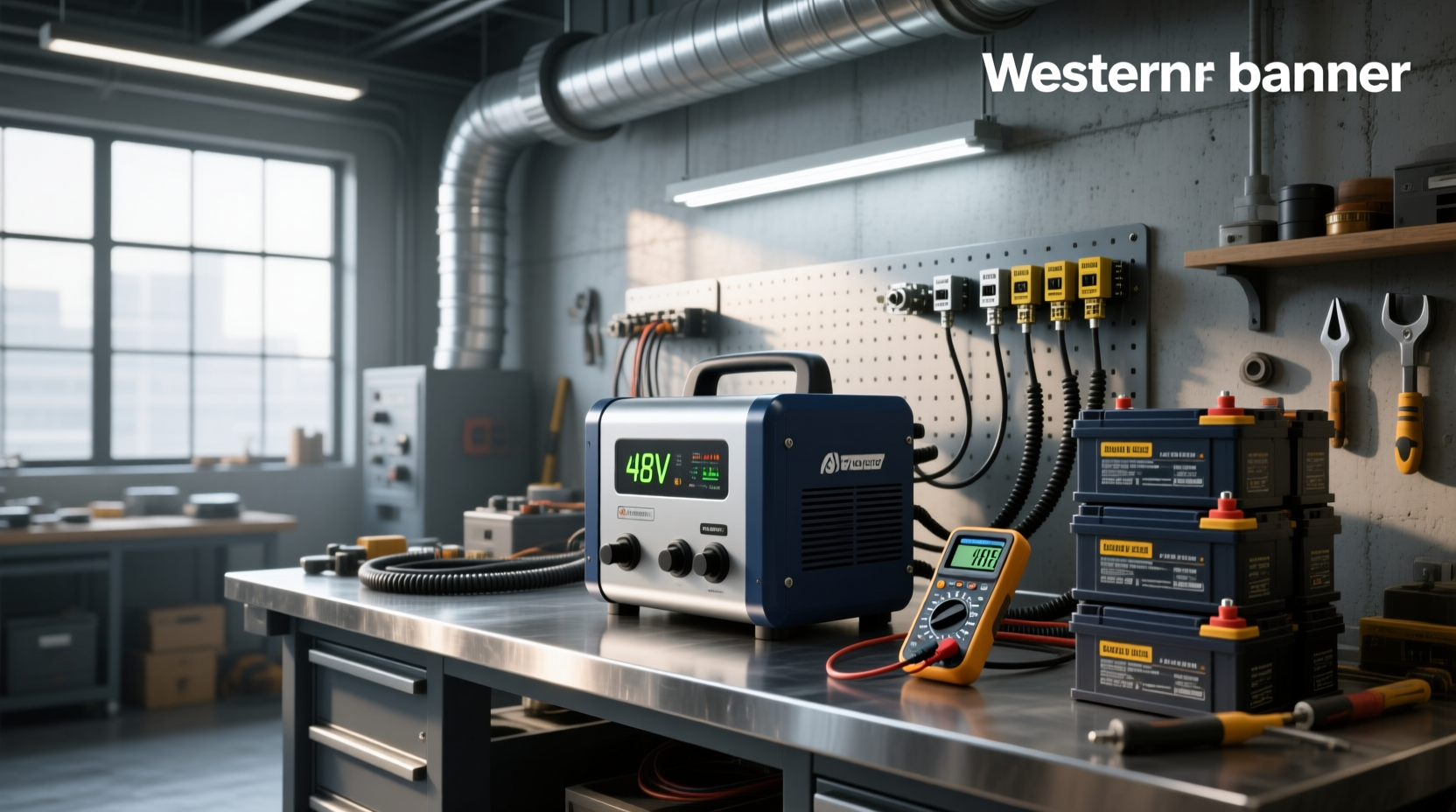
Choosing the right 48V battery charger isn’t just about matching the label — it’s about aligning input power, output profile, battery chemistry, thermal management, and application context. Whether you’re charging a golf cart fleet, an off-grid solar bank, an electric scooter, or industrial equipment like scissor lifts or pallet jacks, using an incompatible or under-specified charger risks reduced cycle life, thermal runaway, BMS communication failures, or complete charge termination before full state-of-charge. The most critical decision factor isn’t price or brand — it’s whether the charger delivers the correct constant-voltage setpoint, supports your battery’s charge algorithm (e.g., CC-CV for LiFePO4, multi-stage for AGM), and includes hardware-level protections like overvoltage cutoff, reverse polarity detection, and temperature-compensated termination. This guide walks through every technical and practical consideration — verified against real product specifications, user-reported failure modes, and industry-standard charging protocols — so you can select, install, and maintain a 48V battery charger with confidence and longevity.
Why 48V Battery Chargers Are Not Interchangeable
A 48V nominal battery system doesn’t mean all ‘48V’ chargers work safely or effectively across applications. Voltage labeling is nominal — actual charging voltages vary significantly by chemistry:
- Lead-acid (flooded/AGM/GEL): Requires ~57.6V absorption, ~54.4V float 1.
- LiFePO4 (16S): Needs precise 58.4V–58.8V constant-voltage (CV) stage; exceeding 59.2V risks cell damage 2.
- NMC/Li-ion (13S): Typically charges to 54.6V; using a 58.4V LiFePO4 charger causes overvoltage and BMS shutdown 3.
Chargers labeled “48V” without chemistry-specific programming often default to lead-acid profiles — making them unsafe for lithium unless explicitly certified for LiFePO4 or programmable. Always verify the charger’s datasheet lists supported chemistries and adjustable voltage/current limits — not just marketing copy.
How to Size Amperage Correctly (Not Just Pick the Highest Number)
Charger amperage (A) determines charge time — but oversizing introduces real risks. A common misconception is “bigger amps = faster = better.” In practice:
- Rule of thumb: For LiFePO4, max charge current should be ≤0.5C (e.g., 50A for a 100Ah battery). Exceeding 1C without BMS approval may trigger current limiting or thermal derating 4.
- Lead-acid limitation: Flooded batteries accept only ~0.1C–0.25C continuously; forcing 30A into a 100Ah flooded bank causes gassing, water loss, and plate warping.
- Real-world bottleneck: Input AC capacity matters more than output rating. A 100A 48V charger draws ~2,400W at 120V — requiring a dedicated 20A circuit. Many users install high-amp chargers only to discover their garage outlet trips or the generator lacks stable 240V output.
Always cross-check: battery manufacturer’s max charge current spec → charger’s adjustable current limit → AC input circuit rating → generator/solar inverter AC output capability.
Input Power Compatibility: 120V vs. 240V — Why It Matters
Over 68% of listed 48V chargers support dual-voltage AC input (120V/240V), but performance differs drastically:
| Input Voltage | Max Output @ 48V | Typical Use Case | Key Limitation |
|---|---|---|---|
| 120V only | ≤25A (1,200W) | Golf carts in residential garages | Cannot sustain >20A continuous without overheating or tripping breakers |
| 120V/240V auto-switching | Up to 100A (4,800W) | Commercial fleets, solar backup systems | Requires NEMA L14-30 or L6-30 receptacle — not standard household outlets |
| 240V only | Full rated output | Industrial settings, EV maintenance bays | Unusable with standard US residential 120V circuits |
If your location uses 220–240V mains (e.g., EU, UK, Australia), confirm the charger lists 230V ±10% input range — many US-market 240V models are designed for split-phase 120/240V, not single-phase 230V.
Chemistry-Specific Features You Can’t Skip
Generic “48V battery charger” listings often omit essential firmware-level features. Here’s what to verify for each chemistry:
For LiFePO4 Batteries
- Programmable CV voltage: Must allow setting 58.4V (±0.1V) — fixed 57.6V chargers undercharge; 59.2V units overcharge.
- BMS communication support: CAN bus or RS485 interface enables dynamic current reduction when battery temperature exceeds safe thresholds.
- 0V activation / deep discharge recovery: Required if battery has been stored below 10V per pack — not all LiFePO4 chargers support this safely.
For Lead-Acid (AGM/GEL/Flooded)
- Temperature compensation: Adjusts absorption voltage ±3mV/°C/cell — critical for garages with >30°C summer swings.
- Equalization mode: Only for flooded batteries; never use on AGM or GEL — causes dry-out.
- Desulfation pulse cycles: Effective only on lightly sulfated batteries; won’t revive plates with hardened sulfate crystals.
Chargers claiming “universal” compatibility without selectable chemistry modes often apply suboptimal profiles — leading to 20–40% reduced battery lifespan 5.
IP Ratings, Certifications, and Real-World Durability
“Waterproof” is not standardized — IP ratings define actual protection:
- IP65: Dust-tight + low-pressure water jets (suitable for covered outdoor storage).
- IP67: Dust-tight + immersion up to 1m for 30 min (required for marine or wash-down environments).
- IP68: Manufacturer-defined immersion depth/duration — verify test conditions in datasheet.
Look beyond marketing claims: check for UL 1236 (industrial battery chargers), UL 1012 (power supplies), or CE/EN 62368-1 certification marks on the unit label — not just packaging. Unlisted chargers lack independent verification of overtemperature, short-circuit, and insulation integrity testing.
Common Failure Modes — and How to Diagnose Them
Based on aggregated service reports from battery distributors and repair forums, these are the top 5 failure patterns — with diagnostic steps:
- No power / LED off: Check AC input voltage with multimeter (not just outlet tester); inspect inline fuses inside charger housing — many have dual fuses (AC input + DC output).
- Charger powers on but stops at 80–90% SOC: Indicates mismatched CV voltage (e.g., using 57.6V charger on LiFePO4) or missing BMS handshake signal.
- Repeated thermal shutdown during charge: Verify ambient temp <40°C, clean cooling fins, and confirm fan operation — blocked vents cause 90% of premature shutdowns.
- Intermittent charging or “clicking” relay noise: Often caused by corroded battery terminals or undersized cabling (>2% voltage drop at terminals).
- Charger displays error code but manual is missing: Search model number + “error code [number]” — most manufacturers publish PDF troubleshooting guides online.
When to Avoid “Smart” Chargers — and What to Use Instead
“Smart” chargers promise automatic detection — but they’re unreliable for mixed-chemistry setups or aged batteries. Avoid them if:
- You regularly switch between LiFePO4 and lead-acid banks on the same charger.
- Your battery has non-standard BMS firmware (e.g., custom RV integrations).
- You need precise control over absorption time or tail-current cutoff (e.g., for minimizing grid draw during peak rates).
In those cases, choose a manually programmable charger with front-panel voltage/current adjustment, clear status LEDs (not just LCD menus), and firmware update capability via USB. Models with configurable charge stages (bulk/absorption/float/storage) offer longer service life than fixed-profile units.
Installation Best Practices That Prevent Damage
Even a correctly specified charger fails prematurely with poor installation:
- Cabling: Use stranded copper wire sized per NEC Table 430.22(A) — e.g., 6 AWG for 50A over 10 ft; never repurpose automotive battery cables (too short, too stiff, wrong insulation).
- Fusing: Install Class T fuse (not ANL or MRBF) within 18 inches of battery positive terminal — required for LiFePO4 per UL 9540A.
- Grounding: Bond charger chassis to battery negative ONLY if charger is isolated-output — non-isolated units require dedicated grounding rod per IEEE 1100.
- Ventilation: Maintain ≥3 inches clearance on all sides; avoid mounting inside enclosed cabinets unless rated for forced-air cooling.
Frequently Asked Questions
- Can I charge a 48V battery with a 12V charger?
No. A 12V charger cannot overcome the 48V battery’s internal resistance — it will not initiate charging and may damage the charger’s output stage. Series-stacking four 12V chargers is unsafe and unsupported. - How can I charge my 48V battery without a dedicated charger?
Only with compatible DC-DC sources: a regulated 58.4V bench power supply (with current limiting), or a solar charge controller paired with appropriately sized PV array (min. 60V Voc). Never use unregulated sources like alternators or DIY transformers. - What are common 48V charger problems?
Slow charging (undersized AC input or corroded terminals), no power (blown internal fuse or tripped GFCI), failure to reach full voltage (chemistry mismatch), and thermal shutdown (blocked vents or high ambient temp). - Do I need a special charger for LiFePO4 vs. lead-acid?
Yes — LiFePO4 requires tighter voltage tolerance (±0.05V), no equalization, and optional BMS communication. Lead-acid needs temperature compensation and multi-stage timing. Using one for the other reduces lifespan by 30–70%. - Is 220V input necessary for a 48V battery charger?
Not mandatory — but required for >30A output on US 120V circuits. A 220V/240V input doubles power delivery efficiency and eliminates voltage sag during high-current charging.
