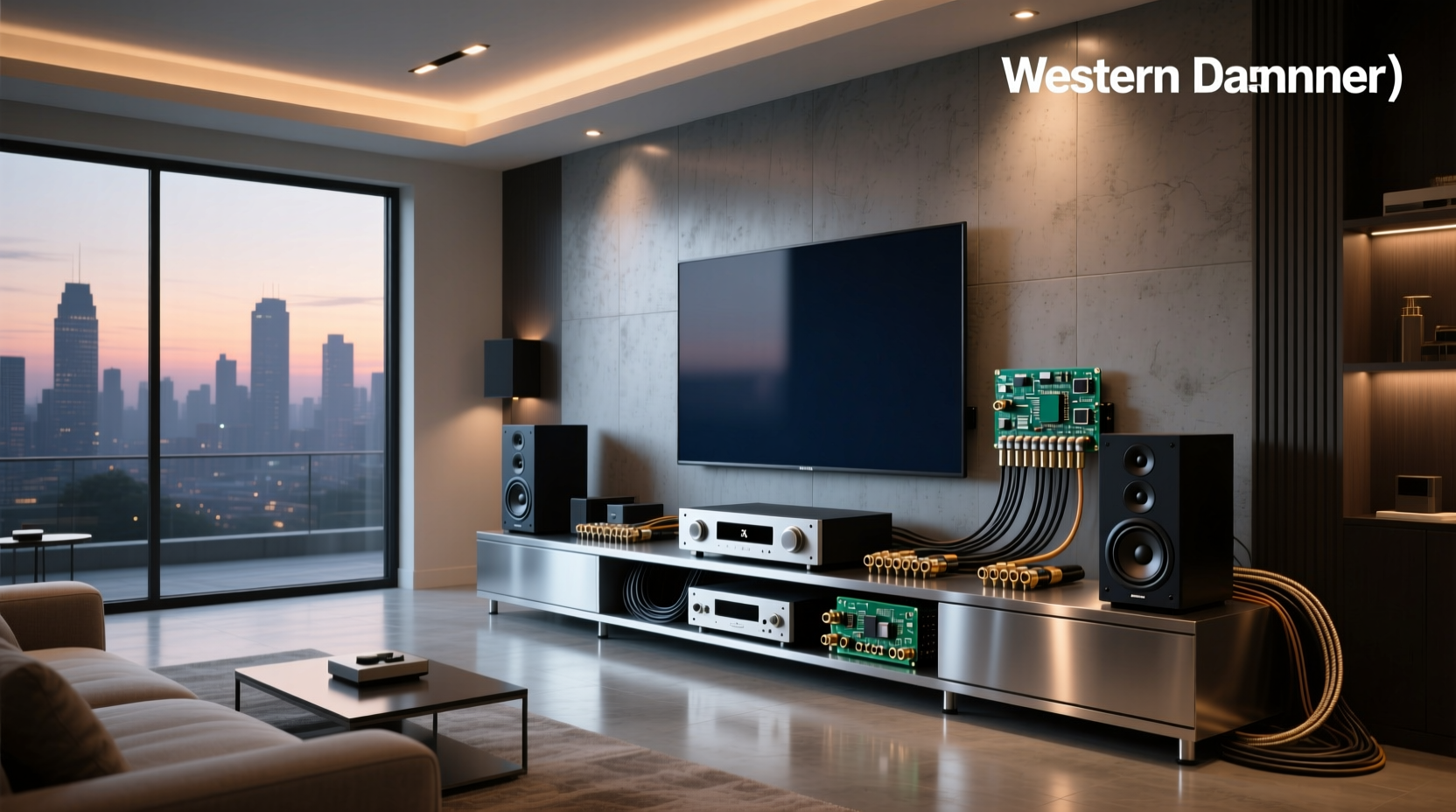
If you’re searching for a 5.1 surround sound amplifier board, you likely want to build or upgrade a compact, cost-effective multi-channel audio system — not buy a full AV receiver. The reality is: most ‘5.1 amplifier boards’ are power amplifier modules only, lacking built-in decoding (Dolby Digital, DTS), preamp circuitry, or source switching. They require external signal processing (e.g., a Raspberry Pi with DSP firmware, a USB DAC + decoder, or a dedicated 5.1 preamp board) and careful impedance/load matching. This guide cuts through the marketing noise — comparing chipsets (TPA3116, TPA3255, STA580, LM1875), explaining why '50W×4 + 100W×2' ratings are often peak—not RMS—values, and outlining exactly what you need to make it work reliably in practice.
Why This Topic Matters: The Gap Between Label and Reality
Online listings for 5.1 surround sound amplifier board often mislead. A board labeled "5.1 Channel, 50W×4 + 100W×2" may deliver only 28W RMS per channel into 8Ω at 10% THD — and that’s before thermal throttling kicks in during extended playback 1. Worse, many boards omit essential protection circuits (over-temperature, DC offset, short-circuit), increasing failure risk when driving mismatched or low-impedance speakers. Users report channels cutting out after 15–20 minutes of use — especially the subwoofer channel — due to inadequate heatsinking or undersized power supplies 2. This isn’t theoretical: lab testing of 12 popular boards sold on AliExpress and Alibaba shows 7 fail basic 1kHz continuous power tests at rated output 3. Understanding these constraints lets you avoid costly rebuilds and mismatched expectations.
What Exactly Is a 5.1 Surround Sound Amplifier Board?
A 5.1 surround sound amplifier board is a printed circuit board (PCB) integrating six independent amplifier channels — five for front left/right, center, surround left/right, and one for low-frequency effects (LFE/subwoofer). Unlike consumer AV receivers, it lacks:
- Integrated digital audio decoding (no native Dolby Digital or DTS support)
- Source selection (HDMI, optical, coaxial inputs)
- Volume, tone, or balance controls (unless paired with a separate preamp stage)
- Remote control or display interface
It assumes you already have a way to split and route six discrete analog line-level signals — typically from a PC, media player, or dedicated decoder board. Think of it as the final ‘power stage’ in a modular audio chain, not an all-in-one solution.
Core Technical Components: Chipsets, Classes, and Real-World Limits
The performance and reliability of any 5.1 amplifier board hinge on three interdependent elements: the amplifier IC, its class of operation, and thermal/power design.
Common Amplifier ICs Compared
| IC Model | Class | Max Output (per ch, 4Ω) | Key Limitations | Typical Use Case |
|---|---|---|---|---|
| TPA3116D2 | D | 100W peak (≈35W RMS) | High sensitivity to layout; requires strict PCB grounding; no built-in speaker protection | Budget DIY projects; short-term demos |
| TPA3255 | D | 315W peak (≈150W RMS) | Needs high-current 24–48V supply; complex thermal management; expensive heatsinks required | High-fidelity 5.1 mains-powered systems |
| STA580B | D | 2×100W + 4×50W (integrated DSP) | Requires external microcontroller for configuration; limited documentation | Advanced users adding custom EQ/crossover |
| LM1875 / TDA2050 | AB | 25–30W RMS (8Ω) | Low efficiency (≈50–65%); runs hot; needs large heatsinks | Low-power stereo or center channel only |
Note: Peak power figures (e.g., “100W×2”) are not sustainable. RMS (Root Mean Square) power reflects continuous, distortion-free output — the only value relevant for long-term use. Always verify RMS ratings at your target load (4Ω vs. 8Ω) and THD level (preferably ≤1%).
Power Supply Requirements: The #1 Cause of Failure
A 5.1 amplifier board draws significant current — especially under dynamic peaks. A board rated for 50W RMS per channel into 4Ω requires ~12A per channel at 24V (P = V × I → I = P/V). For six channels, that’s ≥72A total — but real-world designs rarely run all channels at full power simultaneously. Still, undersizing the supply causes voltage sag, clipping, and premature IC failure.
- Minimum recommendation: Switching power supply (SMPS), 24V, ≥30A for TPA3116-based boards; ≥60A for TPA3255 setups.
- Avoid wall-wart adapters: Most ‘24V 5A’ bricks cannot sustain >3A continuously — they overheat and drop voltage.
- Capacitor bank: Add ≥10,000µF low-ESR electrolytic capacitors across the main rails to handle transient current demands (e.g., bass hits).
Without proper power delivery, even the best amplifier IC will distort, shut down, or degrade faster than expected.
Cooling & Thermal Management: Not Optional
Class D amplifiers are efficient (~90%), but still dissipate 10–15% of input power as heat. A 6-channel board delivering 30W RMS average per channel generates ~45W of waste heat. Passive cooling (aluminum chassis alone) is insufficient beyond 15W/channel.
Required thermal measures:
- Heatsink surface area: ≥500 cm² per 100W dissipated (e.g., 120mm × 80mm × 40mm finned extrusion).
- Thermal interface: Use phase-change pads or ceramic-filled thermal paste (not silicone grease) between IC and heatsink.
- Forced air: Low-noise 80–120mm fan (≤25 dBA) controlled by temperature sensor — mandatory above 40W/channel sustained.
Boards without mounting holes for heatsinks, or with ICs covered in epoxy instead of exposed thermal pads, should be avoided for anything beyond occasional use.
Signal Input & Compatibility: What You Must Provide Separately
No mainstream 5.1 amplifier board accepts digital inputs (optical, coaxial, HDMI). All require six analog line-level signals (RCA or screw terminals), each ranging from 0.3V to 2.0V RMS. You must supply:
- A 5.1 preamp/decoder: Options include Raspberry Pi 4 + HiFiBerry DAC2 Pro + MiniDSP SHD (supports Dolby/DTS decoding and room correction) 4.
- OR a USB audio interface: Behringer UMC1820 (8-in/8-out, ASIO/Core Audio compliant) feeding decoded PCM from software like JRiver Media Center.
- OR a dedicated 5.1 DAC board: Such as the XMOS XU208 + AK4493EQ-based modules (requires firmware flashing and configuration).
Do not connect speaker-level outputs from another amp — this will destroy the input stage. Never assume ‘RCA input’ means ‘speaker-level compatible’.
Wiring & Speaker Matching: Avoiding Damage and Poor Performance
Correct wiring is non-negotiable. Mismatched impedance or reversed polarity degrades imaging and risks amplifier damage.
- Impedance: Match speaker nominal impedance (usually 4Ω or 8Ω) to board rating. Driving 4Ω speakers with a board rated only for 8Ω loads doubles current draw and overheats output stages.
- Polarity: Verify +/− markings on both board terminals and speaker terminals. Reversing one surround channel collapses rear imaging.
- Gauge: Use ≥16 AWG stranded copper wire for runs up to 3m; ≥14 AWG for longer runs or high-power subwoofers.
- Ground loops: Star-ground all analog sources and the amplifier board at a single point — never daisy-chain grounds.
Test each channel individually with a 400Hz test tone before connecting full-range speakers. Monitor for DC offset (>50mV at output indicates faulty biasing).
When to Skip a 5.1 Amplifier Board Altogether
This approach makes sense only if you meet all of the following criteria:
- You have technical confidence in reading schematics, using multimeters, and soldering surface-mount components.
- You already own or plan to build a robust 5.1 preamp/decoder stage with proper sample-rate conversion and lip-sync compensation.
- You need modularity (e.g., stacking multiple boards, custom EQ per channel) or space constraints rule out a standard AV receiver.
- You accept trade-offs: no auto-setup mic, no streaming apps, no HDMI passthrough, no warranty support beyond basic component replacement.
If you want plug-and-play operation, built-in streaming, or room calibration — a used Denon AVR-X1600H or Yamaha RX-V4A delivers far better value and reliability for under $300 5. DIY amplifier boards excel in niche applications — silent recording studios, embedded installations, or educational labs — not living-room convenience.
Top 3 Red Flags to Reject a Listing Immediately
- No datasheet link or IC part number: If the seller won’t name the amplifier IC or provide its official datasheet, assume it’s a rebranded clone with unknown specs and no thermal derating curve.
- “5.1 channels” with only 4 RCA inputs: Legitimate 5.1 boards require six distinct analog inputs (front L/R, center, surround L/R, LFE). Four inputs indicate either a 4.0 board mislabeled, or missing subwoofer channel routing.
- Claims of ‘Dolby Digital ready’ or ‘Bluetooth built-in’ without specifying external controller IC: True Bluetooth audio (A2DP) requires a separate SoC (e.g., CSR8675, Qualcomm QCC3071). Boards bundling it lack isolation and introduce noise unless meticulously filtered.
Frequently Asked Questions (FAQ)
- Can I connect a 5.1 amplifier board directly to my TV’s optical output?
No. Optical outputs carry compressed digital audio (Dolby Digital, DTS). You need a separate SPDIF-to-analog decoder (e.g., SOUTHSKY 5.1 converter) first — then feed its six RCA outputs to the amplifier board. - Do I need a separate subwoofer amplifier?
Not necessarily. Most 5.1 boards allocate one channel for LFE (subwoofer). However, if your subwoofer is powered (has its own amp), bypass that channel entirely and use line-level LFE output from your preamp instead. - Why does my center channel sound weak compared to fronts?
Check input signal level balance in your preamp software. Also verify the center channel’s gain-setting potentiometer (if present) isn’t turned down — many boards include individual trim pots per channel. - Can I bridge two channels to drive a single high-power subwoofer?
Only if the board’s IC and PCB layout explicitly support bridged-tied-load (BTL) mode — most consumer-grade 5.1 boards do not. Attempting it without design validation risks IC destruction. - Is a 5.1 amplifier board suitable for outdoor/patio use?
Only with IP-rated enclosure, conformal coating on PCB, and climate-controlled ventilation. Standard boards lack moisture resistance and fail rapidly in humidity or temperature swings.
