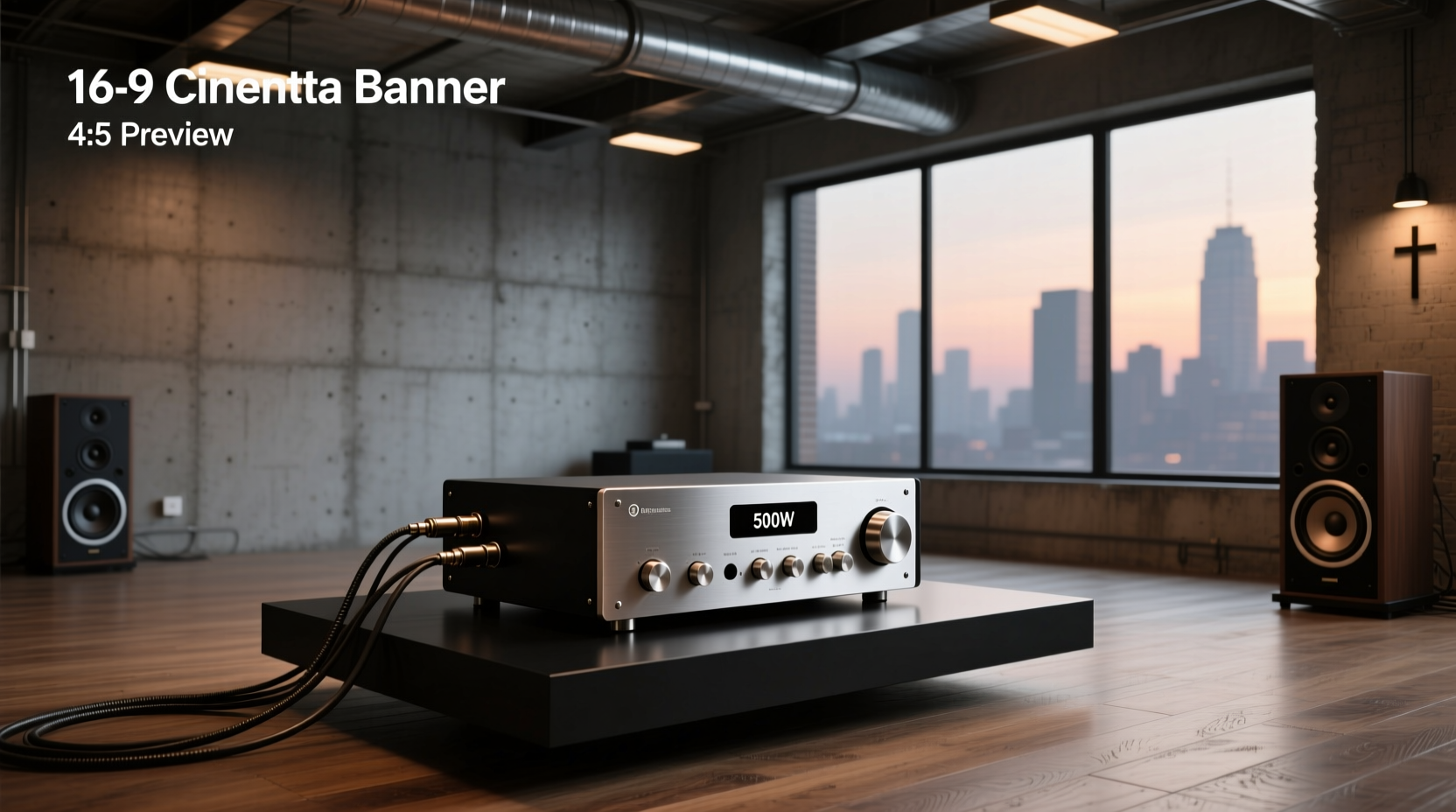
You’re not buying "500 watts" — you’re buying headroom, thermal stability, and amplifier class behavior that determines whether your speakers sound clean at volume or distort under load. A true 500W RMS amplifier (not peak or PMPO) delivers sustained, continuous power into rated impedance (e.g., 4Ω or 2Ω), enabling dynamic audio peaks without clipping — critical for live PA, car subwoofers, or high-efficiency studio monitors1. This guide cuts through marketing noise by explaining how 500W actually performs across home, car, and portable applications — including how many amps it draws at 12V vs. 120V, why doubling wattage doesn’t double loudness, and what speaker sensitivity and impedance make that 500W usable or wasted.
Why '500W' Alone Tells You Almost Nothing
The term "500W amp" appears in over 8 million search results — yet most listings omit the three technical qualifiers that determine real-world performance: RMS rating, load impedance, and measurement conditions. Without these, “500W” could mean:
- A 500W peak output (brief transient bursts, often 2–3× higher than RMS)
- A 500W PMPO (Peak Music Power Output — an obsolete, unregulated metric no reputable engineer uses)
- 500W RMS into 8Ω, but only 300W into 4Ω — meaning mismatched speakers cause underperformance
- 500W total system output across 5 channels (e.g., 100W × 4 + 100W mono), not per channel
This ambiguity directly impacts compatibility, safety, and sonic fidelity. For example, a 500W Class D monoblock designed for 2Ω subwoofers behaves fundamentally differently than a 500W Class AB stereo amp rated at 8Ω — even if both display "500W" on the front panel2.
Understanding Power Ratings: RMS, Peak, and Why It Matters
RMS (Root Mean Square) is the gold standard for continuous power handling. It reflects the amplifier’s ability to deliver steady, undistorted output over time — measured using sine-wave testing at specified THD (Total Harmonic Distortion), typically ≤1% at full rated power. Reputable manufacturers (e.g., Crown, QSC, Behringer Pro) publish RMS ratings per channel, at defined impedances, with all channels driven3.
In contrast, peak power indicates short-term maximum output — usually 1.5–2× RMS — during transients like drum hits. It’s useful for headroom assessment but meaningless for thermal or long-term load planning.
PMPO has no standardized test method. It multiplies instantaneous voltage and current peaks from non-representative signals, yielding inflated numbers (e.g., “5000W PMPO”) irrelevant to real-world operation. Avoid amplifiers advertising PMPO as their primary spec.
Always verify: Is the 500W rating per channel or total? At what impedance (2Ω, 4Ω, 8Ω)? Under what distortion level and how many channels driven? If this information is missing or vague, assume worst-case derating — especially for budget units sold via wholesale platforms4.
How Many Amps Does a 500W Amplifier Draw?
Current draw depends entirely on input voltage and efficiency — not just output wattage. The basic formula is:
I (A) = P (W) ÷ V (V) ÷ η
Where η = efficiency (expressed as decimal; e.g., 0.75 for 75%).
At 120V AC (standard US household):
• Assuming 80% efficiency: 500W ÷ 120V ÷ 0.80 ≈ 5.2 A
• This fits safely within a standard 15A circuit — but consider other loads sharing the same breaker.
At 12V DC (car audio):
• Same 500W output at 80% efficiency: 500W ÷ 12V ÷ 0.80 ≈ 52.1 A
• That requires ≥6 AWG power wiring, fused within 18 inches of the battery, and a robust alternator (≥100A output recommended)5.
Note: These are input-side calculations. Actual current varies with signal dynamics and amplifier class. Class D units (typically 85–92% efficient) draw significantly less current than Class AB (50–65% efficient) for the same RMS output.
Loudness ≠ Wattage: The Decibel Reality Check
A common misconception is that “more watts = louder sound.” In practice, loudness perception follows a logarithmic scale. A 10 dB increase is perceived as “twice as loud” — but requires 10× the acoustic power. So:
- 100W → 200W = +3 dB (barely noticeable change)
- 100W → 1000W = +10 dB (subjectively twice as loud)
- Therefore, 500W is only ~7 dB louder than 100W — not five times louder6
What matters more than raw wattage is speaker sensitivity (measured in dB @ 1W/1m). A 90 dB/W/m speaker fed with 500W reaches ~117 dB SPL. A 98 dB/W/m horn driver with the same amp hits ~125 dB — exceeding most home environments’ safe limits. Always pair amplifier power with speaker sensitivity and intended listening distance.
Matching a 500W Amplifier to Speakers: Impedance & Thermal Limits
Impedance mismatch causes two critical failures:
- Too low impedance (e.g., 2Ω load on an amp rated for ≥4Ω): Overheats output transistors, triggers protection circuits, or causes permanent damage.
- Too high impedance (e.g., 16Ω speaker on 4Ω-min amp): Reduces power delivery and may destabilize feedback loops in some designs.
For a 500W RMS amp:
| Amplifier Type | Typical Min. Impedance | Safe Speaker Load Range | Real-World 500W Use Case |
|---|---|---|---|
| Car Audio Monoblock (Class D) | 1–2Ω | Single 2Ω subwoofer or dual 4Ω voice coils wired in parallel | Powered sub enclosure for bass-heavy systems |
| Home Stereo (Class AB) | 4–8Ω | Two 8Ω bookshelf or floorstanding speakers | Medium-room hi-fi with high-sensitivity drivers |
| PA / Installation (Class D) | 4–16Ω | Multiple 70V line speakers or 8Ω stage monitors | Background music zones or small venue mains |
Also verify speaker power handling: A 500W amp should drive speakers rated for 300–600W program power (not just peak). Underpowering risks clipping-induced tweeter failure; overpowering risks mechanical excursion damage.
Class Differences: How Amplifier Design Changes 500W Behavior
“500W” means different things depending on topology:
- Class AB: Analog design with high sound quality and low distortion, but poor efficiency (~50–65%). Generates significant heat — requires large heatsinks and ventilation. Best for critical listening where fidelity outweighs size/heat concerns.
- Class D: Switching design with 85–92% efficiency, compact size, and minimal heat. Dominates car audio and portable PA. May exhibit higher EMI if poorly filtered — verify RF shielding in sensitive environments.
- Class H/G: Hybrid topologies that dynamically adjust rail voltage to reduce heat. Found in mid-tier pro audio gear. Offers AB-like linearity with D-like efficiency.
For portable or space-constrained applications (e.g., DJ rig, church booth), Class D is objectively superior. For studio control rooms prioritizing harmonic texture, Class AB remains relevant — but only if thermally managed.
500W in Context: Home, Car, and Portable Applications
Home Audio: 500W is overkill for most living rooms unless driving inefficient planar magnetics or horn-loaded speakers. More commonly used in multi-zone systems (e.g., 100W × 4 zones + 100W sub) or as a dedicated subwoofer amp. Verify preamp output compatibility — many AV receivers lack sufficient voltage swing to fully drive a high-gain 500W power amp.
Car Audio: A 500W RMS mono amp is standard for single 12″ or dual 10″ sub enclosures. Key considerations: alternator capacity, battery reserve (≥75Ah AGM recommended), and grounding integrity. Poor grounding causes noise and power loss — measure voltage drop between amp ground terminal and battery negative (<0.1V at full output).
Portable PA / Install: 500W powers 2–4 passive speakers in small venues (≤200 people) or distributed background audio. Look for built-in DSP, limiters, and 70V/100V line outputs for commercial installations. Avoid units lacking thermal protection — sustained high-temp operation degrades capacitor lifespan.
Red Flags When Buying a 500W Amplifier
Not all 500W amps deliver consistent, reliable output. Watch for:
- No published RMS specs — only “500W MAX” or “PMPO” labels
- Vague impedance ratings (e.g., “works with 2–8Ω” without stating power at each)
- No efficiency or THD data — suggests unverified engineering
- Missing safety certifications (UL/ETL for North America, CE for EU, RCM for Australia)
- Unusually low price for claimed specs — e.g., $89 for “500W 5-channel” likely indicates severe derating or false labeling
Reputable brands provide full datasheets — including frequency response (±X dB, Y Hz–Z kHz), damping factor (>200 ideal), and signal-to-noise ratio (>100 dB typical). If unavailable, assume conservative real-world output (e.g., 300–350W RMS).
Verifying Real-World Performance: What to Test Yourself
Before deployment, validate key behaviors:
- Thermal stability: Run a 60 Hz sine wave at 70% volume for 30 minutes. Surface temperature should remain <60°C (140°F). Excessive heat indicates poor heatsinking or inefficiency.
- Clipping onset: Gradually increase input until oscilloscope shows waveform flattening. Note input voltage where clipping begins — compare to spec sheet.
- Ground loop noise: With inputs shorted, measure output noise floor with AC-coupled multimeter (<1 mV RMS expected).
- Protection triggering: Briefly short output terminals — amp should mute instantly and recover automatically. Delayed or no shutdown indicates faulty circuitry.
These tests require basic tools (multimeter, tone generator, oscilloscope optional) but prevent costly failures post-installation.
Frequently Asked Questions (FAQ)
- How many amps does a 500W amplifier draw at 12V?
- Approximately 52 A at 80% efficiency — requiring heavy-gauge wiring, proper fusing, and alternator support. Actual draw varies with signal content and amplifier class.
- Is a 500W amp loud enough for a small club?
- Yes — when paired with 95+ dB sensitivity speakers and proper dispersion. 500W drives two 12″ cabinets to ~115 dB peak SPL at 1 meter, sufficient for venues up to 150 people with controlled acoustics.
- Can I run a 500W amp with 4Ω speakers if it’s rated for 8Ω minimum?
- No. Doing so risks overheating, protection shutdown, or catastrophic failure. Always match speaker impedance to the amp’s specified minimum load.
- Does higher wattage improve sound quality?
- No — wattage affects maximum clean output level, not tonal accuracy. Distortion, damping factor, and signal path design determine fidelity. A well-designed 200W amp often sounds cleaner than a poorly engineered 500W unit.
- What’s the difference between 500W RMS and 500W peak?
- RMS is continuous, sustainable power (the meaningful spec). Peak is momentary maximum — typically 1.5–2× RMS — useful only for headroom estimation, not thermal or speaker safety planning.
