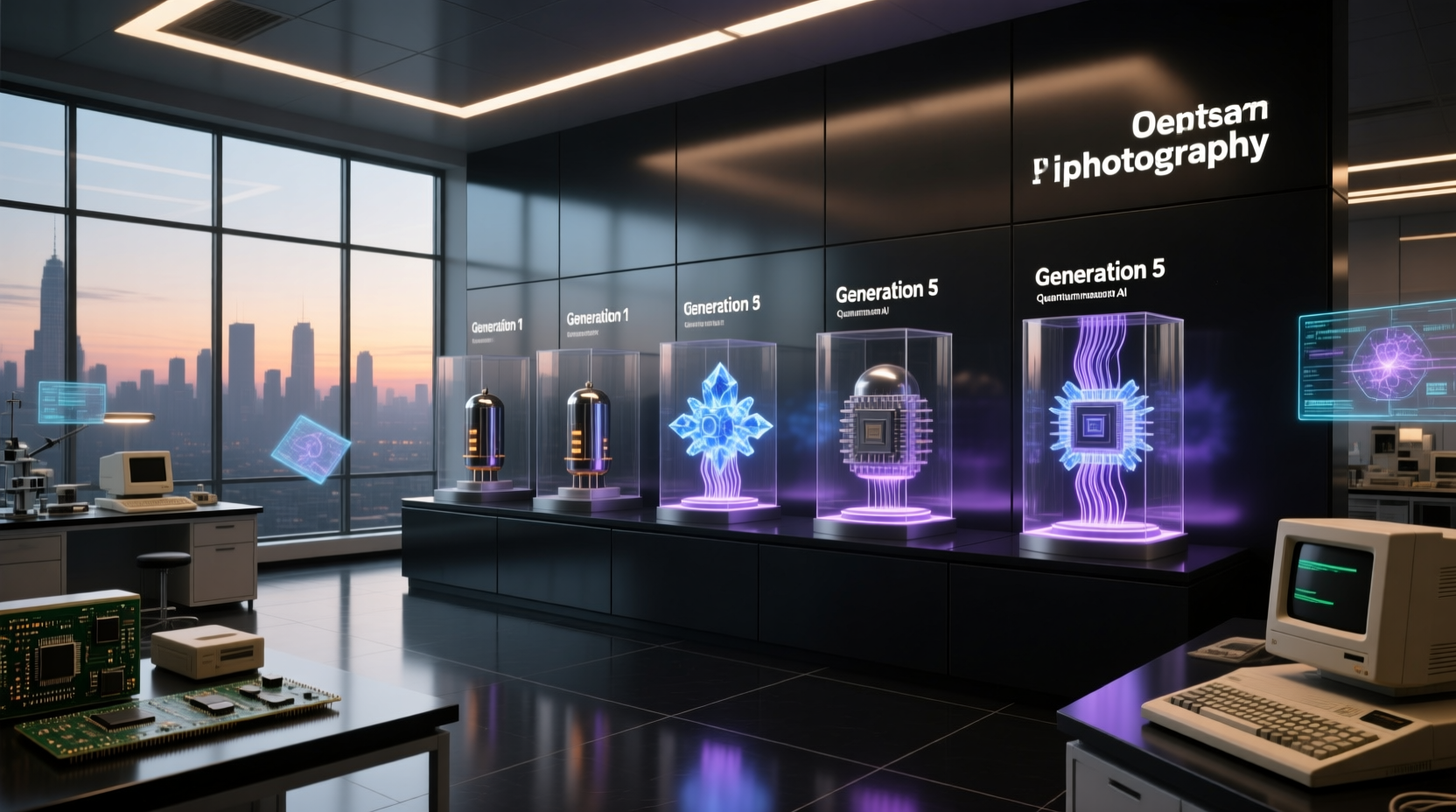
You’re not looking for a new laptop labeled ‘5th Gen’—you’re seeking clarity on a decades-old computing paradigm that’s still evolving today. The term 5th generation computers refers not to consumer CPUs (like Intel Core i5-12400 or AMD Ryzen 7000 series), but to a research-driven era defined by artificial intelligence, natural language understanding, massively parallel architecture, and logic-based programming. Launched officially in 1982 by Japan’s Ministry of International Trade and Industry (MITI), the Fifth Generation Computer Systems (FGCS) project aimed to build machines capable of reasoning, learning, and self-organization—not just executing instructions 1. Unlike generations 1–4—which were marked by clear hardware transitions (vacuum tubes → transistors → ICs → microprocessors), the fifth generation is defined by software capability and architectural intent, not transistor count or clock speed. This distinction resolves the most common confusion: there is no ‘5th gen’ chip you can buy off the shelf in 2024; instead, modern AI accelerators, neural processing units (NPUs), and large-scale inference systems are its functional descendants—still emerging, still experimental, and still grounded in the same foundational goals set over 40 years ago.
Why the Confusion? Generations ≠ Product Cycles
Many users searching for “5 generation computers” arrive expecting a comparison chart like: ‘Intel 13th Gen vs. 14th Gen CPUs’—but that’s a marketing convention, not historical classification. Consumer processor generations (e.g., ‘12th Gen Intel Core’) refer to iterative silicon updates within a single vendor’s roadmap. In contrast, the five-generation framework is an academic and historical taxonomy used in computer science education and policy history to describe paradigm shifts across the entire industry 2. Here’s how they map:
| Generation | Time Period | Core Technology | Key Innovation | Limitation |
|---|---|---|---|---|
| 1st | 1940–1956 | Vacuum tubes | First programmable digital computers (e.g., ENIAC) | Massive size, high heat, unreliable |
| 2nd | 1956–1963 | Transistors | Smaller, faster, more reliable than tubes | No integrated circuits; discrete components |
| 3rd | 1964–1971 | Integrated Circuits (ICs) | Multiple transistors on single silicon chips | Limited memory, batch processing dominant |
| 4th | 1971–present (ongoing) | Microprocessors (VLSI) | Entire CPU on one chip; birth of personal computing | Sequential execution bottleneck; rising power density |
| 5th | 1980–present (uncompleted, evolving) | ULSI + AI software + Parallel architectures | Knowledge-based systems, logic programming (Prolog), natural language I/O | No universal hardware standard; fragmented implementation |
Note: The 5th generation has no definitive end date. It remains an open-ended research horizon—not a finished product line. That’s why you’ll find conflicting timelines online: some sources say it began in 1980 3, others cite the 1982 FGCS launch as the formal start 1, and many textbooks extend it to “the present day.” This ambiguity reflects reality: unlike prior generations, the fifth isn’t demarcated by hardware obsolescence—but by unsolved challenges in machine cognition.
The Core Pillars of Fifth Generation Computing
Five technical pillars distinguish the 5th generation from all predecessors. These aren’t optional features—they’re foundational requirements:
- 🧠 Artificial Intelligence Integration: Not just running AI models, but architecting systems where reasoning, inference, and knowledge representation are native operations. Early FGCS prototypes used Prolog and concurrent logic programming to enable automated theorem proving and expert system development 4.
- ⚡ Massively Parallel Processing: Replacing von Neumann bottlenecks with hundreds—or thousands—of loosely coupled processors sharing memory or communicating via high-bandwidth interconnects. The Japanese FGCS aimed for 1,000+ processors per system—a radical departure from the single-CPU dominance of the 4th generation.
- 🗣️ Natural Language Interface: Moving beyond command-line syntax or GUI clicks toward conversational interaction. This includes speech recognition, semantic parsing, and context-aware response generation—not just voice assistants, but systems that understand domain-specific jargon (e.g., medical diagnosis queries).
- 🧩 Ultra-Large-Scale Integration (ULSI): Chips containing >1 million transistors—enabling on-die memory caches, dedicated AI accelerators, and heterogeneous cores. While ULSI emerged commercially in the late 1980s, its full potential for AI workloads is only now being realized in modern NPUs and TPUs.
- 🔄 Self-Organizing & Adaptive Behavior: Systems that modify their own rules, optimize internal data structures, or reconfigure hardware resources based on workload patterns—without human intervention. This remains largely theoretical outside narrow embedded applications (e.g., adaptive network routers).
Real-World Examples: Where Fifth Generation Concepts Live Today
There is no commercial ‘5th gen desktop’ sold at Best Buy. But its principles power critical infrastructure:
- Cloud AI Platforms: Google’s TPU v5e clusters and NVIDIA’s DGX Cloud use massively parallel architectures with custom interconnects (NVLink, Optical I/O) to train LLMs—direct descendants of FGCS inter-processor communication goals.
- Edge AI Devices: Qualcomm’s Hexagon NPU and Apple’s Neural Engine integrate domain-specific accelerators for on-device speech and vision tasks—fulfilling the ‘natural interface’ and ‘real-time reasoning’ objectives.
- Expert Systems in Healthcare: IBM Watson Oncology (now deprecated but historically significant) attempted clinical decision support using logic-based inference over structured medical ontologies—echoing FGCS’s original expert-system focus.
- Autonomous Systems: Tesla’s Dojo supercomputer employs custom training chips and disaggregated memory architecture to process exabytes of video—mirroring FGCS’s emphasis on parallelism for real-world sensory input.
Crucially, none of these systems claim ‘5th gen’ branding. They evolved organically from research goals—not marketing calendars. That’s why searching for “5th generation computer examples” yields educational case studies, not product SKUs.
Advantages: What Fifth Generation Computing Delivers
When implemented successfully, fifth-gen traits yield measurable improvements:
- ✅ Higher Problem-Solving Autonomy: Systems can diagnose faults, suggest optimizations, or generate hypotheses—reducing human cognitive load in complex domains (e.g., semiconductor yield analysis, climate modeling).
- ✅ Scalable Throughput for Unstructured Data: Parallel architectures handle multimodal inputs (text + image + sensor streams) far more efficiently than sequential CPUs—critical for robotics and smart city infrastructure.
- ✅ Reduced Latency in Human-Machine Interaction: On-device NLP eliminates round-trip cloud dependency, enabling sub-200ms response times for voice-controlled industrial tools.
- ✅ Energy-Proportional Computation: Adaptive hardware (e.g., dynamic voltage/frequency scaling across NPU cores) cuts power use by up to 40% versus fixed-frequency GPUs for inference workloads 5.
Disadvantages & Practical Limitations
Despite progress, fifth-gen ideals face persistent barriers:
- ❌ High Development Complexity: Building logic-programmed systems requires expertise in formal methods, constraint solving, and symbolic AI—skills scarce outside academia and specialized labs.
- ❌ Cost Prohibitive for General Use: Custom AI chips (e.g., Cerebras Wafer Scale Engine) cost millions to design and fabricate—making them inaccessible for consumer or SMB deployment.
- ❌ Lack of Standardization: No universal OS, instruction set, or programming model exists for ‘5th gen’ systems. Developers must write for CUDA, ROCm, or vendor-specific SDKs—fragmenting the ecosystem.
- ❌ Narrow Domain Applicability: Most deployed AI systems are narrow-AI—excellent at one task (e.g., image classification), but unable to transfer learning or reason across contexts. True ‘self-organizing’ behavior remains elusive.
- ❌ Verification & Trust Gaps: When a logic-based diagnostic system recommends surgery, how do clinicians audit its inference chain? Explainability lags behind capability—a major adoption hurdle in regulated sectors.
How to Identify Genuine Fifth-Gen Capabilities (Not Marketing Hype)
Consumers and IT buyers often mistake vendor claims (“5th Gen AI Laptop!”) for historical classification. Here’s how to separate substance from spin:
- 🔍 Check the Architecture Diagram: Does the spec sheet show dedicated NPU/TPU blocks with >10 TOPS (trillion operations/sec) of INT8 inference throughput? Or just a GPU marketed as ‘AI-ready’? Real fifth-gen traits require hardware-software co-design, not repurposed graphics silicon.
- 📝 Review the Software Stack: Is the device certified for ONNX Runtime with support for dynamic shape inference and quantization-aware training? Or does it only run pre-compiled TensorFlow Lite models? True adaptability requires runtime compilation and introspection.
- 🌐 Assess Input Modalities: Can it accept simultaneous speech + sketch + gesture input and resolve ambiguity contextually? If interaction is limited to voice-only commands, it’s 4th-gen HCI extended—not fifth-gen interface.
- 🔧 Verify Self-Management Claims: Does the system auto-tune thermal profiles, rebalance compute loads across cores, or regenerate corrupted firmware partitions without reboot? If not, it lacks the ‘self-organizing’ pillar entirely.
If a product fails two or more of these checks, it’s leveraging ‘5th gen’ as a buzzword—not delivering its defining capabilities.
Myth-Busting: Common Misconceptions
❌ Myth: “Intel’s 13th Gen Core is a 5th generation computer.”
Reality: It’s a 4th generation microprocessor—just a newer iteration. It uses the same von Neumann architecture, runs x86 binaries, and lacks native logic programming or parallel inference engines.
❌ Myth: “The 5th generation ended when laptops got touchscreens.”
Reality: Touch interfaces are UI enhancements—not paradigm shifts. The fifth generation remains incomplete because its core goal—machines that learn, reason, and organize themselves—has not been achieved at scale 6.
❌ Myth: “Quantum computers are the 6th generation.”
Reality: Quantum computing operates on entirely different physical principles. It’s not a successor in the same lineage—it’s a parallel track. The ‘6th generation’ has no consensus definition; most scholars treat the fifth as ongoing 7.
What’s Next? The Unfinished Agenda
The FGCS project officially concluded in 1992 without achieving its most ambitious goals—yet its influence persists. Current frontiers align closely with its original charter:
- Neuromorphic Chips (e.g., Intel Loihi 2): Mimic spiking neuron behavior for ultra-low-power pattern recognition—addressing FGCS’s energy efficiency mandate.
- Federated Logic Programming: Emerging frameworks like Datalog^R allow distributed reasoning across edge devices—reviving FGCS’s vision of collaborative problem-solving.
- Self-Healing Hardware: IBM’s runtime FPGA reconfiguration and Samsung’s adaptive DRAM repair circuits move toward true self-organization.
Until systems routinely pass the Turing Test in constrained domains while managing their own resource allocation and knowledge base evolution, the fifth generation remains aspirational—not consummated.
Frequently Asked Questions
Q: What is the 5th generation of computer?
A: It’s a research paradigm launched in 1982 focused on AI-driven, massively parallel systems capable of natural language interaction and autonomous reasoning—not a specific hardware release.
Q: Are today’s AI laptops ‘5th generation’?
A: No. They contain 4th-gen microprocessors with added AI accelerators. True 5th-gen traits require architectural co-design of hardware, software, and knowledge representation—not incremental upgrades.
Q: What are the main disadvantages of fifth generation computers?
A: High R&D costs, lack of standardized tools, narrow applicability of current AI, verification challenges, and absence of true self-organizing behavior outside lab environments.
Q: Is there a 6th generation of computers?
A: No widely accepted definition exists. Some researchers propose quantum or biological computing as candidates, but consensus is lacking—the fifth generation is still considered active and unfinished.
Q: What are examples of fifth generation computer systems?
A: Historical: MITI’s PIM/micro-PROLOG machines (1980s). Contemporary: Google TPU pods, NVIDIA DGX systems, and neuromorphic testbeds like Intel Loihi—though none bear the ‘5th gen’ label commercially.