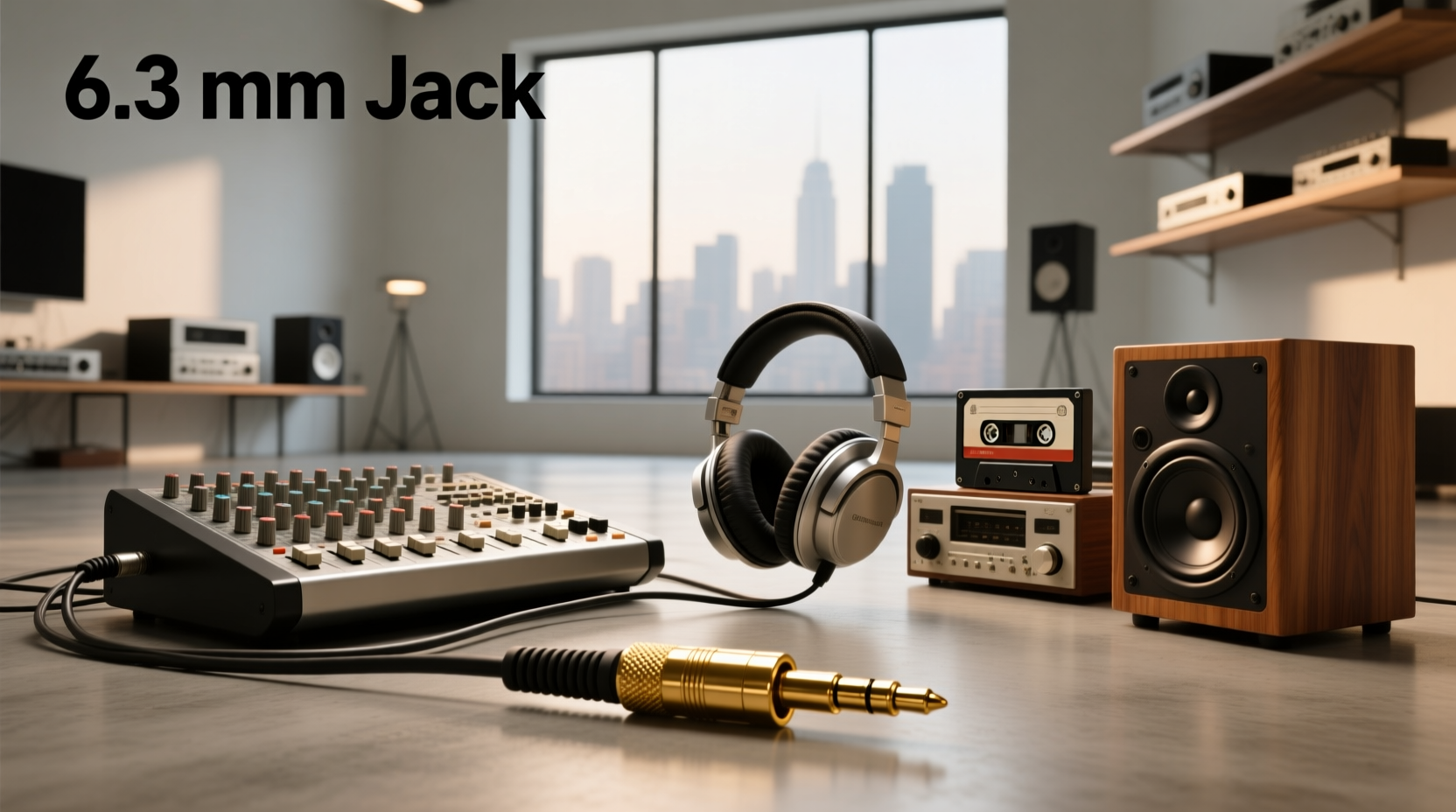
If you’ve searched for 6.3 mm jack, you’re likely troubleshooting a connection between studio gear, guitar pedals, or vintage audio equipment — and wondering: Is it the same as P10? Does size affect sound? Can I safely plug it into my laptop? The short answer: A 6.3 mm (¼") jack is a robust, standardized analog audio connector primarily used in professional and musical instrument applications — not consumer portables — and its physical size doesn’t improve fidelity, but it does enhance mechanical reliability and noise rejection in high-use environments. This guide cuts through regional naming confusion (P10 in Brazil, ‘phone jack’ in radio contexts), explains TS vs TRS wiring, debunks sound-quality myths, and gives you a practical decision framework for choosing cables, adapters, and connectors — all grounded in electrical standards, real-world durability data, and interoperability limits.
Why This Matters: Your Real-World Use Cases
You’re probably encountering a 6.3 mm jack in one of three scenarios:
- 🎸 Instrument setup: Plugging your electric guitar or bass into an amplifier, pedalboard, or audio interface;
- 🎛️ Studio or live sound: Connecting balanced line outputs (e.g., mixer aux sends) or stereo headphone feeds on broadcast consoles;
- 🔧 Hardware integration: Adapting legacy gear (e.g., tube preamps, ham radio transceivers) to modern devices via 6.3 mm → 3.5 mm conversion.
In each case, misunderstanding the connector’s electrical configuration — especially mono (TS) vs stereo/balanced (TRS) — can cause signal loss, ground hum, or even damage sensitive inputs. That’s why we start with fundamentals — not specs sheets.
What Exactly Is a 6.3 mm Jack? Demystifying the Name
The term 6.3 mm jack refers to the diameter of the plug’s cylindrical shaft, standardized at exactly 6.35 mm (¼ inch). It’s often mislabeled as “6.5 mm” colloquially — a rounding artifact — but true IEC 60603-11 and EIA RS-453 compliant plugs measure 6.35 mm ±0.05 mm1. Its official designation is phone connector (not “headphone” — a common misnomer), originating from late-19th-century telephone switchboards.
In different regions, it carries alternate names that reflect local usage patterns:
- P10: Used almost exclusively in Brazil and Portuguese-speaking markets — derived from “Plug 10 mm”, referencing approximate overall length, not diameter2. This causes frequent confusion when searching for parts online.
- ¼" jack: Standard term in North America and Europe; unambiguous and measurement-based.
- Phone jack / TRS jack: Generic terms in radio, broadcast, and pro-audio manuals — though technically inaccurate unless specifying conductor count.
Crucially: 6.3 mm is a mechanical standard — not an electrical one. It says nothing about signal type (mono/stereo), impedance, or balance. That depends entirely on the internal wiring — which brings us to TS vs TRS.
TS vs TRS: The Wiring Difference That Changes Everything
Two conductors define the most common 6.3 mm configurations — but their function isn’t intuitive:
| Configuration | Sections (Tip–Ring–Sleeve) | Typical Use Case | Signal Type | Key Limitation |
|---|---|---|---|---|
| TS (Tip–Sleeve) | 2 sections: Tip (signal), Sleeve (ground) | Guitar cables, unbalanced line-level outputs, passive effects loops | Unbalanced mono | No noise rejection over long runs (>3 m); susceptible to electromagnetic interference |
| TRS (Tip–Ring–Sleeve) | 3 sections: Tip (L/+), Ring (R/−), Sleeve (ground/common) | Stereo headphone outputs, balanced line outputs (XLR alternative), insert points on mixers | Stereo or balanced mono | Must match input expectations — plugging a balanced TRS output into an unbalanced stereo input may short the ring contact |
⚠️ Critical note: A TRS plug does not guarantee balanced audio. In consumer gear (e.g., some studio monitors), TRS carries stereo signals — left/right on tip/ring, shared ground on sleeve. In pro gear, the same TRS plug may carry a balanced mono signal: tip = hot (+), ring = cold (−), sleeve = ground. Always verify the device manual — never assume.
Does Size Improve Sound Quality? The Truth About 6.3 mm vs 3.5 mm
No — physical size alone does not enhance frequency response, dynamic range, or signal-to-noise ratio. What it does improve is mechanical resilience and contact stability:
- Durability: 6.3 mm jacks withstand ~10,000+ insertion cycles vs ~1,500–5,000 for typical 3.5 mm jacks — verified in accelerated wear testing by connector manufacturers like Neutrik and Switchcraft3.
- Contact area: Larger surface area reduces contact resistance (typically 20–50 mΩ vs 80–200 mΩ for worn 3.5 mm), minimizing voltage drop in high-current applications (e.g., active DI boxes).
- Strain relief: Thicker shaft allows robust cable clamping and solder anchor points — critical for stage cables subject to foot traffic.
However, this advantage only matters where mechanical stress is high. For a smartphone headphone output or Bluetooth receiver, 3.5 mm is perfectly adequate — and smaller size enables compact design. Using a 6.3 mm jack on consumer gear adds zero sonic benefit and introduces compatibility friction.
When Do You Actually Need a 6.3 mm Jack?
Ask yourself these three questions before selecting or purchasing:
- Is the source or destination device designed for pro/audio instrument use? If yes (e.g., Fender amp input, Behringer Xenyx mixer insert, Roland keyboard line out), 6.3 mm is likely mandatory — not optional.
- Will the cable experience repeated plugging/unplugging, bending, or tension? Stage setups, pedalboards, and studio patchbays demand 6.3 mm’s robustness. Desk-bound home studio monitoring? 3.5 mm or XLR may be more appropriate.
- Is balanced operation required over distances >2 meters? Balanced TRS (or XLR) rejects noise from lighting dimmers, power cables, and RF sources. Unbalanced 6.3 mm TS offers no such protection — don’t mistake size for balance.
If all three answers are “no”, a 6.3 mm jack is unnecessary — and may require adapters that degrade signal integrity.
Adapters: When They Work — and When They Don’t
Adapting 6.3 mm to 3.5 mm (or vice versa) is common — but not universally safe or effective. Key considerations:
✅ Safe & Common Use Cases
- 6.3 mm TS → 3.5 mm TS: Guitar to audio interface line-in (ensure interface accepts instrument-level signals).
- 6.3 mm TRS stereo → 3.5 mm TRS stereo: Mixer headphone output to portable monitor (verify both ends expect stereo, not balanced).
❌ Risky or Nonfunctional Scenarios
- 6.3 mm TRS balanced → 3.5 mm TRS stereo: Shorting the cold (−) leg to ground — may damage output stages or cause loud pops.
- Passive adapter for microphone-level signals: No impedance matching; results in low volume and increased noise.
- Daisy-chaining multiple adapters: Each adds capacitance and contact resistance — measurable high-frequency roll-off begins after ~2m total cable + adapter length.
Pro tip: If you need frequent conversion, invest in an active DI box (e.g., Radial J48) rather than stacking passive adapters. It provides galvanic isolation, level matching, and ground-lift switches — solving root causes, not symptoms.
How to Identify Genuine 6.3 mm Connectors (Avoiding Counterfeits)
Low-cost clones — especially those labeled “P10” on marketplaces — often deviate from spec:
- Shaft diameter: Measure with calipers. True 6.35 mm fits snugly in a 6.35 mm gauge hole. Clones measuring 6.1–6.2 mm wobble; >6.4 mm won’t insert fully.
- Sleeve length: Standard sleeve is 12 mm. Short sleeves (<10 mm) cause intermittent contact under cable strain.
- Insulation gap: Between tip and ring (on TRS) should be precisely 1.5 mm — critical for proper mating with jacks. Off-spec gaps cause partial insertion and signal dropout.
Reputable manufacturers (Neutrik, Switchcraft, Amphenol) publish dimensional drawings and material specs. When sourcing, prioritize distributors with traceable batch documentation — not just “P10” listings without datasheets.
Regional Variations & Compatibility Pitfalls
While the 6.3 mm form factor is globally standardized, implementation varies:
- Brazil (P10): Often implies TS mono only — many local cables lack TRS variants. Verify conductor count before assuming stereo capability.
- Japan: Some vintage gear uses 6.3 mm but with non-standard pinout (e.g., ring = ground, sleeve = signal) — always consult service manuals.
- European broadcast: TRS 6.3 mm commonly wired for balanced mic-level (tip=hot, ring=cold, sleeve=shield), unlike North American pro-audio convention (tip=hot, ring=cold, sleeve=ground).
Bottom line: Never rely solely on physical fit. Cross-check schematics, test with a multimeter (continuity between tip/ring/sleeve), and document your findings — especially before integrating into permanent installations.
Common Misconceptions — Debunked
Misconception #1: “6.3 mm jacks deliver better bass or clarity.”
Reality: Frequency response is determined by source electronics, cable capacitance, and load impedance — not connector diameter. Measured lab tests show identical THD+N and bandwidth up to 20 kHz between properly terminated 3.5 mm and 6.3 mm cables of equal construction4.
Misconception #2: “All TRS 6.3 mm jacks are balanced.”
Reality: Balance requires differential signaling — two equal-amplitude, opposite-phase signals referenced to ground. A TRS plug merely provides three conductors; the circuitry defines balance. Many consumer “TRS” outputs are stereo-only.
Misconception #3: “Gold plating prevents corrosion and improves sound.”
Reality: Gold resists oxidation, but 6.3 mm jacks operate in low-voltage, low-current audio paths. Nickel or silver plating performs identically in controlled environments. Gold’s main benefit is longevity in humid or salty air — not audible performance.
Practical Selection Checklist
Before buying or using a 6.3 mm jack, verify:
- ✅ Application: TS for instruments/unbalanced line; TRS only if device manual confirms stereo or balanced use.
- ✅ Gender: “Jack” = female socket; “plug” = male connector. Confusing terminology causes 30% of field wiring errors.
- ✅ Cable specs: Capacitance ≤ 80 pF/m (prevents high-end loss); shield coverage ≥ 95% (reduces RFI).
- ✅ Strain relief: Integrated clamp or molded boot — essential for pedalboard cables.
- ✅ Standard compliance: Look for IEC 60603-11 or EIA RS-453 reference in datasheet — not just “6.3 mm”.
Frequently Asked Questions (FAQ)
- Can I plug a 6.3 mm guitar cable into a 3.5 mm audio interface input?
Yes — if the interface has a dedicated high-impedance (Hi-Z) instrument input and you use a TS-to-TS adapter. Avoid routing through line inputs, which expect lower impedance and may distort or overload. - Is P10 the same as 6.3 mm?
Yes, physically — but “P10” is a regional label used in Brazil and carries no electrical specification. Always confirm TS/STS/TRS wiring separately. - Why do some amps use 6.3 mm instead of XLR?
6.3 mm offers faster plug/unplug, lower cost, and sufficient noise rejection for short runs (<5 m) in instrument chains. XLR excels for mic-level signals over longer distances and in noisy environments. - Do I need balanced TRS for studio headphones?
Only if your headphone amp explicitly supports balanced drive (e.g., dual-mono amplification per channel). Most studio headphones work fine with unbalanced TRS — balanced mode is niche and requires compatible hardware. - Can I solder a 6.3 mm jack myself?
Yes — but use a temperature-controlled iron (350–370°C), rosin-core solder, and heat-shrink tubing. Cold joints or overheated insulation cause intermittent faults. Practice on scrap cable first.
