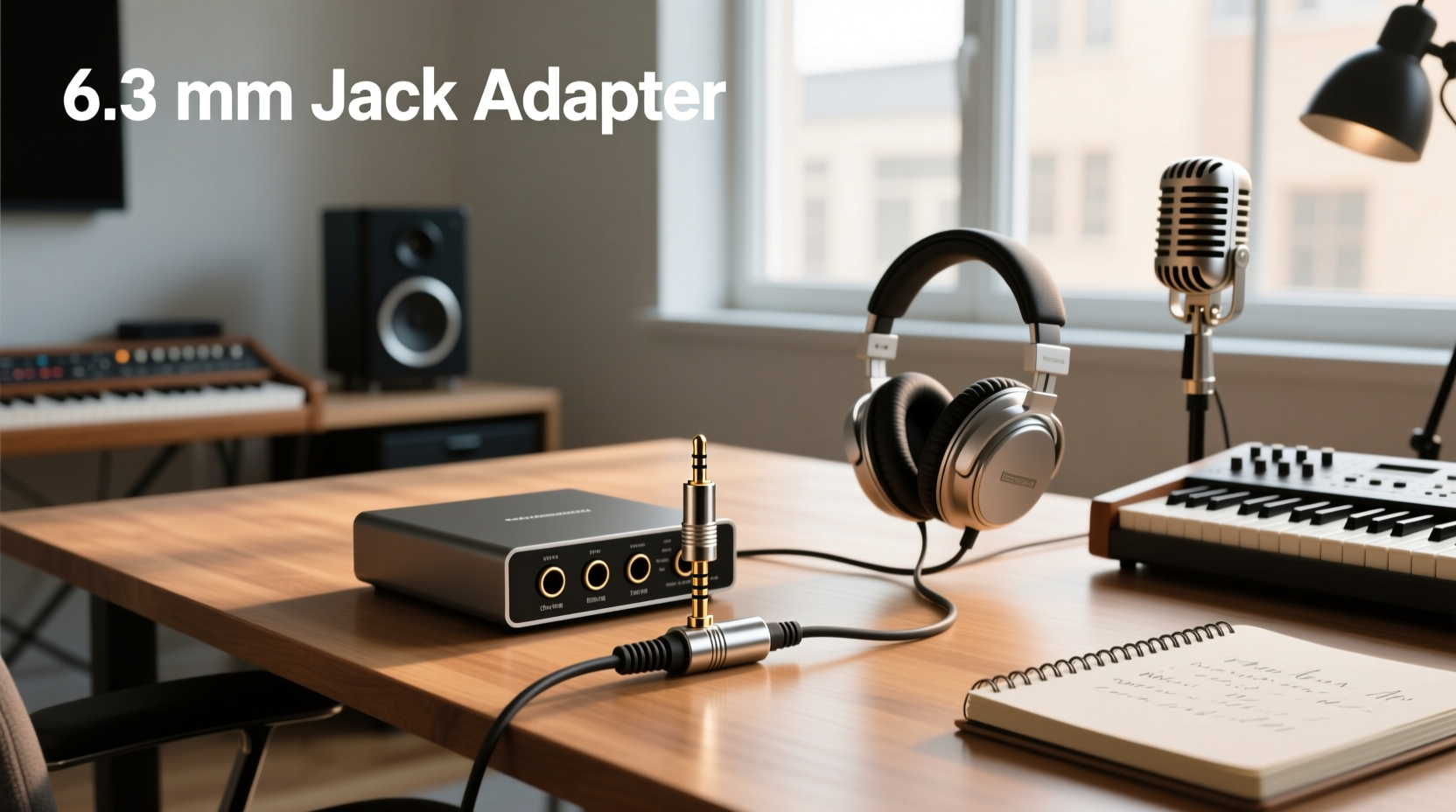
You need a 6.3 mm jack adapter when connecting modern 3.5 mm audio devices (like smartphones or laptops) to professional or vintage audio gear with 6.35 mm (¼-inch) jacks — and choosing the wrong type causes silent output, channel imbalance, or damage. This guide explains exactly which adapter matches your use case: stereo vs. mono, gender configuration (e.g., 3.5 mm male to 6.35 mm female), plating quality, mechanical fit, and why ‘6.3 mm’ is technically shorthand for the standardized 6.35 mm (¼-inch) audio connector used in amplifiers, mixers, studio headphones, and guitar interfaces1.
Why This Confusion Exists — And Why It Matters
The term “6.3 mm jack adapter” appears frequently in search results — yet nearly all commercially available products labeled as “6.3 mm” are actually built to the IEC 61076-2-101 and ANSI/EIA RS-453 standard dimension of 6.35 mm (¼ inch). The 0.05 mm discrepancy isn’t manufacturing sloppiness — it’s decades of colloquial shorthand. Audio professionals say “6.3 mm” the way they say “1/4 inch” interchangeably. But that small gap becomes critical when evaluating mechanical fit: a poorly machined adapter may wobble, lose contact under movement, or fail to fully seat in recessed sockets found on Neumann NDH-20 or Sennheiser HD 600 headphone outputs2.
This ambiguity fuels real-world problems. Users report intermittent left-channel dropouts when using budget adapters with high-end headphones — not due to signal loss, but because the plug’s barrel diameter varies ±0.08 mm across brands, causing inconsistent tip-ring-sleeve (TRS) contact pressure. That’s why understanding mechanical tolerance, not just electrical spec, is essential.
Core Use Cases: Where You’ll Actually Need One
A 6.35 mm jack adapter isn’t a universal accessory — it solves specific interface mismatches. Below are the four most common scenarios, ranked by frequency of user-reported need:
- 🎧 Studio Headphones → Consumer Source Devices: Connecting HD 25, DT 770 Pro, or Beyerdynamic DT 990 (which ship with 6.35 mm plugs) to laptops, phones, or portable DACs with only 3.5 mm inputs.
- 🎸 Guitar Amplifiers & Interfaces → Monitoring Headphones: Using studio-grade closed-back headphones on amp speaker outputs or audio interface line outs — where 6.35 mm is the default jack size.
- 🎛️ DJ Gear & Professional Mixers → Mobile Playback: Plugging smartphones or tablets into Pioneer DJM or Allen & Heath ZED mixers via 6.35 mm aux inputs.
- 📻 Vintage Audio Equipment → Modern Sources: Adapting reel-to-reel decks, tube preamps, or broadcast consoles with legacy 6.35 mm outputs to current-generation DACs or streamers.
Note: Adapters are not needed for passive speaker connections (e.g., powered monitors with RCA/XLR), nor do they convert impedance or power level — they’re purely mechanical and conductive bridges.
Adapter Types Demystified: Mono vs. Stereo, Gender, and Wiring
Not all 6.35 mm adapters function identically. Their internal wiring and physical layout determine compatibility — and many users unknowingly buy the wrong variant. Here’s how to decode labeling:
1. Electrical Configuration: TS vs. TRS vs. TRRS
| Type | Conductors | Signal Support | Common Use | Risk of Mismatch |
|---|---|---|---|---|
| TS (Tip-Sleeve) | 2 | Unbalanced mono | Guitar cables, mic inputs on older mixers | Will mute right channel on stereo headphones; may cause hum if used for stereo output |
| TRS (Tip-Ring-Sleeve) | 3 | Unbalanced stereo (L/R/GND) or balanced mono | Headphone outputs, line-level aux sends | Required for stereo headphones — using TS here yields mono-only playback |
| TRRS (Tip-Ring-Ring-Sleeve) | 4 | Stereo + mic (CTIA or OMTP) | Smartphone headset inputs | Not compatible with standard 6.35 mm adapters — no consumer-grade 6.35 mm TRRS exists; avoid any listing claiming this |
✅ Rule of thumb: For headphones, always choose TRS. For instrument-level signals (e.g., guitar into an interface), TS is correct — but verify input specs first. Never assume “stereo” means TRS — some low-cost listings mislabel TS adapters as stereo.
2. Gender & Directionality
Adapters are defined by their input and output ends — not marketing terms like “converter” or “adapter.” Misreading this causes wasted purchases:
- 3.5 mm male → 6.35 mm female: Lets you plug a 3.5 mm source (phone) into a 6.35 mm input (mixer). Most common for DJ and studio monitoring.
- 6.35 mm male → 3.5 mm female: Lets you plug a 6.35 mm headphone cable into a 3.5 mm device (laptop). Standard for home studio users.
- 6.35 mm male → dual 3.5 mm female: A splitter — useful for sharing audio between two headphones, but degrades signal level and increases crosstalk risk.
- 6.35 mm male → 6.35 mm female (extension): Not an adapter per se — used to extend cable reach without signal conversion.
⚠️ Critical note: Some listings show “6.3 mm to 3.5 mm” without specifying gender. If the product image shows a male 6.35 mm end and female 3.5 mm end, it’s designed for headphones — not sources. Always verify via image and description, not title alone.
Build Quality: What Makes a $3 Adapter Fail — and a $30 One Last
Price correlates strongly with three measurable attributes — not “premium sound” (adapters don’t color tone) but long-term reliability:
1. Barrel Tolerance & Insertion Force
High-tolerance barrels (±0.02 mm) ensure consistent contact depth and rotational stability. Budget units often exceed ±0.07 mm variance, leading to intermittent connection — especially problematic with recessed jacks on devices like the Focusrite Scarlett series or RME ADI-2 DAC. Independent measurements show that adapters with CNC-machined brass barrels maintain stable contact after 500+ insertions; stamped zinc units degrade after ~120 cycles3.
2. Plating Material & Thickness
Gold plating is standard — but thickness matters. Electroless nickel underplating + 0.5–1.0 µm gold resists oxidation far longer than flash-plated (0.05 µm) alternatives. Thin plating wears off after ~18 months of daily use, exposing base metal and increasing contact resistance. Look for “hard gold” or “ENIG” (electroless nickel immersion gold) in spec sheets — not just “gold-plated.”
3. Strain Relief & Housing Integrity
Fully molded housings (no visible seam lines) prevent wire breakage at the solder joint — the #1 failure point in low-cost adapters. Flexible PVC or TPE overmolding absorbs torsion; rigid plastic cracks under repeated bending. Check for reinforced entry points — especially near the 3.5 mm end, which bears more flex stress.
Compatibility Pitfalls: When It Won’t Work — Even If It Fits
An adapter can physically connect two devices and still fail electrically. These are the top non-obvious incompatibility causes:
- Impedance mismatch (rare but possible): While passive adapters don’t transform impedance, some high-output headphone amps (e.g., Schiit Magni) deliver >1 Vrms into 32 Ω. A poor-contact adapter adds series resistance (>1 Ω), causing volume drop and damping factor reduction. Verified solution: Use adapters rated for ≥100 mW continuous power handling.
- Ground loop noise with unbalanced connections: TRS adapters used between grounded gear (e.g., desktop DAC + powered monitor) and floating sources (battery-powered phone) may introduce 50/60 Hz hum. Mitigation: Ensure both devices share the same ground reference — or use a ground-lift isolation transformer (not an adapter).
- Mechanical interference with locking mechanisms: Some 6.35 mm jacks (e.g., on Yamaha MG series mixers) use screw-type locking collars. Standard adapters lack threaded shrouds — forcing users to tighten the collar onto bare metal, risking stripped threads. Genuine Sennheiser adapters include a knurled locking ring; third-party equivalents rarely replicate this.
How to Verify Authenticity & Avoid Counterfeits
Counterfeit adapters mimic branding (e.g., “Sennheiser-style”) but omit critical safety and performance features. Red flags include:
- No CE/FCC ID mark on packaging or housing
- Missing part number (e.g., genuine Sennheiser uses “ADP-6.3” or “HD 600 Adapter”)
- Weight under 12 g (real brass-based units weigh 14–18 g)
- Plating that rubs off with alcohol swab (test inconspicuous area)
- No listed conductor gauge (reputable units specify 24–26 AWG oxygen-free copper)
✅ Verification step: Measure outer diameter with calipers. True 6.35 mm = 0.250″ ±0.002″. Anything outside that range risks intermittent contact.
Alternatives to Consider — Before You Buy
Ask yourself: Is an adapter truly the best solution?
- Replace the cable instead: Many premium headphones (e.g., Audeze LCD-X, HiFiMan Sundara) offer optional 3.5 mm detachable cables. Often cheaper and more reliable than stacking adapters.
- Use a dedicated DAC/amp with native 3.5 mm output: Devices like the iFi Go Link or Topping DX1 cancel the need for adaptation entirely — and improve signal integrity.
- Accept mono limitation for voice applications: If using with podcasting mixers or intercom systems, a TS mono adapter may be sufficient and more durable than TRS.
Frequently Asked Questions (FAQ)
- Is 6.3 mm the same as 6.35 mm? Yes — “6.3 mm” is industry shorthand for the standardized 6.35 mm (¼-inch) audio connector. No functional difference exists; it’s a rounding convention.
- Can I use a 6.35 mm adapter with balanced (4.4 mm Pentaconn) gear? No. Balanced connections require separate conductors for L+/L−, R+/R−, and ground. A 6.35 mm TRS adapter carries only unbalanced L/R/GND — it cannot deliver true balanced output.
- Why does my adapter make a crackling sound? Almost always caused by insufficient contact pressure due to barrel undersizing or oxidized plating. Clean contacts with 99% isopropyl alcohol and reseat firmly.
- Do gold-plated adapters improve sound quality? No — gold prevents corrosion and maintains low contact resistance over time, but introduces no sonic signature. Its benefit is longevity, not fidelity.
- Are there active 6.35 mm to 3.5 mm converters? Not commercially viable for consumer use. Active circuitry would require power, add noise, and defeat the purpose of a passive interface solution. All standard adapters are passive.
