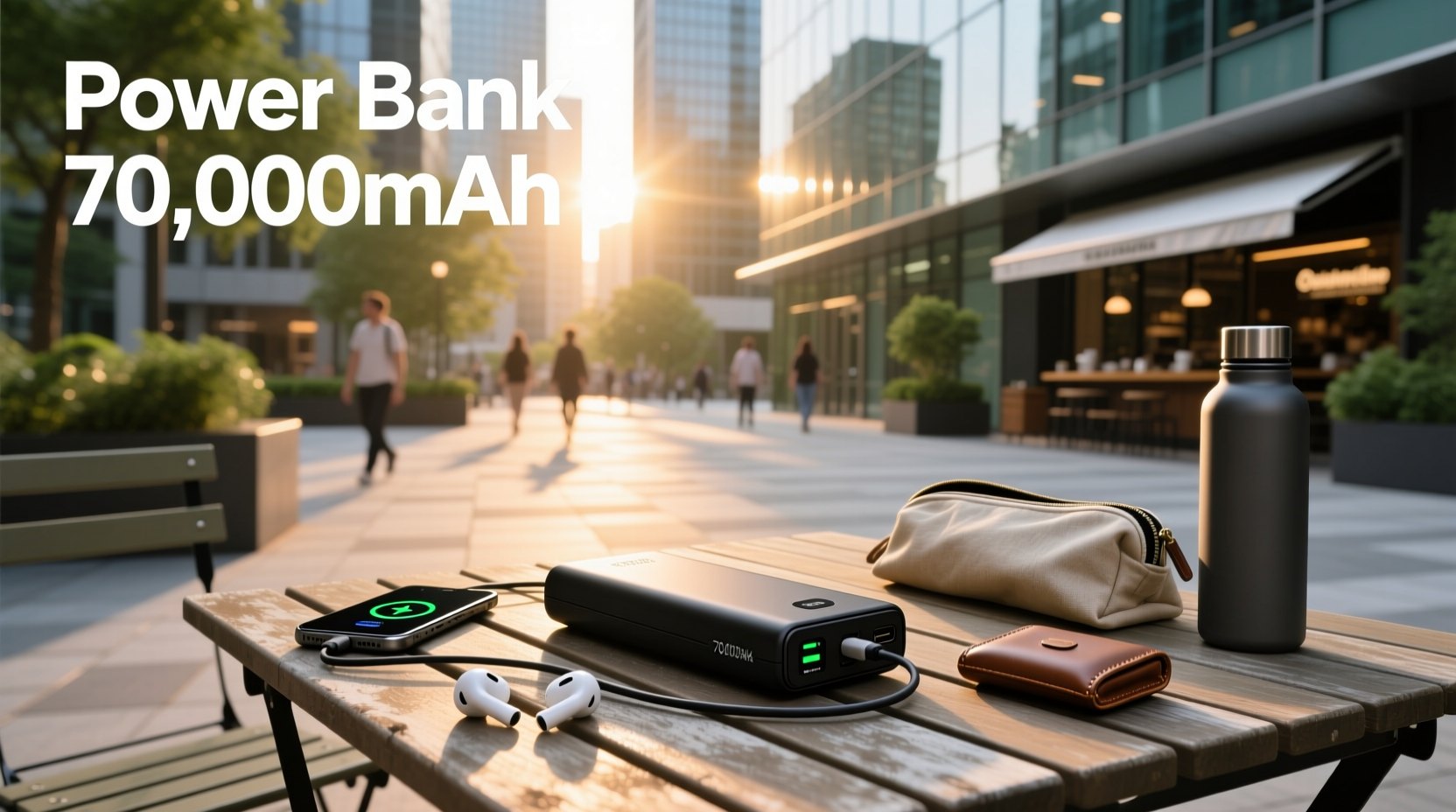
Yes—a 70000mAh power bank can charge laptops, phones, and multiple devices simultaneously, but only if it supports ≥60W USB-C Power Delivery (PD), includes a robust internal battery architecture, and accounts for real-world energy loss. Most advertised 70000mAh units deliver just 35,000–42,000mAh of usable output energy due to voltage conversion (3.7V nominal cell → 5V/9V/15V/20V USB output), PCB inefficiency (10–18% loss), and aging cells. This means: a 70000mAh unit rated at 3.7V stores ~259Wh total energy—but when converted to 20V for laptops, usable watt-hours drop to ~210–230Wh. That’s enough for ~1.5 full charges of a 14-inch MacBook Air (M3, 52.6Wh battery) or ~4–5 full charges of an iPhone 15 Pro (3277mAh). Understanding this gap—between label mAh and real delivered energy—is the single most critical factor before buying any high-capacity portable power bank like a 70000mAh power bank for outdoor use, emergency backup, or extended travel.
Why 70000mAh Power Banks Are Appealing — and Why That Number Is Misleading
The allure is obvious: 70,000 milliamp-hours sounds massive. For context, a typical smartphone battery holds 3,000–5,000mAh; a mid-range laptop battery, 45,000–60,000mAh. So on paper, a 70000mAh unit should fully recharge an iPhone 15 over 10 times—or a MacBook Air nearly twice. But that math assumes 100% efficiency, which violates basic physics.
All lithium-ion (or lithium-polymer) power banks store energy at their native cell voltage—usually 3.7V nominal. USB outputs, however, require standardized voltages: 5V (USB-A), 9V (QC), 15V or 20V (USB-C PD). To step up voltage, the power bank uses a DC-DC converter. Every conversion incurs loss—typically 12–18% depending on load, temperature, and circuit quality. So:
- 70,000mAh × 3.7V = 259Wh (total stored energy)
- After conversion to 20V output: ~259Wh × 0.85 efficiency = ~220Wh usable
- 220Wh ÷ 52.6Wh (MacBook Air M3) ≈ 4.2 full charges at 20V — not 1.4 as raw mAh suggests
- At 5V (phone charging): ~259Wh × 0.92 ≈ 238Wh usable → ~7.3 full iPhone 15 Pro charges
This explains why many users report “only getting 3–4 full phone charges” from a 70000mAh unit—even with new batteries. It’s not defective—it’s physics.
Key Technical Specs You Must Verify (Not Just Trust the Label)
When evaluating any 70000mAh portable power bank, go beyond the headline number. Here are the five non-negotiable specs—and what realistic values indicate:
| Spec | What It Means | Minimum Acceptable Value | Red Flag Threshold |
|---|---|---|---|
| USB-C PD Output Wattage | Max sustained power delivered to laptops/tablets | ≥60W (for modern MacBooks, Windows ultrabooks) | <45W — cannot fast-charge most laptops |
| Real Capacity Verification | Measured discharge at 5V/2A (standardized test) | ≥38,000mAh @5V (i.e., ≥190Wh usable) | No published test data or <35,000mAh @5V |
| Battery Cell Type | Lithium-ion (Li-ion) vs. lithium-polymer (LiPo) | Grade A Li-ion (e.g., Samsung INR18650-35E, LG HG2) | Unbranded, no cell model listed, or “LiPo” without cycle life spec |
| Protection Circuits | Over-voltage, over-current, short-circuit, thermal cutoff | UL 2056 or IEC 62133 certified design | No certification mentioned; no thermal sensor visible in teardowns |
| Discharge Curve Stability | Voltage consistency under load (prevents device shutdown) | ≤0.3V drop from 20V→19.7V at 3A load | Drop >0.8V at 2A — indicates weak BMS or aging cells |
⚠️ Warning: Many budget 70000mAh units list “120W output” but only achieve that briefly—often via burst mode lasting <60 seconds—then throttle to 60W or less. True sustained 100W+ delivery requires dual parallel USB-C ports with independent 50W+ buck-boost circuits and active cooling. Without thermal management, continuous high-wattage output degrades cells rapidly.
Real-World Use Cases: When a 70000mAh Power Bank Makes Sense (and When It Doesn’t)
A 70000mAh power bank isn’t universally optimal. Its value depends entirely on your scenario:
✅ Ideal Scenarios
- Multi-day off-grid camping/hiking: Powers headlamps, GPS, satellite messengers (e.g., Garmin inReach Mini 2), action cams, and phones for 3–5 days without sun or grid access. Units with built-in LED floodlights and SOS modes add utility 1.
- Home emergency backup: Keeps medical devices (CPAP, glucose monitors), Wi-Fi routers, and communication tools running during 24–72 hour outages—especially when paired with solar input (≥30W MPPT).
- Field professionals: Surveyors, wildlife researchers, or film crews needing portable power for drones, audio recorders, and tablets without generator noise or fuel logistics.
❌ Poor Fit Scenarios
- Daily commuter use: At 650–950g and 18–22cm length, most 70000mAh units exceed airline carry-on weight/size allowances (IATA limits: ≤100Wh per battery; 70000mAh × 3.7V = 259Wh → requires airline approval 2).
- Students or remote workers in dorms/offices: Overkill unless no wall outlets exist. A 20,000–27,000mAh PD power bank is lighter, faster to recharge, and more portable.
- Users prioritizing fast recharging: Recharging a 70000mAh unit fully takes 12–18 hours via 18W input—even with 60W input, expect 5–7 hours. Smaller units recharge in 2–3 hours.
How to Spot Marketing Exaggeration vs. Engineering Reality
Manufacturers often inflate specs using three common tactics. Here’s how to detect them:
1. “70000mAh” Listed at 3.7V — But Advertised as “Enough for 12 iPhone Charges”
This conflates storage voltage (3.7V) with output voltage (5V/9V/20V). Always ask: “At what voltage and current was the ‘12 charges’ measured?” Reputable brands publish discharge curves at 5V/2A and 20V/3A. If unavailable, assume worst-case 15% loss.
2. “120W Output” With No Sustained Duration Spec
Check product manuals or teardown videos. If no mention of “sustained” or “continuous” rating—or if the spec appears only in banner text, not technical docs—it’s likely peak/burst power. True 120W requires dual USB-C ports each delivering ≥60W with independent thermal sensors.
3. “Solar Ready” With No MPPT Controller Specified
Many units claim solar compatibility but use basic PWM controllers—inefficient below 18V input. MPPT (Maximum Power Point Tracking) boosts harvest by 25–35% in variable light. If the spec sheet doesn’t name “MPPT” and list compatible panel voltage range (e.g., “12–40V input”), solar charging will be slow and inconsistent 3.
Safety & Certification: Non-Negotiable for High-Capacity Units
A 70000mAh power bank contains ~250–300 Wh of stored energy—equivalent to a small drone battery. Safety failures are rare but severe. Prioritize units with:
- UL 2056 certification (U.S. standard for power bank safety, covering crush, drop, overcharge, and short-circuit tests)
- IEC 62133-2:2017 (international secondary cell safety, required for air transport compliance)
- UN38.3 test reports (mandatory for shipping lithium batteries by air)
Units sold exclusively on marketplaces without these certifications often skip third-party testing. While not illegal, they lack independent verification of thermal runaway resistance or PCB fault tolerance.
Performance Degradation Over Time: What to Expect
All lithium-based batteries lose capacity. A quality 70000mAh power bank should retain ≥80% of its rated capacity after 500 full charge cycles (≈18 months of weekly use). However, degradation accelerates under stress:
- Charging above 35°C or discharging below 0°C cuts cycle life by 40–60%
- Storing at 100% charge for >30 days causes faster SEI layer growth
- Using max-output ports daily reduces longevity vs. mixed low/high load usage
Best practice: Store at 40–60% charge in cool, dry conditions. Re-calibrate every 3 months by fully discharging then recharging.
Alternatives Worth Considering (If 70000mAh Is Overkill)
Not all high-energy needs require 70,000mAh. Consider these balanced alternatives:
- 30,000–40,000mAh with 100W PD: Lighter (~550g), fits in larger backpacks, recharges in ~4 hours, delivers ~20,000mAh usable at 20V—enough for 2x MacBook Air charges.
- 50,000mAh solar-integrated units with MPPT: Better energy harvesting efficiency than adding panels to a 70000mAh bank separately.
- Modular systems (e.g., 2×25,000mAh units): Enables redundancy, easier air travel (each <100Wh), and staggered replacement.
Frequently Asked Questions (FAQ)
- Can I take a 70000mAh power bank on a plane?
Only with airline approval. At 3.7V, it’s ~259Wh—well above the 100Wh limit for carry-on without permission. Most airlines require prior written consent and may restrict quantity to one unit. - Why does my 70000mAh power bank get hot when charging my laptop?
Moderate warmth (<45°C) is normal during 60W+ output. Excessive heat (>55°C) indicates poor thermal design or failing BMS—stop use immediately and contact support. - Do all 70000mAh power banks support pass-through charging?
No. Pass-through (charging devices while recharging the bank) requires separate input/output circuitry. Many budget models disable output during input to prevent overheating. - How long does it take to recharge a 70000mAh power bank?
With 18W input: ~14–16 hours. With 60W PD input: ~5–7 hours. With 100W input (if supported): ~3.5–4.5 hours—assuming efficient AC adapter and cable. - Is there a real 900000mAh power bank?
No verified consumer unit exists. 900,000mAh at 3.7V equals 3,330Wh—larger than most home UPS systems. Listings using this number are either mislabeled, use non-standard measurement, or are physically impossible in portable form 4.
