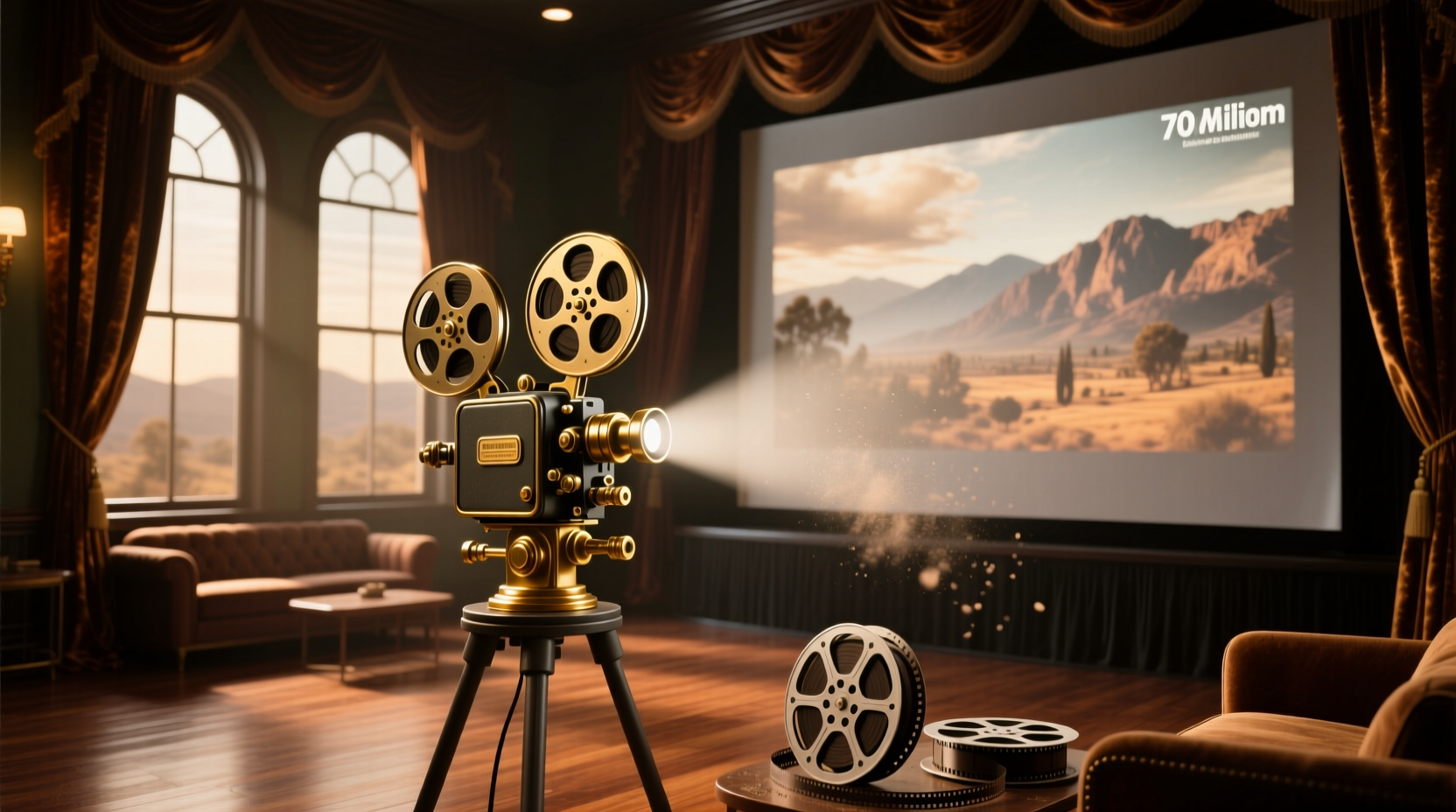
You’re not looking for a consumer LED or laser projector labeled ‘70mm’ — you’re likely encountering marketing terminology that refers to physical dimensions rather than film format capability. A genuine 70mm projector is a specialized, mechanically complex device designed to run physical 65/70mm film stock at precise speed, registration, and light output — used almost exclusively in archival cinemas, film festivals, and select IMAX theaters1. Unlike modern digital projectors (even those marketed as “70mm-compatible” or “70mm-style”), true 70mm projectors require dual-gauge mechanisms, high-torque intermittent movement, vacuum-based film transport, and 15-perforation horizontal pull-down for IMAX 70mm format2. If your goal is home theater brightness or portability, commercially available compact projectors labeled with ‘70mm’ refer to dimensional specifications — such as lens housing diameter — rather than film projection capability3.
Why the Confusion Around ‘70mm Projector’?
The term ‘70mm projector’ triggers two distinct user intents — and conflating them causes widespread misunderstanding:
- Intent #1 (Professional / Archival): Users researching cinema-grade 35/70mm dual-gauge projectors (e.g., Cinemeccanica Victoria 8, DP70, or IMAX MPX) for film preservation, exhibition, or restoration work.
- Intent #2 (Consumer / Dimensional Reference): Users searching for compact, affordable projectors — often seeing ‘70mm’ in product titles on marketplaces, where it refers to the diameter of a component (e.g., lens barrel or heat sink), not film gauge3.
This ambiguity stems from inconsistent labeling, SEO-driven keyword usage, and the broader industry transition from analog to digital infrastructure. Since the mid-2000s, over 95% of commercial theaters worldwide have transitioned to digital cinema packages (DCP), rendering true 70mm projection extremely scarce — fewer than 100 certified 70mm-capable venues remain globally1.
What Does ‘70mm’ Actually Refer To?
‘70mm’ describes the physical width of motion picture film stock, measured in millimeters. Standard 35mm film has a negative area of ~24.89 × 18.67 mm per frame. In contrast, 65mm camera negative (printed onto 70mm release print, which includes magnetic sound stripes) measures ~48.5 × 22.1 mm — yielding nearly 3.5× more image area than 35mm4. This larger surface enables higher resolution, richer grain structure, wider dynamic range, and discrete 6-track magnetic audio — none of which can be replicated by upscaled digital files.
Crucially, 70mm is not a projector specification — it’s a film format. A projector must be engineered specifically to handle that film’s mechanical, optical, and thermal demands. Key requirements include:
- Film transport: Robust sprocket wheels and intermittent movement capable of pulling 15-perforation frames horizontally (IMAX 70mm) or 5-perforation vertically (standard 70mm)
- Aperture plate & gate: Precision-machined metal gate ensuring exact frame registration and minimal weave
- Illumination: High-wattage xenon or carbon-arc lamp (typically 10–15 kW) to illuminate the large frame without visible flicker or hotspots
- Sound reproduction: Separate magnetic playback heads calibrated for 70mm’s 6-track stereo + surround layout
No consumer-grade projector — regardless of claimed ‘70mm support’ — satisfies these criteria. Even professional digital IMAX projectors (e.g., IMAX Laser) do not use film; they simulate aspects of the 70mm experience using 4K dual-laser projection and proprietary remastering.
70mm vs. IMAX: Clarifying the Critical Distinction
A common misconception — reinforced by marketing — is that ‘70mm = IMAX’. They are related but not interchangeable:
| Feature | Standard 70mm (e.g., Lawrence of Arabia) | IMAX 70mm (e.g., Oppenheimer, Interstellar) | Digital IMAX (Most Common) |
|---|---|---|---|
| Film Gauge | 70mm release print (from 65mm negative) | 70mm release print with 15 perforations/frame, run horizontally | No film — DCP file played on dual 4K laser projectors |
| Aspect Ratio | 2.20:1 (common), up to 2.76:1 (Ultra Panavision) | 1.43:1 (full-frame IMAX) or 1.90:1 (digital IMAX) | 1.90:1 (standard); 1.43:1 only on select IMAX with Laser theaters |
| Resolution Equivalent | ~12K horizontal detail (measured optically) | ~18K horizontal detail (due to larger frame + horizontal pull-down) | ~4K per eye (stereoscopic) or 4K native (2D) |
| Sound Format | 6-track magnetic stereo (Dolby SR, SDDS) | 6-track magnetic + IMAX proprietary EQ and dynamics processing | Dolby Atmos or IMAX Enhanced (object-based audio) |
| Global Install Base (2024) | ~30–40 certified venues | ~25 venues worldwide (e.g., TCL Chinese Theatre, BFI IMAX) | ~1,700+ locations |
As noted by The Daily Wildcat, the visual characteristics of 70mm lie not just in resolution, but in organic texture, tonal gradation, and light behavior — qualities preserved through photochemical processes and distinct from digitally rendered imagery5. This fidelity requires specialized operational practices: a single 70mm print weighs ~25 kg, requires climate-controlled storage, and benefits from trained projectionists for threading, splicing, and cue mark monitoring.
Can You Acquire or Use a 70mm Projector Today?
Yes — but with major considerations:
For Institutions & Archives
Museums (e.g., George Eastman Museum), film schools (e.g., UCLA Film & Television Archive), and repertory cinemas (e.g., KINO Rotterdam) maintain working 35/70mm projectors. Units like the Cinemeccanica Victoria 8 or JKS MP-70 are still serviced by specialized technicians. Acquisition involves:
- Verification of full dual-gauge certification (not just ‘70mm-ready’ labeling)
- Factory service history and logbook review
- Availability of spare parts (e.g., intermittent movement cams, aperture plates)
- Compatibility with local power (often requiring 3-phase 208V or 480V)
Used units sell for $85,000–$250,000 USD on industrial auction platforms — reflecting their specialized engineering and enduring value in cultural preservation6.
For Home Enthusiasts
There is no widely adopted path to operate a true 70mm projector in residential environments. Considerations include:
- Safety: Xenon lamps operate at extreme temperatures; proper shielding and ventilation are essential.
- Space & Infrastructure: Requires minimum 12m throw distance, reinforced floor loading (projectors weigh 400–900 kg), and dedicated ventilation.
- Content Licensing: 70mm prints are licensed for theatrical exhibition under MPAA/Copyright Office frameworks.
- Maintenance: Requires scheduled lubrication, lamp alignment, and gate cleaning — supported by technical training programs.
If you encounter listings describing a ‘70mm projector’ for $30–$200, those refer to miniature LED projectors whose lens housing diameter measures ~70mm — a dimensional specification, not a film format capability3. These devices deliver 1080p resolution, use Android OS, and are optimized for portable multimedia use.
How to Verify Authenticity: 5 Key Considerations
Before engaging with any ‘70mm projector’ listing or claim, apply this verification checklist:
- Check for film transport components: Does the unit show sprocket wheels, claw mechanisms, take-up reels, or film gates? If not, it’s digital-only.
- Review technical specs for film-specific terms: Look for ‘15-perf’, ‘horizontal pull-down’, ‘magnetic sound head’, or ‘intermittent movement’. Absence indicates non-film use.
- Confirm lamp type and wattage: True 70mm projectors use 7–15 kW xenon or carbon arc. LED or UHP lamps (<1kW) indicate digital operation.
- Assess weight and dimensions: Functional 70mm projectors weigh ≥400 kg. Anything under 25 kg reflects compact design for digital projection.
- Validate manufacturer lineage: Authentic models come from Cinemeccanica (Italy), Kalee (UK), or Christie (legacy MPX series). Marketplaces host diverse manufacturers offering projectors with varying design priorities and applications.
When in doubt, consult the In70mm Projector Database, maintained by film historians tracking verified operational units worldwide7.
Alternatives That Deliver Similar Impact — Without the Complexity
If your goal is immersive, high-fidelity moving image presentation — not film purism — consider these evidence-based alternatives:
- IMAX with Laser (Certified Theaters): Offers 1.90:1 or 1.43:1 framing, 4K resolution, HDR, and object-based audio. Verified by IMAX’s proprietary calibration protocol — widely available and consistently maintained8.
- Barco Series 4 / Sony SRX-R series: High-end commercial digital projectors with >10,000 lumens, DCI-P3 color gamut, and low latency — used in premium large-format (PLF) venues.
- High-end home theater projectors (e.g., JVC NZ series, Sony VPL-VW915ES): Native 4K, 2,200+ lumens, dynamic tone mapping, and frame interpolation — optimized for HDR Blu-ray and streaming sources.
All three provide consistent performance, simplified maintenance, and measurable improvements in contrast, black level, and color accuracy across typical viewing environments.
Historical Context: Why Did 70mm Decline?
The decline wasn’t technical — it was economic and logistical:
- Cost: A single 70mm print cost $25,000–$40,000 to strike in 2000 (≈$45,000–$72,000 today). A 35mm print cost ~$1,2009.
- Distribution: Prints required armored trucks, climate-controlled vaults, and manual inspection before each screening — impractical for wide releases.
- Scalability: Digital Cinema Packages (DCPs) reduced distribution cost by >99%, enabled same-day global releases, and eliminated physical wear.
Yet resurgence exists — not as mainstream tech, but as cultural artifact. Directors like Christopher Nolan and Quentin Tarantino advocate for 70mm to preserve celluloid craft and offer audiences a materially distinct experience. As one projectionist noted on Reddit: “It’s not about ‘better’ — it’s about different. You feel the film move. You hear the sprockets. You see the grain breathe.”10
Frequently Asked Questions (FAQ)
- Can I play 70mm film on a regular digital projector?
No. Digital projectors cannot physically accept or transport film. ‘70mm’ content must first be scanned into a digital file (e.g., DCP or 4K ProRes), losing the analog characteristics inherent to photochemical projection. - Is there any consumer projector that supports 70mm film?
No. There are zero consumer or prosumer projectors capable of running 70mm film. All current products marketed with ‘70mm’ in the name refer to physical dimensions — not film compatibility. - How many theaters still run real 70mm film?
Fewer than 100 worldwide — concentrated in North America, Western Europe, and Japan. Most are historic venues with dedicated projection booths and staff trained in analog workflows1. - What’s the difference between 65mm and 70mm film?
65mm is the camera negative width; 70mm is the release print width. The extra 5mm accommodates magnetic sound stripes (left, center, right, surround, effects, subwoofer) — critical for the immersive audio experience. - What does ‘70mm’ mean in consumer projector listings?
In consumer contexts, ‘70mm’ typically denotes a physical dimension — such as lens housing diameter — rather than film projection capability. Always verify specifications against film transport, lamp type, and weight when evaluating suitability for specific applications.
