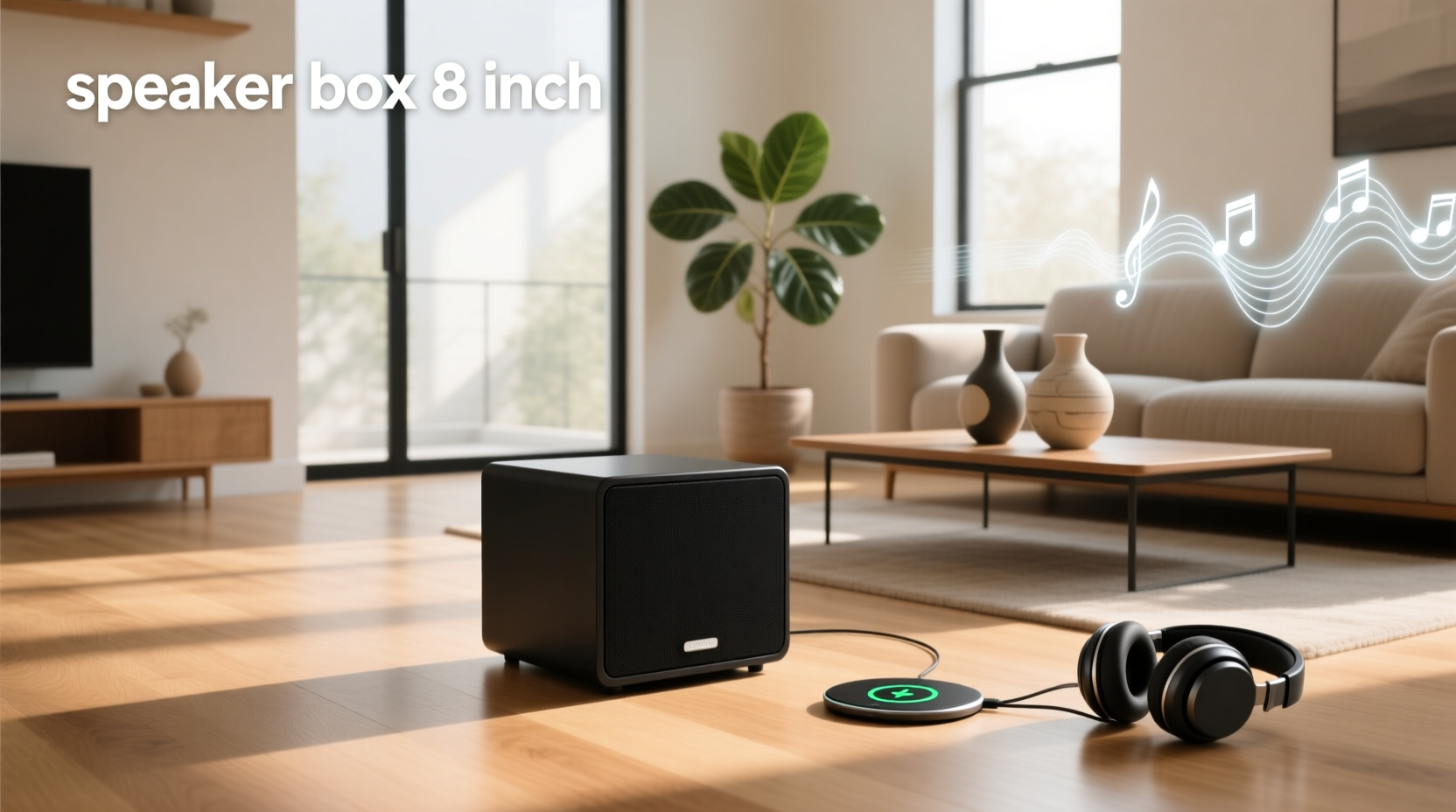
Choosing the right 8-inch speaker box isn’t just about fitting a driver—it’s about matching acoustic physics to your use case. Whether you’re building a compact under-seat sub for daily driving, a sealed enclosure for tight kick-drum accuracy in a studio monitor, or a vented box for maximum low-end output in a portable PA system, the internal volume, porting strategy, material rigidity, and damping all directly determine whether your 8" woofer delivers controlled punch or muddy resonance. This guide cuts through marketing claims and price-driven assumptions—giving you objective, measurement-informed criteria to evaluate any 8-inch speaker enclosure before purchase or build.
Why Enclosure Design Matters More Than Driver Size Alone
An 8-inch speaker driver is versatile—but it’s acoustically neutral until housed. Unlike off-the-shelf Bluetooth speakers that embed drivers in fixed enclosures, a standalone speaker box (also called an enclosure or cabinet) serves two critical functions: acoustic isolation and mechanical control. Without proper enclosure design, the rear wave from the driver cancels or interferes with the front wave—especially below 150 Hz—causing weak output, distorted transients, or even mechanical failure from uncontrolled cone excursion.
Real-world testing shows that identical 8" woofers can vary by up to 12 dB in output between poorly tuned and optimally designed enclosures at 40 Hz1. That’s not subtle—it’s the difference between feeling bass and hearing only mid-bass rumble.
Sealed vs. Ported: The Two Core 8-Inch Enclosure Types
Every functional 8-inch speaker box falls into one of two fundamental acoustic architectures: sealed (acoustic suspension) or ported (bass reflex). There are no universal ‘best’ types—only best fits for specific goals.
✅ Sealed Enclosures: Precision, Speed, Simplicity
How it works: A fully airtight cabinet with internal damping material (e.g., polyfill or fiberglass). Air inside acts as a linear spring, controlling cone movement.
Typical net internal volume for 8" woofers: 0.35–0.65 ft³ (10–18 L), depending on driver Qts and target alignment (e.g., Butterworth, quasi-Butterworth). For example, many OEM car audio 8" subs specify 0.42 ft³ for flat, extended response down to ~45 Hz2.
Pros:
• Fast transient response — ideal for music with sharp attack (jazz, acoustic, electronic)
• Minimal group delay — tighter sync with mids/tweeters
• No port noise or chuffing at high power
• Smaller footprint — easier to fit in tight spaces (trunk corners, under seats)
Cons:
• Lower efficiency — requires ~3 dB more amplifier power for same SPL as ported
• Reduced output below tuning point — no bass boost below ~40 Hz
• Less ‘impact’ perception in casual listening
✅ Ported Enclosures: Output, Extension, and Trade-Offs
How it works: Adds a tuned port (circular or slot) that resonates with the driver’s natural frequency, reinforcing output near tuning point (typically 30–45 Hz).
Typical net internal volume for 8" ported boxes: 0.6–1.1 ft³ (17–31 L), with port area 6–9 in² and tuning between 32–38 Hz. Example: The Skar Audio AR1X8V-SPL uses 0.88 ft³ net volume and a 3" diameter port tuned to 39 Hz3.
Pros:
• +3–6 dB gain near tuning frequency — louder perceived bass with same amp power
• Deeper extension — measurable output down to 28–30 Hz (with appropriate driver)
• Better thermal/power handling margin due to reduced cone excursion near tuning
Cons:
• Larger physical size — often 32×32×32 cm or bigger
• Risk of port turbulence (‘chuffing’) if undersized or poorly flared
• Phase shift and group delay increase below tuning — can blur timing in critical monitoring
• Requires precise tuning — mismatched port length/diameter causes peakiness or nulls
Application-Specific Considerations for 8-Inch Boxes
Not all 8-inch enclosures serve the same purpose. Prioritization shifts dramatically across domains.
🚗 Automotive Use: Space, Vibration, and Thermal Limits
In cars, enclosure design must contend with limited space, cabin gain (acoustic reinforcement from small interior volume), and heat buildup. Key facts:
- Under-seat fit: Slim sealed boxes (e.g., 12–15 cm depth) dominate—net volumes rarely exceed 0.45 ft³. Avoid ported designs unless mounted in trunk with ≥0.8 ft³ available.
- Cabin gain effect: Most vehicles exhibit +6–10 dB gain between 50–80 Hz. This makes sealed 8" boxes sound subjectively louder than in free air—and reduces need for extreme low-end extension.
- Material matters: 15–18 mm MDF remains standard; thinner plywood or particleboard risks panel resonance above 100 Hz. Bracing (cross or corner) is non-negotiable for boxes >0.5 ft³.
🏠 Home/Studio Monitoring: Accuracy Over Impact
For nearfield or midfield use (e.g., desktop monitors, small control rooms), sealed 8" enclosures are strongly preferred. Why?
- Flat, time-aligned response supports critical mixing decisions.
- No port noise interference during quiet passages or vocal sibilance.
- Lower group delay preserves stereo imaging integrity.
A common mistake: using car-oriented ported 8" boxes in home setups. Their boosted 40 Hz hump masks mix balance issues and encourages over-EQing.
🎤 Portable PA & Party Speakers: Durability and Dispersion
Many ‘dual 8" party speakers’ (e.g., Audiobox ABX-2900R) use horn-loaded or trapezoidal cabinets. These prioritize:
• Horizontal dispersion control (via wedge shape)
• High-SPL capability (requiring rigid construction and venting for voice coil cooling)
• Integrated handles, pole mounts, and weather-resistant finishes
Note: These are full-range systems, not subwoofers. An 8" full-range driver in a 35 L cabinet (like some IndiaMART-listed units) will roll off below 80–100 Hz—unsuitable as a true sub, but adequate for speech and light music in open-air events.
DIY vs. Pre-Built: What You Gain (and Lose)
Pre-built 8-inch speaker boxes offer convenience—but rarely transparency. DIY gives control, but demands verification.
🔍 Evaluating Pre-Built Boxes: 5 Must-Check Specs
Before buying any ready-made 8-inch enclosure, verify these—not just marketing claims:
- Net internal volume (not gross): Subtract wood thickness, bracing, and driver displacement. A claimed “0.9 ft³” box with 18 mm MDF walls and no bracing may deliver only 0.72 ft³ net.
- Port tuning frequency (if ported): Should match driver’s Vas and Qts. If unspecified, assume generic 35–40 Hz tuning—often mismatched.
- Internal damping: Look for photos showing polyfill or acoustic foam. Bare MDF interiors cause midrange coloration.
- Terminal quality: Spring-loaded or binding posts > push terminals. Poor connections induce distortion at high current.
- Construction joints: Dado or rabbet joints > butt joints with screws alone. The latter flex under pressure, leaking air and degrading bass.
🛠️ Building Your Own: Tools, Tolerances, and Pitfalls
Diy 8-inch enclosures require precision—not just glue and sawdust. Critical tolerances:
- Panel alignment: ±0.5 mm gap tolerance. Larger gaps leak air, detuning sealed boxes and reducing port output.
- Glue surface prep: Sand MDF edges to remove mill glaze. Unprepared surfaces reduce Titebond III bond strength by up to 40%4.
- Driver cutout: Use a router with template guide—not a jigsaw. Oversized holes allow gasket compression loss; undersized cause frame binding.
Free design tools like SubBox Pro generate dimensioned plans, port specs, and predicted response curves—but always cross-check with manufacturer Thiele/Small parameters (Fs, Qts, Vas) for your specific driver.
Common Misconceptions About 8-Inch Speaker Boxes
Myth-busting based on real user queries and measurement data:
❌ "Bigger box = deeper bass"
False. Excess volume lowers system Q, causing flabby, slow response. Too-small boxes raise Q, causing peaky, boomy output. Optimal volume is mathematically derived—not guessed. For most 8" woofers, 0.4–0.8 ft³ net is the functional sweet spot.
❌ "Ported boxes always sound louder"
Only within their tuned bandwidth (~30–50 Hz). Above 60 Hz, sealed boxes often measure higher due to lack of port cancellation. Loudness ≠ musicality.
❌ "Any 8-inch sub fits any 8-inch box"
No. Drivers vary widely in Xmax (linear excursion), power handling, and compliance. A high-Xmax 8" sub (e.g., 12 mm) needs larger volume and port area than a shallow-excursion unit (e.g., 5 mm). Using mismatched drivers causes bottoming out or thermal failure.
Material, Finish, and Long-Term Reliability
MDF remains the benchmark for rigidity-to-cost ratio—but alternatives exist:
| Material | Pros | Cons | Best For |
|---|---|---|---|
| MDF (15–18 mm) | Dimensionally stable, dense, easy to finish | Heavy, absorbs moisture if unsealed | Fixed installations, studio monitors |
| Marine-grade plywood | Lighter, flexible, moisture-resistant | Resonant if undersized; requires bracing | Mobile DJ, outdoor PA |
| HDF (High-Density Fiberboard) | Higher density than MDF, less prone to swelling | Harder to machine; expensive | High-end studio subs |
| Injection-molded plastic | Weatherproof, consistent, lightweight | Low rigidity → panel resonance above 200 Hz | Consumer Bluetooth speakers |
Finish matters acoustically: carpet or textured vinyl dampens panel vibration better than glossy paint. But avoid foam-backed carpet—it adds unwanted absorption in upper mids.
Frequently Asked Questions (FAQ)
- Can I use an 8-inch speaker box for both music and movies?
Yes—if designed for wide bandwidth (e.g., sealed 0.5 ft³ with 2-way crossover). Avoid narrow-tuned ported boxes: their 35 Hz peak helps action scenes but masks dialogue clarity. - Do I need an amplifier with an 8-inch passive speaker box?
Yes. Passive 8-inch enclosures (like Behringer PK108) require external amplification. Verify RMS power rating and impedance (usually 4Ω or 8Ω) match your amp’s output. - Is a dual 8-inch box always better than single?
No. Two 8" drivers in one box double cone area but also double required air volume and amplifier power. Unless you need +6 dB output and have headroom, a well-tuned single box is more efficient and easier to place. - How do I know if my 8-inch box is properly sealed?
Perform the ‘tissue test’: hold a single-ply tissue 2 cm from all seams while playing 30 Hz tone at low volume. Any flutter indicates air leak. Also check for audible ‘whistle’ when pressing gently on the driver cone—if air escapes, seal with silicone caulk. - What’s the minimum amplifier power for an 8-inch speaker box?
Depends on sensitivity and use. For home monitoring: 25–50W RMS. For car sub: 150–300W RMS. For PA: 400–800W RMS. Never drive below rated RMS—clipping damages voice coils faster than over-powering.
