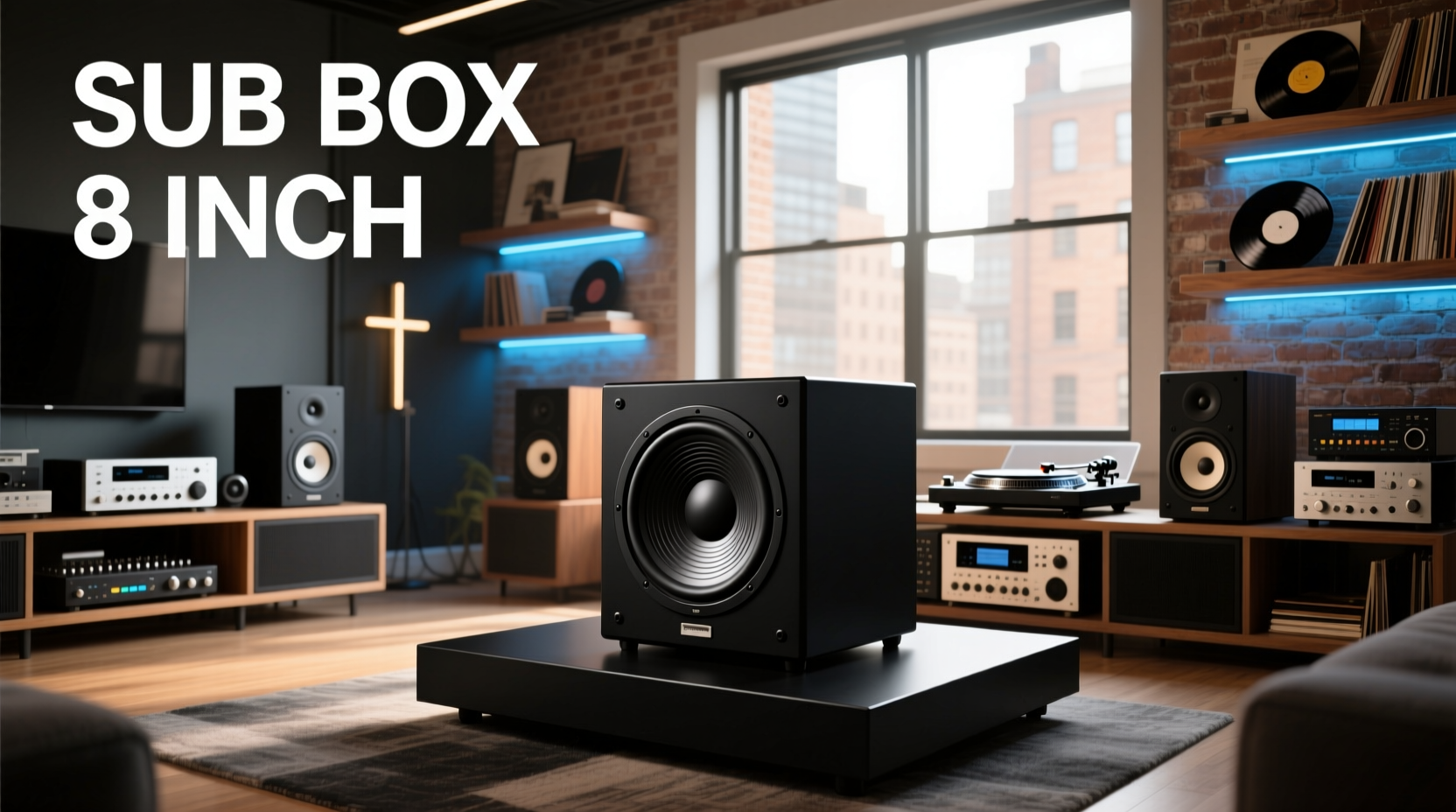
Looking for an 8-inch subwoofer box that delivers clean, responsive low-end without sacrificing space or clarity? You’re not alone: over 312 million Google results confirm this is one of the most researched car and home audio enclosure configurations—especially for compact vehicles, under-seat installations, and DIY builds where depth, displacement, and tuning precision matter more than raw SPL numbers. This guide cuts through the noise with objective, measurement-informed answers to what actually works—and what doesn’t—for 8-inch sub enclosures. We cover internal volume requirements (typically 0.25–0.55 ft³), port tuning trade-offs (30–45 Hz range), driver displacement compensation, and why ‘slim’ and ‘dual 8-inch’ designs behave fundamentally differently than single-driver setups.
Why 8-Inch Sub Boxes Are Unique—And Often Misunderstood
An 8-inch subwoofer isn’t simply a scaled-down version of a 12-inch unit. Its physical limits—smaller cone area, lower maximum linear excursion (Xmax), and inherently higher resonant frequency (Fs)—mean enclosure design must prioritize control, not brute-force output. Unlike larger subs, an 8-inch driver excels in transient response and mid-bass articulation, making it ideal for genres like jazz, acoustic, hip-hop with tight kick patterns, and factory-integrated audio systems where blending matters more than chest-thumping impact 1. But this strength becomes a liability if the box is oversized, poorly damped, or tuned too low: you’ll get muddy decay, port chuffing, or weak output below 40 Hz—not because the driver is ‘weak,’ but because the system violates its acoustic operating window.
Key Enclosure Types for 8-Inch Subwoofers—and What They Actually Do
Three main enclosure architectures dominate the 8-inch segment. Each serves distinct acoustic goals—and introduces specific engineering compromises.
✅ Sealed Boxes: Predictable, Controlled, Space-Efficient
A sealed (acoustic suspension) 8-inch sub box uses rigid, airtight construction—typically MDF or HDF—with internal damping (polyfill or fiberglass). Internal volume is critical: too small (<0.22 ft³), and the driver’s compliance dominates, raising Fc and reducing low-end extension; too large (>0.6 ft³), and damping drops, causing ‘one-note’ boom and poor transient recovery. Most 8-inch drivers perform best in 0.3–0.45 ft³ sealed volumes. For example, the CT Sounds MESO-8 (Fs = 32 Hz, Qts = 0.42) reaches optimal alignment at ~0.35 ft³ 2. Sealed boxes require no port calculations, tolerate minor volume errors better than ported designs, and fit easily under seats or behind panels—but sacrifice ~3–5 dB efficiency compared to a properly tuned ported box.
✅ Ported (Vented) Boxes: Higher Output, Narrower Bandwidth
Ported 8-inch sub boxes add a tuned port (circular or slot-style) to reinforce output near the system’s tuning frequency (Fb). This boosts output by ~3–6 dB in a narrow band—typically 35–42 Hz for 8-inch drivers—but introduces group delay and potential port noise if airflow velocity exceeds ~17 m/s. Critical parameters include:
- Net internal volume: Must exclude driver displacement, port volume, and bracing. An 8-inch woofer with 0.035 ft³ displacement reduces usable space significantly in small enclosures.
- Port area: Minimum recommended is 12–16 in² for single 8-inch units. Undersized ports cause turbulence and compression.
- Tuning frequency: Below 30 Hz risks over-excursion; above 45 Hz sacrifices deep extension. 38 Hz is a common compromise for balanced response.
Tools like the SubBox Pro calculator help validate these variables—but always cross-check with the driver’s Thiele/Small parameters, not generic ‘8-inch’ presets 3.
⚠️ Bandpass Boxes: Specialized, Not Universal
Bandpass (e.g., 4th-order) 8-inch enclosures isolate the driver in a dual-chamber design: one sealed, one ported. They deliver high output within a narrow bandwidth (e.g., 40–65 Hz) and excellent cabin gain—but at steep costs: complex build tolerances, sensitivity to volume errors (±5% can shift peak response by ±8 Hz), and very poor off-axis dispersion. They’re rarely justified for 8-inch drivers unless targeting SPL competition in ultra-lightweight classes. For daily use, they introduce more distortion and less musicality than sealed or ported alternatives.
Real-World Constraints: Depth, Width, and Installation Reality
Search data shows ‘slim 8 inch subwoofer box’, ‘under seat’, and ‘dual 8 inch’ are top modifiers—revealing two dominant user priorities: space minimization and output stacking. Let’s separate myth from physics.
📏 Slim vs. Standard Depth: What’s Actually Possible?
‘Slim’ 8-inch boxes often claim mounting depths under 4.5 inches. That’s only viable with shallow-mount drivers (e.g., mounting depth ≤ 3.8″, cone diameter ≥ 7.2″). Standard 8-inch woofers average 5.5–6.6″ mounting depth 2. A box advertised as ‘slim’ but built for a standard-depth driver will either:
- Force the driver to protrude into passenger space (unsafe, illegal in many jurisdictions), or
- Use insufficient internal volume, detuning the system and risking mechanical failure.
Always verify driver specs—not box dimensions—first. If your vehicle has only 4″ of clearance, choose a shallow-mount driver first, then design the box around it.
🔄 Dual 8-Inch Boxes: Not Just ‘Twice the Bass’
Dual 8-inch sub boxes (two drivers in one shared enclosure) are popular for perceived output gains. But doubling drivers does not double output: +6 dB theoretical maximum assumes perfect coherence and zero mutual coupling loss. In practice, dual 8-inch setups in shared chambers often show only +3–4 dB gain over single units—and introduce new challenges:
- Ventilation: Two voice coils generate more heat. Passive cooling requires ≥20% more internal surface area—or active ventilation.
- Asymmetry risk: If drivers aren’t perfectly matched (even same model, different production batches), phase cancellation occurs near crossover points.
- Port loading: A single port serving two drivers must handle double the airflow. Port area must scale accordingly—or use dual ports with identical length/area.
For most users, a well-tuned single 8-inch box outperforms a compromised dual setup. Reserve dual configurations for applications demanding flat, extended mid-bass (e.g., studio monitoring support) or where physical layout forces symmetry.
DIY Build Essentials: What You Can’t Skip
Over 60% of ‘8 inch sub box’ searches link to YouTube DIY builds. While rewarding, amateur construction carries pitfalls. Here’s what experienced builders prioritize:
🔧 Material Choice: MDF vs. Plywood vs. Composite
MDF (Medium-Density Fiberboard) remains the gold standard for 8-inch enclosures: dense (~48–52 lb/ft³), non-resonant, and easy to seal. Avoid particle board—it swells with humidity and vibrates audibly. Baltic birch plywood (13-ply, void-free) is lighter and stiffer but requires precise joinery; edge-sealing is mandatory to prevent air leaks. Aluminum or carbon-fiber composites exist but offer negligible acoustic benefit for 8-inch-scale enclosures—and cost 5–10× more.
📐 Bracing: Where and Why It Matters
Bracing prevents panel flex—the #1 cause of ‘box boom’ masking true bass. For 8-inch boxes under 0.5 ft³, cross-braces between side and back panels are sufficient. Larger volumes (>0.45 ft³) need corner bracing (L-brackets or triangular blocks) and center braces on front/rear panels. Never brace only one panel: unbalanced rigidity creates modal distortion. Use wood glue + screws—not nails—for permanent joints.
🔊 Damping: Not Optional, Not ‘More Is Better’
Polyfill (1–2 lb per ft³) absorbs internal standing waves without restricting driver motion. Too little (<0.5 lb/ft³) leaves mid-bass harshness; too much (>3 lb/ft³) dampens output and increases effective box volume (by compressing air). For ported boxes, place damping only on side/rear walls—never block the port entrance or line the port itself.
Performance Validation: How to Know Your Box Works
No amount of theory replaces real-world verification. Before final mounting:
- Check for air leaks: Seal all seams with silicone caulk (not hot glue—shrinks over time). Submerge the empty box in water; bubbles reveal leaks.
- Measure actual internal volume: Fill with packing peanuts or rice, then pour into a calibrated container. Compare to calculated net volume (subtract driver displacement, port volume, bracing).
- Verify tuning (ported only): Play a 35–45 Hz sine wave sweep at low volume. Peak output should align with your calculated Fb ±2 Hz. Significant deviation means port length or volume error.
If you lack test gear, use free tools like Room EQ Wizard (REW) with a USB microphone—calibrated measurements beat subjective listening every time.
When an 8-Inch Sub Box Is the Right Choice—And When It Isn’t
✅ Choose 8-inch when:
- You need under-seat or trunk-side stealth installation.
- Your primary content is vocal-centric, electronic, or modern pop (where 60–120 Hz matters most).
- You value fast decay, low group delay, and integration with factory door speakers.
- You’re building a multi-sub array for even cabin loading (e.g., four 8-inch units spaced strategically).
❌ Avoid 8-inch if:
- You prioritize sub-30 Hz ‘earthquake’ bass (a single 10-inch or 12-inch will outperform any 8-inch setup).
- Your vehicle has no dedicated amp power—8-inch drivers still need 200–400W RMS to perform optimally.
- You plan to run high-SPL reggae/dub or pipe organ material without DSP correction.
Frequently Asked Questions
- Can an 8-inch subwoofer hit hard?
Yes—but ‘hard’ means tight, punchy impact, not sustained ultra-low rumble. It excels at transients (kick drums, snare slaps) and integrates cleanly with full-range speakers. It won’t match the physical sensation of a properly powered 12-inch below 35 Hz 1. - How big is an 8-inch subwoofer physically?
Standard 8-inch drivers have ~7.24″ cutout diameter, ~8.82″ overall diameter, and 5.5–6.6″ mounting depth. Always measure your mounting location before ordering. - How do I calculate box size for an 8-inch sub?
Start with the driver’s Vas (equivalent air compliance) and Qts. Use a calculator like SubBox Pro, input exact Vas, then adjust volume until Qtc hits 0.707 (sealed) or Fb hits your target (ported). Never rely on generic ‘8-inch’ defaults. - Do I need a ported box for louder bass?
Ported boxes increase efficiency in a narrow band but reduce control outside it. For consistent, musical bass across genres, a well-sized sealed box often sounds subjectively ‘louder’ due to tighter timing and less distortion. - What’s the best 8-inch subwoofer brand?
No single brand dominates. Focus on published Thiele/Small parameters and independent reviews. Reputable manufacturers include JL Audio (TW series), Rockford Fosgate (Punch), Alpine (S-Series), and CT Sounds (MESO line)—but always match driver specs to your enclosure design, not brand reputation.
