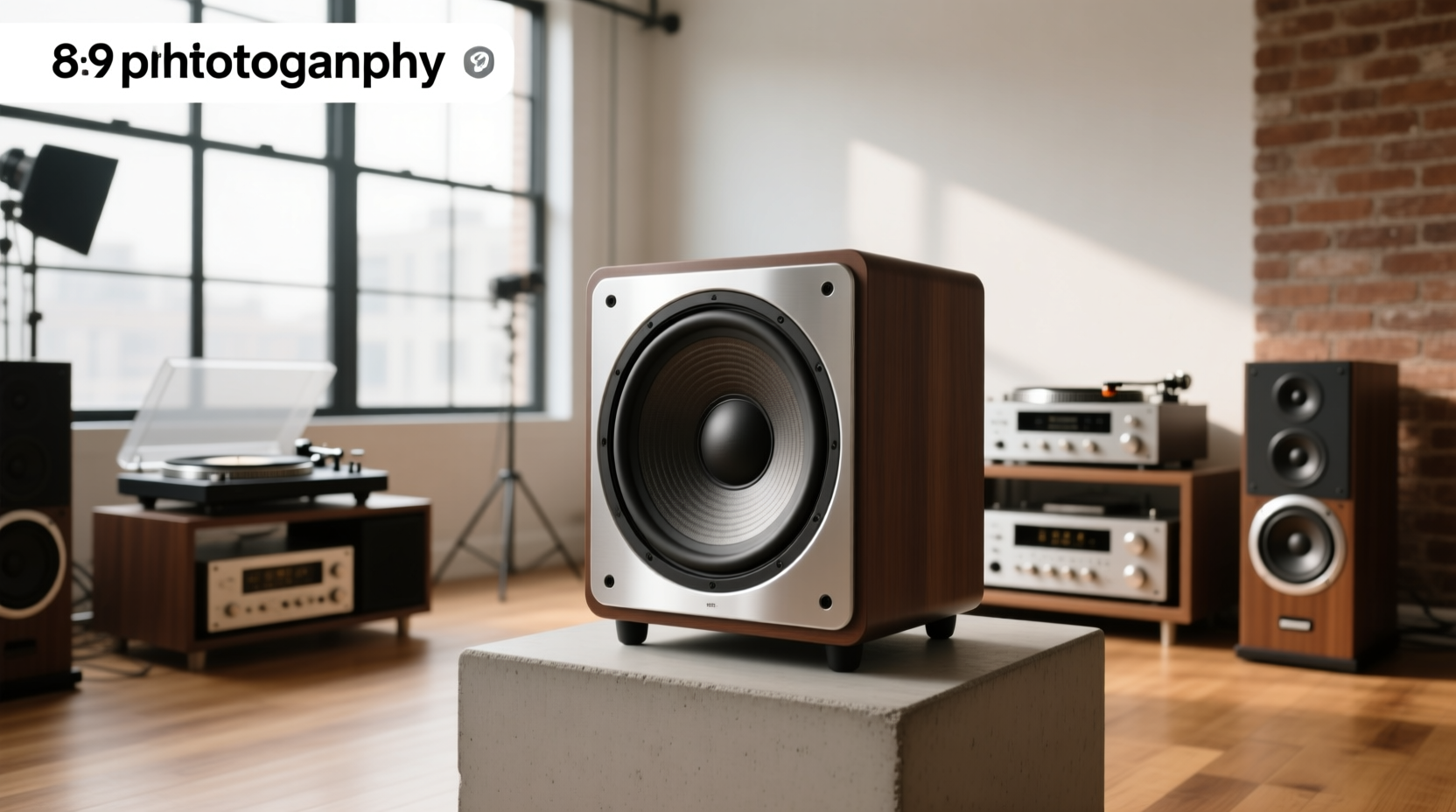
You’re looking at an 8-inch woofer — that means the driver’s cone measures approximately 203 mm (8.0 inches) in diameter across its widest point, not including frame or mounting flange. This size strikes a practical balance: compact enough for tight installations (under-seat car subs, slim studio monitors, or compact PA cabinets), yet capable of delivering authoritative mid-bass (60–300 Hz) with controlled transient response. Unlike larger 10" or 12" drivers, 8-inch woofers typically require less air volume, respond faster to transients, and pair well with modest amplifiers (50–300W RMS). They’re not deep-subwoofer replacements (e.g., 20–40 Hz extension), but excel where accuracy, speed, and space efficiency matter most — especially in 2-way bookshelf speakers, nearfield studio monitors, portable PA systems, and compact car audio setups1. Understanding their physical limits and electrical specs — not just brand names or wattage claims — is essential before purchase.
Why the 8-Inch Size Exists: Physics, Not Marketing
The 8-inch (203 mm) woofer isn’t arbitrary — it reflects a decades-tested engineering compromise between low-frequency extension, motor strength, cone excursion capability, and cabinet volume requirements. Larger drivers move more air, enabling deeper bass, but demand greater amplifier power, larger enclosures, and longer signal propagation time across the cone surface — which can blur fast transients. Smaller 6.5" or 5.25" woofers offer even quicker response but sacrifice output and low-end reach below ~80 Hz.
An 8-inch driver sits in the ‘sweet spot’ for applications where:
✅ You need usable bass down to ~55–65 Hz (not sub-40 Hz rumble)
✅ Cabinet depth or weight is constrained (e.g., wall-mounted PA, desktop monitor, vehicle footwell)
✅ Amplifier headroom is limited (e.g., integrated AV receivers, battery-powered portables)
✅ Mid-bass clarity matters more than chest-thumping impact (e.g., vocal reinforcement, acoustic jazz, podcast mixing)
This explains why professional-grade 8" woofers appear in high-fidelity studio monitors (like Presonus Eris Sub8BT2), commercial ceiling/zone speakers (Electro-Voice EVID-S8.2T3), and competition-grade car audio (Skar Audio SVR-8 D2), despite differing design priorities.
Key Technical Specs You Must Check — And What They Really Mean
Marketing pages often highlight only wattage and size. But four interdependent specs determine real-world performance:
1. Nominal Impedance (4Ω vs. 8Ω)
This is the average AC resistance the woofer presents to your amplifier across its operating range — not a fixed DC value. Most modern 8" woofers are rated at either 4Ω or 8Ω.
- 4Ω drivers: Draw more current from the amp at the same voltage. Require amplifiers rated for 4Ω stability. Common in car audio and powered monitors. Can yield higher output but increase thermal stress on under-specified amps.
- 8Ω drivers: Safer load for older or budget AV receivers. Lower current draw reduces heat buildup. Often found in passive PA cabinets and home hi-fi replacements.
⚠️ Never assume ‘lower impedance = better’. Mismatching can cause amplifier clipping, distortion, or shutdown — especially in multi-driver cabinets where total impedance depends on wiring (series vs. parallel).
2. Power Handling: RMS vs. Peak (and Why RMS Matters More)
RMS (Root Mean Square) is the continuous thermal power the voice coil can handle without overheating. Peak (or MAX) is a short-term burst rating — often 2× RMS — useful only for transient spikes (e.g., kick drum hits), not sustained output.
Example: A ‘200W RMS / 400W Peak’ 8" woofer safely handles 200W continuously. Feeding it 350W RMS risks thermal failure — even if peak rating suggests otherwise. Always match RMS to your amplifier’s continuous output per channel into the woofer’s impedance, not its ‘max’ spec.
3. Fs (Resonant Frequency) & Qts (Total Q Factor)
These Thiele/Small parameters define how the woofer behaves in an enclosure:
- Fs: Natural resonance frequency (Hz) — lower values (e.g., 28–35 Hz) suggest potential for deeper bass *if properly enclosed*; higher values (45–55 Hz) indicate tighter, faster response but reduced low-end reach.
- Qts: Damping ratio — values < 0.35 favor sealed boxes (tight, accurate); > 0.45 suit ported designs (higher output, looser feel). Most 8" woofers fall between 0.30–0.42 — making them versatile for both sealed and vented builds.
⚠️ These values are meaningless without context. A low-Fs 8" woofer won’t deliver 30 Hz output in a small box — it’ll just unload and distort. Always consult manufacturer-recommended enclosure volumes.
4. Sensitivity (dB @ 1W/1m)
Measures how loud the woofer plays with 1 watt of input at 1 meter distance. Typical range: 84–92 dB.
- 84–86 dB: Requires significant amplifier power (e.g., 200W+) for room-filling output.
- 88–90 dB: Balanced — works well with 50–150W amps in medium rooms.
- 91–92 dB: High-efficiency — common in PA and horn-loaded designs; can sound ‘shouty’ if not balanced with tweeter.
Sensitivity interacts directly with impedance. A 90 dB/4Ω woofer will be ~3 dB louder than a 90 dB/8Ω unit with the same amplifier — because it draws twice the current.
Where 8-Inch Woofers Excel — And Where They Fall Short
Understanding application fit prevents costly mismatches:
✅ Ideal For:
- Studio Nearfield Monitors: Fast transient response preserves detail in critical listening (e.g., mixing kick drums or bass guitar). Models like the Dayton Audio PA200-8 prioritize linearity over sheer output4.
- Compact Car Audio: Fits under seats or in shallow trunk enclosures. Dual 4Ω voice coils (e.g., Massive Audio GTS8) allow flexible amp bridging without impedance mismatch.
- Commercial/Background PA: 70V/100V models (e.g., Electro-Voice EVID-S8.2T) distribute audio efficiently across large zones with minimal wiring loss.
- DIY Speaker Building: Abundant off-the-shelf kits and crossover networks exist for 8" drivers — unlike niche sizes like 7" or 9".
❌ Not Suitable For:
- Deep Sub-Bass Extension (<40 Hz): Even high-excursion 8" units (e.g., Rockville Punisher 8D2) roll off steeply below 45 Hz. True infrasonic output requires ≥12" drivers or dedicated active subwoofers.
- High-SPL Live Sound (Front-of-House): While used in stage monitors, 8" woofers lack the cone area and power handling for main PA duty in venues >100 people without array support.
- Home Theater LFE Channels: Dolby Atmos LFE tracks demand headroom down to 20 Hz. An 8" driver alone cannot reproduce this — it must be paired with a dedicated subwoofer.
Passive vs. Active: Which Configuration Fits Your Setup?
‘8-inch woofer’ refers to the driver itself — not the system. How it’s implemented changes everything:
Passive Woofers
Require external amplification and crossover filtering. Found in:
- Replacement drivers (e.g., Beyma 8WRS300 for cabinet repair)
- DIY speaker kits
- Multi-driver PA cabinets (e.g., LD Systems DQOR8TW)
✅ Pros: Flexible integration, upgradeable, cost-effective for bulk builds.
❌ Cons: Demands matching amp + crossover expertise; poor pairing causes phase issues or driver damage.
Active (Powered) Subwoofers
Contain built-in amplifier, DSP, and often auto-on/off or EQ. Examples include Presonus Eris Sub8BT and Monoprice Premium Select.
✅ Pros: Plug-and-play, optimized tuning, protection circuitry, space-saving.
❌ Cons: Less serviceable; fixed voicing limits tonal adjustment; built-in amp may be underpowered for large rooms.
💡 Key tip: If adding an 8" active sub to existing speakers, ensure its crossover is adjustable (40–120 Hz range) and phase switchable (0°/180°) — critical for seamless blend with mains.
Common Misconceptions — Debunked
Misconception #1: “More Watts = Deeper Bass”
False. Wattage determines maximum clean output — not frequency reach. A 1000W 8" woofer still cannot reproduce 25 Hz if its Fs is 52 Hz and enclosure is undersized. Low-frequency extension is governed by Fs, Vas (equivalent air compliance), and box volume — not power alone.
Misconception #2: “Dual Voice Coils Are Always Better”
Not necessarily. Dual 4Ω coils let you wire for 2Ω (parallel) or 8Ω (series), offering amp flexibility — but add mass to the moving assembly, slightly reducing sensitivity and transient speed. Single-coil designs often measure more linear in lab tests.
Misconception #3: “All 8-Inch Woofers Fit Standard Mounting Holes”
No. While many use ~7.25" (184 mm) bolt circles, others vary (e.g., some Celestion models use 7.5", Scan-Speak M21WG09-08 uses 7.1"). Always verify cutout diameter, mounting depth, and frame thickness before ordering replacements.
How to Verify Authentic Specs — Avoiding Marketing Inflation
Many listings inflate peak power or omit critical Thiele/Small data. Here’s how to validate:
- Check the datasheet: Reputable brands (Dayton Audio, Scan-Speak, Beyma, Goldwood) publish full PDF spec sheets with impedance curves, BL (motor strength), Xmax (linear excursion), and frequency response graphs. If unavailable, treat claims skeptically.
- Compare RMS ratings across identical test conditions: Some sellers quote ‘music power’ (unstandardized) instead of IEC 60268-5 RMS. Legitimate specs cite test duration (e.g., 2 hours pink noise) and thermal limits.
- Review independent measurements: Sites like Audioholics or DIYAudio forums host user-measured impedance sweeps and anechoic responses — far more reliable than vendor renderings.
Final Decision Checklist: Before You Buy
Ask these questions — and answer them with hard specs, not brochures:
- What is my amplifier’s stable output into 4Ω or 8Ω? (Match woofer impedance and RMS rating within ±20%.)
- What is my available cabinet volume? (Compare to manufacturer’s recommended Vb/Vas — never guess.)
- What is my lowest required frequency? (If <50 Hz is essential, an 8" woofer alone won’t suffice.)
- Do I need passive integration (for custom crossovers) or plug-and-play simplicity (active sub)?
- Is environmental durability needed? (Marine-rated 8" woofers like Pyle PLMRW8 use UV-resistant cones and corrosion-proof frames — standard units are not.)
Frequently Asked Questions (FAQ)
- Can an 8-inch woofer replace a 10-inch subwoofer?
Only if low-frequency extension below 50 Hz is not required. An 8" unit typically rolls off 6–10 dB earlier than a 10" in identical enclosures — resulting in noticeably thinner bass impact. - What’s the difference between an 8-inch woofer and an 8-inch subwoofer?
A woofer handles mid-bass (80–500 Hz) as part of a multi-driver system; a subwoofer is engineered solely for low bass (20–120 Hz), usually with higher excursion, stiffer suspension, and dedicated amplification. - Do I need a separate amplifier for a passive 8-inch woofer?
Yes — unless it’s installed in a powered cabinet with internal amp. Passive drivers have no built-in electronics and will not function without external amplification matched to their impedance and power rating. - Are 8-inch woofers suitable for outdoor use?
Only if explicitly rated for weather resistance (IPX5 or higher). Standard 8" woofers use paper or synthetic cones vulnerable to humidity and UV degradation. Marine or commercial outdoor models use treated materials and sealed surrounds. - How much cabinet space does an 8-inch woofer need?
Varies by design: Sealed boxes range from 0.3–0.8 ft³ (8–22 L); ported designs from 0.5–1.5 ft³ (14–42 L). Always follow the manufacturer’s recommended volume — not generic ‘rule-of-thumb’ charts.
