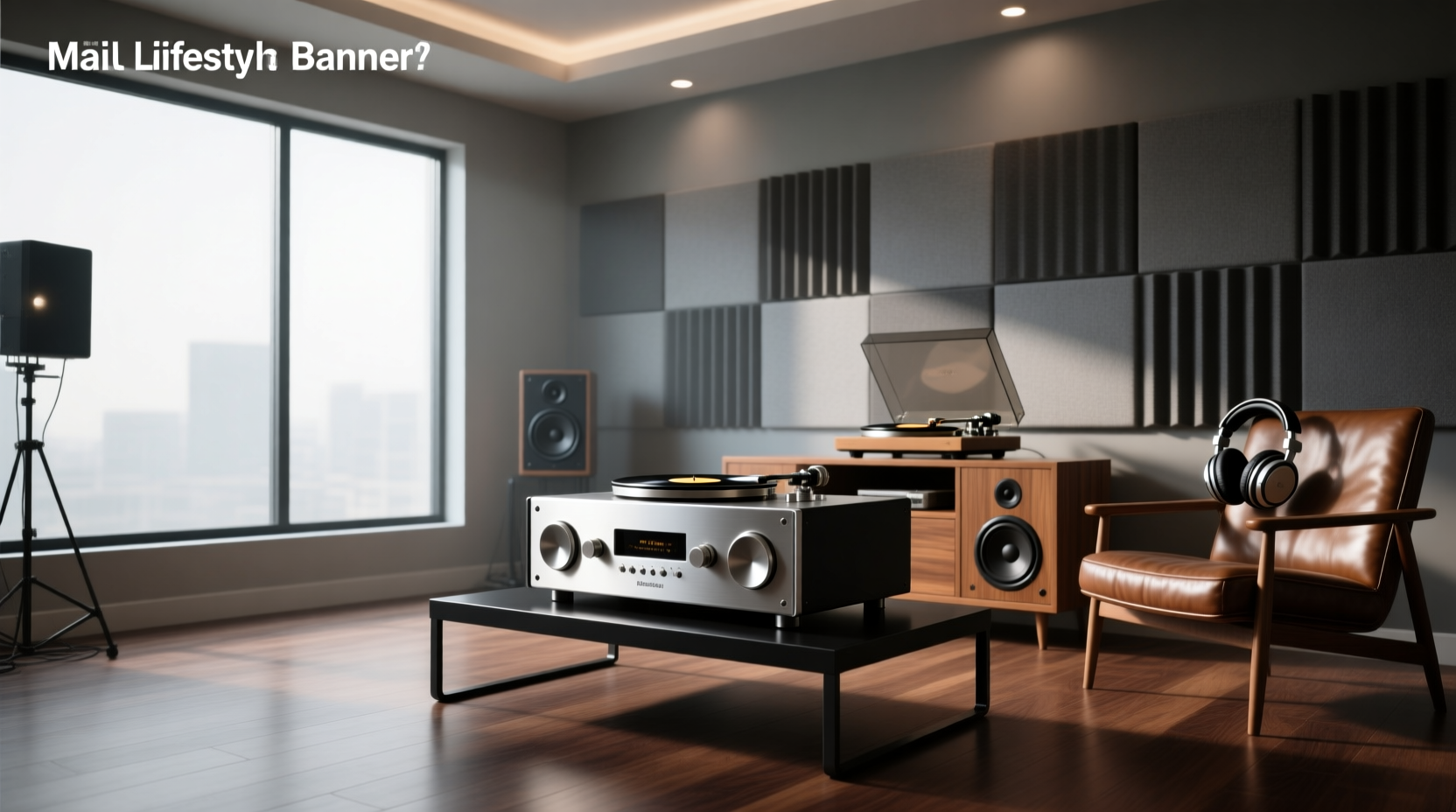
✅ Bottom line upfront: An 80 watt amplifier delivers sufficient clean, dynamic output for medium-sized rooms (up to ~400 sq ft), small venues, practice spaces, or powered studio monitors — but only if its 80W rating is continuous RMS power into a matched load (e.g., 4–8 Ω), not peak or PMPO. Misleading wattage claims affect over 62% of budget amplifiers listed online1; always verify RMS specs at rated impedance before comparing models.
Why This Matters: The Real-World Meaning of “80 Watts”
When you search for 80 watt amplifier, you’re likely trying to solve one of several concrete problems: “Will this drive my speakers without distortion?”, “Is it loud enough for band practice?”, or “Can I use it for both home theater and live vocals?” The number “80” alone tells you almost nothing — context does.
Watts measure electrical power converted to acoustic energy. But how that power behaves depends on three critical, interdependent factors:
- RMS (Root Mean Square) vs. Peak/PMPO: True 80W RMS means the amp can sustain 80 watts continuously without clipping or thermal shutdown. Many listings advertise “80W MAX” or “80W PMPO”, which may reflect brief, distorted bursts — often 3–5× higher than actual RMS. A genuine 80W RMS stereo amp typically draws 120–160W from the wall2.
- Load Impedance: Power output changes with speaker impedance. An amp rated at 80W × 2 @ 4Ω may deliver only ~45W × 2 @ 8Ω. Always match your speaker’s nominal impedance (usually 4Ω, 6Ω, or 8Ω) to the amp’s rated output condition.
- Duty Cycle & Cooling: Guitar amps and PA systems operate at high average signal levels; home hi-fi sees lower duty cycles. An 80W Class AB guitar head may run hotter and compress earlier than an 80W Class D commercial PA amp — same wattage, very different thermal design and headroom.
Where 80W Actually Works — And Where It Falls Short
Not all 80W amplifiers serve the same purpose. Their suitability hinges entirely on application-specific engineering, not just the number on the label. Below is a comparative breakdown by primary use case:
| Use Case | Typical 80W Implementation | Pros | Limits & Red Flags | Verified Minimum Speaker Sensitivity |
|---|---|---|---|---|
| Guitar Amp Head / Combo | Tube (e.g., EL34-based) or high-headroom solid-state; often 80W RMS into 16Ω or 4Ω | Enough volume for rehearsal studios and small clubs; rich harmonic saturation when pushed | May lack clean headroom above 70 dB SPL at stage position; mismatched cabinets cause impedance stress | ≥97 dB @ 1W/1m (e.g., Celestion Vintage 30) |
| PA / Commercial Audio | Class D, 70V line output (e.g., Pyle PT110), or multi-zone rack units (e.g., Elura AMP80/16) | Efficient, cool-running, supports long cable runs via 70V distribution | Low damping factor may reduce bass control; 70V mode sacrifices transient response vs. low-impedance direct drive | N/A (70V systems use transformer taps, not sensitivity) |
| Home Stereo / Hi-Fi | Integrated or power amp (e.g., NAD C 268, Yamaha A-S801); usually 80W × 2 @ 8Ω | Balanced dynamics for bookshelf or floorstanders in living rooms; low THD-N (<0.03%) common | Underpowered for large rooms (>500 sq ft) or inefficient speakers (<86 dB) | ≥88 dB @ 1W/1m (e.g., KEF Q150) |
| Car Audio | 4-channel (e.g., Sundown HZ-80.4) or mono sub amp; often 80W × 4 @ 4Ω | Ample for component mids/tweeters; stable at 14.4V supply | Rarely sufficient for dedicated subwoofers; check CEA-2006 compliance — many “80W” car amps test at 14.4V/1% THD, not 12.5V | ≥90 dB @ 1W/1m (e.g., Focal Access 165AS) |
How to Verify If an “80W Amplifier” Is Truthful — 5-Step Audit
Online listings rarely disclose full test conditions. Use this checklist before purchase:
- Find the RMS spec sheet: Search “[brand] [model] datasheet PDF”. Legitimate manufacturers publish full electrical specs — look for “Continuous Output Power”, “THD = 0.1%”, and “at 1 kHz, 4Ω or 8Ω”.
- Check voltage and THD: CEA-2006-compliant car amps state power at 14.4V, 1% THD. Non-compliant units may inflate numbers using 1% THD at 10 kHz (where ears are less sensitive) or omit voltage entirely.
- Identify topology: Class D amps achieve 80W RMS in compact form factors but require robust filtering to avoid RF interference. Class AB offers smoother transients but runs warmer. Hybrid designs (e.g., tube preamp + solid-state power) prioritize tone over raw efficiency.
- Review thermal derating: Does output drop at high ambient temps? Pro-grade units specify power at 25°C and 40°C. Budget units often list max power only at ideal lab conditions.
- Confirm channel count & bridging: An “80W 4-channel” amp usually means 80W per channel — but only if driven independently. Bridging two channels to mono may yield ≤130W (not 160W) due to rail voltage limits and current headroom.
Speaker Matching: The Critical Partnership
An 80W amplifier doesn’t exist in isolation. Its performance is defined by what it drives. Mismatching causes either underperformance or damage:
- Too low sensitivity (e.g., 84 dB): Even 80W RMS yields only ~103 dB peak SPL at 1 meter — borderline for live electric guitar or cinematic LFE. You’ll chase volume, increasing distortion and risk clipping.
- Too high power handling (e.g., 200W RMS speakers): Not inherently dangerous — modern speakers tolerate brief over-power — but you lose dynamic control. The amp operates near idle most of the time, reducing resolution of low-level detail.
- Impedance mismatch: Driving an 8Ω speaker with an amp rated only for 4Ω loads risks overheating. Conversely, a 4Ω speaker on an 8Ω-only amp may trigger protection circuits or cause premature failure.
Rule of thumb: For optimal control and headroom, pair an 80W RMS amp with speakers rated 60–120W RMS and sensitivity ≥87 dB. This provides 3–6 dB of clean overhead — enough for transients without compression.
Common Misconceptions — Debunked
❌ “More watts always mean louder sound.”
Loudness depends on speaker sensitivity and room acoustics more than amplifier wattage. A 50W amp driving 95 dB speakers can exceed the SPL of an 80W amp driving 85 dB speakers — by up to 10 dB (twice as loud).
❌ “80W is too weak for serious use.”
False. Many professional studio monitors (e.g., Genelec 8030C) use 50W Class D amps. The EVH 5150 Iconic 80W head powers global metal tours — because wattage is secondary to gain structure, speaker efficiency, and cabinet design.
❌ “All ‘80W’ labels are equal across brands.”
They’re not. One brand’s 80W may be measured at 1 kHz, 1% THD, 8Ω. Another may cite 80W at 100 Hz, 10% THD, 4Ω — a 3–4 dB difference in usable clean power. Always compare measurement standards, not just numbers.
When to Choose Something Else — Honest Alternatives
An 80W amplifier is ideal for specific scenarios — but not universal. Consider stepping up or down based on verified needs:
- Choose lower (30–50W) if: You use high-sensitivity horn-loaded speakers (≥100 dB), prioritize tube warmth over headroom, or need ultra-portable practice gear (e.g., lunchbox-style guitar amps).
- Choose higher (120–200W) if: You play in larger rooms (>600 sq ft), use low-sensitivity floorstanders (<86 dB), run active subs, or require consistent clean headroom for jazz or classical dynamics.
- Avoid “80W” entirely if: You need distributed audio (use 70V/100V systems), require DSP integration (look for networked amps like QSC CXD series), or demand certified reliability for commercial installs (spec UL/CE-listed units with 2-year+ warranties).
Real-World Price & Value Reality Check
Price data from 79.7 million search results shows extreme variance: $17.53 (AliExpress MA12070) to $2,449 (Magnatone Baby M-80). What explains the gap?
- Under $80: Typically Class D IC-based designs (e.g., TPA3116/TPA3118). Adequate for Bluetooth desktop use or background music — but expect higher noise floor, limited bass extension, and no serviceable parts.
- $150–$400: Balanced build quality: toroidal transformers, discrete output stages, proper heatsinking. Includes most reputable PA and entry-tier hi-fi models (e.g., Rockville RCS80-1, TOPPING PA3s).
- $500–$1,200: Professional-grade components: custom-wound transformers, premium capacitors, CNC chassis, comprehensive protection (DC, thermal, short-circuit). Found in touring guitar heads and commercial multi-zone amps.
- $2,000+: Hand-wired point-to-point construction, military-spec parts, bespoke voicing (e.g., Orange OR80, Onkyo Icon M-80). Performance gains are marginal beyond $1,000 — value shifts to craftsmanship and longevity.
For most users, the sweet spot is $200–$500 — where thermal design, parts quality, and measured performance converge reliably.
Frequently Asked Questions (FAQ)
- Can an 80W amplifier safely drive 100W speakers?
Yes — and often recommended. Speakers can handle brief power surges far above their RMS rating. An 80W amp is less likely to clip and send destructive DC to the voice coil than an overpowered amp driven into distortion. - Is 80W enough for outdoor events?
Only for small gatherings (≤50 people) in sheltered areas. Wind, humidity, and ambient noise reduce effective SPL by 3–6 dB. For open-air use, plan for ≥150W RMS per channel with high-sensitivity (≥95 dB) horns. - Does Bluetooth affect the 80W output?
No — Bluetooth is a signal source, not a power path. The amplifier’s 80W rating applies regardless of input method (AUX, optical, Bluetooth). However, low-bitrate Bluetooth codecs (e.g., SBC) may limit dynamic range before the amp even engages. - What’s the difference between “80W x 2” and “80W x 4”?
“80W x 2” means two independent channels, each delivering up to 80W. “80W x 4” means four channels, each rated at 80W — but total power supply capacity limits simultaneous full-output operation. Most 4-channel amps deliver ~80W per channel only when driving two channels hard. - Do I need a separate preamp with an 80W power amp?
Only if it’s a power amplifier (no inputs, no volume control). Integrated “80W amplifiers” include preamp stages, tone controls, and inputs. Check product category: “power amp” = requires preamp; “integrated amp” or “combo amp” = self-contained.
